Supplement woven label beanies Bulk Order Planning comes down to a simple decision: do you want a beanie that reads as a cheap promo item, or one that looks deliberate enough for retail, kits, and repeat wear? The knit body matters, but the label finish, placement, and production consistency usually decide how finished the piece feels. Woven labels are especially useful when the logo includes fine text or small details that would blur on textured fabric.
For buyers, that matters because the right label can improve brand read, hand-feel, and carton presentation at the same time. A well-made beanie works in a subscription box, on a retail shelf, or in a staff uniform program without needing extra decoration to explain itself.
Supplement woven label beanies bulk order planning for retail-ready runs
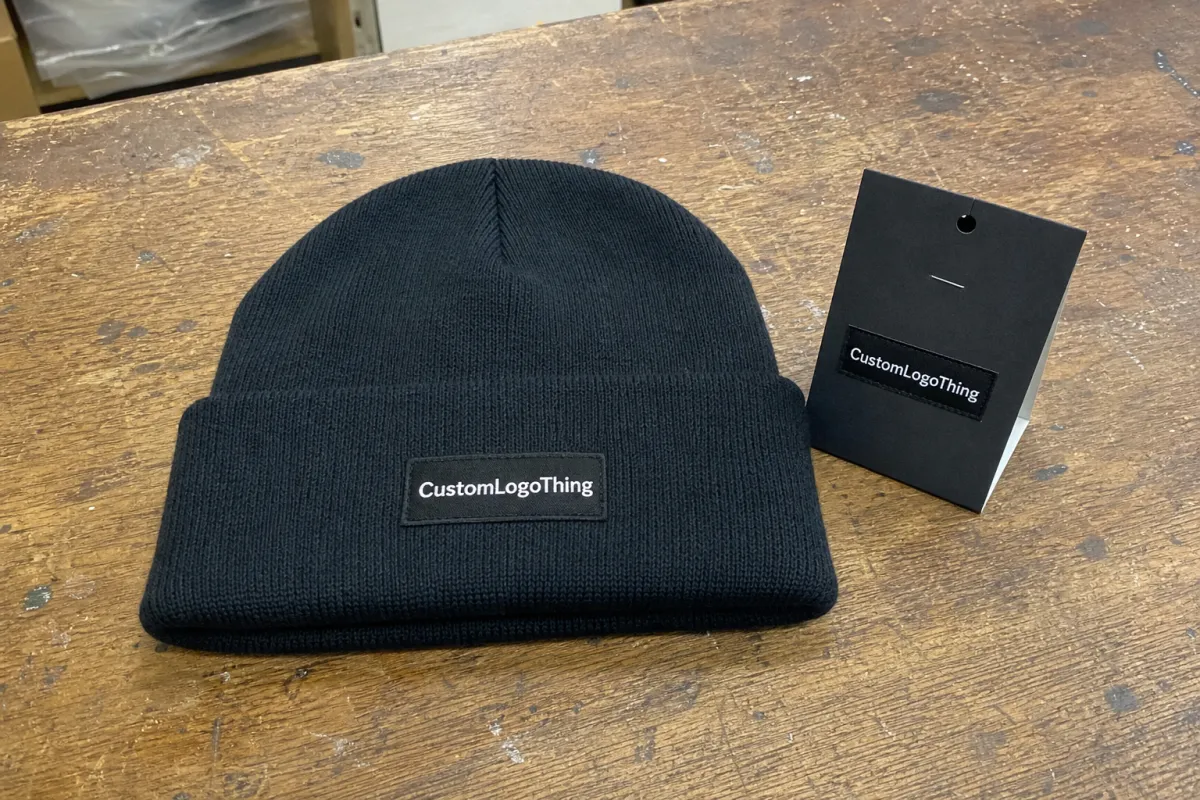
If the goal is a retail-ready piece, the woven label is the clearest brand signal on the hat. It has to hold contrast against textured knit, stay readable when the fabric stretches, and sit cleanly after sewing. That is why supplement woven label beanies Bulk Order Planning should start with the label spec, not with generic hat selection.
Woven labels handle small type and tight borders better than many print methods on knit. That gives supplement brands a better chance of keeping logos legible when the beanie is folded, worn, or packed flat. It also helps the product look more controlled in photos and unboxings, which matters when the beanie is part of a larger branded package.
Consistency is the other major factor. A knit beanie can feel premium or disposable depending on whether the label sits straight, the stitching is even, and the colors match the approved sample. That is especially important for retail bundles, event kits, and subscription inserts where the headwear has to match the rest of the order.
Comfort matters too. Woven labels usually feel flatter than bulky patches or heavy print layers, so they are less likely to irritate the wearer. For a product meant to be used often, that small difference can affect how long the beanie stays in rotation.
The body color also changes the final read. A label that blends too closely into charcoal, black, or heather knit may disappear in photos. A high-contrast label can fix that, but too much contrast can make the beanie feel loud instead of polished. Good planning means choosing the label and hat color together, not separately.
Beanie styles, label placement, and material choices
Beanie construction affects how a woven label sits and how often it stays visually centered. A cuffed acrylic beanie is usually the easiest bulk option because the cuff gives a flat front area and enough structure to keep the label from twisting. Rib knit styles look good on the head but can make small labels wander if the placement is not planned carefully. Fleece-lined and blended yarn styles add warmth, but the thicker seam area can change how neatly the label lays.
Placement is as important as the label itself. Center front on the cuff gives the strongest brand read and works well when the logo needs to be seen immediately. Side placement looks quieter and more premium, especially for smaller logos. Seam placement works for inside branding or size markers, while a sewn patch can add weight if the brand wants a more visible finish.
For supplement woven label beanies Bulk Order Planning, the label size should match the knit density and the intended use. A smaller label can feel balanced on a standard cuff, while a larger one may work on a deeper fold or heavier beanie. Border style, fold type, and stitch density all affect comfort and appearance. A merrowed border gives more edge presence, while a folded edge usually sits flatter against the knit.
Color contrast should be chosen with restraint. The best result is usually one clear brand color, one supporting neutral, and enough separation from the beanie body to keep the logo readable without making the piece feel harsh.
- Cuffed acrylic: best for front label placement and stable bulk production.
- Rib knit: softer hand, but label alignment needs more attention.
- Fleece-lined: warmer and thicker, with more sewing bulk at the seam.
- Slouch: good for lifestyle branding, less predictable for center-front labels.
Artwork, sizing, and production specifications that affect fit
The cleanest woven label art is usually the simplest. Vector files, strong letterforms, and moderate line weights translate more reliably than artwork packed with thin strokes. Knit fabric already has texture, so the design should not fight it. If a logo depends on tiny type or hairline details, it may look fine on screen and still fail once woven into thread.
Before quoting, confirm the finished label dimensions, fold type, attachment method, orientation, and whether the label is brand-only or includes care text. A woven label can carry useful information, but too much content in a small field usually hurts readability. On beanies, that matters even more because the label sits on a curved, flexible surface rather than a flat carton or hang tag.
Seam allowance is another detail that affects fit. A few millimeters can decide whether the label sits centered on the cuff or drifts toward the edge after sewing. That small shift changes how the brand appears in photos and how the label feels against the skin.
Here is the rule that saves most buyers time: if the logo is hard to read on a low-texture proof, it will be harder to read on the finished beanie. That does not mean stripping out the brand; it means editing for the material. Thin outlines, crowded taglines, and legal copy all compete for space. If you need broader package branding, pairing the headwear with Custom Labels & Tags keeps the system consistent.
For repeat programs, save a spec sheet with the exact artwork file, label size, fold, stitch position, and approved beanie color. That record prevents small changes from drifting across future reorders.
Pricing, MOQ, and quote drivers for larger runs
In supplement Woven Label Beanies bulk order planning, quantity is the biggest cost lever. Setup time, sewing labor, and packing all get spread across the run, so smaller orders carry more overhead per piece. Larger runs usually lower the unit cost, but only if the spec stays stable. If the brand keeps changing label size, color count, or packaging, the savings shrink.
The main quote drivers are quantity, number of label colors, label dimensions, stitch complexity, base beanie material, and any retail packaging or tagging. A one-color woven label sewn to a standard cuffed acrylic beanie generally costs less than a multi-color label with custom patch finishing and retail packing.
| Run size | Typical unit range | Best use case | What usually drives the number |
|---|---|---|---|
| 100-250 pieces | $4.20-$7.50 each | Samples, small promos, launch tests | Higher setup share, smaller production spread |
| 500 pieces | $3.10-$5.20 each | First retail test, staff gear, event kits | Better balance of sewing and weaving cost |
| 1,000+ pieces | $2.40-$4.10 each | Ongoing replenishment, multi-channel programs | Lower setup weight, steadier material buying |
Those ranges are planning estimates for a midweight cuffed acrylic beanie with one woven label, before freight and taxes. A brushed or fleece-lined body can raise the price, and so can premium yarn blends, folded interior labels, or individual retail packing.
Ask for tiered pricing at 100, 250, 500, and 1,000 units if the program may grow. That makes the inventory decision clearer. If a larger run only adds a small amount to the total spend while cutting the unit cost meaningfully, the buyer has a stronger case for ordering deeper. For volume programs, Wholesale Programs are often better than piecemeal reorders.
Process, lead time, and approval checkpoints
The usual path is quote request, artwork review, digital mockup, proof or sample approval, label weaving, sewing, inspection, packing, and shipment. That sequence is simple, but each handoff affects schedule. Delays usually happen at the approval stage, not on the machine. One late artwork revision can push the timeline, especially when the order includes multiple label colors or beanie colors.
Lead time depends on four things: how fast the proof is approved, how long the woven labels take to produce, how full the sewing line is, and what shipping method the buyer chooses. A straightforward run with clean artwork can move in a normal production window, but custom color matching, special stitching, or extra packing steps can add days. Rush shipping helps only after production is complete.
“The fastest order is the one with the cleanest file, the fewest label versions, and no changes after proof approval.”
That is not a slogan. It is how production works. If the artwork is final, the beanie color is approved, and the label placement is locked, the factory can move with much less friction. If the buyer keeps adjusting text weight, logo size, or label placement, the job becomes harder to schedule and inspect.
For shipping-sensitive programs, match the outer pack to a recognized distribution standard instead of guessing at carton strength. The ISTA guidance is useful when the beanies will move through fulfillment, retail distribution, or cross-dock handling. If the order includes paper hang tags or inserts, choosing responsibly sourced paper from FSC-certified material can support the brand story without adding clutter.
Keep the approval trail clean. Save the mockup, approve the final artwork once, and avoid changing the file after weaving and sewing begin. That protects both timing and margin.
Quality control, packing, and repeat-order consistency
On a bulk run, quality control is mostly about consistency. Every carton should show the same stitch tension, label alignment, color tone, and hand-feel. Small variation is normal in textiles, but the finish should stay within a reasonable range. If one pallet looks good and another looks loose or tilted, the customer will notice.
The main inspection points are label edge quality, placement accuracy, seam strength, knit uniformity, and color match against the approved reference. If the beanie body has heathering or a dyed effect, ask for a production reference sample so everyone is judging against the same standard. That is especially important for supplement brands that plan to reorder the same headwear for launches, staff gear, or bundled promotions.
Packing matters more than many buyers expect. Polybagging keeps units clean and sorted. Size stickers reduce errors in fulfillment. Master cartons protect the knit shape and speed receiving. For retail or e-commerce use, a buyer may want barcode labels or inserts, but that should be decided early because each step adds handling time.
Repeat-order consistency is where good planning pays off. Keep the approved spec sheet, one reference sample, and clear notes on the exact color, label placement, and stitch style. That way, the next run depends on a documented standard rather than memory. For buyers with a reorder rhythm, it often helps to keep the same labeling plan across seasonal drops instead of redesigning every time.
What to send for a fast quote and clean production start
The fastest way to get a useful quote is to send the facts in one place. Include quantity by color, the beanie style you want, woven label size, logo file, target ship date, and destination address. If the order splits between distribution centers or fulfillment partners, list that too.
It also helps to state whether the program is a one-time promotion or a replenishment system. That changes how the order should be priced and packed. A launch run may favor lower quantity and faster turnaround. A replenishment program may justify a deeper first order, a more durable spec, and more deliberate packaging. If you are comparing options, check the fit against your broader sourcing plan and the support available through FAQ before you finalize the spec.
Request a proof or sample approval whenever the artwork has fine text or the beanie color has to match a brand palette closely. That extra step protects the schedule later. Once approval is locked, production can move with fewer questions.
For teams sourcing through Custom Logo Things, the planning checklist is short: confirm quantity, lock artwork, approve placement, and set the delivery window before production starts. Done well, the beanie feels intentional from the first carton to the last. Done loosely, the run becomes harder to control than it needs to be.
FAQ
How do I estimate the right bulk quantity for supplement woven label beanies?
Start with the channel mix, then add a buffer for giveaways, staff use, or retail replenishment so the order does not run short too early. If the program may repeat, it is usually smarter to keep the first run aligned with a clear restock plan instead of guessing too low. Ask for pricing at a few volume points so you can see where the next breakpoint helps the budget.
What woven label size works best on beanies for supplement brands?
Choose a size that fits the cuff or side placement without crowding the knit texture, because oversized labels can buckle on stretch fabric. Keep text and logo elements large enough to read at arm's length, since very fine details tend to lose clarity on ribbed yarn. In most cases, a simple high-contrast label looks more polished than a crowded one.
Does MOQ change the unit cost for woven label beanies?
Yes, MOQ affects pricing because setup, weaving, and sewing costs are spread across the number of pieces in the run. Small orders usually carry a higher per-unit cost, while larger quantities reduce the unit cost if the spec stays consistent. Tiered quotes are the best way to compare those breakpoints before you choose the final quantity.
What slows the production timeline the most on bulk beanie orders?
Artwork revisions after the proof stage are usually the biggest schedule risk, especially when the design has multiple colors or small text. Custom label weaving and final sewing can also extend lead time if the order needs special placement or more than one label version. Faster shipping helps, but it cannot make up for late approvals or missing order details.
Can I reorder the same woven label beanies later without starting over?
Yes, reorders are usually faster when the approved spec sheet, artwork, and reference sample are already on file. Before repeating the job, confirm whether the beanie color, size, label placement, or packaging needs any updates. Even on a reorder, it is still smart to check current lead time so the delivery window matches the next launch or promotion.


