Tea Frosted Zipper Bags bulk order planning starts with a basic packaging truth: the bag is judged before the tea is tasted. Buyers see the pouch, feel the film, and decide in seconds whether the product looks credible. If the package feels flimsy, the perceived value drops. If it looks refined but cannot protect aroma or run efficiently on the filling line, the savings disappear somewhere else.
The most useful way to think about a frosted zipper pouch is not as a design object, but as a working part of the supply chain. It has to print well, seal consistently, pack into cartons without wasting space, and hold up from production to retail display to home storage. That is why tea Frosted Zipper Bags bulk order planning works best when design, engineering, and purchasing are handled together rather than in sequence.
Frosted film is popular for tea because it sits between two extremes. Clear bags can show every speck and uneven fill line. Fully opaque bags can hide the product entirely and make a tea blend feel heavier than it is. Frosted material gives a softer, more controlled visual, which helps loose leaf tea, herbal blends, and sachet packs look deliberate on shelf and in e-commerce photography.
Why Frosted Zipper Packaging Changes the Shelf Look and Reorder Math
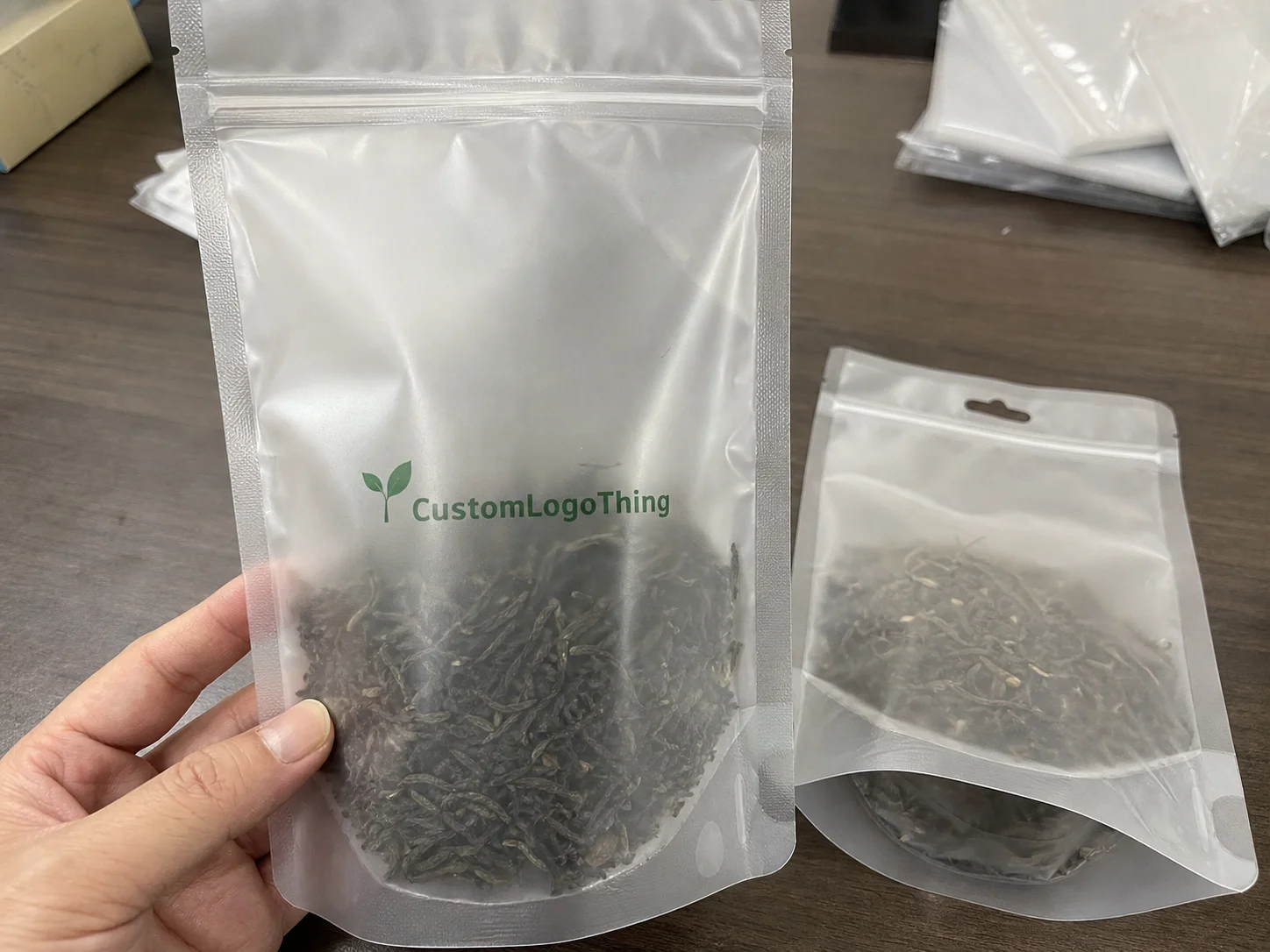
The semi-translucent finish changes the first impression in a practical way. It reduces visual clutter, especially for products with fine particles or mixed botanicals, and it can make the brand look more organized without requiring a complicated structure. That matters because tea packaging is often competing with dozens of similar-looking SKUs. A pouch that reads clearly at arm’s length has an advantage.
There is also a subtle psychological effect. Frosted packaging tends to feel more premium than a plain clear pouch because it suggests restraint. The surface does not shout. It gives the artwork room to breathe. For tea brands positioning themselves above commodity grocery lines, that difference can be worth more than a small material premium.
The zipper matters just as much. A press-to-close zipper gives the customer a reason to trust the pack after the first opening. It supports freshness, keeps loose leaves from spilling in a pantry drawer, and reduces the chance that the outer carton gets blamed for a bag that won’t reclose. In repeat-purchase categories, that small detail often shapes the complaint rate more than the artwork does.
Retail display and freight math are tied together in a way many teams underestimate. A pouch that is only a few millimeters wider or taller can change master carton layout, pallet count, and freight efficiency. A bag that looks better on shelf may ship worse if the dimensions leave too much dead space. That is where tea Frosted Zipper Bags bulk order planning becomes a numbers exercise, not just a visual one.
Approval timing matters too. A package that looks perfect in a flat proof can behave differently once it is filled. Tea settles, powders trap air, and blends with larger leaf pieces can make the pouch bulge unevenly. If the fill weight is not tested before artwork approval, the final result can look overpacked or underfilled. Correcting that after production starts is almost always slower and more expensive than catching it in sampling.
Tea Pouch Construction, Barrier Layers, and Closure Options
Most custom tea pouches use laminated film structures such as PET/PE or BOPP/PE. The outer layer carries print and contributes to stiffness, while the inner sealant layer affects closure strength and filling performance. For tea, the real question is not whether the film is laminated. It is whether the structure provides enough moisture resistance, aroma retention, and handling durability for the product and sales channel.
Frosted finish can be created through material choice or surface treatment, and that changes more than appearance. It affects how ink bonds, how the film resists scuffing, and how sharply fine typography reproduces. On a frosted base, bright colors usually need stronger contrast, and pale brand palettes can disappear unless white ink is used under the print. If the artwork relies on thin lines or very small type, the substrate should be tested before volume production.
The closure style is another point that should be settled early. A standard press zipper is the usual choice for tea because it balances cost and customer convenience. A tear notch can improve first-open experience. Some buyers also ask for hang holes or special reseal features, though those choices affect both die structure and line speed. The bag should open cleanly, close predictably, and survive repeated use without the zipper drifting out of alignment.
Bag shape is not cosmetic. A stand-up pouch gives stronger shelf presence and usually works well for branded retail tea. Flat pouches often make more sense for refill packs or lighter sachet formats where carton efficiency matters more than display profile. Side gusset formats can increase volume without making the front panel look oversized. The best format depends on how the tea behaves inside the pouch, not only on the branding brief.
Barrier requirements should match the tea itself. Some blends are relatively forgiving, while others are highly sensitive to moisture, oxygen, and aroma loss. If shelf life expectations are long or the product contains volatile botanicals, a higher barrier layer may be justified. That improves protection, but it also raises cost and can increase MOQ. Packaging buyers who order by instinct rather than by product behavior often overspec the pouch and pay for protection they do not need.
“A tea pouch has to do three jobs at once: protect the product, sell the product, and still run like a production item.”
Size, Thickness, and Print Specifications to Lock Before Ordering
Before requesting pricing, the buyer should have the essentials locked: width, height, gusset depth, film thickness, zipper type, seal style, and any extra features such as a tear notch or hang hole. That specification sheet is not paperwork for its own sake. It tells the supplier whether the pouch can actually fit the product, seal reliably, and present well once filled.
Tea fill weight is not interchangeable across product types. A 100g loose leaf tea blend behaves differently from a 100g powdered mix or a sachet-based product. One may settle densely, another may trap air, and another may require more headspace for the zipper and top seal. The result is that tea frosted zipper Bags Bulk Order Planning should start from the product’s bulk density, not from a generic bag size someone used in a previous run.
Thickness should be chosen for handling performance, not just for the impression of quality. Thicker film can feel more substantial, but it also increases material cost, may take up more carton space, and can make the pouch less flexible during filling. For many tea applications, buyers review a range around 100–150 microns, although the correct figure depends on the structure, the fill product, and whether the bag is meant for retail display or transport protection.
Print requirements deserve the same discipline. Artwork files should be clean, with the resolution suited to the intended process. PMS colors need to be discussed if brand shade accuracy matters. Bleed, safe area, and seal overlap all need to be understood before files are approved. Frosted film changes the way ink appears, so a design that looks crisp on a monitor can become faint if it does not include enough contrast on the substrate.
Food-contact compatibility and regulatory space also belong in the setup phase. Tea may not be a high-risk product, but it is still sensitive to moisture and odor transfer. If the bag must carry nutrition panels, lot codes, multilingual labeling, or market-specific warnings, those areas need to be reserved in the layout from the beginning. Retrofitting legal copy late in the process usually creates awkward spacing and weakens the design.
A practical comparison of common options is below.
| Option | Typical Use | Strengths | Tradeoffs |
|---|---|---|---|
| PET/PE frosted stand-up pouch | Retail tea, branded shelf packs | Good stiffness, reliable sealing, premium shelf presence | Usually costs more than simpler structures |
| BOPP/PE frosted flat pouch | Refill packs, lighter tea formats | Efficient carton use, clean print surface | Less display impact than a stand-up format |
| Higher-barrier laminated pouch | Aroma-sensitive blends, longer shelf-life targets | Better moisture and odor protection | Higher material cost and sometimes higher MOQ |
| Custom printed pouch with white ink base | Detailed branding on frosted film | Better readability and color contrast | Extra print step can increase setup cost |
Cost, Pricing, MOQ, and Quote Variables Buyers Should Compare
Price comparisons are easy to misunderstand because a pouch quote often hides several assumptions. Material structure, bag size, zipper style, print coverage, and order quantity all move the number. Two quotes that look close on paper may actually be built on different film thicknesses, different seal specs, or different carton counts. That is why unit price alone is a weak buying metric.
MOQ varies by whether the item is stock-sized, semi-custom, or fully custom. Standard printed pouches may start lower. Fully custom size and structure work usually starts higher because tooling, cylinders, plates, or setup costs have to be recovered across the run. For many tea programs, buyers encounter entry quantities in the low thousands, but that range shifts with print process and product complexity.
There are several quote variables buyers should ask about directly: plate or cylinder charges, proofing fees, sample costs, freight terms, carton configuration, and whether the supplier is quoting one artwork version or multiple SKUs. A run with three flavors is not the same as a run with one flavor and a single label change. Inventory complexity has a cost of its own, and packaging budgets often ignore that until reorder time.
Tiered pricing is far more useful than a single unit number. Seeing the cost at 5,000, 10,000, and 20,000 pieces shows how setup is amortized and whether a larger run actually creates meaningful savings. In many cases, the price drop is real but not dramatic. That is the point where buyers decide whether they want lower per-piece cost or lower inventory exposure.
Freight should be included in the comparison as well. A pouch is lightweight, but volume drives shipping cost quickly. Carton layout, pallet stackability, and the origin of shipment can move the landed cost enough to erase a small unit-price advantage. For buyers managing tea frosted zipper Bags Bulk Order Planning, total landed cost is the number that matters, not the ex-factory quote by itself.
A useful shorthand for cost drivers looks like this:
- Lower cost: standard size, one or two colors, simple zipper, common film structure.
- Mid-range cost: custom size, full-color print, frosted finish, stand-up pouch format.
- Higher cost: special barrier layer, custom zipper feature, heavy white ink coverage, multiple SKUs.
For buyers comparing broader sourcing programs, the Wholesale Programs page is a useful starting point, and the FAQ page can help clarify basic ordering questions before a quote request is submitted.
Process, Timeline, and Production Steps for Bulk Orders
The production path is predictable, but only if the information is complete. A typical job moves through inquiry and specification review, artwork confirmation, material selection, proofing, production, finishing, quality inspection, and shipment. Every delay usually comes from an unclear detail at one of those stages. A missing dimension, a changed logo file, or an unresolved zipper style can slow the entire schedule.
Lead time depends on several practical factors. Fresh artwork takes longer than reorders. Special sizes take longer than standard dimensions. High-contrast print on frosted film may require more proofing than a simpler design. Buyers often focus on the manufacturing window and forget the sample window, yet those are not the same thing. Sample timing matters because it is the only stage where the bag can be handled, filled, and inspected before commitment to volume.
Physical samples reveal details that PDFs never show. The zipper feel, seal stiffness, color density, and how the frosted finish changes the look under store lighting all become visible only in hand. If the pouch will be reviewed by a retailer, distributor, or internal product team, the sample should arrive early enough for feedback and revision. Otherwise, a technically correct bag can still fail the presentation test.
Quality control on the production side should include seal integrity, zipper alignment, print registration, bag dimensions, and carton inspection. For stand-up pouches, bottom seal formation and gusset shape deserve special attention because they affect both shelf appearance and stability on the filling line. Many buyers also ask for reference testing aligned with ISTA procedures when shipping conditions are rough or order volumes are high. That is a sensible request when the product will travel long distances or sit in warehousing before release. Standards and resource material can be reviewed at ISTA and through broader packaging education resources at Packaging School.
Seasonal launches need backward planning. If the product is tied to a holiday reset, trade show, or retail promotion, the safest schedule starts from the shelf date and works in reverse. That leaves room for artwork revisions, sampling, production, and freight delays. Reorder planning improves when it is based on actual sell-through rather than optimistic inventory assumptions. The bag spec should stay stable; the quantity can move.
What to Expect From a Packaging Supplier on Custom Tea Runs
A capable supplier should do more than return a price. They need to translate product requirements into a usable pouch spec, identify production risks early, and help narrow the options before tooling or volume production begins. That means asking about fill weight, shelf life expectations, print needs, transportation method, and reordering plans rather than building a quote from incomplete information.
Clear communication is the difference between a controlled order and a messy one. If the artwork is incomplete, that should be stated directly. If the frosted substrate may weaken contrast, the supplier should flag it. If the bag dimensions leave too little room for the product, the issue should be raised before any commitment is made. A good supplier helps prevent expensive corrections, not just process purchase orders.
Sampling support is also part of the job. A useful sample does more than confirm dimensions. It shows whether the zipper closes smoothly, whether the printed colors hold up on the frosted film, and whether the filled pouch stands or stacks as expected. That kind of review becomes even more valuable when the same tea pouch will be reordered multiple times across a year.
Packing discipline matters too. Carton labeling should be consistent, pallet build should be stable, and the bags should be protected from abrasion during transit. If the shipment will move through long freight lanes, asking about carton strength, corner protection, and stretch wrap is reasonable. Sustainability claims also deserve documentation rather than assumption. If paper components or certifications are part of the brand story, FSC-related guidance can be reviewed at FSC.
The best supplier fit is usually the one that can maintain repeatability without becoming rigid. A buyer may need the same pouch spec for months, then a modest artwork refresh, then a phased delivery schedule tied to demand. A manufacturing partner that can preserve the original structure and still manage those adjustments is usually worth more than the cheapest quote.
Next Steps to Finalize Your Tea Bag Order Without Delays
The fastest way to move a quote forward is to prepare a one-page specification sheet before sending the request. Include dimensions, fill weight, material preference, zipper type, print count, target quantity, and delivery window. If the supplier has to ask for each of those details separately, the order slows down and the quote becomes less reliable.
Artwork should travel with the initial inquiry whenever possible. If the logo is still being finalized, say so. If PMS matching is required, provide the reference values. If the pack has regulatory text, include that in the draft. Frosted film can shift color appearance, so it is better to discover contrast issues in proofing than after a full production commitment.
For a new market launch, request either a sample or a digital proof before release. The finished pouch may look slightly different under showroom lights, in photography, or on a retail shelf than it does on a screen. That is normal. The buyer’s job is to confirm that the difference still works for the brand and the product.
Inventory planning should be realistic as well. If the product is a new SKU, avoid over-ordering based on enthusiasm alone. If it is a proven seller, align the order with actual consumption and replenishment timing rather than a rough guess. Many packaging problems begin with the wrong quantity, not the wrong pouch.
For tea frosted zipper bags bulk order planning, the final check is simple: confirm the spec, the pricing tier, and the delivery window before release. If those three are aligned, the order is much more likely to run cleanly, with fewer revisions, fewer surprises, and a finished pouch that protects the tea while presenting it well.
What information do I need for tea frosted zipper bags bulk order planning?
You need bag dimensions, fill weight, film thickness, zipper style, print requirements, artwork files, color expectations, and target quantity. It also helps to know whether you need samples, proofs, labeling space, or a specific delivery window before requesting pricing.
How does frosted film affect the look of custom tea packaging?
Frosted film creates a softer semi-translucent finish that often feels more premium than clear film. It can reduce harsh reflections, but it also changes color appearance, so logos and text usually need stronger contrast and sometimes white ink support.
What is the main factor that changes MOQ and unit cost?
Customization level is usually the biggest driver. Size, print complexity, zipper style, and special structure options all affect setup cost. Higher quantities usually lower unit cost because fixed setup expense is spread across more bags.
How long does production usually take for custom zipper bags?
Timing depends on artwork approval, sample requirements, order size, and whether the pouch is standard or fully custom. Repeat orders are usually faster than new jobs, but the lead time should always be confirmed after the final specifications are approved.
Can I reorder the same tea pouch design later?
Yes, as long as the specs, artwork, and material structure are documented and kept on file. Reorders are usually smoother when the first run was approved clearly and the carton, size, and proof records were retained for reference.


