A plain beanie can move from filler item to meaningful retail piece with one small change: the label. That is why a tea woven label beanies Unit Cost Review belongs near the front of the buying process, not after artwork is already approved. A woven label affects more than branding. It changes sewing time, placement tolerance, pack-out behavior, and the way the item reads in a store, in a photo, and in a customer’s hand.
The practical question is not whether a woven label looks polished. It is whether the trim choice supports the target price, the expected order size, and the production line you are actually using. A label that looks understated on a screen can become the most expensive detail on the spec sheet once setup, revisions, and sewing labor are counted.
If you are comparing trim directions, the label category is a useful place to start. Our Custom Labels & Tags page is a straightforward reference for woven label options, and it helps frame the decision before you lock the beanie body and packaging. For buyers who want to compare trim methods side by side, woven label trims give a clean baseline for cost and finish.
Why a tea woven label can lift beanie shelf value
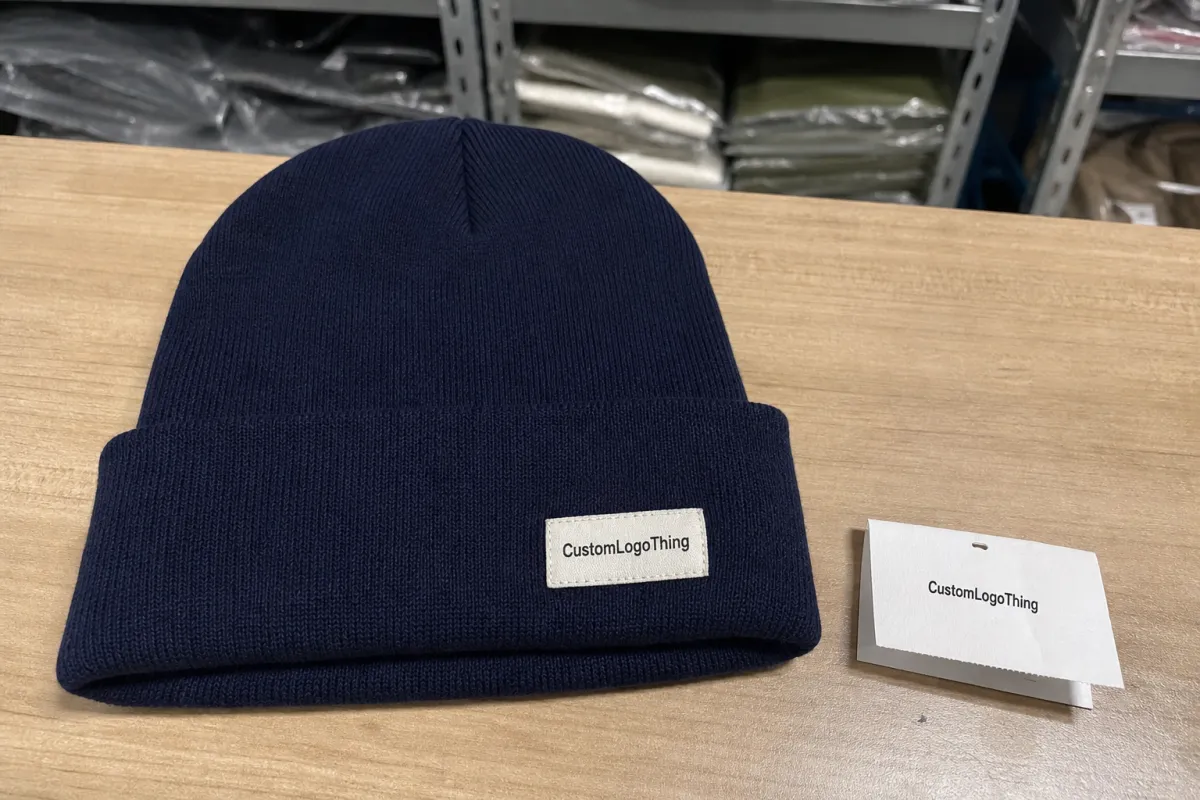
Beanies are sold on texture as much as on logo. Two products can share the same yarn weight, the same cuff depth, and the same silhouette, yet the one with a crisp woven label usually looks more intentional. That is not a branding theory. It is a retail observation. Shoppers read finish quality in seconds, and they often use the label as a shortcut for judging the rest of the item.
The effect is stronger in headwear than many categories because the item is handled close up. Customers touch the cuff, stretch the knit, check the edge, and then decide whether the beanie feels like a blank or a branded product. A woven label gives the piece a focal point. It also helps the product photograph better because the logo adds contrast without covering the knit texture.
Placement can raise or lower that perceived value. Front-cuff placement creates the fastest brand read. Side placement is quieter and usually suits minimalist lines. Back-cuff placement keeps the front clean when the knit pattern itself is the main visual. Those choices are not just aesthetic. They affect how consistently the beanie can be sewn and how often a factory can repeat the result without rework.
Buyer rule of thumb: if the label floats on the surface like an afterthought, the beanie tends to look cheaper than the body cloth deserves. If it sits like part of the construction, the same item can support a higher shelf position.
That is why woven labeling is often treated as a merchandising decision, not a decorative one. It influences folding, stacking, and unboxing. A product that arrives neatly aligned and visually coherent is easier for a retailer to trust, especially in a seasonal category where buyers may only have one shot to move inventory before weather changes.
Picking the right beanie body, knit, and label placement
The body construction sets the ceiling for how good the label can look. Cuffed beanies are the most forgiving option because the cuff gives the label a structured base. Uncuffed or single-layer beanies can look cleaner, but they leave less room for error. A label that is a little off-center on a cuffed style may still pass. The same offset on a thinner body can look sloppy immediately.
Rib knits generally hold shape better than loose or highly relaxed constructions. That matters because the label needs a stable landing zone. A slouch beanie can still work with woven branding, but the pattern layout must account for how the fabric drapes once the cuff is folded. If the crown shaping is too soft, the label area can twist during packing and arrive with a visual lean.
Placement should follow the silhouette, not fight it. Front cuff is the easiest to repeat at scale. Side seam is useful when the brand wants something quieter, but the sewing tolerance gets tighter because small shifts are more visible. Back cuff works well when the logo on the front would compete with a knit texture or other embellishment. Hem-edge placement can be effective, though it needs a soft enough finish that the label does not create bulk against the forehead.
Label size deserves the same attention as placement. A label that is too large can curl on a lightweight knit, especially if the cuff is thin. A label that is too small may disappear once the beanie is folded for packing. The right size balances visibility, comfort, and sewing efficiency. That balance is a big part of a tea woven label Beanies Unit Cost Review because larger labels, denser weaves, and more exact placement all add labor.
Most buyers are trying to solve four things at once:
- Visibility: the logo should be legible without taking over the knit.
- Comfort: the label should lie flat and avoid scratchy edges.
- Repeatability: the sewing team should be able to place it consistently.
- Wash and wear behavior: the label should remain stable after folding and laundering.
For production, the best design is the one that can be repeated under normal line conditions. A beautiful first sample does not mean much if the crew has to slow down to center each piece. That kind of slowdown is where unit cost rises. It is also where a simple program can become a custom one in practice, even if the blank body looked inexpensive on paper.
Specs that shape fit, durability, and label consistency
Artwork matters, but the spec sheet controls the result. Yarn type, knit gauge, cuff depth, crown shaping, label weave density, and attachment method all affect how the beanie looks and how the label behaves. A 100 percent acrylic body will not feel or drape the same way as a wool blend or a recycled polyester blend. Tight gauges usually provide a cleaner surface for branding. Looser gauges are softer and more casual, but they make label alignment more sensitive.
Soft yarn can improve hand feel, yet softness also means more movement in the knit. That can help comfort and hurt repeatability. A deep cuff gives the label more surface to settle against. A thinner cuff may reveal the label edge more sharply, which can be good for visibility but risky for curling. The crown matters too. If the body stretches too easily, the label area can drift out of square during packing or transit.
Durability is mostly about attachment quality. A sewn-in woven label tends to be the strongest choice for repeated wear, but only if the stitching is tight and clean. Folded tabs can look neat, though they may create more bulk. Edge-finished labels are softer against skin, but the finish has to be controlled. If the edge is weak, the label can fray, twist, or lose shape after handling.
A sample should be checked as a product, not as a picture. Measure it. Fold it. Put it on a head form. If possible, leave it compressed for a day and inspect the label line afterward. Small flaws often show up after stress, not before it. That is one reason buyers who work with knit goods tend to trust wear testing more than presentation samples.
Practical checklist:
- Confirm label width and height in millimeters, not just in artwork pixels.
- Review where the stitches land on the cuff and whether they stay outside the logo area.
- Check knit gauge and see how much the fabric distorts under tension.
- Inspect the edge finish for curl, fray, or hard corners.
- Measure the beanie against the spec sheet after packing, not only at first inspection.
Packaging documentation can matter too. If cartons or inserts are part of the order, FSC-certified paperboard is a clean way to document responsible sourcing. The FSC explains the framework at FSC. That does not change the beanie itself, but it can matter for retail compliance, procurement records, or ESG review.
Tea woven label beanies unit cost review: pricing and MOQ
Unit cost for this type of program usually comes down to five things first: body style, yarn content, label complexity, color count, and sewing labor. After that, packaging, carton configuration, and freight can move the landed price more than people expect. A beanie with a simple label and stock construction can look inexpensive until the quote adds setup, proofing, folding, and shipping assumptions.
Low MOQ orders almost always cost more per piece. That is not a supplier trick. It is arithmetic. Artwork setup, woven label programming, sample approvals, and line adjustment all have to be paid for somewhere, and with a short run those costs spread across fewer units. If a quote looks unusually low at a small quantity, check whether the factory has excluded revisions, packaging, or freight from the headline number.
It also helps to ask how the supplier separates setup charges from tooling fees. Some factories use the terms interchangeably; others split loom programming, art prep, and sewing setup into different lines. If the label width changes after the first proof, or if the weave density needs to be adjusted for readability, a rework fee may appear. That is normal. What causes friction is not the charge itself but the lack of clarity around where it came from.
| Order Profile | Typical Unit Cost Range | What Usually Drives the Price |
|---|---|---|
| 1,000-2,000 pcs, stock body, simple woven tab | $1.40-$2.10 | Lower quantity, basic label weave, standard packing |
| 3,000-5,000 pcs, custom cuff label, 2-color knit | $1.05-$1.65 | Better spread on setup charges, more efficient sewing |
| 5,000-10,000 pcs, custom body, higher label density | $0.92-$1.48 | Bulk pricing, repeatable line setup, simpler per-piece labor |
| 10,000+ pcs, private-label retail program | $0.78-$1.30 | Best spread on unit cost, but packaging and freight still matter |
Those ranges are a buying frame, not a promise. Material choice can move the number faster than many teams expect. A recycled yarn body may cost more than a standard acrylic body. A denser woven label may add a few cents per piece, but if the sewing line slows down to place it, the labor impact can be larger than the label cost itself.
Quoting in tiers helps expose the real break point. Ask for pricing at 1,000, 3,000, and 5,000 pieces, then compare the savings against inventory risk. If the unit cost barely improves at a higher tier, the larger order may not justify the exposure. If the price drops sharply, the line is telling you where it becomes more efficient.
A good quote should separate unit cost, sample charges, packaging, and freight. That lets you compare true landed cost instead of headline price. In knit accessories, the difference is often several percentage points. On a 5,000-piece run, that gap can determine whether a margin target holds or collapses once the shipment reaches the warehouse.
Production steps and timeline from proof to shipment
The cleanest production flow starts with brief intake, then art review, then proofing, then approval, then bulk production, then inspection and packing. Delays usually happen before bulk work begins. Missing measurements, unclear placement instructions, and label artwork that needs a second round of correction are the usual culprits.
Lead time changes with the amount of customization. A stock beanie with a simple woven label can move faster than a fully custom body with yarn matching, special folding, and printed packaging. Sample lead time and bulk lead time should always be quoted separately. That distinction matters because a factory might be able to turn a proof in 5 to 7 business days, while bulk production needs 12 to 18 business days or longer depending on schedule load and material availability.
Approval speed is one of the easiest ways to control timeline. If artwork has to move through several internal reviewers, the calendar can stretch more than the production itself. For a seasonal launch, it is safer to plan backward from the delivery date and leave room for at least one revision cycle. That is especially true for private-label programs, where the label often determines the final look of the product.
Freight deserves its own line of attention. Cartons, pallet counts, and route planning can add days if the packing spec is not locked in early. A product that is finished but waiting on carton marks is still not ready to move. The handling logic described by ISTA is useful here because it frames drop, vibration, and compression as part of the product journey rather than afterthoughts.
If the beanie is part of a bundled launch, align the label, folding, outer carton, and insert specs together. A delay in one layer tends to hold everything else. More often than not, the slow step is not manufacturing. It is coordination.
Quality control, packing, and carton details buyers should verify
Quality control on woven-label beanies is not complicated, but it has to be specific. The checks that matter most are label alignment, stitch security, color consistency, measurement tolerance, and clean trimming. If the label is off by even a small amount on a cuffed beanie, the error will show under retail lighting. If the stitch line is loose, the label may shift after the first handling cycle. If the knit shade varies too much, the logo can look inconsistent even when the label itself is perfect.
Packing affects arrival condition more than many buyers expect. Polybag count, carton labeling, compression, and moisture protection all change how the product reaches the warehouse. A beanie packed too tightly can lose shape and make the label appear skewed. That is not just an appearance problem. Once the product is flattened, the receiving team may flag it even if the sewing was correct.
Carton size also matters. Dense cartons reduce air in transit, but they can increase compression risk. Oversized cartons waste freight space and create messy warehouse handling. A well-built pack spec gives the warehouse a cleaner count and reduces the odds of mixed sizes or labels being misread at receiving.
For larger runs, pre-ship photos are worth asking for. They are not a substitute for inspection, but they catch avoidable mistakes: wrong label placement, mixed color lots, incorrect carton marks, or packing that looks too tight for the knit. On a seasonal launch, that kind of early catch can save a week of back-and-forth later.
Useful checks before shipment:
- Confirm label position on at least one folded unit per size or color.
- Review carton marks against the purchase order and SKU structure.
- Check the pack ratio for warehouse handling and retail count accuracy.
- Ask whether moisture protection, polybag thickness, or compression limits are included.
A serious tea woven label beanies Unit Cost Review should include these packing assumptions. On paper, packaging can look like a minor line item. In transit and receiving, it is often the difference between a smooth launch and an avoidable exception report.
What to send for a fast quote and the next steps to order
The fastest quote comes from a brief that removes guesswork. Send the beanie style, quantity, label artwork, preferred placement, size range, target delivery date, and packaging notes in one message or file. If the budget ceiling is already known, include it. That helps narrow whether the best fit is a stock body, a simpler weave, a different MOQ tier, or a more compact packaging plan.
Ask for a quote that separates unit cost, setup charges, sample cost, packaging, and freight. That structure makes comparison much easier because you can see where each supplier is absorbing cost and where cost is being pushed downstream. If one quote is much cheaper than the others, the reason is usually in packaging assumptions, revision allowances, or a timeline that assumes no changes after the first proof.
Once the numbers make sense, the approval path should be simple: confirm specs, approve the sample or proof, lock the MOQ, and sign off on the schedule. After that, keep artwork changes to a minimum unless the change affects legibility or construction. Late changes tend to cost more than people expect, and the impact shows up as time as much as money.
A quick internal review usually comes down to five questions:
- Does the label placement support the brand read on the shelf?
- Does the unit cost still work at the expected sell-through volume?
- Are sample charges and setup charges clearly separated?
- Do packing and carton details fit the warehouse plan?
- Is the timeline realistic for the launch window?
That is the practical side of the decision. A tea Woven Label Beanies unit cost review is not really about chasing the cheapest quote. It is about choosing a build that can be approved, sewn, packed, shipped, and reordered without turning every revision into a new project. The best brief is usually the one that is specific enough to produce a clean quote and disciplined enough to keep the production line from improvising.
How does tea woven label beanies unit cost change with order size?
Unit cost usually drops as quantity rises because setup, labeling, and sewing effort are spread across more pieces. Small runs can still make sense for testing a color or silhouette, but the quote should show the setup charges clearly. Ask for several quantity breaks so you can see the true savings at each tier.
What MOQ is typical for woven-label beanies?
MOQ depends on the body style, the label complexity, and whether the order uses stock yarn or a fully custom knit. Lower MOQs are possible, but they usually carry a higher unit price and less flexibility on packaging. The right MOQ is the one that fits your sell-through plan, not just the smallest number available.
Which specs matter most when reviewing beanie label quality?
Focus on label size, weave density, edge finish, placement accuracy, and stitch security. Also check how the label sits on the cuff and whether it stays flat after handling, folding, and laundering. A solid spec sheet should let you repeat the same result across every production batch.
How long does woven-label beanie production usually take?
Timeline depends on sampling, approval speed, stock availability, and whether the knit or label is custom. Simple runs move faster when the design is approved quickly and no revisions are needed after the first proof. Separate sample lead time from bulk lead time so the launch calendar stays realistic.
What should I send to get a fast beanie quote?
Send the product style, quantity, label artwork, placement preference, target delivery date, and any packaging notes. If you already know your target budget, include that too, because it helps narrow the best material and MOQ options. A complete brief shortens revision cycles and usually produces a more accurate landed-cost quote on the first pass.

