Custom Logo Things
Chocolate Embroidered Baseball Caps Unit Cost Review
For buyers comparing branded headwear, a chocolate Embroidered Baseball Caps Unit Cost Review usually starts with the same question: why does this color feel more premium than the numbers suggest? The answer is partly visual and partly mechanical. A deep brown cap can make embroidery look more deliberate, but the bill still depends far more on stitch count, cap structure, and order quantity than on the color of the fabric itself.
That matters because chocolate sits in a useful middle ground. It can read upscale like espresso, but it does not carry the visual harshness of black. It also pairs well with cream, gold, white, tan, olive, and tonal thread, which gives buyers room to build a stronger retail presentation without changing the cap body or adding expensive decoration.
The most useful way to review pricing is to separate appearance from production cost. A cap may look richer in brown, but the factory usually charges for the same line items it always charges for: blank cap, embroidery setup, digitizing, labor, packaging, and freight. Once those are broken out clearly, the quote becomes much easier to compare.
Why chocolate reads premium without pushing costs higher
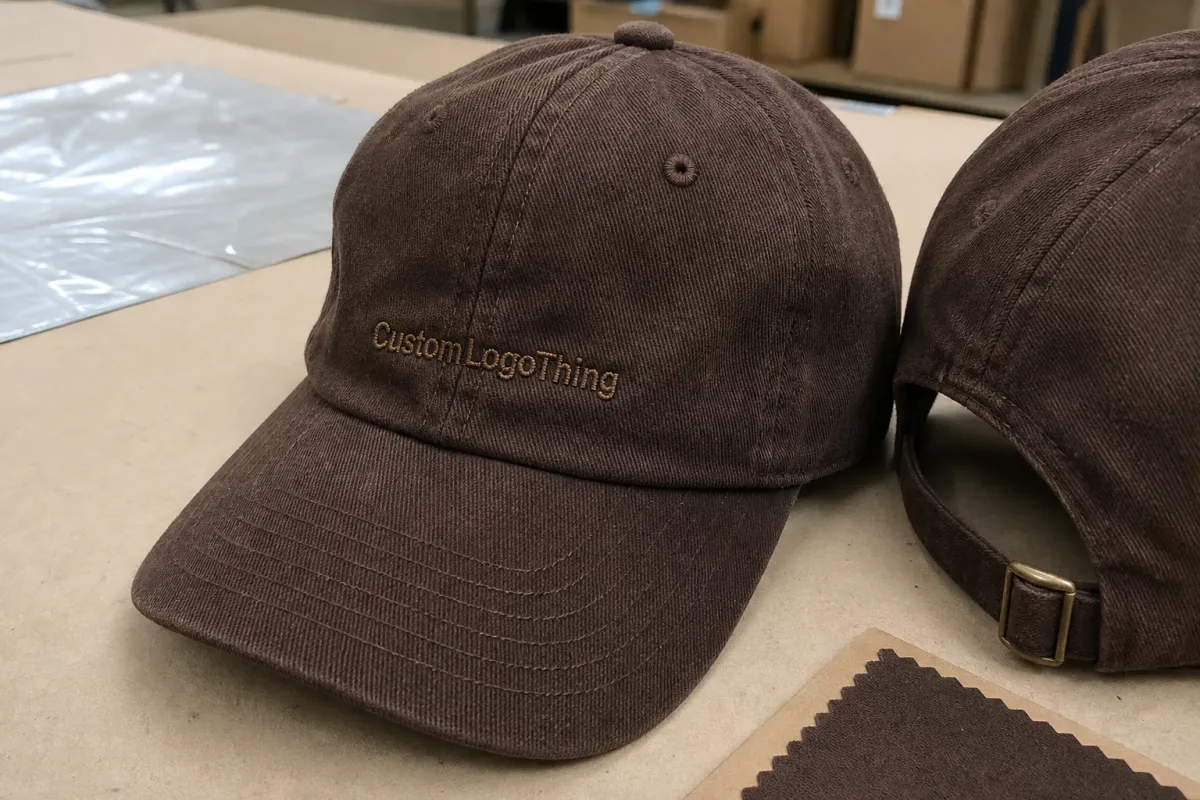
Chocolate works because it behaves like a neutral with more depth. On a shelf or in a product photo, the color creates more contrast than tan and more warmth than black. That can make even a simple logo feel more finished. For coffee brands, outdoor programs, premium promo kits, and boutique retail lines, that impression is often worth more than a small difference in base cost.
The color itself rarely changes the price much unless the buyer needs a custom dye lot, a lab dip approval, or a branded color match across multiple products. Stock chocolate shades usually come from existing fabric runs, which keeps the cost stable. What can change the cost is a requirement for exact tone matching between cap, apparel, and packaging, especially if the buyer wants the brown to line up with a Pantone target rather than a general shade family.
There is also a practical branding advantage. On a chocolate crown, white and cream thread can stand out sharply, while tonal brown thread can feel restrained and more expensive than loud contrast embroidery. That gives merch teams two different looks from the same blank cap: one with higher visibility and one with a quieter retail feel.
A chocolate cap does not automatically cost more to make, but it often looks more expensive than it is. The premium effect comes from the combination of color, structure, and embroidery discipline.
That is why this style keeps showing up in collections that need to feel intentional rather than promotional. The cap can hold its own beside retail apparel without requiring a heavy production upgrade. Buyers who understand that distinction tend to specify better artwork, choose more practical thread colors, and avoid paying for decoration that does not add value.
Cap construction that changes the quote
The cap body has a bigger impact on cost than most first-time buyers expect. A structured six-panel cap gives embroidery a firmer front panel and usually creates the cleanest result. The internal buckram or similar support helps the logo sit flat during stitching, which reduces puckering and makes small details more readable. Low-profile caps sit closer to the head and feel more casual, while unstructured caps are softer but more likely to show the shape of the embroidery rather than the shape of the panel.
Fabric choice matters too. Cotton twill is still the most common choice because it balances comfort, durability, and stitch stability. Brushed cotton has a softer hand and can feel more retail-ready. Polyester blends and performance fabrics hold color well and dry faster, but they can behave differently under the needle, so the machine settings need to be tuned carefully. A fabric that stretches too easily or collapses under tension can create minor distortions in the logo.
Brim style changes how the cap is perceived and sometimes how it is packed. A pre-curved bill feels ready to wear and works well for uniforms and promotional programs. A flat bill leans more fashion-forward and often suits lifestyle merchandise. Neither style is inherently better, but each one implies a different market, and that market often determines how much buyers are willing to spend per unit.
Closure choice also matters. Snapback caps are fast to produce and easy to size, which keeps them popular for volume orders. Strapback styles can feel a little more refined. Fitted caps may cost more because sizing runs are less forgiving and inventory risk is higher. If the order includes custom interior taping, woven labels, or branded sweatbands, the cost climbs again because those features add separate production steps.
Chocolate shade consistency is another detail worth watching. Stock fabrics can vary from espresso-heavy brown to a softer cocoa tone, and that shift can be visible when the reorder is placed months later. Keeping the approved sample, noting the fabric code, and documenting the thread colors together helps preserve consistency across repeat runs. Without that record, even a good factory can deliver a cap that looks slightly different from the first batch.
Embroidery specs to lock before requesting pricing
Embroidery pricing becomes much more predictable once the specs are fixed. The factory needs to know logo size, placement, stitch count, thread colors, and whether the design is flat embroidery or raised puff. Those details drive digitizing time and machine time. If they are still moving, the quote will be more of an estimate than a usable number.
Logo complexity is the first place where budgets drift. Thin type, small outlines, and dense fills can all be difficult on curved cap panels. The problem is not just aesthetics. Very fine detail can collapse once it is stitched, especially if the panel is lightly structured or if the logo crosses a seam. Good digitizing can salvage a surprising amount, but it cannot change the physics of thread and fabric.
Stitch count is one of the clearest cost drivers. A simple front mark may sit in a lower range, while a dense crest with shading, outlines, and layered fills can require thousands more stitches. More stitches mean more machine time, more thread use, and a higher chance of needing a correction if the logo rides too close to a seam or crown curve. Raised puff embroidery adds even more complexity because the foam layer has to be cut cleanly and stitched in a way that keeps the edges crisp.
Placement is equally important. Front-panel embroidery is the standard and usually the most efficient. Side-panel or back-panel decoration can look sharp, but it adds setup and increases the risk of misalignment because the available stitching area is smaller and less forgiving. Multiple placements almost always raise the price because each location has its own setup and its own labor cost.
Artwork quality can save more money than a small discount on the blank cap. Vector files are the cleanest starting point because they allow the digitizer to map the stitches without redrawing the logo from scratch. A low-resolution JPEG may still be usable, but it often leads to extra back-and-forth, longer proof cycles, and a higher chance of revision charges. If the buyer wants a faster quote, sending a clean file is one of the easiest ways to get it.
Practical detail: if the thread palette includes many colors, the setup can become more complicated than the embroidery itself. A one-color logo usually runs efficiently. A logo with several thread changes may still be fine, but it needs to be priced with the actual color count, not with a simplified guess.
From an operations standpoint, it helps to lock the following before a quote is requested: cap body, logo size, stitch count range, placement, thread colors, and packaging level. That is the difference between a usable production quote and a placeholder number that has to be revised later.
Chocolate embroidered baseball caps unit cost review
The final unit cost is usually built from six parts: the blank cap, embroidery digitizing, machine labor, thread, packaging, and freight. If the order includes woven labels, swing tags, or custom cartons, those are added on top. None of the pieces looks dramatic by itself. Together, they set the real cost per cap.
Order quantity has the strongest influence. Setup fees are fixed, or close to fixed, so smaller runs carry a larger share of those charges. A 250-piece order may still need the same digitizing and machine programming as a 1,000-piece order, which is why the per-unit price looks much higher at lower quantities. As volume increases, the setup burden gets spread out and the unit price falls.
MOQ is not just a sales tactic. It usually reflects the economics of production: machine time, fabric availability, packaging needs, and how much handling the order requires. A simple stock chocolate cap with one embroidered location can often be produced at a lower MOQ than a retail version with custom labeling and branded packaging. The exact minimum should always be tied to the actual specification sheet.
Sample charges should be separated from bulk pricing. A digital mockup, a stitched pre-production sample, and the finished order are different line items. Buyers get confused when those costs are blended into one number. Separating them makes it easier to see where the money is going and which part of the process is creating the delay.
The ranges below are typical for stock caps with standard one-location embroidery and normal packaging. Freight, duty, taxes, and rush fees are not included unless a supplier states otherwise.
| Order quantity | Typical cost per piece | What usually drives the number |
|---|---|---|
| 250 pcs | $4.90-$7.80 | Setup charges and digitizing take a large share of the total |
| 500 pcs | $4.10-$6.20 | Better spread on tooling fees, but labor still matters |
| 1,000 pcs | $3.20-$4.95 | More efficient bulk pricing with a standard front logo |
| 5,000 pcs | $2.15-$3.75 | Lower setup impact and smoother production flow |
Those ranges move quickly if the spec changes. A dense multi-color crest, a 3D puff logo, a woven side label, or individual polybagging can push the quote up. A simple one-color front mark on a standard structured cap usually sits toward the lower end. Once the buyer starts adding retail presentation elements, the top end becomes more realistic.
Chocolate color can influence cost indirectly if the buyer needs an exact match or a special finish. A standard stock brown cap is usually straightforward. A custom-dyed fabric, a garment-washed body, or a precise match to another product line takes more coordination and can add both time and expense. That is especially true when the same brown has to be consistent across hats, sweatshirts, and printed cartons.
One easy mistake is comparing a landed quote to an ex-factory quote. If one supplier includes packaging and freight while another leaves them out, the numbers are not actually comparable. The same is true for samples, duty, and rework allowances. A proper chocolate embroidered baseball caps Unit Cost Review only works if every quote is built on the same assumptions.
For buyers who need stronger transit protection, carton spec and pack count deserve attention. Caps are not fragile in the glass-and-ceramic sense, but poor packing can flatten crowns, crease bills, and make the first retail impression weaker than it should be. Industry test frameworks like ISTA are useful when the shipment has to survive long freight routes or multiple distribution handoffs. If paper inserts or hangtags are part of the order, FSC sourcing can help support documentation for retailers that ask for paper traceability.
Production sequence and lead time
The production flow is usually predictable once the artwork is ready. It starts with file review, then digitizing, then a digital proof. If the logo is simple and the cap body is already in stock, the order may go straight into bulk embroidery after proof approval. More complicated artwork, custom shade requests, or a new cap body often justify a stitched sample before the full run is released.
Most production delays come from ordinary avoidable issues. Artwork arrives in the wrong format. Thread colors are changed after proof approval. The buyer wants a different cap profile after stock has already been checked. Each one is manageable, but each one adds time and can break a promised shipping window.
For common stock caps, lead time often falls around 12-15 business days after proof approval. A physical sample can add 5-8 business days before bulk production starts. Larger orders, denser stitching, custom labels, or special packaging can extend the timeline further. Rush orders are possible in many cases, but the rush only applies cleanly when the artwork is final and the blank cap is already available.
The approval chain matters more than buyers sometimes expect. One person should sign off on the artwork, thread colors, placement, and packing notes. Multiple approvers can cause slowdowns when one department wants a cleaner logo, another wants a darker brown, and a third wants a different carton count. Those changes may sound small, but they force the factory to rework files, reset machines, or hold production until the next confirmation arrives.
If a brand wants a retail-capable result on a fixed launch date, the safest path is a final vector file, a firm quantity, and a confirmed shipping method. That gives the supplier enough information to schedule production without guessing. It also reduces the chance that a good-looking quote turns into a late shipment because the spec was never fully locked.
Quality control that protects reorders
Quality control is where repeat buyers save the most money over time. The early checks that matter most are embroidery registration, stitch density, crown shape, brim symmetry, and thread color consistency. If those stay consistent, a reorder looks like the original run instead of a near match.
Chocolate caps deserve extra attention on shade control. Small shifts in brown tone are easier to notice than people expect, especially under store lighting or beside a previous delivery. Keeping the approved sample, the final thread card, and the spec sheet together is one of the simplest ways to prevent a mismatch on the next order.
First-off approval is the best checkpoint before full production. It confirms that the logo sits in the right place, the stitches are tight enough, and the crown is holding shape correctly. In-line inspection then catches problems while they are still correctable. Thread breaks, skipped stitches, uneven tension, and slight puckering are all easier to fix early than after the run is packed.
Packaging deserves the same discipline as the cap itself. If the order includes paper inserts, swing tags, or branded cartons, those elements should stay constant across repeats unless the buyer intentionally wants a new presentation. A changed carton size or insert board can alter how the caps sit in transit, and that affects the product before it reaches the shelf.
Good quality control is not just about rejecting flaws. It is about writing down enough detail that the next order can be produced without debate. Logo scale, placement distance from the seam, thread color codes, packing count, and carton configuration should all be saved. That is especially useful for buyers who reorder seasonally or need the same cap across multiple distribution cycles.
Information that gets cleaner quotes
The fastest quote requests are the ones that leave very little open to interpretation. The most useful first message includes the logo file, target quantity, cap style, embroidery placement, thread color ideas, and shipping destination. If the order needs custom labeling, retail packaging, or a delivery deadline, those details should be included immediately. Leaving them out usually creates a second round of quoting.
It also helps to say whether the order needs a sample, a rush schedule, or simple bulk packing. Those choices change both the unit cost and the lead time. A supplier cannot price a retail-ready order the same way it prices a plain bulk carton order, even if the embroidery art is identical.
Comparing quotes works best when the spec sheet is identical across suppliers. The useful comparison is not the cheapest number on the page. It is the number that covers the same cap body, the same embroidery size, the same thread count, the same packing method, and the same freight terms. Anything less is a false comparison.
- Confirm the cap body, stitch count, and logo placement.
- Review the mockup and approve thread colors.
- Approve the sample if the shade or logo detail needs confirmation.
- Release bulk production and lock the shipping plan.
That sequence keeps the order moving and makes the final quote easier to trust. For buyers focused on a chocolate embroidered baseball Caps Unit Cost Review, the practical goal is not finding the flashiest number. It is getting a price that matches the spec, the timeline, and the packaging reality from the first proof through the final carton.
What affects chocolate embroidered baseball caps unit cost the most?
Order quantity usually has the biggest effect because setup and digitizing get spread across more caps as the run grows. Stitch count, cap structure, packaging, and shipping terms also move the price more than the chocolate color itself.
What MOQ should I expect for chocolate embroidered baseball caps?
MOQ depends on the cap body, embroidery complexity, and whether the order includes custom labels or specialty packaging. It is better to ask for the minimum tied to the exact spec set than to rely on a generic number that may not apply.
Can fewer thread colors lower the price?
Usually, yes. A simpler thread palette reduces setup work and makes production easier. The bigger savings still come from clean artwork and avoiding tiny details that force extra digitizing time.
How long does production take after artwork approval?
For common stock caps, production often runs about 12-15 business days after proof approval. A physical sample can add 5-8 business days, and more complex embroidery or custom packaging can extend the schedule further.
What should I compare when reviewing quotes for embroidered baseball caps?
Compare the cap body, embroidery size, thread count, packaging, freight terms, and sample charges so the quotes are actually comparable. For a spec-matched chocolate embroidered baseball caps unit cost review, a lower number only matters if it covers the same build from start to finish.


