Toy Paper Bags Lead Time: What Buyers Usually Underestimate
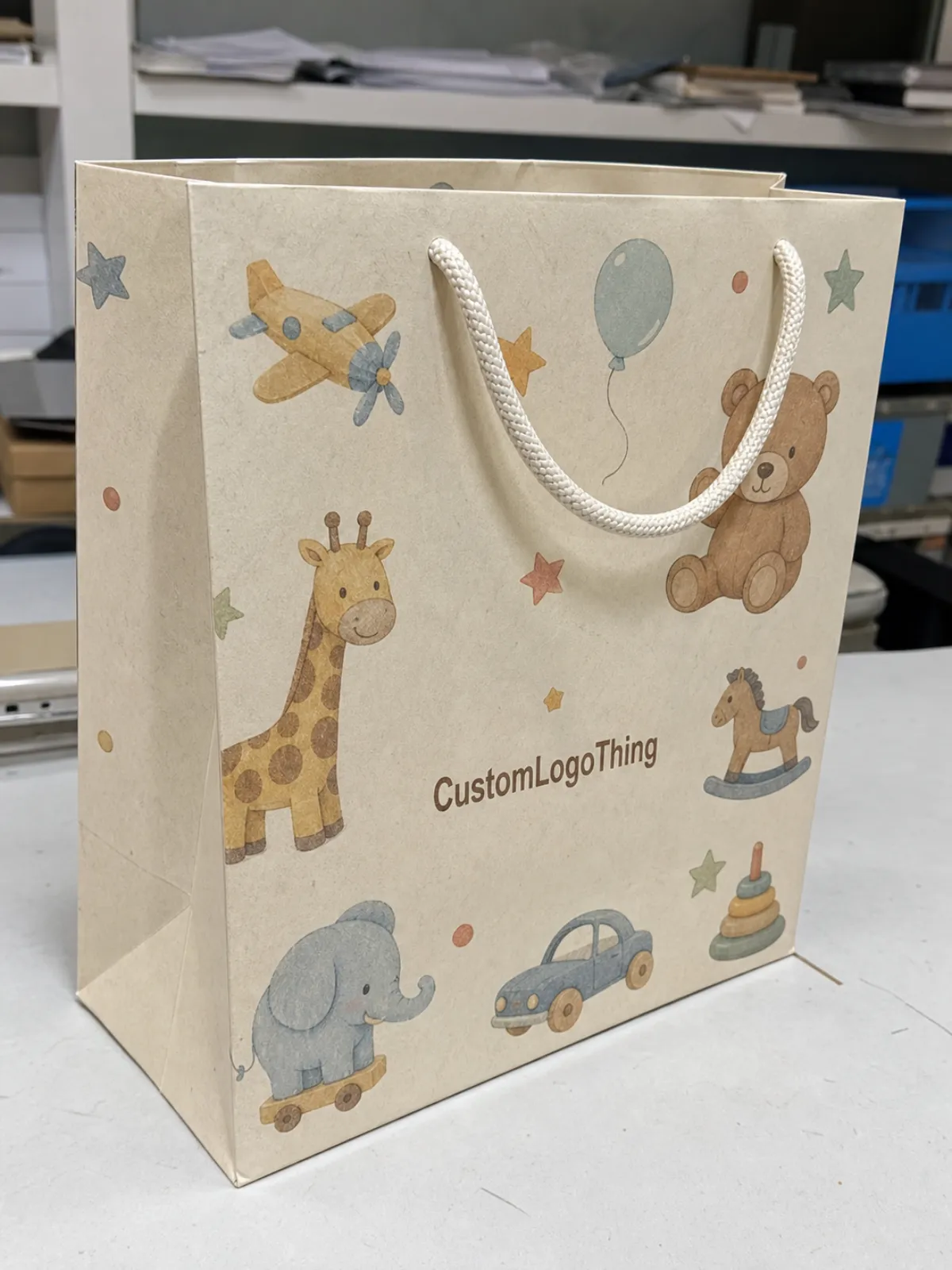
The toy launch is ready. Product cartons are booked, photography is finished, the retail display plan is approved, and then one small packaging item starts holding the shipment hostage: branded paper bags are still waiting on proof approval. That is why toy Paper Bags Lead time should not be treated as factory production time alone. It is the full chain of artwork review, quotation, proofing, material checks, printing, finishing, bag conversion, inspection, packing, and freight pickup.
Paper bags look simple because shoppers use them briefly. Buyers live with them for weeks. Toy packaging is especially timing-sensitive because the bag may be tied to a launch window, seasonal promotion, retailer presentation, or event date where the artwork has to look right the first time. Bright reds, character blues, safety icons, cheerful full-bleed graphics, and brand marks leave less room for “close enough.” Add reinforced handles for heavier boxed toys, low-odor finishes, and consistent retail display color, and the calendar tightens quickly.
A plain stock kraft bag with no logo can sometimes ship from inventory in a few business days. A custom toy paper bag is a different order. Change the size, print four-color artwork, specify 180gsm white kraft, request matte lamination, add a die-cut handle, attach a hang tag, or run holiday graphics across three panels, and the schedule expands. Not wildly, in most cases, but enough to affect a launch if nobody planned for it.
From a packaging buyer’s view, the quoted production window becomes useful only after the inputs are locked. Final artwork, confirmed dimensions, deposit timing, raw paper availability, sample approval, inspection requirements, and shipping method all influence the final date. A supplier may quote “12 business days,” but that often means 12 business days after proof approval, not 12 business days after the first email.
Practical rule: treat a custom paper bag like a small print-and-converting project, not like an office supply purchase.
A good plan shows where the time goes before the order becomes urgent. The sections below break down the production path, the choices that stretch the schedule, how speed affects cost, and what buyers should prepare before requesting a quote from Custom Logo Things.
How the Custom Toy Paper Bag Production Process Works
A clean custom bag order follows a predictable path: specification, artwork submission, quotation, proofing or sampling, deposit, material sourcing, printing, surface treatment, conversion, quality inspection, packing, and freight. Miss one step and the timeline becomes soft. Miss several, and the order starts drifting.
The hidden distinction is design approval versus production start. Factories usually do not reserve full press time, lamination time, die-cutting time, or handle assembly capacity until payment terms, final files, and confirmed specifications are complete. A buyer may feel the order started when the quote was accepted. The production team may see it as unstarted until the dieline, Pantone references, order confirmation, and deposit arrive.
Manufacturing can involve more steps than buyers expect. Paper is cut to size. Offset or flexographic printing is scheduled. A varnish, gloss lamination, matte lamination, or soft-touch film may be applied. The sheet is creased, folded, glued, and formed into a bag. Rope, ribbon, flat paper, twisted paper, or die-cut handles are added. Reinforcement cards may be inserted at the top fold or base. Cartons are then packed, labeled, counted, and prepared for pickup.
Each step has its own queue. Printing presses, laminating machines, die-cutting equipment, and manual handle stations are not always open on the same day. During toy-heavy buying periods, a supplier may have press capacity but limited finishing capacity, or paper may be available in 157gsm while the buyer requested 210gsm. Even a reasonable substitution question can pause the order until someone approves it.
Many delays come from treating a full-color toy bag like a decorated commodity. A one-color kraft bag behaves like a quick procurement item. A glossy character-themed bag with tight color tolerance behaves more like a coordinated miniature print campaign.
Proofs reduce ambiguity. Digital proofs confirm placement, scale, bleed, safety zones, copy, and panel alignment. Physical pre-production samples catch issues a PDF cannot show: handle strength, gloss level, paper stiffness, gusset proportion, ink odor, and whether the bag feels too flimsy for the actual toy weight. For repeat orders, digital proofing may be enough. For a new toy retail bag, a sample can prevent an expensive surprise.
Key Factors That Change Turnaround for Toy Retail Bags
The fastest way to misread toy paper Bags Lead Time is to ask for “a paper bag” without defining the bag. Turnaround changes with order quantity, dimensions, paper weight, print coverage, color count, handle type, finish, sampling route, and destination. A 5,000-piece logo bag and a 50,000-piece seasonal retail bag are not the same job.
Quantity affects both scheduling and inspection. A small run may finish quickly if the paper is available and the print setup is simple, but the unit price is usually higher because setup time is spread across fewer bags. A larger run can lower unit cost, yet it needs more paper, longer press time, more glue and handle checks, and more cartons. A 5,000-piece custom paper bag order may be easier to place than a 30,000-piece order, while the larger order may still be better for unit economics.
Artwork complexity is another quiet schedule driver. Full-bleed illustrations, licensed characters, tiny safety icons, QR codes, age-grade marks, and multi-panel graphics need cleaner files than a centered logo. Prepress teams look for bleed, resolution, font outlines, barcode contrast, color mode, and panel alignment. One missing font or low-resolution mascot file can turn a same-day proof into a two-day correction loop.
Paper stock matters too. Common choices include 120gsm to 180gsm kraft for lighter retail use, 190gsm to 250gsm white card for a more premium bag, and 250gsm-plus board for rigid presentation-style packaging. FSC-certified material can be a good fit for documented sustainability claims, but availability depends on the supplier’s inventory and paper channels. Buyers can review certification basics through the Forest Stewardship Council.
Finishes add steps. Matte lamination, gloss lamination, embossing, foil stamping, spot UV, custom die-cuts, and textured paper can improve shelf presence, but each may require setup, drying, curing, or additional inspection. Foil registration that looks polished on a mockup can be unforgiving at scale, especially near folds, gussets, and handle openings.
Toy packaging also carries a compliance layer. A paper bag is not the toy itself, but major retailers may still ask about low-odor inks, warning label placement, child-safe materials, carton markings, and documentation for sustainability or sourcing claims. For transport testing expectations, buyers often reference organizations such as ISTA, especially when packaging moves through complex distribution networks.
| Specification Choice | Typical Schedule Impact | Buyer Watch-Out |
|---|---|---|
| Standard size, one-color logo, kraft paper | Often the shortest custom route | Less visual impact for premium toy launches |
| Full-color print with lamination | Adds prepress and finishing time | Color tolerance should be agreed before printing |
| Reinforced rope or ribbon handles | Adds material checks and assembly time | Load test with the actual toy weight |
| Foil, embossing, spot UV, custom die-cut | Adds setup, curing, and inspection steps | High impact, but risky on compressed schedules |
Cost, Pricing, and MOQ Trade-Offs When You Need Faster Bags
Faster bags are rarely just a calendar question. They are a pricing question. Rush production can mean priority scheduling, overtime labor, expedited paper sourcing, short-run inefficiency, or premium freight. Two suppliers can quote different timelines and both be telling the truth because they may have different material inventory, equipment queues, or assumptions about approval timing.
Unit cost usually depends on paper grade, grammage, bag size, print method, color count, coating, handle material, reinforcement, MOQ, defect allowance, packing style, and shipping route. As a rough planning range, a simple custom kraft bag in a moderate quantity may land around $0.18-$0.35 per unit before freight, while a premium laminated toy gift bag with rope handles, heavier paper, and full-coverage printing can run $0.45-$1.20 or more depending on size and volume. These are not universal prices. They are useful sanity checks before comparing quotes.
MOQ, or minimum order quantity, is tied to setup economics. Printing plates, machine setup, paper purchasing, ink preparation, and labor need a stable batch to make commercial sense. Ordering below an efficient threshold may be possible, but unit cost rises because the same setup work is spread across fewer bags. A 1,000-piece order may feel safer for cash flow; a 5,000-piece order may price much better per unit.
Speed changes freight math even more aggressively. Paper bags are lightweight but bulky. Air shipping can rescue a launch, yet it may cost more than the bags themselves if cartons are large. Sea freight is cheaper per carton but slower and less flexible. Express courier can work for a small launch quantity, but not always for 80 cartons of folded retail bags.
A practical quoting structure is to ask for three scenarios:
- Standard production with standard freight: usually the lowest total cost if the launch calendar allows it.
- Rush production with standard freight: useful if factory timing is the bottleneck, not transport.
- Standard production with expedited freight: helpful if the bag can be made normally but arrival date is tight.
The cheapest quote can become expensive if it excludes sampling, color matching, reinforced handles, export cartons, inspection photos, customs paperwork, or delivery to the final warehouse. Ask what is included. Then ask what is not included. That second question often reveals the real schedule risk.
Step-by-Step Timeline Planning Before You Request a Quote
Start with the launch date and work backward. Not the production deadline. The needed-in-hands date. If the toy promotion starts on a Monday, the bags should not arrive at 4 p.m. the Friday before unless the team has already planned receiving, counting, and distribution down to the hour.
- Define the bag’s job. Is it a retail carry bag, gift-with-purchase bag, event giveaway, boutique packaging piece, subscription box insert, or holiday promo bag? Each use changes strength, print quality, and quantity needs.
- Lock structural specs. Confirm width, gusset, height, paper weight, handle style, surface finish, reinforcement, expected product weight, carton packing preference, and pallet requirements. For toy products, test the actual weight, not just the box dimensions.
- Prepare artwork correctly. Send dieline-ready files, vector logos, CMYK or Pantone references, bleed, safe zones, barcode or QR placement, and any licensing approval notes. If a character license holder must approve the bag, build that into the schedule.
- Choose the proofing route. Digital proofing is faster for a repeat logo bag. A physical sample is smarter for a new structure, a heavy toy load, a premium finish, or a major retail pitch.
- Separate flexible time from fixed time. Artwork review can move in hours if one person owns the decision. Ink drying, lamination curing, freight sailing schedules, and customs clearance may not respond to urgency.
- Quote against arrival, not production. Ask for factory lead time and transit time separately so you can see whether the risk sits in production, freight, or approval.
One decision owner helps more than people admit. Procurement, design, compliance, and sales may all have valid opinions, but scattered approvals are one of the quietest causes of delayed packaging. A buyer who can approve a proof in four hours has a real advantage over a committee that needs four days.
For planning, use a simple buffer: 2-3 business days for artwork cleanup, 1-3 business days for proofing, 10-18 business days for many standard custom production runs, and extra time for sampling, premium finishes, or international freight. Your actual toy paper Bags Lead Time depends on the final specification, but that framework exposes the weak points early.
Common Mistakes That Delay Custom Toy Paper Bags
The first mistake is asking for a lead time without complete specifications. “How fast can you make 10,000 bags?” sounds simple, but the supplier still needs size, paper, print, handle, finish, destination, and proofing requirements. Without those facts, the answer is an estimate, not a schedule.
Vague artwork is the second troublemaker. Low-resolution logos, missing fonts, RGB colors, no dieline, unclear print placement, and unapproved character art can trigger multiple rounds of prepress questions. A 300dpi image may be acceptable for some print work, but vector artwork is usually cleaner for logos, icons, and type.
Late design changes are worse. Change the bag size after proof approval and the dieline may need to be rebuilt. Change handle type and reinforcement may shift. Add foil after the quote and a new production step appears. Even changing from matte to gloss can affect material sourcing and finishing queues.
Another mistake is assuming all paper bags are structurally equal. Toys can be dense, boxed with sharp corners, or oddly shaped. A small STEM kit may weigh more than its size suggests. A plush toy may be bulky but light. Weak handles, thin paper, or a narrow gusset can fail at a retail counter or event booth, exactly where the brand wants to look polished.
Shipping volume surprises buyers too. Paper bags are light, but they occupy space. Carton dimensions, freight class, pallet height, and warehouse receiving rules can change the delivered cost. Expedited routes punish bulk. One air shipment of bulky bags can erase the savings from a cheaper unit price.
Skipping samples can be reasonable for a repeat order. For premium toy brands, it can also be risky. Screen color does not reveal paper stiffness, handle feel, gloss level, gusset behavior, or how a bright red prints on kraft versus white stock.
Documentation traps are less glamorous but just as real. Chain retailers may require carton labels, barcodes, packing lists, routing guide details, compliance statements, or sustainability claim support before goods can move. Most packaging delays are not dramatic factory failures; they are small unanswered questions that accumulate interest.
Expert Tips for Shortening Turnaround Without Sacrificing Quality
The fastest order is usually not rushed. It is complete from day one.
Choose proven structures if speed matters. Standard sizes, common paper weights, existing handle styles, and familiar finishes reduce uncertainty. A 160gsm white kraft bag with twisted paper handles is easier to schedule than a custom-dyed textured stock with ribbon handles and foil across two panels.
Separate must-have features from decorative extras. Reinforced handles may be essential if the bag carries a 2 lb boxed toy. Foil stamping may be optional if the delivery window is tight. Matte lamination may protect the print and improve touch, but if the bag is for a one-day event giveaway, a varnish might be enough.
Approve print tolerance upfront. Toy colors carry emotion; a slightly dull yellow can make a cheerful character look tired. Still, paper printing has limits. Agree on Pantone targets, CMYK builds, and acceptable variation before bulk production. Repeated color debates can delay production longer than the printing itself.
Use one master artwork file with version control. Name it clearly. Lock dimensions. Outline fonts. Keep old drafts out of the email chain. Sales, design, compliance, and procurement should not circulate conflicting files with names like “final-new-revised-actual.” That is how errors become cartons.
Test early. Put the actual toy, or an equivalent weight, inside the proposed bag size. Lift it by the handle. Walk ten steps. Set it down. Pick it up again. If the handle bites into the hand, the gusset strains, or the top fold flexes too much, fix the structure before mass production.
Digital proofs are faster for repeat orders and simple logo bags. Physical samples are smarter for new styles, heavier toys, premium launches, unusual finishes, and retailer presentations. If the deadline cannot move, consider a split shipment: a smaller launch quantity by air and the balance by economical freight. It is not always cheaper, but it can protect the selling date.
Practical Steps Before You Order Custom Toy Bags
Before requesting pricing, collect the facts that turn a vague estimate into a workable quote: target delivery date, bag dimensions, toy weight, quantity, paper preference, handle type, print coverage, finish, destination address, and whether a sample is required. Ten minutes of preparation can save three days of clarification.
Gather brand assets early. Send a vector logo, Pantone or CMYK references, dieline if available, product photos, retailer packaging rules, and any safety or sustainability claims that must appear on the bag. If the packaging will mention recycled content, FSC certification, or low-odor inks, the supplier needs to know before quoting, not after production starts.
Build a decision calendar with real dates: artwork due date, proof approval date, deposit date, sample review date, production start date, inspection date, pickup date, and arrival date. Buyers who only track the final delivery date miss the smaller deadlines that control the order.
Ask the supplier five direct questions:
- What starts the clock on this order?
- What could delay this specification?
- Which materials are currently in stock?
- What is the fastest safe shipping method for this carton volume?
- What information is still missing from me?
Choose the simplest specification that still protects the toy, carries the brand, and fits the launch environment. A retail toy bag does not need every decorative feature available. It needs the right size, the right strength, the right print quality, and the right arrival date.
Document every approved spec in one place so procurement, design, and the manufacturer work from the same facts. Understanding toy paper bags lead time turns a vague waiting period into a manageable production plan with fewer avoidable surprises.
FAQs
What is the typical lead time for custom toy paper bags?
A simple custom printed paper bag can often move faster than a complex premium bag, but buyers should separate artwork approval, sampling, production, inspection, and shipping. The clock usually starts after final artwork, specifications, payment terms, and proof approval are complete. Rush options may be possible if the structure is standard, materials are in stock, and approvals move quickly.
How can I reduce toy paper bag turnaround without raising costs too much?
Use standard sizes, common paper stocks, simple handles, and fewer specialty finishes. Submit print-ready artwork with correct dielines, bleed, fonts, color references, and logo files before asking for final timing. If the deadline is tight, compare rush production against partial air freight because one may cost less than the other.
Does the MOQ affect toy paper bags lead time and pricing?
Yes. MOQ affects scheduling and unit cost because machine setup, paper sourcing, and print preparation must be spread across the order quantity. Very small runs may be possible, but they often carry higher unit prices or fewer customization choices. Larger orders may reduce unit cost while adding production, material planning, and inspection time.
Should I request a sample before producing toy retail paper bags?
A sample is recommended for new bag sizes, heavy toys, premium finishes, unusual handles, or retail presentations where appearance and strength matter. Digital proofs are faster and may be enough for repeat orders or simple logo bags. Physical samples add time, but they can prevent expensive problems with color, handle strength, finish, or bag proportions.
What information should I send to get an accurate toy paper bag quote?
Send quantity, bag size, paper weight, handle style, printing requirements, finish, destination, target delivery date, and whether you need sampling. Include artwork files or a clear design brief with logo placement, color references, warning labels, and retail marks. Ask for production time and shipping time separately so the schedule risk is visible.


