Trade show Unstructured Dad Hats unit cost only matters if the cap gets worn after the booth lights go down. If it stays folded in a tote bag or gets left on a conference table, the number on the invoice was never the real number. The useful question is sharper: what kind of hat gives you the best mix of wearability, decoration quality, and price per piece without drifting into flimsy promo territory?
That is why soft-crown, low-profile caps keep showing up in event programs. They feel closer to retail apparel than giveaway inventory, and buyers notice the difference as soon as they handle a sample. The same cap can work as staff uniform, VIP gift, or the one item from the show that actually makes it into someone’s weekend rotation.
The strongest orders are usually the least dramatic ones. One cap silhouette, one logo location, one clean spec sheet, and a unit cost that can survive procurement review without a long explanation. The goal is not to chase the cheapest number. It is to land on a hat people will keep wearing long enough for the brand to matter.
Why soft-crown caps sell faster on the booth table
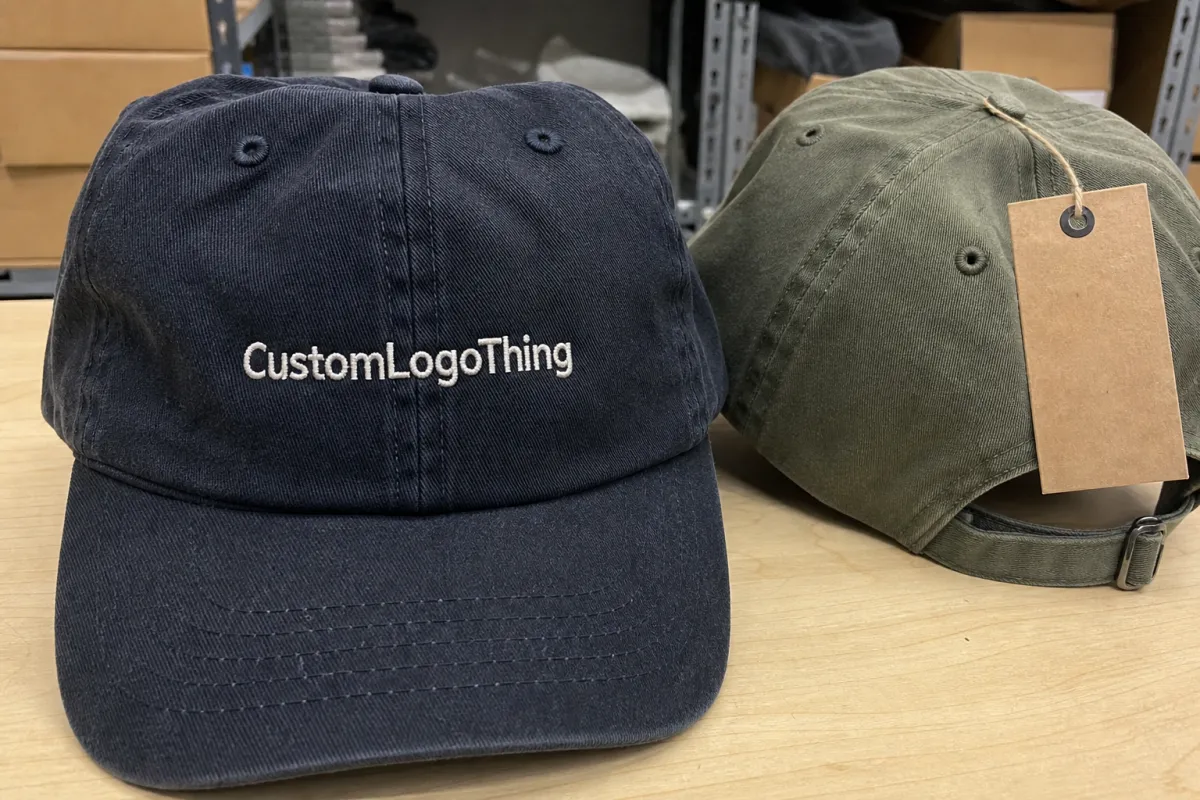
Unstructured Dad Hats have a practical advantage: they do not announce themselves as promo items the second someone picks them up. The soft crown drapes more naturally, the front panel feels less rigid, and the whole hat reads as everyday clothing instead of a trade show afterthought. That matters on a busy aisle where attention spans are measured in seconds.
Fit is part of the appeal. A low-profile crown sits lower on the head and tends to feel less bulky than a stiff structured cap. For many buyers, that is enough to make the cap more wearable across different head shapes and hair volumes. The less the hat feels like a costume, the more likely it is to leave the show floor with the attendee.
There is also a perception problem that softer hats solve. A rigid front panel can push a cap toward the “freebie” category, even when the decoration is decent. A washed or garment-dyed unstructured cap, by contrast, can feel like something from a retail wall. That shift in perceived value is why the category keeps winning for staff kits, speaker gifts, and higher-end event giveaways.
“If the hat feels cheap in the hand, the decoration has to work twice as hard. If the hat already feels like apparel, the logo gets a fair chance.”
Buyers usually see the best results when they keep the art small and the shape relaxed. One restrained logo on a wearable cap does more than a crowded front panel covered in slogans. People are far more willing to wear a hat that looks like something they chose than something they were handed.
Build details that change fit, feel, and perceived value
Many event teams start with the logo and work backward. That is usually the wrong order. Crown shape, panel count, brim curve, closure style, and fabric finish often influence the buying decision more than the decoration itself. On an unstructured cap, those details are visible immediately because there is less internal structure hiding the construction.
Crown shape is the first decision that changes how the hat wears. Low-profile crowns feel casual and modern, while deeper crowns can fit more heads but may also look taller and bulkier. For trade show use, low-profile usually feels safer because it sits closer to retail styling and is easier to pair with casual uniforms.
Panel count shapes the silhouette. Six-panel hats are still the most common because they balance well and accept embroidery cleanly. Five-panel styles have a flatter front and can read a little more streetwear or vintage. That can be a good thing if the brand identity supports it, but it should be a deliberate choice rather than a reaction to a low quote.
Brim curve changes the mood more than people expect. A lightly pre-curved brim is easy to wear straight from the box and usually feels finished without much handling. A flatter brim can support a patch more cleanly and trend a bit more contemporary, though it is not as universally flattering. For broad trade show programs, a mild curve is often the least risky option.
Closure style affects both comfort and price. Self-fabric strapbacks keep the soft look intact and usually feel more natural on unstructured caps. Metal buckles add a little polish. Plastic snaps are typically the cheapest, but they can pull the hat closer to promo behavior if the rest of the build is too basic.
Fabric choice carries more weight than some buyers realize. Washed cotton gives the easiest broken-in feel and suits casual branding well. Chino twill is cleaner and slightly more polished without becoming stiff. Canvas offers durability and a stronger hand, though it can feel heavier in warm venues. Corduroy is more distinctive and retail-forward, but it works best for lifestyle brands rather than plain conference swag.
Decoration method matters too. Small embroidery is still the workhorse choice because it is durable, legible, and usually the most cost-efficient premium-looking option. Woven patches can sharpen fine detail and give the hat a more retail feel, but they introduce separate setup work and can push the budget higher than a first glance suggests. Leather or faux leather patches, metal emblems, and 3D puff embroidery all add visual punch, but each one adds complexity that shows up in pricing and lead time.
Small finishing choices can improve the result without turning the order into a custom product. Matching underbrims, tonal thread, antique brass buckles, and garment-washed fabric can make the cap feel more intentional. None of those are mandatory. They are useful when the program needs the hat to feel like part of a curated event kit rather than a random giveaway item.
There is no free lunch here. Softer fabric improves wearability. Better hardware improves perceived value. More custom trims raise cost. The right mix depends on whether the hat needs to move fast at the booth, support staff visibility, or live on after the event as regular apparel.
Specs to confirm before you request samples or artwork
The quickest way to get a useful quote is to stop leaving details open. Send the hat color, logo size, placement, thread colors, closure preference, and target fit before anyone starts guessing. That one step cuts down on revisions, keeps setup charges from multiplying, and helps the first proof arrive with fewer surprises.
Placement deserves more scrutiny than it usually gets. On an unstructured cap, the front panel shifts a little when worn, so a logo that looks centered on a flat mockup may sit differently on a head. Left-front placement is often easier to keep clean because it avoids the deepest curve of the panel. Center front can still work, but the artwork needs better proportion control and a more forgiving logo shape.
Before sample approval, ask for a digital mockup and check it as if you were trying to reject it. Look at logo scale, stitch density, thread contrast, and how the decoration sits against the crown. If the artwork is low resolution or not supplied as vector, fix that before asking for pricing. Bad files waste time for everyone and can make simple work behave like a custom job.
Packaging is another detail that changes how the order lands. Ask whether the caps will ship bulk-packed, polybagged, or sorted into mixed cartons by destination. If the order needs to split across multiple show floors or receiving locations, say so early. Repackaging after production is not impossible, but it is a good way to add cost without improving the product.
A complete spec sheet is the most useful tool in the room. Put the cap style, material, color, decoration method, placement, quantity, destination, and delivery date into one document. Then compare quotes against that same sheet. Without that discipline, one supplier may be pricing a stock hat with simple embroidery while another is quoting a custom color, a patch, and additional setup. Those are not comparable numbers, even when the logo is identical.
For buyers who need a tighter quality check, it helps to define what “approved” means before the order moves. Check seam symmetry, crown balance, stitch tension, and color consistency under daylight rather than only under warehouse lighting. Small thread shifts are easy to miss on a screen and obvious in hand. If the brim curve is uneven or the panels pull in different directions, the cap will look off even if the logo itself is perfect.
Teams with sustainability requirements should also review documentation, especially if the order includes inserts, hangtags, or secondary packaging. Claims should be verified rather than assumed. If shipping protection matters, practical packaging standards from groups such as ISTA can help reduce crushed cartons and bent brims. If paper-based inserts are involved, FSC is the right place to confirm the paperwork behind the paper.
The best quotes come from the best inputs. That is not a slogan. It is the difference between a number you can approve and a number you have to explain.
Trade show unstructured dad hats unit cost, MOQ, and price breaks
Here is the part everyone ends up caring about. Trade show unstructured dad hats unit cost is built from four pieces: the blank cap, decoration, setup work, and freight. If any one of those shifts, the total shifts with it. A cheap blank does not rescue a complicated decoration. A beautiful patch does not rescue expensive rush freight. The math is annoyingly consistent.
For a stock cap with one small embroidery location, a practical planning range often looks like this:
| Quantity | Typical cost per piece | What is usually included | Buyer note |
|---|---|---|---|
| 100 pieces | $4.25-$7.50 | Stock blank, one embroidery location, standard setup | Highest unit cost because setup is spread across fewer hats |
| 250 pieces | $3.35-$5.95 | Stock blank, one logo, normal thread count | Often the best balance for a single show or regional event |
| 500 pieces | $2.95-$4.95 | Better bulk pricing, lower decoration ratio | Useful for multi-day programs or shared inventory |
| 1,000 pieces | $2.45-$4.35 | Most efficient cost per piece on stock builds | Best when the same cap will be used across several events |
Those figures are planning ranges, not a promise. Fabric choice, thread count, logo complexity, freight method, and delivery location all change the real total. If the design is dense, uses fine detail, or needs multiple decoration locations, the cost rises. If the order is kept simple, the number stays easier to defend.
MOQ depends on how custom the build gets. Stock blanks often begin around 48 to 100 pieces, sometimes lower if the right color is already available. Custom colors, specialty materials, and patch constructions usually push the minimum higher because sourcing and setup are less flexible. Buyers sometimes compare a low-MOQ stock quote with a custom run and assume someone is padding the margin. Usually they are pricing different products.
Decoration choice has a large effect on the final figure. Simple embroidery is usually the lowest-cost premium-looking option. Woven patches can preserve detail while still looking polished, but they may introduce separate tooling or setup fees. Leather patches, embossed emblems, and 3D puff embroidery each add visual weight and cost. That is fine if the brand wants the look. It is a problem only when the budget was built around a simpler build.
For teams comparing options, it helps to separate perceived value from cost impact:
| Build choice | Perceived value | Cost impact | Best use case |
|---|---|---|---|
| Small left-front embroidery | Clean and versatile | Lowest | Budget-conscious trade show runs |
| Woven patch | Retail-like | Moderate | Simple logos with sharper detail |
| Leather patch | Premium and casual | Moderate to high | Lifestyle brands and higher-end giveaways |
| Multi-location decoration | High brand visibility | Highest | Limited runs with stronger budgets |
The cheapest clean order is usually one stock color, one logo location, standard thread colors, and no rush shipping. Add a second decoration spot and the quote climbs. Add a custom fabric color and it climbs again. Add urgency and freight becomes the new problem. That is not a flaw in the supplier. It is how production works.
If a supplier can quote at 100, 250, 500, and 1,000 units, ask for all four. The breakpoints show where the real savings sit, and they make procurement decisions easier because the slope is visible. Sometimes the answer is a small run for one show. Sometimes the right move is to buy enough to cover the whole season and stop paying the setup cost twice.
Production steps, proof approval, and lead time planning
A competent supplier process should feel boring. Art review first. Digital proof next. Sample approval if needed. Bulk production after sign-off. Quality check before shipment. That sequence protects both the budget and the date on the calendar.
For a simple stock blank with straightforward embroidery, a workable lead time is often 7 to 15 business days after proof approval. More involved builds, such as custom colors, patch work, or specialty trim requests, commonly need 2 to 4 weeks. If the order has to move through international freight or split delivery, add more time. Transit does not care that your show opens on Tuesday.
Most delays trace back to the same few issues. Artwork arrives in the wrong format. Pantone references are vague. Placement instructions change after the first proof. Someone on the marketing side wants a revision after procurement already approved the quote. None of these are dramatic on their own, but together they can turn a normal schedule into a rush order.
Rush production only makes sense when the artwork is clean and the spec is locked. If the cap still needs a special patch, a color match, or multiple revisions, rush fees usually buy stress rather than certainty. The extra money is often being spent to compress uncertainty, and uncertainty is usually the part that should have been fixed earlier.
Good buyers work backward from the booth date. They ask for the latest safe approval date, not whether the order can be “done fast.” That single question forces everyone to respect proof timing, freight windows, and the actual production cycle. It is also the only realistic way to protect delivery when the event schedule gets crowded.
If the hats are being shipped to several venues, build in a little buffer for labeling and sorting. Mixed cartons can cause headaches if the receiving team is not ready. A simple packing plan saves a long email chain later. Nobody wants to discover three colorways in one box on the afternoon before setup.
One more production reality matters: repeatability is easier than novelty. Once a spec is locked, the supplier can hold stitch count, panel shape, and thread tone from run to run. That consistency matters more than some buyers admit, especially if the cap will be reordered for quarterly events or regional shows.
Why repeat event buyers stick with the same cap spec
Repeat buyers are usually not being conservative for the sake of it. They are removing risk. Once a cap spec works, they keep it because it shortens approvals, reduces sample waste, and protects the brand from accidental drift. Same fabric. Same crown. Same closure. Same placement. That kind of consistency makes procurement much easier.
A locked spec also helps with forecasting. If the team already knows how the hat wears, how it photographs, and how it holds up after a full day of handling, the next order becomes a variation on a proven item rather than a fresh experiment. That is especially useful when different departments place their own orders and need the final product to look aligned.
There is a retention benefit too. A better-fitting cap is more likely to leave the event and enter regular rotation. That turns a single giveaway into repeated impressions. Cheap-looking hats often disappear quickly. Better-constructed unstructured hats tend to stay in use longer, which is one reason the slightly higher upfront unit cost can make sense.
Consistent reorders also make quality control easier. If a supplier can match the same blank and the same thread tone on the second and third run, that is a real operational advantage. A low quote means very little if the follow-up order arrives with a different handfeel, a different color cast, or a logo that sits in a different place on the crown.
Packaging standards matter here as well. If the caps are part of a broader event kit, the whole program looks more deliberate when every component arrives with consistent counts and clear labeling. It is not glamorous work, but it keeps the order from unraveling at receiving.
Next steps: send the right inputs and lock the order
If you want a quote that actually means something, send six things first: quantity, due date, logo file, decoration placement, hat color, and shipping address. If you already have a budget ceiling, include that too. It narrows the options quickly and saves time that would otherwise disappear into guesswork.
Ask for pricing at several volumes, not just one. A quote at 100 pieces and a quote at 500 pieces tell a very different story about the real unit cost. That spread is useful because it shows whether the order should cover one event, a full roadshow, or the whole quarter.
Request the mockup and timeline before payment clears. If the proof is off, fix it before production. If the deadline is tight, say so early. If the artwork is rough, clean it up before anyone starts talking about rush fees. The strongest orders are the ones that leave as little interpretation as possible.
The simple version is still the right one: keep the cap wearable, keep the art disciplined, and keep the schedule realistic. That is how trade show Unstructured Dad Hats unit cost stays manageable without making the hat look cheap. Done well, the cap feels like apparel first and a giveaway second, which is exactly why it keeps getting worn.
What affects trade show dad hat unit cost the most?
Quantity usually has the biggest impact because setup charges get spread across more pieces. Decoration method comes next: small embroidery is often cheaper than patches, heavy stitch counts, or multiple logo placements. Freight and rush fees can erase savings quickly, so shipping terms should be clear before the order is approved.
What is the usual MOQ for custom unstructured dad hats?
Stock blank orders often begin around 48 to 100 pieces, depending on color availability and decoration. Custom colors, specialty trims, and patch builds usually require higher minimums because sourcing and setup are less flexible. If the project is still taking shape, ask for pricing at several volumes so the breakpoint is visible.
How long does production take after artwork approval?
Simple embroidery on stock hats is often the fastest path, while custom colors and patch orders need more time. A practical planning window is about 7 to 15 business days for simpler runs and 2 to 4 weeks for more involved builds. Late artwork and revision cycles are the usual reasons the schedule slips.
Can I mix colors or logo placements in one order?
Yes, but every added color or placement can increase setup time and may affect MOQ or unit cost. Keeping one base hat style and one logo location is the easiest way to hold pricing steady. If multiple versions are necessary, ask for a cost split before the order is locked.
What decoration keeps the unit cost low but still looks premium?
Small left-front embroidery is usually the cleanest low-cost option when the logo is simple. A woven patch can also look premium without a major price jump if the design stays straightforward. Oversized artwork, extra locations, and dense stitch counts tend to push the budget up faster than buyers expect.


