For bulk buyers, a white boutique paper Bags Factory Quote is not a routine pricing note. It is a forecast of margin, presentation, and avoidable risk. White bags can look simple on a screen and still be unforgiving in production: glue marks, crushed corners, handle failures, and shade variation all stand out faster than they do on kraft.
The real job is not to buy paper bags. It is to secure bags that arrive clean, hold their shape, and match the brand once they are stacked at retail. A useful quote makes the tradeoffs visible before money changes hands. If it hides the paper grade, handle build, or finishing method, the buyer is still guessing.
Practical rule: if a quote does not spell out the paper, handle, finish, and inspection standard, it is not a final buying quote. It is only a starting point.
Why pricing changes margin
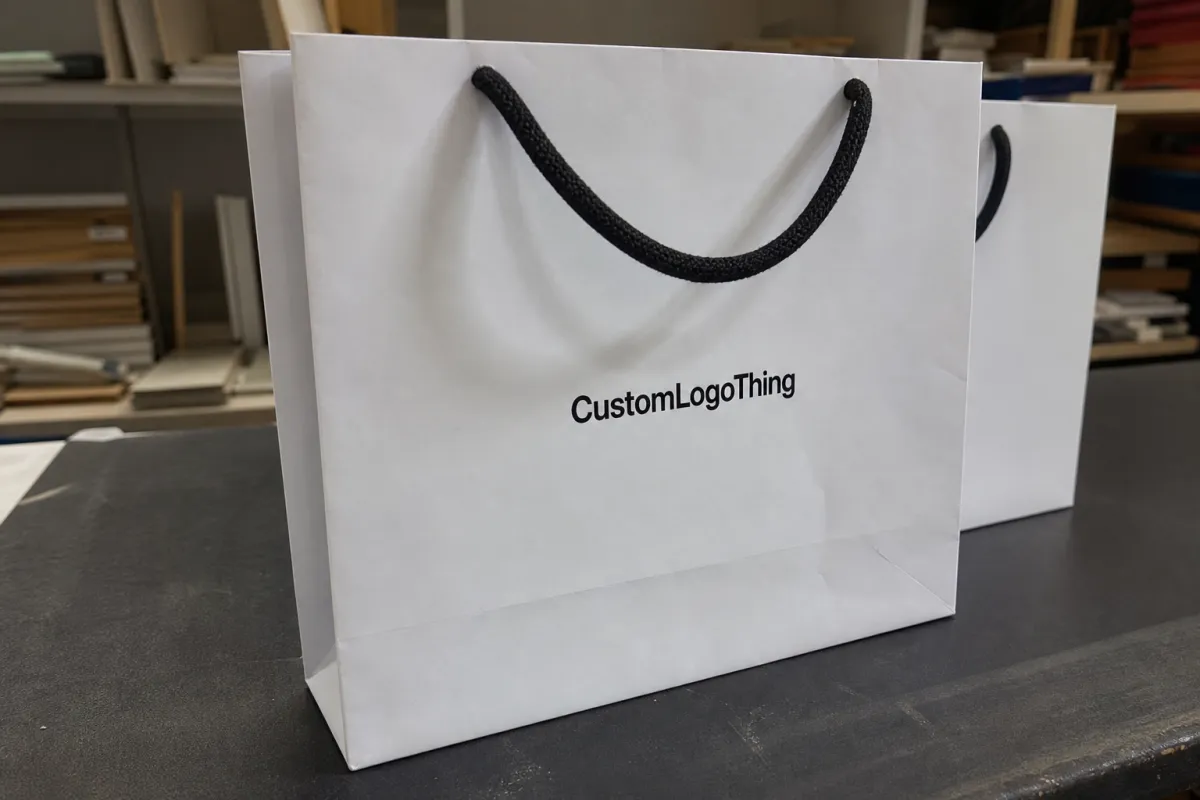
Retail packaging has a habit of hiding in plain sight. A bag may cost only a few cents more per unit, yet that difference can add up quickly across a season, a chain rollout, or repeated replenishment orders. That is why a white Boutique Paper Bags factory quote should be read as a margin document as much as a packaging document. It is part display, part protection, and part quality control.
White is less forgiving than kraft. Surface scuffs, uneven lamination, tiny adhesive stains, and corner crush show immediately under store lighting. Two quotes can look similar at first glance and still reflect very different production standards. One may include tighter material sorting, more careful carton packing, or a stricter final inspection. The other may simply be cheaper because fewer defects are being screened out.
The best comparison is not headline price versus headline price. It is specification versus specification: paper weight, reinforcement, handle type, print coverage, coating, carton pack count, and whether the factory inserts inner protection. Those details explain why one price looks low and another looks safer for premium retail. They also explain why a quote that seems expensive can become the cheaper choice after claims and replacements are counted.
There is also a brand-side calculation. A luxury or gift bag should not only survive transit; it should look ready for the floor when the carton is opened. That means the quote should reflect visible quality control, not just material cost. Buyers who focus only on the lowest unit price often end up paying for rework, rush freight, or rejected stock later.
Bag construction that defines the finished look
Construction changes both appearance and cost. Flat handles, twisted paper handles, cotton rope, ribbon, and die-cut formats all create different visual and tactile effects. They also create different assembly paths. A boutique apparel bag with cotton rope handles usually costs more than a comparable twisted-handle version because the handle attachment is slower and the attachment points need better reinforcement.
The body structure matters just as much. A top board helps the opening stay crisp. A bottom insert improves load distribution. Side gussets add room for folded garments, boxed gifts, or thicker retail purchases. Patch reinforcement around the handle area can reduce tear risk when a customer carries the bag by one hand for a longer distance. These are small details on paper and major ones in use.
Finish changes the way white reads. Matte, gloss, aqueous coating, soft-touch lamination, and uncoated board all reflect light differently. Matte often feels restrained and premium. Gloss looks brighter and can make the white surface more reflective. Soft-touch creates a muted, tactile finish, but it increases cost and needs better packing discipline because scuffs and pressure marks can show during transit.
Logo placement should be planned around the actual structure, not a flat mockup alone. A design that looks balanced on a dieline can shift once the gusset folds or the handle patch is attached. Fine lines, reversed type, foil stamps, and embossed marks are especially sensitive to movement in the production process. Sampling exists to catch those shifts before the full run starts.
For buyers comparing suppliers, it helps to ask which parts are standard and which are custom. A standard carrier may be produced faster, but a true boutique bag often needs more precise die-cutting, better adhesive control, and closer color matching. That difference should show up in the quote. If it does not, the buyer will discover it later in sample revisions or quality complaints.
Specifications to lock before sampling
Start with dimensions. Width, gusset, and height should be written clearly, because a bag that is technically large enough can still fail in use if the opening is too narrow for folded apparel, rigid boxes, or bottle necks. The factory needs the usable internal size, not a rough estimate. If the product is boxed or unusually shaped, ask for the internal clearance rather than just the nominal outer size.
Paper weight should match the load. Lightweight accessories can often use 170-210 gsm board, while heavier retail items may need 250 gsm or more, depending on the build. If the bag carries hard edges, such as cosmetics boxes or hardcover gifts, ask whether the base needs extra board or a double-layer bottom insert. Recycled board can work well for some programs, but virgin-fiber board usually gives better brightness and a cleaner print surface when the brand wants a high-end white.
Handle details belong on the quote sheet. Confirm handle length, knot style, attachment method, and the expected pull strength. A rope handle with a neat knot does not automatically outperform a twisted paper handle. The correct choice depends on carry weight, brand position, and how the bag will be used. If the bag is likely to be carried for a long walk, handle comfort matters more than the drawing on the mockup suggests.
Print should be defined before the first sample leaves the factory. State Pantone targets, coverage area, foil or embossing requirements, and any no-print zones. If the artwork includes fine lines or reversed type, say so. White bags expose registration problems quickly, so the sample must reflect the real production method rather than a simplified proof. It also helps to agree on acceptable shade tolerance. A bright white may look identical in a PDF and visibly different once paper from a different pulp lot is used.
Sample review should go beyond appearance. Measure the opening width, check whether the bag stands upright, inspect corner squareness, and open and close the bag several times. Look at the fold memory after the bag is packed and unpacked. A sample that looks beautiful but collapses at the base is a warning, not a success. If the bag is meant for gift retail, the way it sits on a counter matters almost as much as the artwork on the face.
One more detail often gets missed: tolerances. A factory that can hold a 2-3 mm dimension tolerance will usually give a cleaner repeat order than one working loosely. That may sound minor, but small variance becomes obvious when bags are stacked next to each other on a shelf.
Cost, MOQ, and unit cost drivers
Unit price usually tracks four variables: material grade, print complexity, finishing steps, and handle construction. A plain white bag with one-color print is not comparable to a laminated version with foil stamping, rope handles, and a reinforced base. Buyers who treat those as the same product end up comparing unrelated numbers.
MOQ is tied to setup time and production efficiency. Larger runs spread plate costs, color matching, and press setup across more units. Smaller runs can still work, but the per-unit price rises because the factory cannot distribute those fixed costs as widely. That is a normal production reality, not a sales tactic. The question is whether the MOQ matches actual demand and reorder frequency.
For planning, ask for tiered pricing at common quantities such as 1,000, 3,000, 5,000, and 10,000 units. That format shows where the price break happens and makes it easier to choose an order size that fits the sales calendar. It also gives procurement teams a cleaner basis for comparison. A quote with only one quantity can hide how quickly pricing improves at scale.
Below is a practical comparison many buyers use while reviewing a white Boutique Paper Bags factory quote. The figures are typical ranges, not promises. Actual pricing changes with paper source, print coverage, finish, and freight destination.
| Bag build | Typical MOQ | Indicative unit price | Best fit | Risk to watch |
|---|---|---|---|---|
| Plain white paper bag, twisted handles, one-color print | 1,000-3,000 pcs | $0.18-$0.30 | Promotions, accessories, light apparel | Scuffs and corner marks show quickly on white |
| White boutique bag, rope handles, matte lamination | 3,000-5,000 pcs | $0.28-$0.48 | Fashion, gifting, premium retail | Handle attachment and lamination alignment |
| White boutique bag, foil, embossing, reinforced base | 5,000-10,000 pcs | $0.45-$0.85 | Luxury launches, VIP packaging, seasonal campaigns | Longer lead time and tighter QC needed |
Compare landed cost, not only factory price. Sampling, freight, carton format, and any special inspection requirements should sit in the same calculation. A low ex-works number can turn into a weak landed number once international freight, local handling, and repacking are included. In some programs, a slightly higher factory quote saves money because the cartons are packed more efficiently or arrive with fewer damaged units.
Sustainability claims can also affect price and supplier choice. FSC-certified paper may be required for some retailers or brand programs, especially when packaging sits inside a broader sourcing policy. Certification does not automatically make a bag better, but it does help narrow the field when compliance matters. It is also a useful signal that the supplier understands traceability.
Production process and lead time from artwork to delivery
A reliable process usually follows a clear path: project brief, dieline confirmation, artwork proof, sample approval, production, QC, packing, and shipment. If one of those steps is skipped, the problems usually show up later, when the bags are already on a vessel or stacked in a warehouse. The best factories do not rush past the setup work; they control it.
Lead time depends on how many custom elements are involved. Special handles, metallic finishes, heavy board, unusual dimensions, and dense print coverage all add time because they increase sourcing and inspection work. A simple order may ship faster than a premium build, but the schedule should be written around the real build, not an optimistic one. For many boutique jobs, a realistic window is roughly 12-25 working days after sample approval, before transit time is added.
Ask the factory which steps can be accelerated and which cannot. Artwork feedback is usually the easiest stage to speed up. Glue cure time, drying, pressing, and carton conditioning are less flexible. Rushing those stages may save a day and cost a week in claims. That tradeoff is one of the first things experienced buyers check when reviewing a quote and timeline together.
Transit testing is worth asking about for export orders. The testing profile does not need to be complicated, but it should match the route and the handling environment. Standards aligned with the International Safe Transit Association, or ISTA, are useful because a bag that survives production still needs to survive stacking, vibration, and store handling. A premium paper bag that arrives flattened or scuffed is still a failed product.
Build buffer time into the schedule if the bags support a store opening, event launch, or seasonal drop. A quote only helps if it matches a realistic production window. A number that looks attractive but misses the launch date has limited value, and late freight usually erases any unit savings.
Quality checks that protect white finish and reduce returns
White surfaces make defects obvious, so the inspection plan matters. Buyers should ask how the factory checks for scuffs, glue bleed, uneven coating, corner crush, and color variation before cartons leave the plant. A neat-looking bag in the sample room is not proof that the full order will stay neat after production and packing.
Inspection should happen at more than one stage. Incoming material checks catch paper variation early. In-line checks catch print or glue issues while the job is still running. Final carton sampling catches packing damage and visual defects that survive earlier checks. Each checkpoint sees a different problem, which is why a single final inspection is rarely enough for premium white bags.
Load testing matters because a bag can look perfect and still fail in use. Ask for pull tests on handles, adhesion checks on folds, and transit checks on packed cartons. If the order is going to retail, it should survive repeated customer handling, not just one careful lift at the factory gate. For heavier items, a pull test on the handle area tells more than a surface inspection ever will.
Reject criteria should be agreed before production starts. That sounds basic, but it prevents disputes later. If both sides know what counts as an acceptable shade, acceptable glue mark size, and acceptable handle tolerance, there is less room for delay when the shipment is on the line. It also makes reorders easier because the first run becomes a working standard.
For premium programs, batch records and defect photos are worth requesting. Those records do not add glamour, but they preserve consistency when a second order needs to match the first. A clean paper trail also helps if a retailer asks for proof of inspection or if a quality issue needs to be traced back to a specific production lot.
Direct factory sourcing vs broker pricing
Direct factory sourcing usually gives buyers clearer visibility into materials, tolerances, and production decisions. That matters when the bag must meet a premium brand standard rather than a generic retail spec. If the order is custom, visibility is not a luxury. It is a way to reduce expensive surprises.
A broker quote can look convenient, but it sometimes hides the actual maker and makes it harder to assign responsibility if the sample and bulk order diverge. That risk grows when the order is time-sensitive or involves a specific shade of white. The details that seem small on paper become obvious once the bags arrive and sit under retail lighting.
When comparing suppliers, ask for evidence of equipment, export experience, and response speed on revisions. A factory that answers technical questions quickly often handles production issues more cleanly too. The speed of the first reply is not everything, but it is a useful signal. So is the quality of the answers: vague replies usually mean vague control over the process.
Here is the practical reality. The best supplier is not always the cheapest. It is the one that can hold a white finish consistently, confirm specs in writing, and keep the order moving without guesswork. For a buyer managing multiple packaging SKUs, that predictability is worth money because it reduces rework, stock losses, and last-minute substitution.
One more detail often gets missed. If a supplier cannot explain the difference between a standard bag and a boutique build in plain language, the quote may be missing something. Either the spec is too vague or the factory is pricing from memory instead of process. Both cases deserve a second look.
How to request an accurate order quote
A white boutique Paper Bags Factory Quote becomes useful only when the brief is complete. Send the size, quantity, paper type, handle style, print colors, finish, and shipping destination in one message. The more complete the input, the fewer revision rounds you need. That usually improves pricing accuracy as well.
Attach a reference bag or artwork file if possible. Visual references help the supplier spot hidden cost drivers, such as special coatings, unusual handle attachments, or difficult logo placement. A simple reference can prevent a long chain of clarification emails. If the artwork has multiple versions, say which file is final and which elements are optional.
Ask the supplier to separate unit price, sampling, packaging, and freight. That split makes comparison much cleaner. It also helps internal buyers or finance teams understand why one supplier appears lower on paper but higher once logistics are added. Transparency is not a nice extra; it is how procurement decisions stay defensible when the order is reviewed later.
Set a clear approval deadline and ask how long each revision will take. Production schedules slip most often during indecision, not on the press line. Fast feedback protects the timeline, especially if the bags support a launch date or a promotion window. If the project has a hard date, say so early. Factories can usually plan around a fixed date, but they cannot plan around silence.
The strongest quotes usually do one thing well: they describe the bag the buyer actually wants, not just a paper carrier with a logo. They identify the material, the build, the risks, and the timeline in the same language the production team will use later. That is what separates a useful quotation from a placeholder number.
FAQ
What details do I need for a white boutique paper bags factory quote?
Share bag size, quantity, paper weight, handle style, print colors, finish, and shipping destination. Include artwork or a reference bag so the factory can catch hidden cost drivers early. Ask for a quote that separates unit price, sampling, packaging, and freight, because those pieces often move independently.
What is a realistic MOQ for white boutique paper bags?
MOQ depends on size, print complexity, and finishing steps. Simple stock-style builds usually support lower minimums than fully custom bags. Higher MOQs often improve unit pricing because setup costs are spread across more bags, but the right number is the one that fits reorder timing without forcing excess inventory.
Why does white paper bag pricing differ from kraft bag pricing?
White bags usually need tighter surface control because defects show more easily. Coating, print alignment, and color consistency can add inspection and production steps. If the bag includes premium finishes, the price gap can widen quickly, especially when the order uses rope handles or reinforced inserts.
Can I approve a sample before bulk production starts?
Yes, and buyers should usually insist on it for custom boutique bags. A sample confirms size, handle feel, print placement, and finish before the full run starts. In some cases, the sampling fee can be credited against the bulk order, although that depends on the supplier’s policy and the complexity of the job.
What usually slows down lead time for a white boutique paper bag order?
Delays often come from artwork changes, custom handles, special finishes, and peak-season factory congestion. Late approval on the sample also pushes the schedule back. Clear specs and fast feedback are the best ways to protect the timeline, especially when the order has a fixed launch date.


