A custom woven label Beanies Bulk Order usually comes down to a small set of choices: fabric, label construction, placement, packing, MOQ, and Lead Time. The quote can look simple until those pieces are separated, so buyers who compare them line by line usually get cleaner pricing and fewer surprises.
Woven labels are a strong fit for knit hats because they keep small text and fine edges readable without adding much bulk. They also hold up well when beanies are stretched, folded, bagged, and shipped, which matters for retail, fulfillment, and team distribution.
The best way to evaluate the order is as a product spec, not just a logo placement. The right answer depends on how the beanies will be used, how they will be packed, and how much hand work the run requires.
Why woven labels work well for wholesale beanie programs
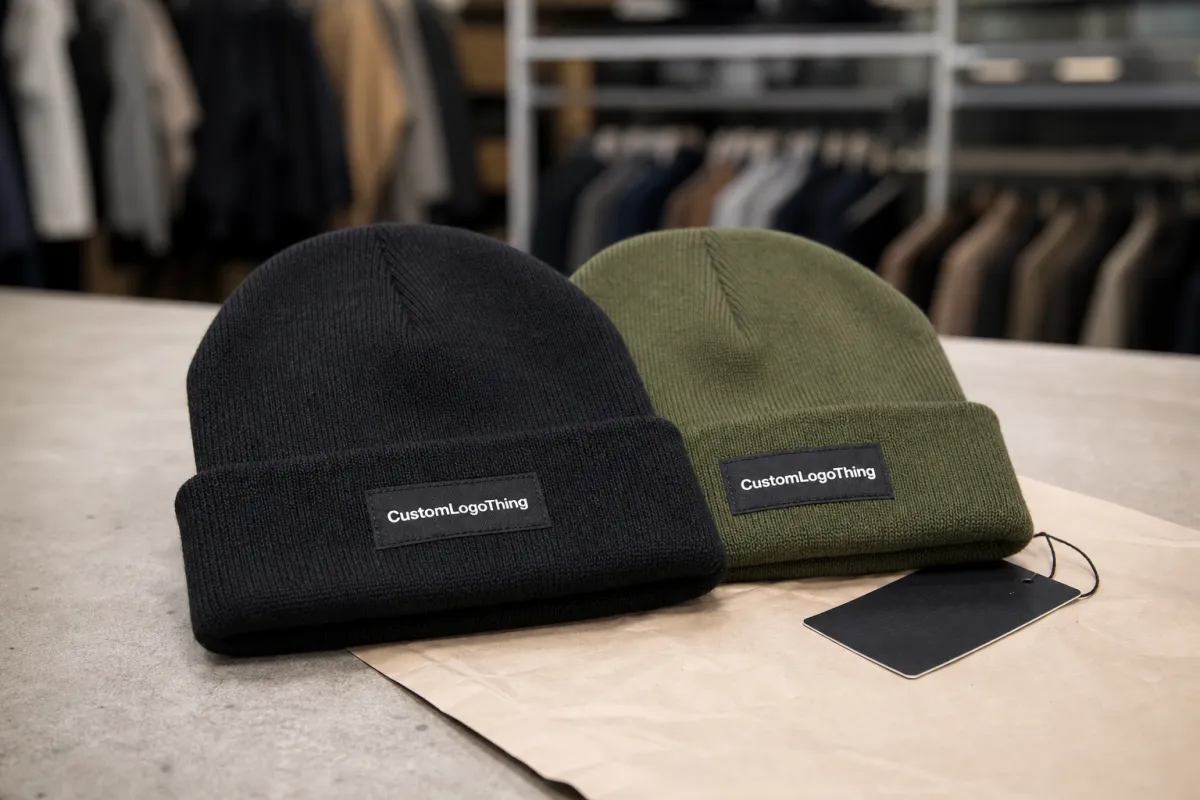
Woven labels are practical when the logo has small type, narrow lines, or tight borders. The weave usually keeps the mark more legible than a print on textured knit, especially after repeated handling. That makes woven labels a good fit for wholesale programs where consistency matters more than novelty.
Compared with embroidery, woven labels are often lighter and cleaner on softer beanies. Embroidery adds texture, but it can feel bulky on thin knits or overwhelm a small front panel. Compared with print, woven labels are more stable for products that will be folded, cartoned, and redistributed many times.
Show the spec, not just the mockup. Digital proofs do not reveal thread density, edge finish, or how knit fabric changes the final look.
They also work well for repeat orders. Once the label file, stitch path, and placement are approved, future runs can be reproduced with less variation. That is one reason woven labels are common in retail, corporate gifting, and uniform programs.
If your business already orders Custom Labels & Tags, the logic is similar: the artwork is front-loaded, then the run becomes a matter of executing the same spec reliably. Woven labels also help the beanie feel finished rather than promotional, which matters if the product needs shelf appeal.
Durability is part of the decision too. A label that survives sewing but frays in transit is not a strong spec. Testing and handling standards matter as much as the mockup, which is why organizations like ISTA exist around shipment performance.
Beanie styles, materials, and placement options buyers should compare
Fabric choice is the first cost and quality decision. Acrylic is the most common wholesale option because it is predictable, easy to source, and usually the lowest entry price. Recycled polyester costs more but supports sustainability-led programs. Wool blends sit higher in the price range and usually feel more premium.
Fit changes how much decoration space you have. Cuffed beanies usually give the best front branding area and are the safest choice when the logo needs to be seen quickly. Slouch beanies are looser and often look better with a smaller side or seam label. Low-profile and fisherman styles favor restrained branding rather than oversized placement.
Placement is not just cosmetic. Front cuff placement is the easiest to read and usually works best for recognizable logos. Side seam placement feels quieter and can suit fashion-led or retail programs. Back seam placement can work, but only if the label remains readable at small scale. Interior placement keeps the outer face clean, though it is less visible on shelf.
- Acrylic: lowest cost, stable color, common for large wholesale runs.
- Recycled polyester: moderate cost, stronger sustainability story.
- Wool blend: warmer hand feel, higher price floor, more premium signal.
- Cuffed fit: best visibility for front labels and retail presentation.
- Slouch or low-profile: better for subtle branding and fashion-led programs.
For a custom woven label Beanies Bulk Order, placement should match the channel. Giveaway orders usually need quick recognition. Retail orders often benefit from restraint. Team orders can carry bolder branding without hurting the product. If the beanie is part of a larger branded package, align the label position with the carton, hang tag, and insert so the whole kit feels planned.
Ask about packaging at the same time you discuss the hat itself. Polybags, carton counts, size stickers, and hang tags all affect labor and receiving. A small packing change can add more work than the label.
Artwork and decoration specs to confirm before approval
The quote is only as useful as the spec behind it. Before approval, confirm the label width and height, stitch density, edge finish, backing type, and exact placement on the beanie. If the label is too small, fine type can disappear. If the weave is too loose, the logo can look soft. If the placement is vague, the final run may shift from unit to unit.
Pantone references help, but woven labels translate color through thread rather than ink. The goal is not perfect numeric matching; it is clean visual contrast under normal lighting. A thread color that reads clearly is usually better than a technically exact match that blends into the knit.
Safe zones matter. Tiny symbols and narrow text should sit at least 1.5 to 2 mm inside the edge so they do not get lost at the border. If the logo depends on very fine detail, ask for the minimum readable text size before approving the file. That one question can prevent a muddy production run.
Double-sided labels cost more than one-sided labels and are easy to overlook if the quote is not line-itemed. One-sided branding is usually the cleaner and cheaper choice. If the second side is only carrying size or origin information, an inside tab or hang tag may be the better place for it.
Packaging should be confirmed at the same time as decoration. Ask whether the order includes polybags, retail stickers, carton labeling by color, or hang tags. If the supplier handles recycled cartons or paper inserts, check whether they can document the material chain. That matters when the overall presentation is part of the buyer’s standards.
One common mistake is forcing care text, country-of-origin copy, and the decorative mark onto one tiny woven face. That usually creates clutter. Decorative labels should stay decorative. Technical information belongs on an inside tab, back neck label, or separate hang tag.
Pricing, MOQ, and unit cost drivers for a custom woven label beanies bulk order
Price usually moves in bands rather than one fixed number. For a typical bulk order, an acrylic beanie with a simple woven label may land around $2.40-$4.50 per unit at higher quantities. Recycled polyester often runs about $3.60-$5.90, depending on decoration and packing. Wool blends with more detailed branding or retail packing can run roughly $4.75-$7.50. These are working ranges, not guarantees.
The MOQ matters as much as the unit cost. Some suppliers quote by total order, others by colorway, and some by size split. A 500-piece order in one color is not the same as 500 pieces across three colors. The same is true if the label artwork changes between colors or if the packing must be separated by SKU.
The most common cost drivers are not dramatic. Extra label colors, premium yarns, retail packing, mixed-SKU carton plans, and rush timing all add cost. The lowest quote usually assumes the simplest version of the order: one body color, one label layout, standard packing, no extra sorting. That can be a useful baseline only if the buyer knows it is a baseline.
| Option | Typical MOQ | Indicative Unit Cost | Best For |
|---|---|---|---|
| Acrylic beanie, single woven label | 100-300 pcs | $2.40-$4.50 | Promos, team issue, fast replenishment |
| Recycled polyester, front cuff label | 300-500 pcs | $3.60-$5.90 | Sustainability-led branded packaging programs |
| Wool blend, detailed label, retail packing | 500-1,000 pcs | $4.75-$7.50 | Retail, resale, premium package branding |
| Mixed colors or mixed sizes | Depends on split | Often +8% to +18% | Broad campaigns with inventory flexibility |
Ask for a line-item quote so you can compare the base beanie, label cost, packing cost, and freight separately. That avoids comparing a fully loaded quote against one that quietly excludes packaging or shipping assumptions. It also makes reorders easier if you later want to upgrade cartons or inserts.
For a custom Woven Label Beanies bulk order, the quote only works if it also states the MOQ, lead time, and packing assumption. If those are vague, the price is not enough to buy on.
Production workflow and lead time from proof to shipment
The cleanest workflow starts with artwork review, quantity confirmation, and placement approval. If the file needs redrawing, the color split is unsettled, or the label position is not fixed, the order can stall before production begins.
After that comes proofing. A digital proof is useful for layout, but it will not fully show weave density or how thread color will read on the finished knit. A pre-production sample is worth it when the logo is detailed, the text is small, or the order is meant for retail. It adds cost but reduces the chance of a weak full run.
The production path is usually straightforward: material allocation, label weaving, stitching, inspection, and packing. For simple orders with stock fabric, standard runs may fit inside 12-18 business days after proof approval. More complex jobs with mixed colors, custom packaging, or tighter color matching can stretch to 20 business days or more. Rush work is possible, but it usually narrows flexibility and raises cost.
Manual handling adds time. Carton packing by size, polybag inserts, barcode stickers, and mixed-color bundling all require more sorting. That extra work can be useful for retail or fulfillment-center deliveries, but it is unnecessary for some event programs. The decision should match the channel.
Approval lag is the quietest schedule killer. A supplier can only move as fast as the slowest response on a proof question. If the buyer takes four days to answer, the calendar usually still slides four days.
If the beanie is part of a broader wholesale package, it should be planned alongside the rest of the system. Suppliers that already handle Wholesale Programs generally give more realistic timing because they understand how production and shipping interact.
Quality control, reorders, and supplier comparison criteria
Quality control on Woven Label Beanies is simple, but it should be consistent. The main checks are stitch tension, label alignment, seam placement, color accuracy, and pack count. A label that sits a few millimeters off center may still be usable, but it can make the whole order look less finished.
Reorders go smoother when the first run is documented. Keep the approved artwork, weave reference, placement measurements, thread colors, and packing method on file. If the next order comes six months later, those records reduce guesswork and help prevent a costly mismatch.
Supplier comparison should go beyond price. Ask how they handle last-minute spec changes, whether sample support is available, how clearly they state MOQ and Lead Time, and whether decoration and packaging are separated in the quote. A low quote that hides the real constraints is not a bargain.
Good vendors usually ask more questions, not fewer. What is the label size? Is the logo centered or offset? Does the order ship retail-ready or bulk packed? Those questions are a sign that they know where errors happen.
Vague quotes rarely stay cheap. If the supplier cannot explain the fabric, decoration method, packing method, and freight assumption, something is missing.
For brands running a broader packaging system, consistency matters as much as the beanie itself. A label that matches cartons and inserts gives the product more authority on arrival. That is one of the main reasons some wholesale orders look better than others even when the components are ordinary.
Next steps for a quote-ready beanie order
Before requesting pricing, gather the logo file, target quantity, color breakdown, size split, label placement, and ship-to address. Decide what is fixed and what can flex. That saves time on both sides and helps the supplier tell you whether the order belongs in a standard lane or a more customized one.
Then decide what else belongs in the order: samples, carton labels, retail polybags, size stickers, or mixed-color packing. Those details matter more if the beanies are going into retail or e-commerce fulfillment. If the order is part of a broader packaging update, align it with Custom Packaging Products so the presentation stays coherent from carton to shelf.
Review the mockup for legibility and placement first, then approve only after the size, weave, and packing details are confirmed in writing. That is the simplest way to keep a custom Woven Label Beanies bulk order from becoming a spec dispute later. Compare vendors line by line on MOQ, lead time, artwork requirements, and packing assumptions rather than relying on one sales promise.
The best orders usually come from the most specific briefs. Specificity limits the number of decisions that can drift during production, which is how buyers control cost in this category.
What is the usual MOQ for custom woven label beanies bulk order requests?
MOQ depends on the beanie style, label size, and whether the order is one color or split across multiple colorways. Some suppliers set MOQ by total run, while others require a minimum per color or per size. Ask for the MOQ in writing before comparing vendors.
How does woven label decoration affect beanie unit cost?
Unit cost rises with more label colors, larger label size, custom packing, and lower order volume. Placement can also matter if it needs extra sewing or handling. A useful quote separates the beanie from the decoration so the real cost driver is visible.
How long does a custom woven label beanie order usually take?
Most timelines include artwork review, proof approval, production, inspection, and shipping. Simple runs move faster when materials are in stock and the label spec is already approved. Rush orders may be possible, but they usually raise cost and reduce flexibility.
Can I mix colors or sizes in one woven label beanie bulk order?
Yes, but mixed runs can change pricing, packing, and the minimum quantity required per color or size. Confirm the split before quoting so inventory and production are scheduled correctly. If the mix is complex, ask whether the supplier can carton-pack by color or by size.
What information do you need to quote custom woven label beanies accurately?
Provide the logo file, preferred label size, placement, quantity, color breakdown, and delivery location. Pantone colors and packing details reduce guesswork on the final quote. If you want a tighter estimate, include your target date and whether you need samples first.

