Wholesale Pom Pom Beanies: Materials, Sizing, Pricing, and Lead Times
If you are buying for resale, team merch, or a private-label winter program, the Pom Pom Beanies material and sizing guide matters more than the cute mockup. A beanie can look great in a render and still fail in the hand if the yarn pills, the crown collapses, or the fit only works on one head shape. That is how returns happen. Quietly, then all at once.
From a buyer’s point of view, the two specs that decide whether the style sells are Material and Sizing. Material controls warmth, softness, weight, and unit cost. Sizing controls comfort, approval speed, and how many people can actually wear the thing without tugging at it for ten minutes. If you get those two parts right, the rest of the order gets easier. If you get them wrong, the supplier will still happily take your money.
A beanie that looks expensive in a product photo can still feel cheap on a head. Buyers usually find that out after sampling, which is an irritatingly expensive lesson.
This guide breaks down the pom pom Beanies Material and Sizing guide in practical buying terms: what fabrics do, how pom styles change the feel, what measurements matter, where quotes move, and what to confirm before you place a wholesale order.
Pom Pom Beanies Material and Sizing Guide: Why the Specs Decide the Sale
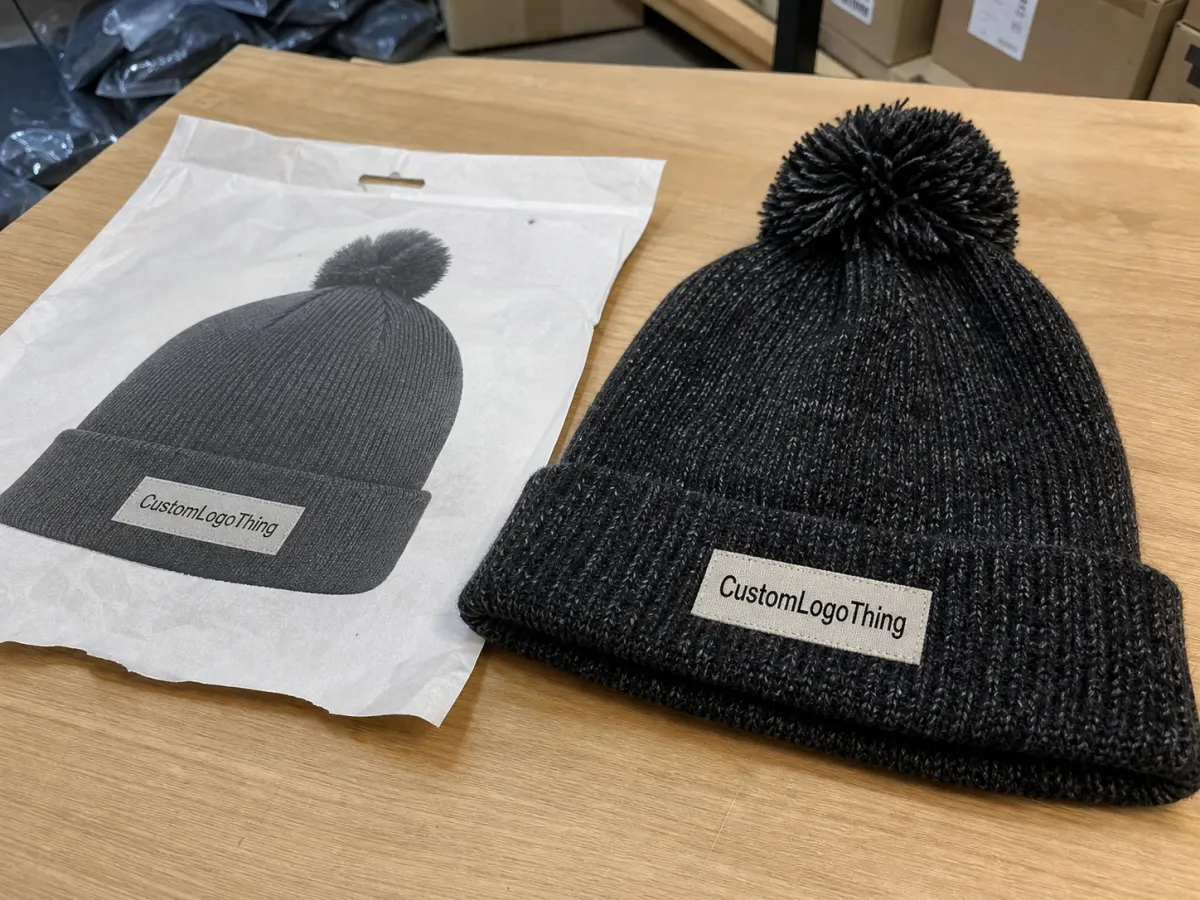
A pom pom beanie is a simple product on paper: knit body, folded cuff or no cuff, sewn-on pom, and maybe a lining. In production, it gets less simple fast. Yarn choice changes the stretch. Stitch density changes the drape. Crown shaping changes whether the top stands up, slouches, or collapses into a sad little cone. That is why the Pom Pom Beanies material and sizing guide is not a decorative document. It is a buying tool.
Most wholesale buyers care about four things: warmth, comfort, shelf appeal, and margin. Those are connected. A thicker wool blend may feel warmer, but it can also raise cost and make embroidery harder. A soft acrylic body can improve color consistency and price stability, but the wrong gauge can make it stretch out after repeated wear. A lined beanie sounds premium until it gets too tight on the head. Packaging the style in kraft paper sleeves or corrugated cardboard mailers does not fix any of that, of course, but it does affect presentation and freight efficiency.
The cleanest way to brief a supplier is to treat the beanie as a spec stack, not a mood board. Start with the body yarn, then the pom construction, then the fit profile, then labeling and packaging. If you are buying for retail, ask for a sample that shows the actual fabric hand, the seam finish, and the way the cuff recovers after being stretched. If the supplier cannot explain those points clearly, the order is probably going to be a conversation later anyway.
One more practical point: buyers often focus on decoration first. That is backwards. A logo can only carry a product so far. If the knit feels scratchy or the fit is weird, the logo becomes expensive embroidery on something people do not wear. Not a great use of budget.
Material Options That Change Warmth, Drape, and Durability
For most wholesale programs, the body fabric comes down to acrylic, wool, or a blend. Acrylic is the easiest starting point. It is usually softer to the touch than buyers expect, takes color well, and stays in a workable price band. It also gives the manufacturer more flexibility on shade matching, which helps if you need multiple colorways or seasonal updates. The tradeoff is durability perception. Low-grade acrylic can pill, so ask what yarn count and anti-pilling treatment the supplier uses.
Wool brings natural warmth and a more premium hand feel. It also behaves like wool, which means you need to think about shrink risk, itch factor, and care expectations. From a buyer’s perspective, wool makes sense when the product sits at a higher retail price or when the user expects genuine cold-weather performance. For promos or price-sensitive retail, pure wool often pushes the quote higher than the market will tolerate.
Blends are where most practical programs land. An acrylic-wool blend can give you better warmth and hand feel than straight acrylic without jumping straight into premium pricing. Add a bit of polyester and the fabric may improve recovery and reduce sagging, though I would still check the actual knit sample before believing the lab description. Suppliers love a technical sheet. The head, unfortunately, is a more honest reviewer.
Lining changes the game again. A fleece or brushed lining can improve comfort, block wind, and make a lighter knit body feel warmer. It can also make the beanie tighter, heavier, and less flexible. That matters if your target customer has a larger head size or if the style relies on a snug, close-to-head fit. Lined beanies usually work best when the outer knit already has enough stretch and the pattern is adjusted for the added thickness.
Pom construction matters too
Yarn poms are the common, budget-friendly option. They are lightweight, easy to color match, and less likely to overwhelm the crown. Faux fur poms look more dramatic and often photograph better, which is why they show up in fashion-forward lines. They also add cost and assembly time. If the fur is dense, the pom can feel heavy, wobble awkwardly, or lose shape if the attachment point is weak. For brands selling on style, faux fur can be worth it. For utility programs, yarn poms are usually the cleaner choice.
Durability questions are worth asking early. How does the yarn handle pilling after wear? Does the color bleed when wet? Does the knit relax after being stretched a few times? Is the pom sewn through a reinforced patch or just tacked on with a few lazy stitches? If the supplier uses recycled materials, ask whether the yarn has been tested for consistency across batches. Buyers often assume eco-friendly means predictable. It does not. It just means you need a sharper spec sheet.
| Material / Trim | Feel and Performance | Typical Wholesale Impact | Best Fit |
|---|---|---|---|
| Acrylic body | Soft, stretchy, easy to color match, moderate warmth | Lowest base cost; usually the easiest to quote | Promos, retail basics, broad unisex programs |
| Acrylic-wool blend | Warmer hand feel, better drape, slightly more premium | Often adds about $0.20-$0.60 per unit at mid-volume | Mid-tier retail and winter collections |
| Wool body | Warm, natural, premium, but can itch or shrink if poorly handled | Commonly adds $0.60-$1.50+ per unit depending on yarn quality | Higher retail price points, colder climates |
| Fleece lining | Warmer, softer against skin, but reduces stretch | Usually adds $0.35-$0.90 per unit | Cold-weather use, comfort-first buyers |
| Yarn pom | Lightweight, balanced, easy to produce | Lowest trim cost | Volume orders, practical retail programs |
| Faux fur pom | High visual impact, softer look, more premium feel | Often adds $0.25-$0.80+ per unit | Fashion retail, gift sets, premium branding |
If packaging is part of the order, keep the materials aligned. Biodegradable packaging sounds nice, but it should still hold shape in transit. FSC-certified kraft wraps are a safe middle ground for retail presentation, and paper-based inserts can work well when the product is folded to a fixed width. For freight and drop resistance, a supplier that understands transit testing matters more than a glossy sales deck. ISTA is a useful reference if you want to think like a buyer who does not enjoy crushed cartons.
Sizing by Head Circumference, Stretch, and Fit Profile
Sizing is where vague language causes very real losses. “One size fits most” is not a spec. It is a shrug. Start with target head circumference, then match the garment to that number. Adult heads commonly fall somewhere around 21.5 to 24.5 inches, but that range is too wide to treat as one flat bucket. If you are ordering for a mixed audience, ask the supplier how the beanie behaves at the low end, middle, and high end of the target range.
The measurements that matter most are laid-flat width, body height, cuff depth, stretch range, and recovery. A beanie with a 9-inch laid-flat width may fit very differently from another 9-inch sample if the knit density is tighter or the yarn has less elastic memory. Recovery matters because a beanie that stretches easily but never snaps back will bag out after a few wears. That looks sloppy on a shelf and worse on a customer.
There are four common fit profiles. Snug sits close to the head and usually works better for colder weather or minimal styling. Standard is the safest wholesale fit because it gives room without looking oversized. Slouch adds height and drape, which can help fashion appeal but makes sizing less forgiving. Cuffed styles give more control over body height and logo placement, but they also change the way the beanie stretches when worn.
Use a physical sample to check how the fit behaves, not just how it measures. Pull it on, leave it on for a few minutes, then remove it and check for memory. If the cuff stays distorted, the knit is too loose or the yarn is too soft for the pattern. If it feels tight after a short wear, the crown depth may be short or the lining is stealing stretch. These are small things on paper and big things in practice.
Special sizing cases deserve extra attention
Kids’ sizes need more than a reduced circumference. The crown shape, cuff depth, and pom scale should all be adjusted together, or the product looks proportionally off. Oversized fashion beanies are another trap. Buyers often ask for more height because the silhouette looks better in photos, but too much height can make the crown flop around or distort the logo zone. For unisex programs, test on narrower and wider head sizes before signing off on bulk production.
If you want fewer surprises, ask for the spec in both inches and centimeters, plus a lay-flat measurement photo. That sounds basic because it is. Still, half the sizing problems I see come from one party thinking in centimeters and another in inches. The machine does not care. The customer definitely does.
For retail programs that ship in folded form, think about how the knit recovers after compression. A tighter gauge may look better in a box, especially if you are using corrugated cardboard shippers with kraft paper sleeves, but a weak recovery knit can keep the fold line forever. That is not a premium look.
If the product has a sustainability angle, confirm whether the supplier can support FSC certified paper packaging or a higher share of post-consumer waste content. Those choices do not solve sizing, but they do keep the order aligned with the rest of the brand story. And if the supplier cannot keep the size consistent, the eco story will not save it.
Cost Drivers That Move the Quote Up or Down
Beanie pricing is usually a stack of separate decisions, not one magic number. The main inputs are yarn choice, knit complexity, pom type, lining, embroidery, labeling, and packaging. If you want a cleaner comparison between suppliers, ask them to break the quote into body cost, decoration cost, assembly cost, and freight-ready packaging. Otherwise you will compare three offers that look different for reasons nobody bothered to explain.
MOQ affects unit cost heavily. At 300 to 500 pieces, custom knit programs often carry a noticeable setup premium. By the time you get to 1,000 to 3,000 pieces, unit cost usually settles into a more useful range. At 5,000 pieces and up, the quote can become competitive, especially if you keep colorways limited and use standard yarns. Add multiple shades, mixed sizes, or custom woven labels, and the price climbs again. Simple math. Annoying, but simple.
Decoration matters more than some buyers expect. Flat embroidery is usually cheaper than a large jacquard knit change, but it may not deliver the same look on a thick rib. Woven labels, custom hangtags, and branded inner labels each add small costs that stack quickly across a big order. Stronger pom attachment methods, extra reinforcement stitches, and custom trims also move the number. You are not just buying a beanie. You are buying labor in several small pieces.
Packaging can add cost too, especially if you want retail-ready presentation. A plain polybag is cheap. An FSC-certified kraft sleeve, printed insert card, or branded folding carton costs more, and the box style matters. Clear-view cartons, recyclable wraps, and low-ink graphics can keep the order aligned with budget and sustainability goals. If you want a premium unboxing feel, just admit it and budget for it. Nothing weird about that. Pretending it is free is where projects get messy.
If you are comparing quotes, use this quick framework:
- Body cost - yarn, knit gauge, size, and stitch complexity.
- Trim cost - pom type, labels, embroidery, patch work, and reinforcement.
- Assembly cost - lining, hand-finishing, folding, and packaging.
- Logistics cost - freight, carton count, and customs paperwork.
That breakdown keeps the conversation honest. It also makes it easier to spot the quote that is missing something. If one supplier is dramatically cheaper, ask what they left out. Usually it is either better yarn, better finishing, or better packaging. Sometimes all three. Suppliers are not charity organizations.
For packaging sourcing, I like seeing simple paper-based choices that hold up in transit: kraft paper wraps, recycled materials, and corrugated cardboard shippers with enough burst strength for the lane. If your team wants to go further, check whether the packaging can be sourced through an FSC chain-of-custody path. That is cleaner than vague green claims and much easier to defend internally.
Sampling, Lead Time, and Production Workflow
The normal workflow is straightforward: spec sheet, quote, sample, approval, production, shipment. The trouble starts when the buyer treats the sample as a casual preview instead of a decision point. Sampling is where you catch fit errors, color drift, pom size problems, and label mistakes. If you skip that check, the bulk order becomes the sample. That is an expensive way to learn.
Typical timing depends on complexity and season, but a practical planning range looks like this: sample development often takes 7 to 14 business days after the spec is clear; production commonly takes 15 to 30 business days after approval; freight adds its own timeline on top, and customs can add more. If you need a launch date, plan from final approval to arrival, not from the moment the quote lands in your inbox.
Delays usually come from the same few places. Unclear sizing causes back-and-forth. Color matching takes longer if you want a very specific shade or a high contrast pom. Lined styles need extra fit checks. Custom packaging introduces another approval step. And yes, last-minute changes after sampling starts will push everything back. That is not a factory problem. That is a planning problem wearing a factory hat.
If you want a stronger workflow, ask for the sample to confirm four things before bulk approval:
- Measured width, height, and cuff depth.
- Stretch and recovery after wear.
- Pom shape, size, and attachment strength.
- Decoration placement and label accuracy.
Some buyers also ask for transit testing when the order ships in display-ready packaging. That is smart. Beanies are soft, but boxed goods still get crushed, dropped, and compressed. Good packaging is not glamorous. It just prevents a pile of disappointments from arriving at the dock. If your program uses printed cartons or retail shippers, ask whether the supplier has tested the pack-out against common distribution abuse rather than assuming the first box design will survive by charm alone.
One practical note: if you are ordering for a brand with stricter compliance expectations, keep documentation clean. Ask for material declarations, package specs, and if relevant, a clear statement on recycled content. That is not overkill. It is how you avoid spending two weeks chasing a missing label photo.
Common Buying Mistakes That Cause Returns or Margin Loss
The biggest mistake is approving a sample without checking stretch recovery. A beanie that bags out after one wear will not hold retail value, even if the yarn looks premium in the photo. Buyers tend to focus on first impression because it is easy. Customers focus on comfort and whether the thing keeps its shape. Those are not the same test.
Another common error is choosing a pom that looks good on a screen but behaves badly in use. Oversized faux fur poms can photograph beautifully and still feel awkward, shed, or throw off the balance of the beanie. On smaller crowns, the pom can overwhelm the top and make the whole style look clumsy. A yarn pom is often safer if your customer wants a cleaner, more wearable profile.
Measurement system confusion is a classic. Someone sends inches, someone quotes centimeters, and the finished fit lands somewhere in the middle of nowhere. Shrink allowance gets ignored too often, especially on wool or lined styles. If a supplier does not build in a little movement for the material, you can end up with a product that passes inspection on the table and fails on a head.
Pricing mistakes are usually self-inflicted. Buyers compare quotes without confirming fabric weight, trim method, lining, or what the supplier actually includes. One offer may include a reinforced pom stitch, a custom woven label, and a fold-ready package. Another may not. The cheaper one is not always cheaper. It is just less complete.
Keep the review practical: ask what changes cost money, what changes only need approval, and what changes force a new sample. That one conversation can save a lot of margin later. Not all surprises are pleasant. Some are invoice-shaped.
This is also where sustainability claims need a reality check. Recycled yarn can be a good fit, but only if the final hand feel, durability, and color matching meet the program. Same for biodegradable packaging. Nice idea. Still has to fold, protect, and ship without turning into confetti. If the packaging is decorative but the beanie itself is off-spec, the order is still off-spec.
What to Confirm Before You Request a Wholesale Quote
If you want a cleaner quote, send a real spec package. Not a casual “can you make this?” message. Start with the target head sizes, then choose the body material, pom type, fit profile, and packaging level. Add quantity, color targets, logo method, and delivery date. The more clearly you describe the order, the fewer assumptions the supplier has to make. Assumptions are where hidden costs hide.
Here is the shortlist I would ask for before locking production:
- One size spec sheet with laid-flat width, height, cuff depth, and stretch range.
- A material swatch or knit sample of the actual yarn.
- Pom options with size, density, and attachment method.
- One physical sample before bulk approval.
- Packaging spec, including kraft paper, cartons, or other retail-ready components.
If the order needs a branding story, confirm whether the packaging can use FSC-certified paper, post-consumer waste content, or a reduced-ink print approach. Those details help if your retailer asks questions later. If the shipment is going direct to a warehouse, also confirm carton count, pack ratios, and whether the beanies arrive folded flat or lightly shaped.
The smartest buyers treat the pom pom beanies material and sizing guide as part of procurement, not marketing. That means choosing specs based on the customer, the climate, the target price, and the fit you actually want to sell. Fancy photos are nice. Proper measurements are better. And yes, the pom pom beanies material and sizing guide should be written before the quote request, not after the sample goes wrong.
Bottom line: if you lock material, sizing, pom style, and packaging early, your order is easier to quote, faster to approve, and less likely to come back with complaints attached. That is the whole point of a pom pom beanies material and sizing guide that works in the real world.
What material is best for pom pom beanies if softness is the priority?
Acrylic is usually the easiest budget-friendly choice for softness, stretch, and color matching. An acrylic-wool blend often feels better in hand and looks a little more premium without jumping too far in cost. If the beanie is meant for colder use, a light lining can improve comfort more than simply making the yarn heavier.
How do I choose the right adult sizing for pom pom beanies?
Start with target head circumference in inches or centimeters instead of vague size labels. Ask for laid-flat width, stretch range, and recovery so you can judge whether the fit stays consistent after wear. If the style is unisex, check the sample on both narrower and wider head sizes before approving production.
Do faux fur poms increase the unit price a lot?
Usually yes. Faux fur costs more than a standard yarn pom, and the assembly can take more time as well. The gap grows if you want exact color matching, a larger pom diameter, or stronger attachment stitching. If budget matters, yarn poms are often the simplest way to keep the style without pushing the quote too high.
What is a normal turnaround time for custom pom pom beanies?
Sampling often takes about 7 to 14 business days, depending on how many changes are requested. Production commonly takes 15 to 30 business days after sample approval, though complex trims or peak season demand can extend that. Shipping time is separate, so buyers should plan the full schedule from approval to delivery.
What should I include in a quote request for wholesale pom pom beanies?
Send quantity, size range, material preference, pom type, logo method, and packaging requirements. Add a reference photo or spec sketch so the supplier is not guessing at the silhouette or finish. State your target delivery date and budget range up front, because those details affect material and production options quickly.


