The quickest way to turn a promising beanie order into an expensive disappointment is to choose the logo treatment first and leave the fabric, fit, and head depth for later. A knit hat can look polished in a mockup and still arrive stiff, itchy, shallow, or too loose to stay put once real people put it on.
That is why the Knit Hats With Logo material and sizing guide conversation needs to happen before artwork approval, not after. Yarn, stitch density, crown depth, logo method, and packaging all shape the final result. A winter promo drop may call for a softer hand and a simple mark. Employee uniforms usually need consistent sizing, a cleaner wear pattern, and enough durability to survive regular use.
There is no single best beanie spec. A run for a retail brand, a warehouse crew, and a holiday giveaway can all start with the same basic cap and end up with very different materials, fit depths, and decoration choices. The product only works if the details match the job.
Knit hats with logo material and sizing guide for buyers
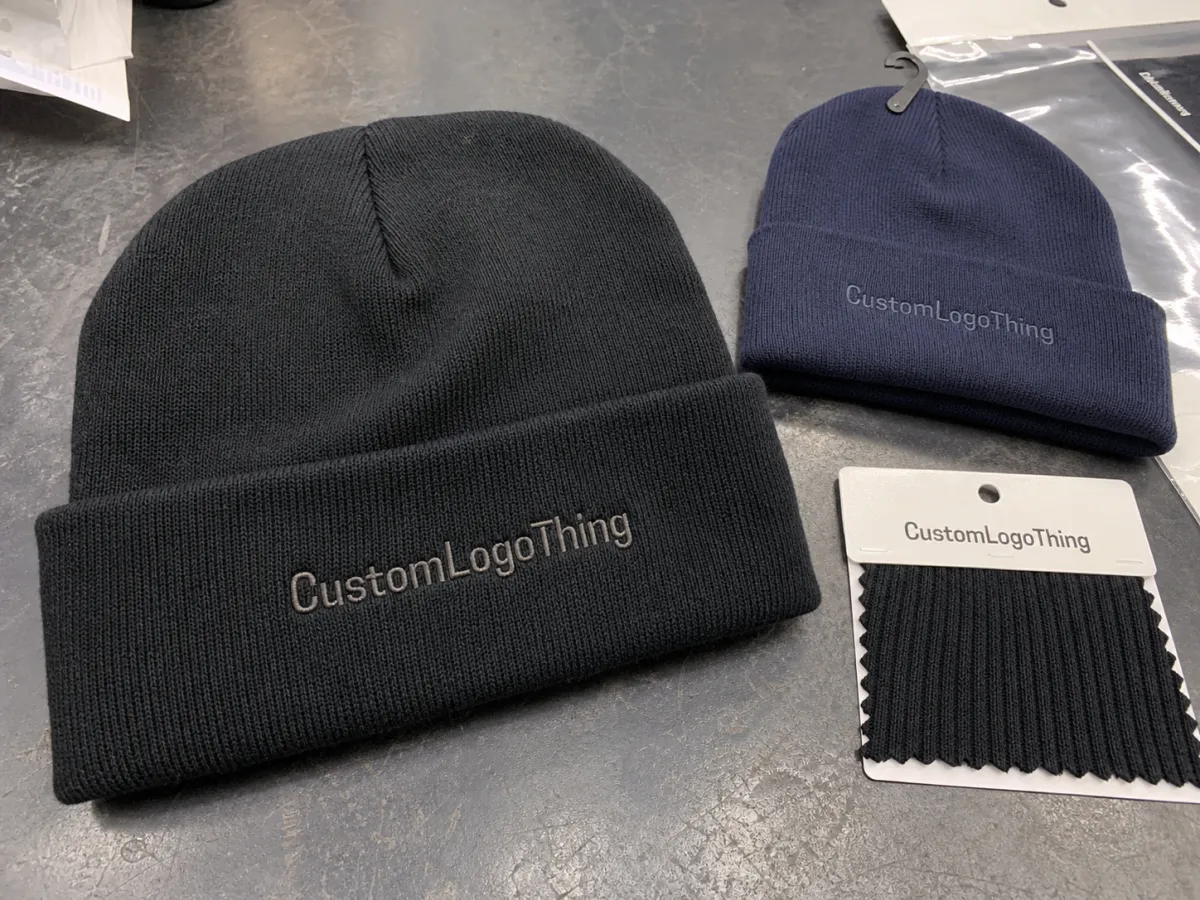
Most bad beanie orders fail for ordinary reasons. The logo file is fine. The real problem is a mismatch between the decoration method and the knit structure, or a fit that looked acceptable on a flat spec sheet but does not sit properly on a head. Thick ribbing can swallow small lettering. A loose gauge can stretch a logo into something tired before the box is even opened.
When you order custom knit hats, you are really choosing five things at once:
- Yarn type for warmth, softness, and color range.
- Stitch density for clarity, stretch, and hand feel.
- Fit shape for shallow, standard, slouch, or cuffed wear.
- Decoration method for look, cost, and detail level.
- Size range for adult, youth, or mixed-audience use.
Here is the practical test. A coffee brand ordering 800 beanies for a holiday launch probably wants a soft feel, a clean logo, and a shape that does not flatten hair into a mess. A warehouse team ordering uniforms may need a deeper crown, simpler artwork, and a knit that keeps its shape after repeated wear and washing. Same category, different priorities.
Most beanie failures are quiet ones. Wrong yarn, wrong depth, wrong decoration. The logo gets blamed because it is visible, but the fabric choices caused the problem.
That is the real value of a knit hats with logo Material and Sizing guide approach. It prevents the common mistake of treating beanies like blank promo items instead of constructed garments. Once the hat is on a head, the differences become obvious fast.
Logo application process and production steps
There are several common ways to place a logo on a knit hat, and each behaves differently on ribbed fabric. Choose based on how the hat will be worn, not just how it looks in a digital proof.
Knit-in jacquard logos are built directly into the fabric during production. They are usually the cleanest choice for bold shapes, simple lettering, and two to four colors. Because the design becomes part of the knit, the finish feels integrated and durable. The tradeoff is detail. Tiny text, thin outlines, and gradients disappear quickly.
Embroidered patches work well if you want a raised, premium look. They suit badges, heritage branding, and small logos that need more definition than direct stitching can provide. Woven labels are slimmer and quieter visually, which makes them useful for side placements and understated branding. Leather patches lean rugged or outdoors. Direct embroidery is familiar and cost-effective, but it can pucker on stretchy knits if the stabilizer, stitch density, and placement are not handled carefully.
| Method | Best for | Typical per-unit impact | Main tradeoff |
|---|---|---|---|
| Knit-in jacquard | Bold logos, simple art, repeat orders | Low to moderate | Fine detail is limited |
| Embroidered patch | Premium feel, small logos, textured branding | Moderate | Adds an extra production step |
| Woven label | Minimal branding, clean side placement | Low | Not ideal for large front logos |
| Leather patch | Outdoors, workwear, heritage styling | Moderate to higher | Less flexible on very soft knit styles |
| Direct embroidery | Simple marks on stable knits | Low to moderate | Can distort on loose gauges |
The production sequence usually follows a predictable path: artwork review, stitch or knit conversion, proof approval, sample or strike-off, bulk knitting, trimming, finishing, final inspection, and packing. The slowest step is often the conversion stage, especially when a logo has too many colors, thin lines, gradients, or tiny type. A flat file is not production-ready just because it opens on a screen.
Clean vector art saves time. So does deciding early whether you want a flat, woven-looking logo or a more textured patch. If brand colors matter, send Pantone references or a close-match target that everyone can understand. “Close enough” can mean three different things to three different people, and none of them are useful in approval rounds.
Material choices that change warmth, stretch, and decoration
The material section of the knit hats with logo Material and Sizing guide is where good buyers save money in the right place and avoid cheaping out where it hurts. Acrylic is the standard budget-friendly option. It holds color well, gives a broad shade range, and keeps unit cost manageable on larger runs. For many promo programs, that is exactly the right balance.
Wool blends feel warmer and more premium, especially in colder markets. They usually cost more, and some buyers need to provide care guidance so the hats do not end up treated like throwaway merch. Cotton blends breathe better and feel less scratchy, which helps in milder climates or for indoor-outdoor wear. Recycled yarns can support a sustainability message, but they are not a shortcut. A recycled yarn still needs the right gauge, finishing, and color control to look professional.
Gauge matters more than many first-time buyers expect. A looser knit feels relaxed and soft, but it may distort small logos and pill faster. A tighter knit usually gives better structure, clearer branding, and stronger stretch recovery, though it can feel a little less airy. For outdoor work, a denser knit is often safer. For commuting, events, or casual retail styles, comfort may matter more than maximum insulation.
Material choice is also tied to decoration. A firm rib knit handles embroidery more cleanly than an overly soft, open knit. Jacquard patterns hold up best when the yarn is consistent and the stitch count is stable. If the hat is supposed to look premium, the fabric should support that decision instead of fighting it.
Here is the short version:
- Acrylic for broad color matching, lower cost, and easy scale.
- Wool blend for warmth and a more premium hand feel.
- Cotton blend for softer, less itchy everyday wear.
- Recycled materials for sustainability positioning, if the sourcing is documented.
Also think about pilling, moisture behavior, and colorfastness. A bargain yarn that fuzzes after a few wears is not a bargain. It is just delayed disappointment. If the beanies will ship in retail packs or subscription boxes, ask how they will be packed: corrugated cardboard cartons with kraft dividers are practical, while FSC certified paperboard inserts can support greener claims more credibly than loose language on a spec sheet. If your brand needs post-consumer waste content or biodegradable packaging, bring that up early so the sample does not arrive in a standard mailer that misses the point.
For packaging claims, ask for documentation rather than adjectives. FSC certification is a real sourcing standard, and shipping performance can be checked against recognized carton tests. If you want to verify transit protection for retail or e-commerce programs, review ISTA packaging test guidance. For paper sourcing, FSC certification is the reference to check.
Sizing guide for adults, youth, and cuffed fits
Fit is where many orders go wrong because buyers treat beanies like one-size accessories with no real dimensions. The better starting point is head circumference, not a generic small, medium, or large label. Measure around the head where the hat will sit, usually just above the ears and across the fullest part of the forehead.
For most adults, a practical stretch range often falls around 20 to 24 inches in circumference, though the final feel depends on knit density and yarn elasticity. Youth sizes are usually lower, commonly around 18 to 21 inches, with a shallower crown depth. Those are workable starting ranges, not magic numbers. The way the hat stretches and recovers matters as much as the measurement itself.
Fit style changes the result as much as circumference:
- Cuffed beanies sit more securely and give extra logo space on the fold.
- Shallow fashion fits look cleaner but can ride up on larger heads.
- Slouch styles add length and a looser silhouette.
- Youth fits need less crown depth and more careful stretch control.
If the order is for giveaways, assume mixed head sizes. If it is for a retail assortment, assume some customers want a snug fit while others want a looser profile. One size can work well across a broad range, but only if the stretch range, cuff height, and crown depth are set honestly.
Use this buyer checklist before approval:
- Measure one sample on at least two head sizes.
- Check how high the cuff sits and whether it flips cleanly.
- Confirm the crown depth does not collapse after wear.
- Look at logo placement on the head, not just flat on a table.
- Test stretch recovery after pulling the hat on and off several times.
That last point saves a lot of trouble. A beanie can fit once and still bag out by lunch if the yarn and knit structure are too soft. The Knit Hats with Logo material and sizing guide process is really a matching exercise: logo size to fabric density, fit depth to audience, and stretch to use case.
Pricing, MOQ, and what drives unit cost
Pricing for custom knit hats is never just the unit number printed in a quote. Yarn, decoration, setup, sample time, finishing, packing, and freight all sit behind that figure. Buyers who compare only the headline price usually discover the missing pieces later, after the order is already in motion.
The main cost drivers are straightforward:
- Yarn quality and whether it is standard acrylic, wool blend, or recycled.
- Number of colors in the knit pattern or logo.
- Decoration method and whether it needs patch work or embroidery setup.
- Finishing labor for labels, packing, and inspection.
- Sampling and digitizing for first-time artwork.
For rough planning, simple acrylic beanies in larger quantities often land around $2.20 to $4.50 per unit before freight when the design is clean and the order reaches a few hundred pieces or more. More colors, premium yarns, or layered patch work can move that into the $4.50 to $7.50 range. At low quantities, the unit price climbs fast because setup gets spread across fewer hats. That part of the math is not generous, but it is predictable.
Minimum order quantities vary by factory and construction method. Simple stock-base runs may start around 50 to 100 units. Fully custom knit programs often make more sense at 100 to 300 units, and more complex jacquard builds may need 300 to 500 units before the pricing stops looking inflated. If a vendor offers a very low MOQ on a complicated design, ask what was removed from the process. Something usually got simplified.
Use this comparison framework when quotes come in:
| Quote item | What to verify | Why it matters |
|---|---|---|
| Unit price | Includes decoration and finishing? | A low headline number can hide extra charges |
| Sampling | Paid or credited back later? | First approvals cost time and money |
| Setup or digitizing | One-time or per color? | Complex logos can multiply fees |
| Freight | Domestic, air, or ocean? | Shipping can erase a good unit price fast |
| Packing | Bulk, folded, gift-ready? | Packaging affects labor and presentation |
Ask for total landed cost, not just a neat per-piece number. That is the only reliable way to compare options without pretending freight, setup, and packing do not exist.
Timeline, proofing, and turnaround expectations
From first inquiry to shipment, a typical custom knit hat order often runs 3 to 6 weeks, assuming the artwork is clear and approvals move at a normal pace. First-time orders can take longer because sample approval and stitch programming usually need more back-and-forth. Reorders tend to move faster because the production files already exist.
The usual sequence looks like this:
- Artwork review and quote.
- Digital proof or sample approval.
- Revisions if the logo, colors, or fit need adjustments.
- Bulk production and trimming.
- Final quality check and packing.
- Freight or domestic shipping.
Delays tend to come from the same places: late art files, vague color targets, size changes after proof approval, and shipping congestion during peak cold-weather season. If the order supports a retail drop or a holiday giveaway, buffer time should be built into the schedule from the start. A deadline with no slack is a schedule that expects luck to do the work.
Packaging belongs in the timeline, too. Hats are usually folded into corrugated cardboard cartons with tissue or kraft separators to keep the shape tidy. If you want a presentation upgrade, ask for kraft paper wraps, FSC certified cartons, or recycled-content inserts. That creates a cleaner unboxing without pretending every order needs fancy biodegradable packaging. In many cases, the smart choice is simple recyclable packaging that arrives intact and protects the hats in transit.
For shipping-heavy programs, ask whether cartons are tested to a recognized method and whether the packout survives compression. That is where standards matter, not in the marketing copy.
Common mistakes, expert tips, and next steps to order
The most expensive mistakes are rarely dramatic. They are usually small decisions stacked on top of each other until the order looks off. A logo that is a little too small, a yarn that is a little too loose, a cuff that is a little too tall, and suddenly the whole run feels generic.
- Tiny logos on thick knits disappear or blur.
- Loose gauge yarns can distort lettering and lose shape.
- Ignoring stretch makes logos sit too high or too low.
- Choosing fast-fashion yarn can lead to pilling and complaints.
- Approving one sample size only can hide fit problems.
The better move is usually simpler. Scale the artwork so it survives the knit structure. Ask for real swatches, not just digital mockups. Compare knit-in, patch, and embroidery options side by side. If the order matters, test the sample on at least two head sizes and one person who will tell you immediately if the fit is off. That person is useful, even if they make the room quieter for a minute.
My ordering sequence is usually this:
- Define the use case: giveaway, retail, team uniform, or event.
- Choose the material based on warmth, comfort, and price target.
- Lock fit style and size range before final art approval.
- Request quotes for at least two decoration methods.
- Approve the proof only after the sample sits correctly on real heads.
- Confirm timeline, packout, and freight before paying the deposit.
Good suppliers can explain how the yarn behaves, how the logo sits on the knit, and how the hats will be packed. That is a better sign than a polished mockup alone. If the goal is to order knit hats with logo Material and Sizing guide specs that people actually wear through winter, the right questions are simple, specific, and usually about fit, fabric, and finishing rather than appearance alone.
FAQ
What material is best for knit hats with logo branding?
Acrylic is the common budget pick because it holds color well and keeps unit cost manageable. Wool blends feel warmer and more premium, but they usually cost more and may need care guidance. Cotton or lighter blends work better when breathability and softness matter more than heavy winter warmth.
How do I choose the right size for custom knit beanies?
Measure head circumference and compare it to the supplier's stretch range instead of relying on a generic size label. Check cuff depth and crown height, because those dimensions change how the beanie sits. If the order is for a mixed audience, test the sample on more than one person before final approval.
Is knit-in branding better than embroidery on beanies?
Knit-in logos are cleaner for bold shapes and simple artwork because the design becomes part of the fabric. Embroidery or patches work better when you want texture, a premium feel, or smaller detail on top of a finished hat. The better choice depends on logo complexity, budget, and how durable the branding needs to be.
What is a typical MOQ for knit hats with logo orders?
Many custom knit programs start around 50 to 100 units, while more fully customized builds often work better at 100 to 300 units or more. More colors, more complex stitching, and special finishes usually push the minimum higher. Lower MOQ options exist, but the unit price often rises quickly when setup costs are spread across fewer hats.
How long do custom knit hats usually take to produce?
Proofing and sample approval can take several business days before production starts. Production commonly runs a few weeks, depending on design complexity, order size, and factory schedule. Add shipping time on top, especially for holiday orders or overseas freight.

