Cuffed Knit Beanies Unit Cost Breakdown by Quantity
See how yarn, cuff height, decoration, MOQ, packing, freight, and approvals change the unit cost of custom Cuffed Knit Beanies.
The Hidden Margin Test: Why a $0.40 Beanie Detail Can Decide the Order
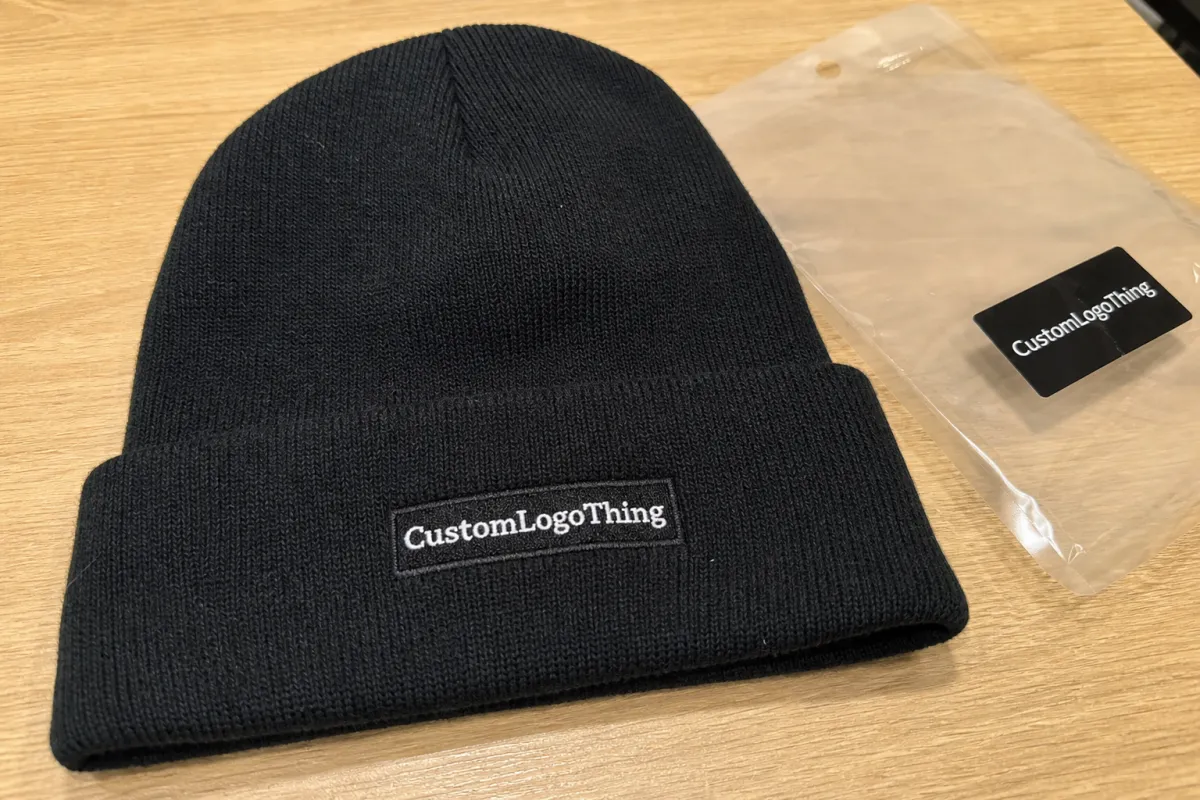
Two cuffed knit beanies can land on a buyer's desk and look almost identical from three feet away. Then the quotes arrive. Buyers searching for a cuffed knit beanies Unit Cost Breakdown are usually not browsing for style inspiration. They are comparing real numbers, defending a budget, and trying to avoid a margin leak that will not show up until the invoice is approved.
Here is the trap. One beanie uses a lighter acrylic yarn, a 2.75-inch cuff, a simple embroidered logo, and bulk carton packing. The other uses a denser rib knit, a 3.5-inch cuff, a faux leather patch, individual polybags, and barcode labels.
On the desk, both say "custom winter beanie." On a purchase order, the second version can add $0.40 to $1.25 per unit before freight.
That small difference matters. On 500 units, $0.60 is $300. On 2,000 units, it is $1,200. That money may be justified if the beanie is a retail item, ski trip gift, campus store product, or employee welcome kit. It may be waste if the order is a short-run event giveaway.
Most buyers get one thing wrong: they treat decoration as the expensive part and the beanie as the commodity. Not always. In soft goods, the cheapest-looking change can be operationally annoying. A woven label may be simple. A leather-style patch can trigger extra sewing time, needle changes, placement checks, and compliance review if the material claim is unclear.
Margin test: If a design detail does not improve perceived value, retail readiness, durability, or brand recognition, it should earn its place in the quote.
A clear cost breakdown gives buyers a purchasing tool, not a style guide. It separates controllable costs from fixed costs. It shows which details need approval before deposit. It also exposes quotes that look cheap only because freight, setup charges, labels, or inspection were left outside the headline price.
Cuffed Knit Beanies Unit Cost Breakdown: What Buyers Actually Pay For
A useful cuffed knit beanies Unit Cost Breakdown starts with the base cap, then follows every handling step until the carton ships. The visible product may be yarn and logo. The invoice is wider: knitting, cuff construction, decoration, labels, packing, quality control, inland freight, export handling, and supplier margin.
Yarn is usually the largest visible driver. Standard acrylic often prices lower than wool blends, recycled acrylic, cotton blends, or performance fibers. Decoration can still create sharper jumps at smaller quantities. Embroidery may need digitizing once, then runs efficiently. A rubber patch may require tooling, a mold, sewing, longer approval, and extra inspection. At 100 units, that setup feels heavy. At 1,000 units, it almost disappears into the per-piece cost.
| Cost Line | Typical Buyer Impact | Common Range or Decision Point |
|---|---|---|
| Base knit beanie | Largest product cost driver | Stock acrylic usually costs less than recycled, wool, or custom-dyed yarn |
| Embroidery | Efficient for simple logos | Best for clean marks, moderate stitch counts, and one location |
| Woven patch | Good for detailed artwork | Setup plus per-patch cost; sewing adds handling time |
| Faux leather or rubber patch | Raises perceived value | May add tooling, mold cost, longer sampling, and extra inspection |
| Labels and packing | Often underestimated | Fiber labels, hangtags, barcode stickers, polybags, and carton marks add labor |
| Freight | Can reverse quote comparisons | Air is faster; ocean lowers freight-per-unit but needs more lead time |
Sample cost, setup Cost, and Production unit cost should not be mashed together in a buyer's head. A prototype invoice may include one-off artwork work, sample handling, express freight, or patch setup. Scaled production pricing should spread fixed costs across the order quantity. That is why MOQ matters.
Ask for itemized quote lines. One supplier may quote FOB only, meaning freight and import costs are still ahead. Another may quote delivered pricing. A third may bundle setup charges into the unit cost. None of these formats is automatically wrong. Comparing them without normalization is the problem.
For packaging and shipping performance, buyers can reference transit test standards from ISTA, especially if beanies ship as part of retail kits, subscription boxes, or multi-item employee packs. Soft goods are forgiving. Cartons, labels, and pack density are less forgiving.
Product Details That Change the Quote Before Decoration Starts
Cuffed knit beanies are usually rib-knit or acrylic knit caps with a folded cuff. That cuff adds warmth around the ears and gives the logo a stable presentation area. It also creates cost decisions before decoration begins.
Cuff height is a quiet cost driver. A 2.5-inch cuff may work for a small embroidered logo. A 3.5-inch cuff gives a patch more breathing room and can look better in retail photography, but it may require more yarn, more folding control, and tighter packing tolerance. If cuff height drifts by half an inch across a production run, the order starts to look sloppy fast.
Knit structure changes both hand feel and branding. A 1x1 rib has strong stretch and a clean surface. A 2x2 rib feels chunkier and reads more winter-ready. Waffle knit adds texture but can complicate small embroidery. Cable knit looks premium, though direct embroidery can sink into the pattern. Chunky knit increases perceived value and bulk. Great for touch. Less great for carton density.
Yarn choice deserves blunt attention. Standard acrylic is common because it is warm enough, color-stable, and cost-efficient. Recycled acrylic can support sustainability claims, but buyers should request documentation instead of accepting a sales line. Cotton blends feel softer but may not hold winter shape as firmly. Wool blends can raise warmth and perceived value, but fiber content labels and care instructions need to be accurate.
Color decisions affect timeline. Stock yarn colors are faster and usually less expensive. Custom-dyed yarn can require higher MOQ, lab dip approval, and dye-lot scheduling. If the brand color is strict, custom dye may be worth it. If "navy close to PMS 296" is acceptable for a giveaway, stock yarn can protect both timeline and budget.
Use case should drive the spec. Staff uniforms need repeatability. Winter retail drops need texture, hangtags, and presentation. Ski events need warmth and a logo that photographs clearly. Campus stores may justify woven labels and retail polybags. Promotional kits often perform better with a reliable stock acrylic beanie than with a premium spec that misses the event date. Brutal, but true.
Specifications to Lock Before Requesting a Beanie Quote
A vague request such as "custom beanie with logo" produces vague pricing because the supplier must guess. The guess may be cheap. It may also be wrong. A disciplined RFQ brief improves the cost breakdown because every supplier prices the same product.
- Quantity: Ask for your target quantity plus at least one higher tier, such as 250 and 500 units.
- Yarn: State acrylic, recycled acrylic, cotton blend, wool blend, or open to supplier recommendation.
- Knit pattern: Choose 1x1 rib, 2x2 rib, waffle, cable, chunky knit, or a stock style.
- Dimensions: Adult one-size beanies often sit around 8 to 9 inches tall when folded, depending on stretch and cuff.
- Cuff height: Common cuff heights run about 2.5 to 3.5 inches.
- Logo: Include size, location, decoration method, and number of colors.
- Packing: Confirm bulk pack, folded polybag, retail polybag, hangtag, barcode, or carton marks.
- Delivery: Give destination ZIP or country, in-hands date, and any split shipment needs.
Artwork files matter earlier than many buyers expect. Vector files are preferred for embroidery, woven patches, and most patch production. Tiny type, thin strokes, gradients, and distressed textures may need simplification. For embroidery, stitch count affects cost and production speed. For woven patches, minimum line width and thread color limits can decide whether the art looks sharp or muddy.
Compliance details can change the quote too. Fiber content labels, country-of-origin labels, care labels, barcode stickers, hangtags, and carton marks all require time. If the beanie enters retail, those details are not decoration. They are part of the sellable unit. For paper tags or FSC-labeled packaging, confirm claim rules and sourcing through the Forest Stewardship Council rather than assuming any kraft tag qualifies.
A one-page RFQ brief is not bureaucracy. It is quote control. Without it, one supplier may quote a stock acrylic beanie with embroidery while another prices a custom patch, individual packing, and delivered freight. The cheaper quote may simply be a different product.
MOQ and Pricing Tiers: Where Custom Beanie Orders Get Efficient
MOQ is a production efficiency threshold, not a punishment. Factories need enough units to justify yarn allocation, knitting setup, decoration setup, inspection, packing labor, and administrative handling. Below that threshold, the order may still be possible, but the unit cost climbs because fixed work has fewer beanies to absorb it.
Common bulk pricing tiers often improve around 100, 250, 500, 1,000, and higher quantities. The exact breakpoints depend on supplier capacity and decoration method, but the pattern is consistent: fixed costs shrink as volume rises. A $75 digitizing fee adds $0.75 per unit at 100 pieces. At 1,000 pieces, it adds $0.075. Same fee. Very different economics.
Several choices can keep MOQ lower: stock yarn colors, standard cuff construction, one logo location, simple embroidery, and bulk packing. These specs reduce custom handling and use materials already in the supply chain. They also shorten the approval path.
Other choices push MOQ higher. Custom-dyed yarn may require minimum dye lots. Multiple colorways split the order into smaller production batches. Jacquard knit-in logos demand more complex knitting setup. Custom Rubber Patches may need tooling fees. Retail packaging and split shipments add labor that does not scale neatly.
Quote the next tier above your target quantity. If you need 400 units, ask for 400 and 500. The difference can be revealing. Sometimes 500 pieces lower the cost per piece enough that the extra 100 units are nearly self-funded, especially when setup charges and freight spread more efficiently. Other times the tier break is too small to justify carrying extra inventory.
Buyer discipline: Never compare headline unit price alone. Samples, setup charges, freight, duties, packaging, and inspection can overturn the apparent winner.
A practical cuffed knit Beanies Unit Cost Breakdown should show what changes by tier and what stays fixed. If a quote drops sharply at 500 units, ask which line caused the drop. Was it decoration efficiency? Yarn buying? Freight density? Or simply margin flexibility?
Production Steps and Lead Time From Artwork to Delivery
Beanie production looks simple from the outside because the final item is soft, small, and familiar. The workflow is more structured than it appears. A normal custom order moves through RFQ review, quote confirmation, artwork check, digital proof, sample or pre-production approval, yarn sourcing, knitting, decoration, labeling, inspection, packing, and shipment.
Stock-yarn orders usually move faster because the supplier can pull from existing color programs. Custom-dyed yarn adds lab dips, approval time, dye-lot scheduling, and sometimes a higher minimum. A buyer who takes five business days to approve a shade card can lose more time than the factory needs to start knitting.
Approval bottlenecks are often buyer-side. Digital mockups confirm placement and scale. Physical pre-production samples confirm construction, hand feel, cuff height, and logo execution. Production samples confirm that the approved spec is being followed. Each approval step has value, but each one also consumes calendar days.
For many standard orders, buyers should think in practical windows rather than promises. Stock acrylic with straightforward embroidery may move in a shorter production cycle after proof approval. Custom patches, multiple colorways, or physical sampling can add one to three weeks before full production. Air freight can rescue a deadline, but it raises landed cost. Ocean freight lowers freight-per-unit yet requires inventory planning and a less reactive calendar.
Build the schedule backward. Start with the event date, store launch, employee kit drop, or seasonal delivery window. Then add time for quote review, artwork revisions, sample approval, production, inspection, freight, and receiving. If the beanies must be kitted with boxes, cards, or other merchandise, add a buffer for inbound matching. One late component can stall the whole program.
ASTM textile and packaging-related test methods may also be relevant for larger retail programs, especially where labeling, packaging performance, or material claims are reviewed by a compliance team. The point is not to over-engineer a beanie order. The point is to know which requirements belong in the quote before production starts.
Quality Checks That Prevent Expensive Beanie Reorders
Quality failures in beanies are rarely dramatic at first glance. They show up in rows: inconsistent cuff heights, off-center patches, weak stretch recovery, loose threads, shade variation, crooked labels, and carton counts that do not match the packing list.
The unit economics can break quickly. If 6 percent of a 1,000-unit order cannot be used for retail or employee distribution, the effective cost per usable beanie rises. Add replacement freight or missed-event risk, and the cheap quote stops looking cheap.
Inspection should cover yarn color, knit density, finished dimensions, cuff height, logo placement, patch stitching, label accuracy, packing count, and carton markings. For logo placement, define a tolerance. For example, buyers may approve a centered front patch with a small left-right tolerance, rather than relying on a vague "looks centered" standard. For cuff height, confirm whether measurement is taken before or after final folding and packing.
Approved samples act as a contract reference. They settle arguments about texture, logo scale, patch edge finish, label position, and overall hand feel. Photos help, but physical samples are stronger for higher-value retail programs or orders with new materials.
Ask whether inspection is inline, final random inspection, or both. Inline checks catch problems while production can still be corrected. Final random inspection verifies finished goods before shipment. Photo reports are useful, but they should show more than hero shots. Ask for carton labels, packing arrangement, close-ups of decoration, and measurements against the approved spec.
A serious cost breakdown should not treat quality control as a vague promise. It should identify who checks the goods, when the check happens, and what evidence the buyer receives before shipment.
Build a Quote Pack That Gets a Firm Price Fast
The fastest route to a firm price is not a longer email. It is a cleaner quote pack. Give the supplier enough information to price the product you actually want, then ask for options that expose the tradeoffs.
- Target quantity: Include your ideal order and one higher tier for bulk pricing comparison.
- Delivery date: State the in-hands date, not only the event date.
- Shipping destination: Provide ZIP code, country, and whether delivery is residential, commercial, or warehouse.
- Yarn and color: Name preferred material and whether stock colors are acceptable.
- Cuff and knit: Provide cuff height, knit style, and any warmth or stretch requirement.
- Artwork: Send vector files early, even if final brand approval is pending.
- Decoration: Specify embroidery, woven patch, faux leather patch, rubber patch, or open recommendation.
- Packaging: Confirm bulk pack, individual polybag, hangtag, barcode, carton marks, or kit requirements.
- Budget range: Share a target if you have one; it prevents a premium quote for a value program.
Ask for two quote versions if budget and presentation are both under discussion. One should be the value option: stock yarn, standard cuff, efficient logo method, and practical packing. The other should be the premium option: upgraded yarn, patch, retail presentation, or tighter branding. That comparison gives commercial context. It also makes internal approval easier because stakeholders can see what the extra spend buys.
Request landed cost where possible, not only factory unit price. Freight, import variables, and packaging volume can affect the final number more than a small difference in decoration. If landed pricing is not available, ask for FOB terms plus estimated carton dimensions and weight so freight can be modeled.
Separate must-have specs from flexible specs. A must-have may be logo color accuracy or a retail hangtag. A flexible spec may be exact yarn shade, individual polybag, or patch material. Flexibility on one line can shorten production and reduce unit cost without making the beanie look cheap.
Custom Logo Things can help turn a rough idea into a quotable spec: quantity tiers, decoration method, yarn choice, label needs, packaging, and delivery assumptions. The useful outcome is not a prettier spreadsheet. It is a controlled sourcing decision where the buyer knows which details are driving the final number.
FAQs
What is included in a cuffed knit beanie unit cost breakdown?
A useful breakdown should include yarn, knitting, cuff construction, logo decoration, labels, packing, quality control, freight assumptions, setup charges, and any sample costs. Ask whether the quote is ex-factory, FOB, delivered, or landed so freight and import costs are not hidden outside the unit price.
How does MOQ affect custom cuffed beanie pricing?
Higher quantities usually reduce unit cost because fixed expenses such as artwork setup, machine setup, patch preparation, and quality documentation are spread across more beanies. MOQ can rise when buyers request custom yarn colors, multiple logo versions, retail packaging, or split shipments.
Which logo option is most cost-effective for cuffed knit beanies?
Embroidery is often efficient for straightforward logos and moderate quantities, while woven patches can be better for detailed artwork. Leather, rubber, or specialty patches may improve perceived value but can add setup time, sewing labor, tooling fees, and higher per-unit handling costs.
How long does production take for custom cuffed knit beanies?
Lead time depends on yarn availability, decoration method, sample approval, order quantity, and freight mode. Stock yarn and standard decoration usually move faster; custom-dyed yarn, physical sampling, or retail packaging adds time.
How can I lower the unit cost without making the beanie look cheap?
Use stock yarn colors, keep one logo location, simplify artwork, consolidate colorways, and choose packaging that fits the sales channel. Quote multiple quantity tiers because moving to the next MOQ bracket may reduce the delivered cost more than trimming product quality.


