matte zipper Bags for Streetwear labels cost breakdown matters because packaging is part of the product decision, not an afterthought. It affects first impression, perceived condition, pack-out efficiency, and landed cost. A matte bag usually reads cleaner than a glossy sleeve, especially for black-heavy graphics, restrained typography, and premium basics that need a controlled presentation.
For streetwear buyers, the real question is not whether matte packaging looks good. It is which specs drive the price, which details can be simplified, and which ones affect brand perception enough that they should stay fixed. That is the difference between a quote that looks good on paper and a package that works in production.
If the packaging sits alongside labels, hang tags, or other finishing pieces, it helps to review the broader trim system too. Packaging rarely behaves like an isolated purchase; it usually belongs in the same branding conversation as the garment itself. For that reason, the Custom Labels & Tags page is a practical reference point while planning the full presentation.
Why matte zipper bags can raise perceived value before the garment is even touched
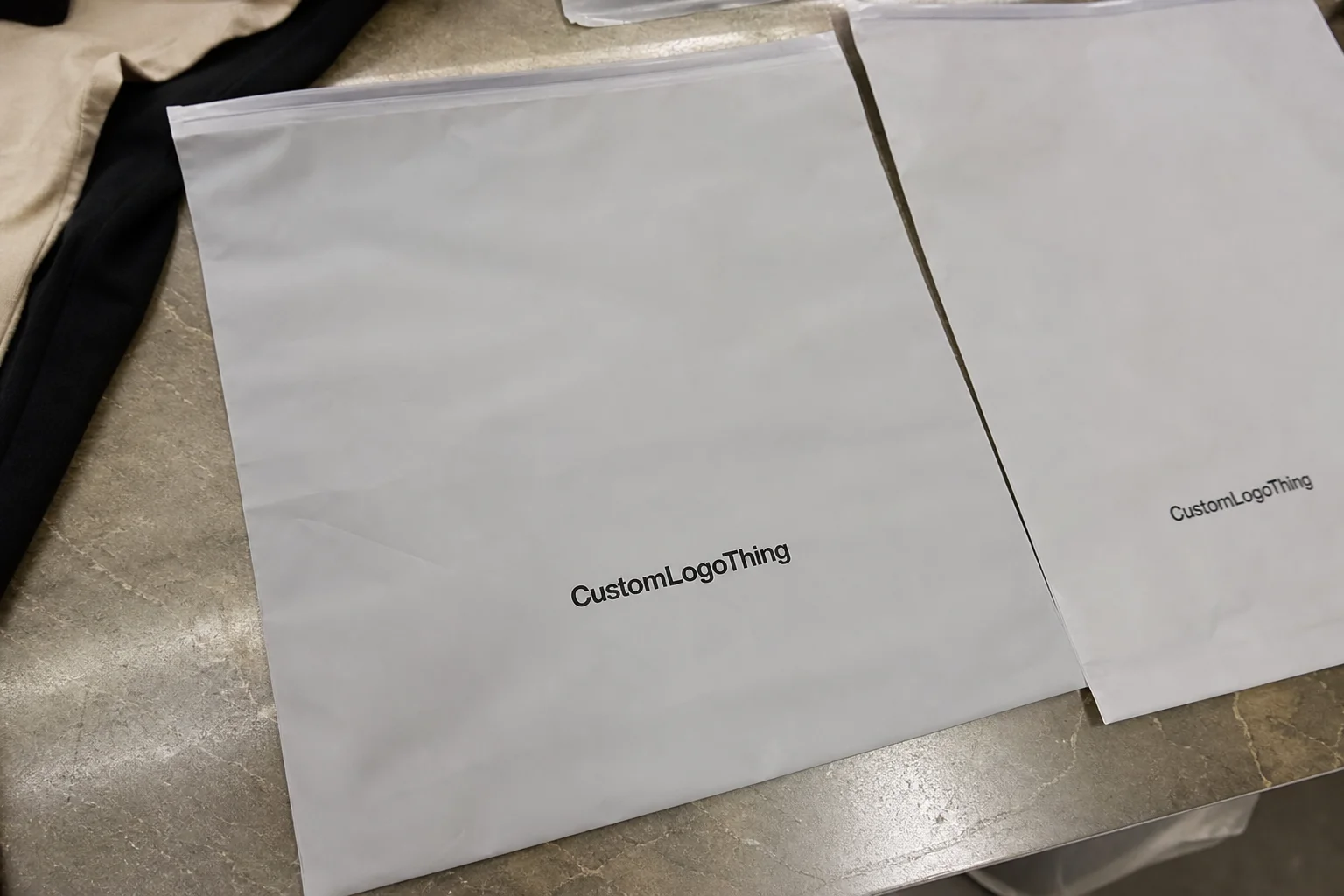
Packaging earns its place by shaping the first impression. Matte film reduces reflected light, so artwork stays readable and the package looks more controlled in person and on camera. That matters for streetwear labels that depend on dark palettes, small logo marks, or minimal layouts that would get washed out by shine.
The effect is visual, but it also changes how the garment is judged. A matte zipper bag tends to suggest care and consistency, which helps a folded tee, hoodie set, or accessory feel more deliberate before it is removed from the pack. Buyers often underestimate how much packaging affects perceived condition. A scratched or cloudy bag can make new stock look handled. A clean matte surface does the opposite.
There is also a practical brand benefit. In some cases, a matte bag replaces extra wrapping, stickers, or a second decorative layer just to make the package look finished. That can save time during pack-out and keep the presentation tight. A useful matte zipper Bags for Streetwear labels cost breakdown has to account for that tradeoff: the bag may cost more than a plain sleeve, but it can eliminate weaker packaging decisions elsewhere.
A packaging buyer is usually paying for two things at once: protection and perception. Matte zipper bags are one of the few options that can do both without looking loud.
What buyers need to lock down before requesting a quote
The fastest way to get a usable price is to give the supplier real specs, not a rough idea. Bag width, height, gusset depth if needed, zipper style, finish, print colors, and target quantity all matter. A bag for a heavyweight hoodie set is not the same structure as a bag for a single tee, and a display bag for retail is different from a warehouse-only sleeve.
Buyers should also decide how the bag will be used. Retail presentation usually requires better surface consistency and clearer print registration. Ecommerce inserts need decent presentation and handling resistance. Warehouse packaging can be simpler, but once the customer sees the bag, the finish and print quality start to matter more. That is why the quote should begin with use case, not a generic size guess.
Artwork details affect pricing too. One-color logo printing is one production path. Full-coverage graphics, white underprint, metallic ink, or inside printing are another. More ink coverage means more setup, more calibration, and usually more waste during press adjustment. If the artwork is still being debated internally, the supplier may give a placeholder estimate, but it will not be the number that survives production.
There are a few details buyers forget until the last minute:
- Hang holes or euro slots for retail display
- Press-to-close or slide zipper style
- Tear notch for easier opening
- Anti-static performance for certain fabrics
- Moisture resistance for humid storage or long transit
The best quote request includes final dimensions, print artwork, target quantity, and a clear example of the desired pack style. If any of those pieces are vague, the answer usually comes back padded with caution or missing the thing the buyer actually needs.
Material, finish, and print specifications that change the final look
Material choice is one of the main price drivers. LDPE is common for apparel because it is flexible, folds well, and gives a softer hand feel. CPP is firmer and tends to hold its shape better, which can help the bag look cleaner on display. Blended structures appear when a buyer wants a more controlled surface, better stiffness, or more predictable print behavior.
The matte finish changes how the package reads. Gloss bounces light and can make artwork appear brighter, but it also introduces reflections that interfere with small typography and fine lines. Matte is calmer. It keeps the surface more even under LEDs, flash, and showroom lighting, which is why many streetwear brands prefer it for restrained graphics and dark palettes.
Zipper selection changes both function and cost. Press-to-close zippers are common because they are familiar, quick to use, and adequate for most apparel. Slide zippers feel more premium, but they add assembly complexity and usually increase the unit price. If the bag is heat-sealed around the edges, that process also affects labor, inspection time, and the likelihood of rework.
Thickness is not a cosmetic spec. A thin film can wrinkle, collapse, or split under carton pressure, especially with folded hoodies or layered sets. A thicker gauge gives better protection and a sharper look, but it adds material cost and shipping weight. Buyers often discover that the right gauge is not the highest one available; it is the one that survives distribution without making the order unnecessarily heavy.
Print method matters as much as the film. Flexographic printing is common for repeat runs because it becomes efficient once the setup is approved. Gravure is better suited to higher-volume programs where consistency matters and tooling fees can be absorbed over a larger quantity. For simple matte bags with minimal print, the bag itself does the branding work and the production path stays cleaner.
Packaging buyers who coordinate bags with labels and hang tags usually end up with a more coherent result. A garment can look properly finished only if the outer pack and the trim language feel aligned. That is one reason it helps to keep packaging, label, and tag decisions in the same review cycle rather than handling them one at a time.
For transit and handling, the ISTA testing framework is a useful benchmark. It is not about paperwork. It is about whether the pack will still look good after stacking, vibration, and ordinary warehouse abuse.
Cost, pricing, MOQ, and unit cost for streetwear packaging runs
matte zipper Bags for Streetwear Labels cost breakdown usually comes down to five variables: size, material gauge, zipper type, print complexity, and total quantity. Quantity changes the price fastest because setup charges get spread across more units. That is why a first order often looks expensive compared with a repeat run using the same spec.
Buyers should read a quote in layers. The base material tells one story. Printing tells another. Zipper style, finishing, inspection, and cartons add more. Freight is separate again, and it can change the landed cost more than expected if the order is light but bulky. A low headline price is not useful if the shipment cost or packing cost wipes out the savings.
| Option | Typical Spec | Estimated Unit Cost | Best Fit |
|---|---|---|---|
| Plain matte zipper bag | Standard apparel size, no print, press-to-close zipper | $0.10-$0.18 | Core basics, simple folding protection, low-ink presentation |
| One-color printed matte bag | Single logo print, standard gauge, retail-ready finish | $0.14-$0.24 | Most streetwear drops with moderate branding |
| Full-coverage printed matte bag | Multiple ink passes, white underprint, higher setup needs | $0.22-$0.38 | Launch collections, stronger graphics, photo-heavy presentation |
| Heavy-duty custom build | Thicker film, special zipper, euro slot, larger format | $0.28-$0.48 | Hoodies, premium sets, retail display, higher perceived value |
MOQ matters because it determines how hard the setup costs get spread. A small run is useful for testing a new look or matching a limited drop, but the unit cost usually rises. Larger runs are more efficient, but only if the spec is settled. If the artwork is still changing or the bag size is still being debated, the order loses efficiency fast.
There are also hidden costs that Buyers Should Check early: sample charges, plate or tooling fees, carton packing, reprint risk, and any special packing instructions. A quote can look attractive until those items appear. The cleanest comparison is always the landed price per usable bag, not the factory number alone.
If a quote looks unusually low, check what has been omitted. The missing line item is often setup, freight, or a material choice that is thinner than the buyer expected.
For brands using paper inserts, hang tags, or cartons alongside the bag, fiber sourcing can also affect the broader packaging budget. If paperboard enters the spec, the FSC system is a practical reference for responsibly sourced material.
Process, timeline, and lead time from artwork approval to shipment
The production flow is usually predictable: inquiry, spec confirmation, artwork review, proofing, sample approval if needed, mass production, inspection, packing, and shipment. Delays do not usually come from the process itself. They come from missing information, slow approvals, or a design change after the proof has already been signed off.
Artwork is one of the biggest pressure points. Vector files are best for logos and text because they hold crisp edges at any scale. If the brand needs exact color control, Pantone references or a previously approved sample are more reliable than a verbal description. If a proof is approved and then changed, the timeline moves immediately.
Lead time depends on quantity and complexity. Repeat orders with locked specs can move faster because there is less back-and-forth. First-time runs usually take longer, especially if sampling is required before mass production begins. A practical expectation for repeatable specs is often around 12-18 business days after proof approval, while more complex first runs can stretch beyond that if the artwork, finish, or zipper spec still needs work.
Shipping detail matters too. A warehouse delivery, a fulfillment-center drop, and a direct garment shipment do not behave the same way. The supplier should know whether the bags are being packed with the apparel, stored separately, or sent to a third party. Late clarification here creates avoidable delays, and that delay usually costs more than the material difference in the bag itself.
Repeat orders are easier because the approved color, film feel, zipper behavior, and pack-out method already exist. The second or third run is where the packaging program starts to pay for itself in efficiency. There is less revision, fewer sample loops, and less time spent correcting what should already be settled.
Quality controls that keep repeat streetwear drops consistent
Streetwear labels rarely need one perfect sample. They need consistency across runs. A bag that looks correct in one batch but shifts in sheen, zipper feel, or print placement on the next batch creates a problem that customers notice immediately. The fix is not more decoration. The fix is tighter control.
Good quality control starts with a retained sample and a clear spec sheet. That gives the production team something measurable: film thickness, seal width, print placement, zipper alignment, and acceptable color variance. It also keeps the packaging buyer from having to explain the same detail repeatedly every time a new order starts.
Scuff resistance is another practical concern. Matte surfaces show handling marks more easily than rough utility packaging, so the pack-out method matters. Carton loading, stacking pressure, and outer protection all affect how the bag arrives. If the product is retail-facing, it should be checked after packing, not only before it leaves the production line.
Another useful control is carton compression awareness. Thin film can take a bad shape when boxed too tightly, especially on large runs with mixed garment types. A better supplier will flag that issue before production rather than after a shipment arrives with creased corners and damaged presentation. That kind of check saves money because rework on packaging is rarely cheap.
What matters most is repeatability. A label may be willing to pay a little more for a finish that stays stable across seasons, because unstable packaging undermines the brand faster than a slightly higher unit cost. The cheapest pack is not the best pack if it varies from order to order.
Next steps to confirm your matte zipper bag order
Before requesting a quote, collect the details that shape price: exact dimensions, artwork files, and target quantity. Those three inputs drive most of the matte zipper Bags for Streetwear labels cost breakdown. If one of them is vague, the estimate will be vague too.
If the bag needs to match a previous drop, send a sample or a clear reference photo. Texture, zipper feel, and matte level are difficult to judge from a description. A visual reference reduces revision time and lowers the chance of getting a bag that technically fits the spec but misses the look the brand wanted.
Comparing offers should go beyond the headline unit price. Check whether the quote includes setup, shipping, packing format, and the finish level you actually need. If one option is cheaper because the material is thinner or the print is simplified, the savings may disappear once the order hits the warehouse.
The right bag should protect the garment, support the brand, and stay consistent across repeat drops. That balance is the whole point. A good matte zipper bag is valuable because it solves presentation and handling in one piece without forcing the label to overpay for either.
What affects matte zipper bags for streetwear labels cost breakdown the most?
Size, film thickness, print complexity, zipper style, and total quantity matter most. Quantity changes the unit price quickly because setup and tooling costs are spread across more bags.
What MOQ should a streetwear label expect for matte zipper bags?
MOQ depends on the bag size, print method, and whether the order is plain or custom printed. Smaller runs are possible, but the price per bag usually rises because the production setup is carried by fewer pieces.
How do matte zipper bags compare with glossy bags for apparel packaging?
Matte bags reduce glare and usually photograph better under retail lighting. Glossy bags can look brighter, but they also reflect more light and can make small artwork harder to read.
What artwork files are best for custom matte zipper bag printing?
Vector files are preferred for logos, text, and line work because they keep edges clean at any scale. If color matching matters, supply Pantone references or an approved sample.
How long is the usual lead time for matte zipper bags for streetwear labels?
Lead time depends on the size of the order, the print method, and whether sampling is required first. Repeat orders usually move faster than first-time runs because the spec is already approved.


