Apparel Cuffed Knit Beanies MOQ for Bulk Order Quotes
Compare apparel Cuffed Knit Beanies MOQ, pricing, and lead times so you can source bulk beanies with clearer numbers and fewer delays before sampling starts.
For apparel cuffed Knit Beanies MOQ, the lowest quoted number is often the least useful one. A buyer can save a few cents on paper and lose the gain quickly once embroidery setup, color splits, packaging changes, or a second proof cycle enter the picture. A quote that looks lean on a spreadsheet can turn expensive the moment it touches production.
The better question is not, “What is the minimum?” It is, “What quantity lets this beanie repeat cleanly, hold its shape, and stay worth reordering?” That distinction matters because a cuffed knit beanie is usually bought as a program, not a one-time novelty. Retail teams, promo buyers, and private-label brands all feel the difference between a controlled run and a pile of inventory that never earns its way back.
Market behavior backs that up. A low opening order can be useful for testing demand, but it usually carries a higher per-piece cost and more setup friction. Larger runs reduce unit cost, yet only if the build is stable enough to absorb the volume. The sweet spot is rarely the smallest number a supplier will accept. It is the smallest number that still behaves like a production order.
Apparel Cuffed Knit Beanies MOQ: Where Small Orders Break
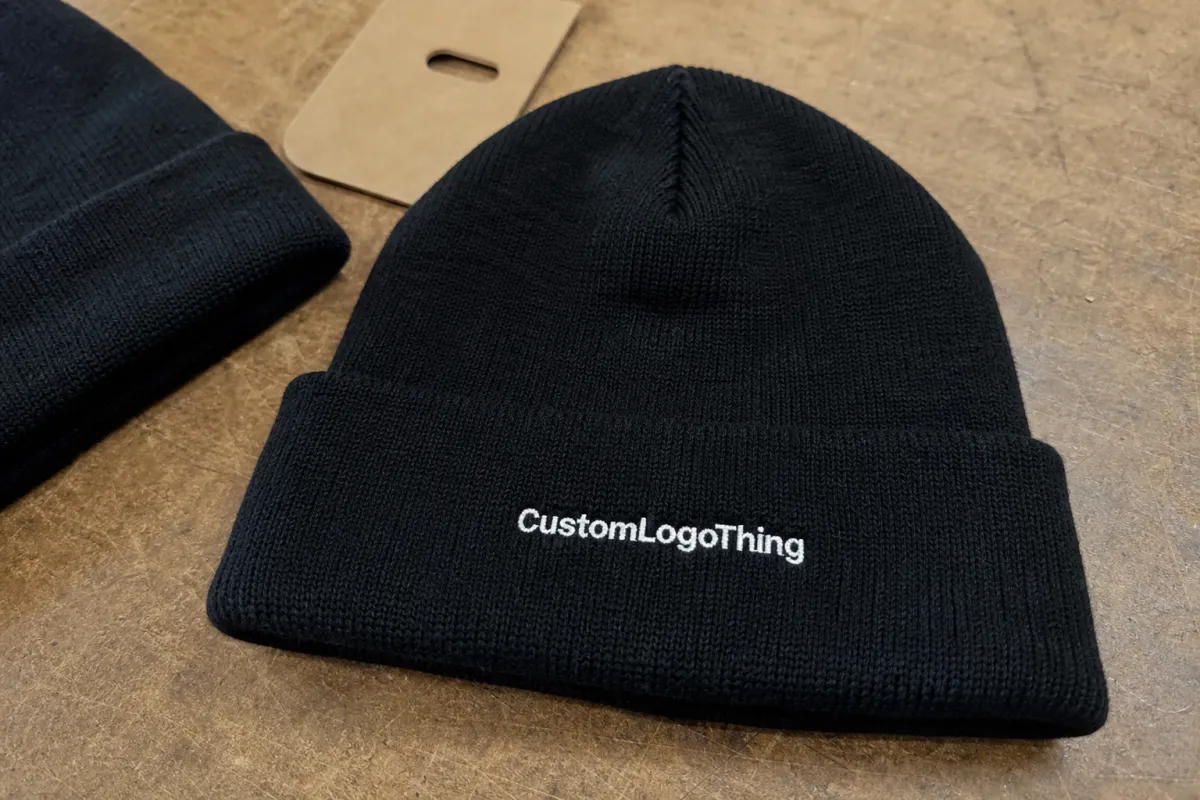
The cuffed knit beanie has one major advantage over more complex headwear: the silhouette is forgiving. The cuff gives you a clear branding zone, the body stretches well, and the basic shape is familiar enough that most teams do not need a long development cycle. That makes apparel Cuffed Knit Beanies MOQ easier to manage than a fully custom hat program, but not easy enough to ignore the details.
Small orders tend to break in the same places. A supplier may quote a low decoration MOQ, then discover the real work is in the splits: separate yarn colors, separate thread matching, separate packaging labels, separate cartons, or separate destination shipments. A 100-piece order can quietly become three 100-piece orders if the program has multiple colorways or logo versions. That is not a pricing trick. It is production logic.
Cuff height causes more trouble than buyers expect. A 2.5-inch cuff and a 4-inch cuff may look similar on screen, yet they change the decoration area, the finished height, and sometimes the balance of the hat after it is worn. The same applies to the crown. A deeper crown can look more relaxed; a shallower one can fit tighter and feel more retail-friendly. Those changes do not just affect style. They affect the allowed stitch count, embroidery scale, and how much the logo can breathe on the front panel.
One more trap: low MOQ does not always mean low risk. A small run with multiple revisions, custom color matching, and retail packaging can take more attention than a larger run with a simple structure. In practice, the most durable programs are the ones that keep the variables contained.
- Low MOQ helps only if the style stays consistent from sample to bulk.
- Color splits usually increase setup, inspection, and packing labor.
- Decoration choice matters as much as the beanie body itself.
- Repeatability is worth more than a headline quote that cannot be reordered cleanly.
That is why apparel Cuffed Knit Beanies MOQ is better judged as a production threshold than as a sales talking point. A buyer planning employee kits, school merch, or seasonal retail needs a style that can be replicated without rediscovering the entire spec every time.
What a Cuffed Knit Beanie Program Includes
A cuffed knit beanie program has four main parts that shape the final result: the cuff, the crown shape, the yarn body, and any finishing such as a lining, label, patch, or hangtag. The cuff matters most for branding. It is the flattest, most visible area, so it carries logos more cleanly than the rest of the knit. The body does the heavy lifting for warmth and stretch, while the cuff gives the product its retail face.
Material choice changes the feel faster than many buyers expect. Acrylic remains common because it is steady, widely available, and usually the lowest-cost base. Polyester blends can improve durability and drying time. Wool blends raise warmth and often improve handfeel, but they also increase cost and can bring care concerns. Recycled fibers are now common in mid- and higher-tier programs, though the pricing depends on the source of the recycled content, the dye lot, and whether documentation needs to be maintained for claim support. A recycled claim without traceable paperwork is just decoration in another form.
Decoration creates the biggest split in both MOQ and cost. Embroidery works well for sharp logos and lower quantities. Woven labels are useful when the logo needs smaller detail or a softer handfeel. Patch applications add texture and can make a basic knit body look more premium. Fully knit-in graphics, such as intarsia-style patterns, usually push MOQ higher because the factory has to control the stitch map more closely and spend more time on setup and sampling.
Most buyers source cuffed beanies for one of a few reasons:
- Retail resale with a seasonal margin target.
- Internal uniforms or employee gifting.
- Promotional campaigns tied to winter events.
- Private-label merchandise for a brand extension.
- Bundle programs paired with scarves, gloves, or outerwear.
That mix explains why apparel cuffed knit beanies MOQ is never just a factory number. The same physical style can act like a promo item, a retail item, or a uniform piece depending on the decoration and packaging. The quote changes with the use case because the production risks change with it.
“The cuff is the sales surface. If the placement is off, the beanie feels wrong even if the knit itself is fine.”
Specs That Shape Fit, Stretch, and Decoration
If the quote needs to be accurate, send the technical specs early. Yarn type affects both feel and price, but so do gauge, cuff height, finished length, stretch recovery, and the final dimensions after wear. A beanie that looks balanced on a flat table can sit too high, too tight, or too loose once it is on a head. That is a common failure point in small-batch sourcing: the sample is technically acceptable, yet the fit does not read right in use.
Start with the measurement points that actually control the outcome. Finished width, finished height, cuff depth, crown shaping, and stitch density should all be listed in one place. If the supplier does not get those numbers up front, they will build from assumptions, and assumptions are expensive once sampling has begun. For apparel cuffed knit beanies MOQ, the lower the quantity, the less room there is to absorb a bad assumption.
Decoration details should be locked before bulk pricing starts. That means Pantone references or a clear visual standard, thread color instructions, patch dimensions if relevant, and the exact placement of the logo on the cuff. If labels or hangtags are included, say whether they will be sewn in, folded in, or packed separately. Those choices affect labor, carton count, and the way the order is priced. A label packed loose is cheap to source and expensive to finish. The difference is easy to miss until the first quote arrives.
There are a few quality checks that are worth asking for, even on modest runs:
- Stitch consistency across the sample and the bulk production lot.
- Colorfastness review for dark shades, bright accents, and mixed fiber content.
- Stretch recovery so the beanie does not bag out after wear.
- Seam inspection on the crown join and cuff attachment.
- Shrink behavior after wash or steam exposure when the yarn blend makes it relevant.
Packaging can carry more risk than buyers think. A knit beanie is soft, which sounds like an advantage until the product needs to hold a fold, a barcode, or a retail presentation standard across a long shipment. If cartons will travel through multiple handling points, transit testing methods such as ISTA are worth discussing. If paper tags or printed cartons are part of the order, sourcing through FSC-certified paper channels is a cleaner path for buyers who need documentation. That does not solve every issue, but it prevents packaging from becoming the weakest link in the chain.
A one-page spec sheet usually saves the most time. Keep it simple: measurements, color references, decoration placement, packaging notes, and deadline. That file becomes the baseline for reorders, which matters more than people expect. A good spec sheet is a defense against drift. A weak one turns every season into a fresh negotiation.
There is also a commercial reason to be specific. Suppliers tend to price confidence. If the build is clear, the quote is faster and the hidden contingencies shrink. If the build is vague, the factory protects itself with extra padding in the number, and the buyer pays for uncertainty whether it appears on the line item list or not.
Pricing, Unit Cost, and MOQ Breakpoints
Bulk pricing for knit beanies follows a familiar pattern: the unit cost falls as quantity rises, but only if the style stays stable. One body color, one cuff color, one decoration method, and one packaging format usually produce a better rate than a split run with multiple finish options. That is the main reason apparel cuffed knit beanies MOQ and unit cost are tied together. Production efficiency is the hidden variable behind the quote.
The main cost drivers are straightforward:
- Yarn type affects raw material cost, feel, and consistency.
- Decoration method drives setup time and labor.
- Color count can increase knitting complexity and waste.
- Packaging format changes finishing, folding, and carton work.
- Order shape matters: stock style, custom knit, or custom label packout.
| Decoration path | Typical MOQ posture | Typical cost per piece | Notes for buyers |
|---|---|---|---|
| Embroidery on stock beanie | Lower, often 100-300 pcs | $2.80-$5.50 | Best for simple logos; setup charges are usually modest. |
| Woven label on stock beanie | Lower to medium | $2.60-$5.00 | Good for fine detail; sewing and placement add labor. |
| Patch application | Medium | $3.20-$6.20 | Raises perceived value; patch sourcing can add tooling fees. |
| Fully custom knit pattern | Higher, often 300-1000 pcs | $4.00-$8.50+ | More development time; colorwork and sampling can lift unit cost. |
These are working ranges, not fixed market prices. They move with yarn availability, destination, timing, packaging, and the number of revisions. Still, they are useful because they show the tradeoff clearly. A buyer chasing the smallest MOQ can end up paying more per unit than a buyer who accepts a slightly larger run with a simpler decoration path. That is not a contradiction. It is the market pricing production risk.
Watch for hidden line items before approving a quote. Sampling fees are common. Revision fees can appear if the logo changes after the first proof. Freight is often separate. Hangtags, retail folds, barcode labels, and split shipments may all sit outside the base unit price. If the supplier also needs custom knit charts, patch tooling, or special bagging, the number can climb without warning unless those items are listed early.
There is a useful way to compare offers: ask for one quote that keeps MOQ low and another that improves unit cost. That spread tells you how much the order benefits from scale. For a test launch, the lower quantity may be the right move. For a confirmed retail window or a reorderable uniform program, the larger run can make more sense. The wrong decision is the one made from a single price without seeing the breakpoint.
Some buyers fixate on the minimum and miss the actual economics. A 150-piece order that costs more per piece than a 300-piece order is not a bad quote; it is the honest cost of fragmentation. A better question is whether the demand pattern justifies the lower threshold or whether a larger order would reduce the total cost enough to protect margin.
Production Timeline, Lead Time, and Approval Steps
Most delays happen before knitting starts. The process usually moves through quote, spec confirmation, sample development, sample approval, bulk production, finishing, packing, and shipment. Each stage looks simple on paper. In practice, one unclear logo note or one late color correction can hold everything back for days.
For a straightforward cuffed knit beanie with embroidery, sampling often takes about 7-14 business days if the artwork is clean and yarn is in stock. Bulk production commonly adds another 15-25 business days after approval. Transit is a separate clock, and seasonal congestion can add more time than anyone wants to budget. For winter programs, the real risk is not manufacturing alone. It is missing the window far enough upstream that the product arrives after the selling moment has passed.
Buyers lose time in predictable ways:
- Color confirmation drifts because the team compares screens instead of physical references.
- The logo placement changes after the first mockup.
- Packaging requirements appear after the sample is already approved.
- Three stakeholders want to review the proof separately.
- The order is placed too close to the seasonal launch date.
A clean schedule helps more than pressure. If the beanies support a seasonal sell-in, leave room for one revision cycle and one shipping buffer. If the order is for a promo launch, check whether the deadline is tied to a trade show, a retail reset, or an internal distribution date. Those are different clocks. Missing one can leave finished stock sitting in a warehouse while the event has already passed.
The simplest production sequence is usually the safest: send artwork and quantity, confirm construction, approve the sample, lock packaging, then release bulk production. That order keeps the quote tied to the real product instead of a placeholder. It also reduces the odds that a late change creates a hidden cost spike.
There is a reason experienced buyers care so much about lead time. In knitwear, the actual knitting is only part of the timeline. Yarn allocation, finishing, folding, carton prep, and final inspection can each add friction. A supplier who can map those steps clearly is usually more reliable than one who only says the job is possible.
How to Vet a Supplier for Repeat Orders
The right supplier for a one-time purchase is not always the right supplier for a repeat program. If you plan to reorder, ask for proof, not promises. That means past production photos, spec sheets, acceptable tolerance ranges, and examples of similar cuffed knit projects. A supplier that can show how they handled a logo patch, a woven label, or a multi-color cuff is more useful than one that says everything is possible.
Repeatability is the real test. Apparel cuffed knit beanies MOQ is often shaped by what the factory can repeat without rebuilding the job from scratch. A dependable partner will tell you which changes are free, which changes affect price, and which changes require a new sample. That kind of honesty is valuable because it prevents a small artwork tweak from turning into a fresh setup bill after the order is already approved.
Look closely at the operational details:
- Archivable specs so the second order matches the first.
- Clear tolerances on size, color, and decoration placement.
- Reorder behavior that does not restart the job every time.
- Communication speed when a proof needs correction.
- Packaging discipline so folds, cartons, and labels stay consistent.
If a supplier cannot explain what actually moves the MOQ, that is a warning sign. If they can explain it in plain language, that is usually a better sign than a polished presentation deck. The strongest quotes are the ones that show where the cost lives. Weak quotes hide the cost until sample approval, when the buyer has less room to push back.
Documentation matters here too. If the order includes retail tags, printed cartons, or sustainability claims, the paper trail should be part of the file. Some buyers care about FSC-linked paper packaging, while others care more about box strength and transit survival. Both are legitimate priorities. The important thing is to keep knit specs separate from packaging specs so the order does not turn into one vague promise that nobody can verify later.
For repeat orders, ask how the supplier stores color references, embroidery files, and approved dimensions. If those files are easy to retrieve, the reorder should be faster and closer to the original result. If they are not, the buyer ends up paying for rediscovery. That is a hidden cost that rarely shows up on the first quote but often appears on the second one.
Next Steps for a Clean Quote and Faster Start
If you want a credible quote, send the details that drive the build, not just the quantity. Start with target unit count, preferred colors, logo file, decoration method, size preference, packaging needs, and destination address. If you already know the delivery deadline, include it. A quote without timing is only half a quote.
The best order of operations is simple. Lock the logo method first. Confirm yarn and color next. Finalize dimensions and cuff height after that. Then decide whether the order needs retail folding, barcode labels, or individual polybags. That sequence keeps the price tied to the actual product instead of a rough placeholder that will need to be corrected later.
Ask for two paths if possible: a lower-MOQ option and a better unit-cost option. You may not choose immediately, but seeing both numbers gives context. Sometimes the spread is small enough that scaling up makes sense. Sometimes the larger run makes the economics work for a replenishable program while the smaller run only makes sense for a short test. Without both, the decision is guesswork dressed up as caution.
One final point: don’t let the minimum distract from the build. Apparel cuffed knit beanies MOQ should be judged against the whole program, not just the headline number. The right order size is the one that supports the decoration method, the color plan, the packaging, and the reorder strategy without creating avoidable cost. That is how a simple winter accessory turns into a controlled bulk quote instead of a sourcing headache.
What affects apparel cuffed knit beanies MOQ the most?
The biggest drivers are decoration method, number of colorways, yarn availability, and whether the beanie uses a stock shape or a custom knit pattern. More artwork changes or packaging variations usually push MOQ higher because the order needs separate setup and finishing steps.
Can I mix colors in one cuffed knit beanie order?
Yes, but each color may count as its own SKU, so the minimum often applies per color rather than across the full total. A shared base style with different labels or patches is usually easier to split than a fully separate knit colorway.
Which decoration method is best for lower-MOQ cuffed knit beanies?
Embroidery and woven labels are usually the most flexible for lower quantities because they do not require full knit-in artwork setup. The right choice still depends on logo detail, texture preference, and how much stretch the cuff needs to retain.
How long does production usually take after approval?
After sample approval, bulk production often takes a few weeks depending on yarn stock, finishing requirements, and factory capacity. Shipping time is separate, so seasonal deadlines need extra buffer before launch.
What should I send to get an accurate quote for cuffed knit beanies?
Send quantity, preferred colors, logo file, decoration method, size or fit notes, packaging needs, and the destination postal code or port. Including your target deadline and any sample timing helps the supplier quote the real cost and lead time.
Is a lower MOQ always the safer choice?
Not always. A smaller run can reduce inventory risk, but it often raises unit cost and sometimes creates more setup friction. The safer choice is the order size that fits your demand pattern and can be repeated without rebuilding the program from scratch.