Apparel Retail Merch Caps bulk order is one of those sourcing phrases that sounds narrow until you look at the economics behind it. Caps sit where shoppers actually see them, they travel well across channels, and they usually do not create the sizing chaos that comes with tees, denim, or outerwear. That makes them unusually efficient for retail merchandising.
Buyers tend to like caps for a practical reason: they reduce variables. A cap program can test artwork, color, and price response with far fewer moving parts than a full apparel buy. There is no size curve to split across S through XXL, no return pile caused by fit issues, and no need to overthink gendered assortment balancing. For a merchant trying to protect margin while keeping the floor fresh, that simplicity has value.
The other advantage is visibility. A cap is worn at eye level and often photographed from the front. Logos, patches, and small label details get repeated exposure in a way that a chest print or hem tag rarely does. In retail, repeated exposure matters. It lowers the cost per impression without requiring a bigger garment budget.
That is why an Apparel retail merch caps bulk order can do more than fill a fixture. Done well, it gives a store a fast-read branded item with manageable risk, predictable replenishment, and a clear margin story. Done poorly, it becomes a box of underwhelming stock that never really earns its space.
Why bulk caps often outperform larger apparel buys
Retail buyers usually evaluate products through sell-through, turns, and the pain level of the return process. Caps score well on all three. A hoodie can still create fit complaints even when the design is strong. A cap is simpler: crown, brim, closure, decoration. That reduction in complexity is not flashy, but it is one of the reasons caps often punch above their weight in merchandising programs.
There is also a merchandising truth that gets overlooked: caps are compact. They fit in bins, on wall hooks, on peg boards, and on shelf edges without needing much front-facing real estate. That matters for stores working with tight square footage or seasonal resets. A buyer can test several colorways without reworking half the floor.
A well-planned apparel Retail Merch Caps Bulk order can also serve as a low-risk demand test. Instead of committing to an entire apparel assortment, a merchant can place a 100-, 300-, or 1,000-unit order and learn which silhouette, logo treatment, or colorway actually moves. That data is more useful than a mood board. If a black structured cap outsells a washed olive dad hat by a wide margin, the next reorder is a cleaner decision.
Compared with many garments, caps usually have lower sizing risk and fewer post-sale issues. That does not mean quality can be ignored. It means the quality problems are easier to isolate. A misaligned patch, a weak closure, or a poor sweatband choice is a production issue, not a sizing mystery. Buyers can diagnose those failures faster and correct them sooner.
The strongest cap programs are easy to approve, easy to display, and easy to reorder. A low unit price does not help much if the cap looks generic on the shelf or drifts from sample to sample.
There is a channel advantage too. Brands that sell direct, through wholesale, and in physical retail can use caps as a common denominator. The item is small enough to ship efficiently, visible enough to support brand recognition, and flexible enough to adapt to different packaging or labeling standards. If your business already runs through a Wholesale Programs workflow, caps usually fit that process cleanly.
Choosing style, fabric, and decoration that fit the shelf
The most common mistake in cap sourcing is choosing a silhouette because it is cheap rather than because it supports the brand. A 5-panel cap reads flat and modern. A structured 6-panel cap feels more classic and usually presents logos with more definition. A trucker cap brings ventilation and a more casual retail posture. Dad hats and other unstructured styles soften the look and often work better for lifestyle assortments than for harder-edged streetwear.
Fabric changes the commercial read just as much as shape. Cotton twill tends to feel more substantial in hand and usually photographs well on a retail wall. Washed cotton gives a broken-in look that can make a cap feel less promotional and more like a regular closet item. Polyester mesh works when breathability matters or when the target customer expects a lighter summer cap. Blends can stabilize shape and help maintain consistency across large runs, though they sometimes sacrifice the softer feel shoppers notice when they touch the product.
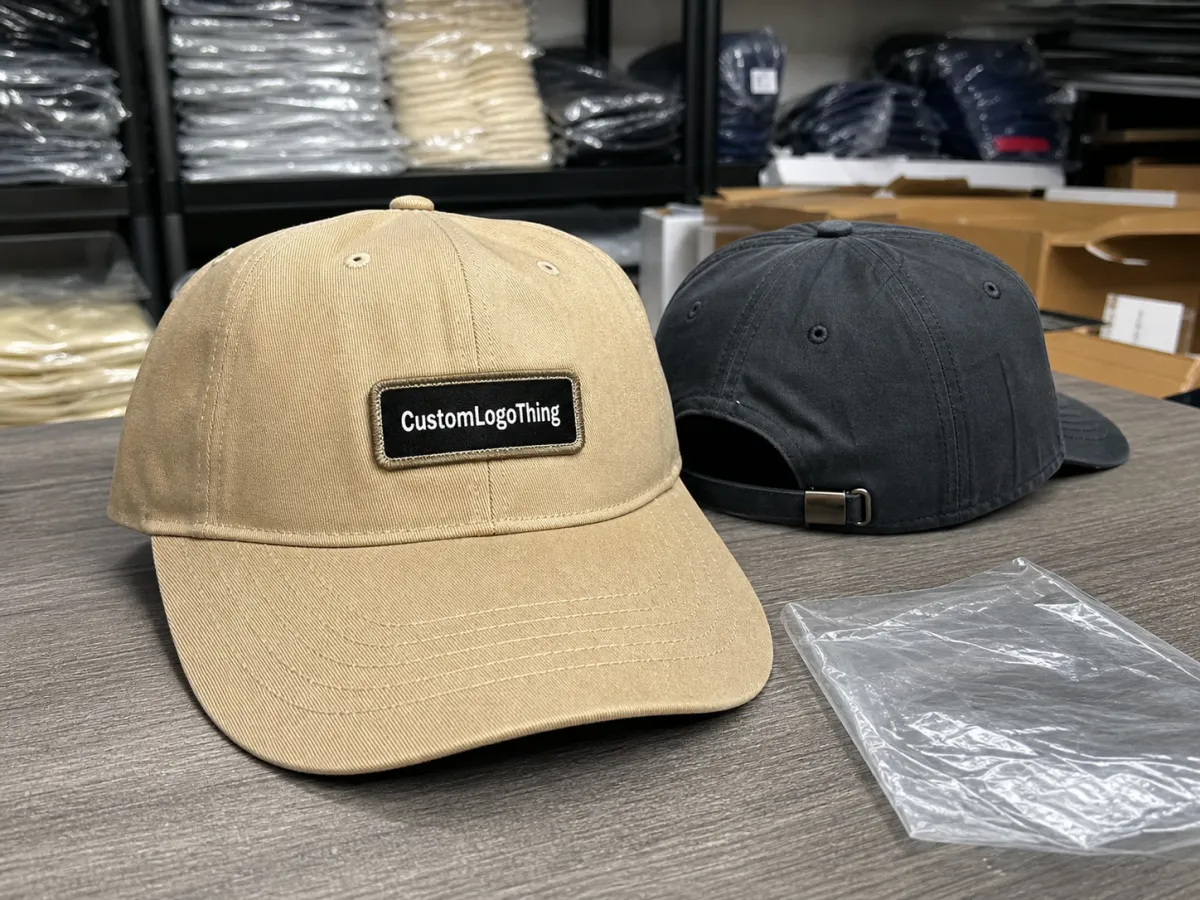
Decoration should follow the artwork, not the other way around. Embroidery adds depth, texture, and durability. It works especially well on structured crowns where the front panel can hold the stitch density without puckering. Woven patches give a cleaner graphic edge and are useful when the logo has small type or fine lines. PVC patches can deliver a more dimensional look and are often chosen when the brand wants something bold and easy to read from a distance. Print can work, but only when the surface area is adequate and the design is not trying to do too much.
For buyers comparing options before an apparel retail merch Caps Bulk Order, the following ranges are useful as a starting point. They are not universal. They do, however, reflect the way construction tends to affect both cost and shelf appeal.
| Style | Retail Read | Decoration Fit | Typical MOQ | Indicative Bulk Price |
|---|---|---|---|---|
| 5-panel | Flat-front, street-ready, minimal | Patches, embroidery, print | 100-300 | $4.25-$8.25 each |
| 6-panel structured | Classic retail shape, crisp front panel | Embroidery, woven patch | 100-250 | $4.00-$7.75 each |
| Dad hat / unstructured | Soft, casual, lifestyle-oriented | Small embroidery, low-profile patch | 150-300 | $4.50-$8.75 each |
| Trucker | Ventilated, familiar, high-contrast on shelf | Patches, embroidery, print | 200-500 | $3.75-$7.50 each |
| Snapback | Bold, recognizable, strong front branding | Embroidery, patch | 100-250 | $4.75-$9.25 each |
Those figures shift with blank quality, thread count, patch construction, and carton requirements. A slightly higher unit cost can still be the better buying decision if the cap feels more premium and holds its shape on the sales floor. Merchandising is full of these tradeoffs. The cheapest option is rarely the most profitable one.
Construction specs to lock before you place the order
Strong programs are built on exact specs, not loose descriptions. For an apparel retail merch caps bulk order, “black cap with logo” is not enough. A supplier needs to know the panel count, crown height, brim curve, closure type, stitching style, and where the decoration sits relative to the center seam. Without that detail, the quote may look right while the finished cap is wrong.
The best spec sheets stay short but precise. Include Pantone references for the cap body and the decoration. State the logo dimensions in inches or millimeters. Note whether the brand wants a high-profile or low-profile crown, a curved or flat brim, a metal buckle, a snap closure, or an adjustable strap. If there is a house standard for crown depth or logo placement, call it out. Those details decide whether the cap looks like part of a retail line or a one-off sample made in a hurry.
Sizing is often underestimated because caps are marketed as one size fits most. That works for a lot of assortment plans, but not all of them. Youth caps, deeper crowns, and broader closure ranges change both the fit and the production method. If the audience includes customers with larger head sizes or if the cap is meant for long daily wear, test the fit before approving bulk production. A cap that looks balanced on a table can sit too shallow in real use.
Packaging and labeling belong in the brief, not in a follow-up email. Ask for polybags if the retail channel requires them, barcode stickers if the warehouse scans at receiving, hang tags if the store uses them on the floor, and case pack counts if the distribution center has carton standards. If the order uses paper components, FSC-certified material may matter to your sourcing team; if the caps need to survive more aggressive transit, it is smart to reference ISTA distribution testing standards. For public sourcing references, FSC and ISTA are the most straightforward starting points.
One more practical point: request decoration mockups at actual size, not just in abstract. A logo can look balanced on a flat digital proof and still feel oversized once it is stitched onto a small front panel. That mismatch is common, and it is expensive to fix after production has started.
Spec discipline does not mean overengineering the order. It means removing the interpretations that create avoidable mistakes.
Bulk pricing, MOQ, and the real unit cost
The economics of an apparel retail merch caps bulk order usually come down to six line items: the blank cap, decoration, setup or digitizing, packaging, freight, and any custom trim or label work. Buyers often focus only on the unit price. That is a mistake. A quote that looks cheap can become the most expensive option once freight, carton handling, and rush charges are added.
MOQ changes with construction. A simple embroidered cap may qualify at a lower threshold because the factory can standardize the blank and move directly into stitching. Add a patch, special hardware, custom inner tape, or difficult color matching, and the minimum often rises. That is not arbitrary. Each extra step adds changeover time and more chances for variance.
The real question is not “What is the lowest price?” It is “At what quantity does the landed cost improve enough to justify the inventory risk?” That is where tiered quotes become useful. A 250-unit run may carry a higher unit price than a 500-unit run because setup gets spread over fewer pieces. The jump from 500 to 1,000 can sometimes be more efficient than it looks on paper. The numbers tell the story better than polished sales language.
Ask suppliers to separate sample cost, production cost, rush charge, and freight. A clean quote is easier to compare, and landed cost is the number that actually hits margin.
Indicative pricing on mid-volume runs often looks something like this:
- Simple embroidered cap: about $4.50-$8.50 per unit at 500-1,000 pieces, before freight.
- Patch cap with extra trim: about $6.50-$12.50 per unit, depending on patch type and placement.
- Premium retail build: about $8.00-$15.50 per unit when specialty fabric, custom labeling, or upgraded hardware is included.
Those ranges are broad because the variables are real. Stitch count, fabric weight, sweatband quality, and carton specs can move the cost in a noticeable way. If a quote lands far below those ranges, something may be missing. If it lands far above them, the supplier should be able to explain why in plain terms.
Buyers also need to watch hidden cost creep. A small design change after the sample stage can force a new digitizing file, another proof, or a packaging revision. Those are not catastrophic expenses, but they add up quickly when the order is time-sensitive.
Production timeline, approvals, and quality control
A cap order usually moves through the same sequence: brief intake, artwork review, mockup or proof, sample approval, production, quality check, packing, and shipment. The order can move quickly if the brief is complete and the approvals are fast. It can stall for days if the team debates placement, color, or packaging after the supplier has already started working from the wrong assumption.
The approval checkpoints that matter most are predictable. First, artwork placement. Second, color matching. Third, logo size and orientation. Fourth, packaging and labeling. Once those are signed off, the factory can cut, stitch, and pack with fewer interruptions. If they are still moving, the schedule becomes fragile.
Lead time depends on complexity. A straightforward embroidered cap can often move in about 12-15 business days after proof approval. A run with patches, special labels, or more custom components may take 20-30 business days or longer, especially when the supplier is working through peak-season demand or sourcing a less common fabric. Freight adds another layer. Domestic shipping, air freight, and ocean freight are not interchangeable, and a buyer should never assume they will land in the same window.
Quality control is where the best suppliers separate themselves from the merely responsive ones. A reliable program should check stitch density, logo placement, patch adhesion, brim shape, sweatband alignment, and closure consistency. If the cap is packed in cartons for retail receiving, the carton count and barcode labeling should be checked too. A wrong label on a good cap still slows down receiving.
Some buyers want a first article sample, some want a pre-production sample, and some want both. The right choice depends on how custom the order is. If the order uses a standard blank with a simple logo, one approval step may be enough. If the cap includes a custom patch, tonal embroidery, and a specific closure finish, a second sample can be worth the extra time. That extra step is often cheaper than correcting an entire run.
Documentation matters here. Keep the approved proof, color references, and packaging notes in one place so the reorder follows the same path. Caps are small enough that small changes are easy to miss, and that is exactly why they need a disciplined paper trail.
What a reliable cap supplier should be able to show
Do not buy on promises alone. Ask for proof. A dependable supplier should be able to show factory photos, sample photos, QC checkpoints, and a straightforward rework policy. If the logo is 3 mm off, if a patch color misses the approved reference, or if cartons are mislabeled, the supplier should be able to explain what happens next. That answer matters because retail operations do not forgive ambiguity at receiving.
Communication quality often predicts production quality. If a supplier responds quickly, flags tradeoffs clearly, and marks up proofs without turning every question into a sales pitch, the order usually moves with less friction. If the replies are vague, delayed, or overfilled with generic reassurance, expect the same pattern when the production schedule gets tight.
Reorder consistency is another useful test. Ask how the supplier stores the approved spec, artwork, and placement notes so the next run matches the first. With caps, small changes are noticeable. A crown that sits a little higher or a logo that drifts by a fraction can make a restock look out of place beside the original units on the shelf.
Operational questions should also be specific. Ask about overrun and underrun policy, carton labeling, freight coordination, and how the supplier handles shortages or excess units. If they cannot explain those basics, the buyer is being asked to absorb risk that should have been managed upstream.
A good supplier should also be able to identify the most likely failure point before production starts. That answer is more useful than a polished brochure. It reveals whether the factory understands the order or merely wants to collect it.
Getting an accurate quote without wasting a round of revisions
Before releasing an apparel retail merch caps bulk order, gather the inputs that actually affect price and timing: artwork files, target colors, preferred cap styles, quantity range, ship-to address, packaging requirements, and the date the goods must be in hand. If the buying team has a shelf-price target, include that too. A supplier can often recommend a construction that protects margin if they understand the retail ceiling early.
Channel context also matters. A stadium shop, a brand pop-up, a specialty retailer, and a broader wholesale program all reward different combinations of finish, price, and packaging. A premium wall-display cap is not the same brief as a high-turn trucker for a multi-store chain. The more clearly the channel is defined, the less likely the quote is to miss the mark.
Once the quote comes in, check it against the brief line by line. Make sure the sample method, production quantity, packaging, payment terms, and delivery milestones all match. Then compare the lead time, not just the price. A lower number does not help if the stock lands after the buying window closes.
A simple launch checklist keeps the process grounded:
- Confirm quantity by style and colorway.
- Approve artwork, placement, and decoration size.
- Verify packaging, labeling, and case pack details.
- Lock the ship date and transit method.
- Save the approved spec for the next reorder.
That workflow is not elaborate, but it protects margin and schedule integrity. If the order sits inside a broader sourcing plan, align it with your existing Wholesale Programs process so purchase approvals and receiving rules stay consistent across categories.
Good cap sourcing is not about chasing the cheapest piece. It is about landing a product that looks correct on the floor, survives the retail path, and can be reordered without a fresh round of guesswork. That is the real value behind a well-run apparel retail merch caps bulk order.
Frequently Asked Questions
What is a realistic MOQ for an apparel retail merch caps bulk order?
MOQ depends on the silhouette and decoration method. Simple embroidery often starts lower than patch-heavy or highly customized builds. Some suppliers can pool colors within one style, while others treat each colorway as a separate minimum. Ask for tiered pricing so you can see whether a larger run lowers the landed cost enough to justify the extra inventory.
How long does a retail merch cap bulk order usually take?
A straightforward order may move in about 12-15 business days after proof approval. More complex decoration, special fabrics, or custom labels can push that to 20-30 business days or more. Freight time sits on top of production time, so the delivery plan should always include transit, not just factory lead time.
Which cap styles sell best for retail merchandising orders?
Five-panel, six-panel, dad hats, and truckers cover most retail merchandising needs. Structured caps give logos a cleaner presentation, while unstructured styles feel softer and more lifestyle-driven. The better choice depends on the target customer, the brand positioning, and the shelf price you need to hold.
What artwork should I send for a bulk cap quote?
Send editable vector files such as AI, EPS, or PDF whenever possible. Include Pantone colors, exact text, and the intended decoration placement. If the art is not vector-ready, ask whether the supplier can redraw it before the order is quoted.
Can I mix colors or styles in one apparel retail merch caps bulk order?
Usually yes, but every style or decoration variation can affect MOQ and pricing. Ask whether the supplier counts mixed colors toward one pooled total or separate minimums. Keep the program simple if the priority is faster production and Lower Unit Cost.
What should I check before approving a cap sample?
Check crown shape, brim curve, logo placement, thread tension, patch alignment, closure quality, and inside finish. The sample should match the approved artwork and the retail standard you are trying to hit. If it looks different in the hand than it did on screen, fix that before production starts.