For a bakery buyer, a bakery frosted zipper bags Unit Cost Review is not a hunt for the cheapest line item. It is a check on whether the package supports the product, protects freshness, and looks right under retail lighting. A bag that saves a cent but weakens the presentation can cost more in the long run than a slightly higher-priced option that moves product faster.
Frosted Zipper Bags keep showing up in bakery packaging because they solve several problems at once. The frosted surface softens glare and fingerprints, the zipper adds reseal value, and the format sits in a useful middle ground between a basic pouch and a rigid gift box. That balance matters for cookies, pastry bites, granola, and other dry bakery items that need to feel polished without overpackaging.
There is also a practical buyer reason these bags keep getting chosen: they are easier to standardize than many specialty bakery packs. One size can often cover several SKUs, provided the fill weights are close and the product shape behaves well in the pouch. That flexibility can reduce inventory clutter and simplify reorder planning.
Why Frosted Zipper Bags Change Bakery Shelf Appeal
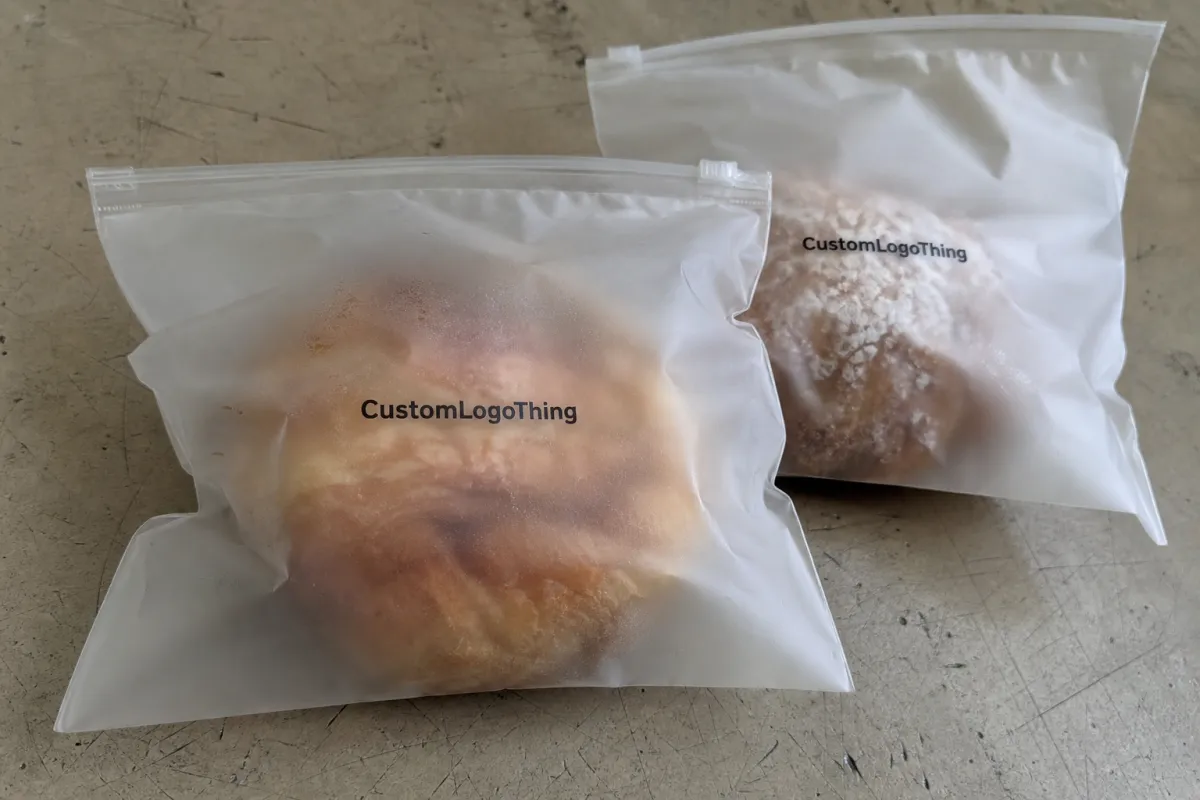
A frosted finish changes the first read of a product. Clear glossy film can look bright, but it also catches light, shows scuffs quickly, and can make a shelf look busy if there are several SKUs stacked close together. Frosted film diffuses that glare, so the package reads cleaner from a few feet away. In a crowded bakery set, that matters more than most buyers admit.
The effect is not only cosmetic. A cleaner surface can make the bag seem more consistent from case to case, especially after handling during packing, transport, or store stocking. That consistency influences perceived quality, which is why packaging teams often treat finish selection as part of the product strategy rather than a finishing touch.
The zipper adds another layer of value. Customers understand resealability immediately. If the contents are dry and the portion size is reasonable, a zipper suggests convenience and helps the product stay usable after opening. For many bakery buyers, that creates enough utility to justify a small price increase, especially on products meant to be shared over more than one sitting.
That said, the zipper should be judged on function, not theory. Some closures feel tight at first but weaken with repeated use. Others close reliably but are awkward to align on a production line. A useful Unit Cost Review includes the closure experience, because a low-cost zipper that frustrates packers or end users is not really low cost.
There is a real comparison here with rigid packaging. Boxes offer structure, but they bring more material, more freight volume, and often more assembly steps. Frosted zipper bags do not replace boxes in every case, yet they can deliver a more premium look than a plain poly bag while staying far lighter and cheaper than a carton system. That is why they are common in mid-tier bakery programs that need retail appeal without inflated packaging spend.
"Packaging has two jobs here: it has to protect the contents, and it has to earn its shelf space before the customer tastes anything."
One practical observation from sourcing work: the bag itself may not need to be fancy to look good. Good dimensions, a clean seal, a consistent frost level, and a closure that feels deliberate often matter more than extra decoration. If the product is strong, the package should frame it instead of overpowering it.
Product Details: Frosted Finish, Zipper Seal, and Bakery Use
Most frosted zipper bakery bags use a multilayer plastic film built for light barrier, seal strength, and visual softness. A common structure is a PET/PE or similar laminate, though exact construction varies by supplier and food-use requirement. The outer layer gives the frosted look and handling strength, while the inner layer handles product contact and sealing behavior.
The finish can be a light frost or a more opaque matte effect. Light frost keeps more product visibility and works well when the item inside is part of the sell. Heavier frost hides more of the contents and creates a more curated, giftable look. Neither is automatically better. The right choice depends on whether the bakery item needs to be seen clearly or presented more like a branded collection.
Closure style matters just as much as the film. A press-to-close zipper is usually enough for dry bakery products that do not need repeated heavy-duty opening. A more defined interlocking zipper can offer a stronger feel and better reclosure behavior, but it can also raise cost and sometimes slow packing if the closure alignment is less forgiving. For bags used by consumers, that tactile difference can shape the perceived quality of the whole package.
These bags are commonly used for:
- Cookies, biscotti, and biscuit assortments
- Scones, mini loaves, and pastry portions
- Granola clusters and dry snack mixes
- Tea biscuits and gift-pack bakery assortments
Buyers often ask about structure because bakery products vary more than they first appear. A soft cookie assortment and a denser, sharper-edged snack mix do not behave the same way in a pouch. Product shape can affect seal pressure, package fullness, and how cleanly the zipper area closes after filling. A bag that looks ideal on paper may feel cramped once the real product is loaded.
Gussets, hang holes, and tear notches are small features that can alter both unit cost and usability. A gusset gives the bag more standing ability and can improve shelf presentation. A hang hole supports peg display in some retail setups. A tear notch makes opening easier and can reduce customer frustration, especially if the zipper is tight and the outer seal is heat-closed.
Print coverage also changes the buying equation. A simple one-color logo near the top is easier to price than full-panel art with large ink coverage. If the brand wants the product to feel premium, though, that extra print area may be worth the added cost. This is where a packaging review stops being a price comparison and becomes a visual merchandising decision.
One caution: the frosted finish should not hide the product so much that the buyer cannot recognize what is inside. If the bakery item has visual appeal, allow enough transparency or window area to show it. If the product itself is not the main attraction, a stronger frost can help create a more controlled brand look. The best setting depends on the product story, not on the packaging trend of the moment.
Specifications to Confirm Before You Request Samples
If the specification is loose, the pricing will be loose too. Before asking for samples, define the finished width, height, gusset depth if needed, zipper style, film thickness, and whether the bag should be flat or stand-up. Those details determine fit, fill behavior, and how much material the supplier needs to build the bag properly.
For bakery use, the fill weight and shape of the product should be included from the start. A light cookie assortment, a dense granola cluster, and a pastry bite with sharp corners can all require different bag geometry. The zipper can also behave differently depending on how full the pouch is. Too much product near the top can interfere with closure; too little can make the bag look underfilled and thin on shelf.
Printing decisions should be specified early as well. A small logo on one panel is not the same as full-surface branding. Ink coverage changes not just appearance, but cost, drying behavior, and the likelihood of surface inconsistency. If the bag will be displayed under strong lights, a heavier frost level may improve the look. If shoppers need to identify flavor or texture quickly, more visibility may be the better tradeoff.
Before sample approval, confirm these points:
- Finished width, height, and gusset depth
- Film thickness and zipper type
- Artwork coverage and logo placement
- Food-contact expectations and sealing method
- Case pack requirements and target fill weight
It also helps to ask how the sample was made. A hand-cut proof can look close but still behave differently from a machine-run production bag. The difference shows up in seal consistency, zipper alignment, and edge finish. Buyers who only compare appearance sometimes approve a sample that is not process-close, then discover the mismatch after production starts.
For broader packaging guidance, third-party resources can be useful as reference points. Food-contact decisions and transit considerations often sit beside industry standards and testing expectations. If you need a baseline for logistics or packaging development, the Packaging Association and the International Safe Transit Association are reasonable places to check how packaging is typically evaluated.
A good sample review should answer one question: will this bag run cleanly on the actual line? If the answer is uncertain, the sample still needs work. A nice-looking pouch that jams at filling or closes unevenly is not ready for a bakery rollout.
Unit Cost, Pricing, and MOQ for Bakery Orders
In a bakery frosted zipper bags Unit Cost Review, the main cost drivers are usually predictable. Bag size, film gauge, zipper type, print complexity, and order quantity do the heavy lifting. A larger bag uses more material. A heavier film adds strength and thickness. A more specialized zipper or a higher-coverage print increases setup and production cost.
MOQ is where many buyers get surprised. Stock frosted zipper bags can often be ordered in lower volumes because the structure already exists. Custom sizes, custom print, and unusual gusseting usually raise MOQ because the manufacturer has to dedicate material and machine time to that specific job. If a supplier gives a very low entry point on a custom bag, ask what is being reused, simplified, or excluded.
Unit price and landed cost are not the same thing. A quote that looks attractive can change after freight, carton count, and destination handling are added. Smaller cartons may be easier to move, but they can raise shipping cost. Larger cartons may lower freight per unit, but they need better warehouse handling and more disciplined packing. The cheapest bag on paper can turn into the less favorable option once it lands.
| Option | Typical MOQ | Approx. Unit Cost | Best For |
|---|---|---|---|
| Stock frosted zipper bag, unprinted | 1,000-3,000 pcs | $0.12-$0.24 | Fast replenishment and lower risk |
| Custom size, unprinted | 5,000-10,000 pcs | $0.16-$0.30 | Exact fit for a specific bakery item |
| Custom printed frosted zipper bag | 10,000-20,000 pcs | $0.22-$0.45 | Retail branding and stronger shelf presence |
| Heavier gauge, high-coverage print | 20,000+ pcs | $0.30-$0.60 | Premium lines and larger rollouts |
Those ranges are practical, not universal. A small change in width, zipper profile, or print coverage can move the quote more than expected. Material markets also shift. Resin cost, packaging demand, and freight conditions all affect supplier pricing, even when the bag specification itself has not changed.
Bulk pricing usually improves with volume, but the breakpoints are not always neat. Sometimes a manufacturer hits a machine-efficiency threshold at a specific quantity, and the next price tier becomes meaningfully better. Sometimes the break is only modest. It is worth asking where the actual thresholds sit rather than assuming a larger order automatically gives a better rate.
For a clean comparison, ask each supplier to quote the same basis: stock or custom, printed or unprinted, film thickness, zipper style, carton count, and destination. If one quote leaves out the zipper detail or the packing format, the comparison is incomplete. A lower line-item price can hide a thinner film or a weaker closure, both of which matter in bakery use.
Lead Time and Production Steps From Approval to Ship Date
The strongest production timeline starts with clear input. The supplier needs dimensions, estimated quantity, print files, zipper preference, and a target ship date before they can tell whether the order fits a stock line or requires a custom run. If any of that is missing, the schedule usually expands later, not sooner.
The usual process is simple in theory: inquiry, spec confirmation, artwork review, proof or sample approval, production, inspection, packing, and shipment. The part that slows orders down is not the manufacturing itself. It is the approval chain. A small print correction, a revised dimension, or a late change in closure type can push a run back several days.
Stock-based bags are faster because the structure already exists. Custom printed orders need more coordination around film, color, print registration, and packing format. In practice, straightforward custom jobs often land around the 12-15 business day window after approval, while more complex runs may take longer if the artwork changes, the zipper must be sourced differently, or the bag needs nonstandard pack-out requirements.
Two checkpoints deserve close attention:
- Proof approval: confirm size, logo placement, and print color before the run starts
- Final quantity confirmation: verify carton count and case pack so shipping and receiving stay aligned
Inspection should not be treated as optional. A reliable supplier checks zipper closure, bag dimensions, print alignment, seal quality, and visible surface defects before packing. That matters more on bakery orders than some buyers expect, because a slight defect can become very visible on a shelf full of similar-looking items. If the packaging is for a launch or a chain rollout, ask how the approved sample is linked to the production run so there is no confusion later.
The best lead times are not the shortest ones. The best are the ones that stay stable. A slightly slower schedule is easier to live with than a rush order that arrives with zipper inconsistencies, print drift, or a frost level that differs from the approved sample. Once product is filled and boxed, the cost of correction rises quickly.
What a Reliable Bakery Packaging Supplier Should Prove
A reliable supplier should show, not just describe. For frosted zipper bakery packaging, that means consistent dimensions, dependable zipper closure, a clean frosted surface, and repeatable print quality across the full order. If tolerances matter, the supplier should be able to explain them in plain language. That is especially important when the bag must run on a filling line with limited room for variation.
Documentation is another good sign. A supplier that clearly states film construction, material options, packing format, and sample control is easier to work with during both the first order and reorders. That matters when a bakery has multiple SKUs and wants the same family look across the line, changing only the print, size, or closure detail from item to item.
I also look for honesty about tradeoffs. Heavier film may improve stiffness and reduce scuffing, but it raises cost. A stronger zipper may feel better in hand, but it can add complexity. Buyers do not need polished language. They need a direct answer about what the bag does well, where the limits are, and how the quote changes if they want a lower MOQ or a faster schedule.
For broader packaging programs, especially ones that include cartons, inserts, or display components, sourcing standards can matter beyond the pouch itself. If your package system includes paper-based elements, the Forest Stewardship Council is a familiar reference for responsible fiber sourcing. That does not replace product testing, but it can help buyers evaluate the packaging stack as a whole.
Reorders are where the real supplier test begins. The first order is about approval. The second order is about consistency. If the frost level changes, the zipper feel shifts, or the print sits differently, the supplier is not really controlling the process. In bakery packaging, that kind of drift can be more disruptive than a slightly higher initial quote from a more dependable source.
Ask for sample support, clear communication, and written confirmation of the approved spec. Those three things reduce surprises more effectively than a low first price. If a supplier is vague on any one of them, the risk usually appears later in production or in warehouse receiving.
Next Steps for a Clean Quote and Sample Comparison
If the goal is a useful quote, send the real variables. Finished dimensions, estimated quantity, print artwork, zipper preference, food-contact expectations, and target ship date should all be included. If you know the product weight and packaging format, add that too. A bakery frosted zipper bags Unit Cost Review is only as accurate as the information behind it.
Once samples arrive, compare them side by side. Look at how they read under normal store lighting, how the zipper feels during repeated opening and closing, how the film holds its shape, and whether the print stays sharp at the edges. If one bag looks better but costs more, the question is not whether it is nicer. The question is whether the visual lift justifies the price difference in your retail math.
It is also smarter to compare landed cost than to judge unit price alone. Freight, carton count, and setup charges belong in the same calculation. Two quotes that seem close can separate quickly once shipping and packing assumptions are added. In that situation, the better choice is often the one with cleaner communication and a lower chance of rework, not the one with the prettiest headline number.
Practical next steps:
- Confirm bag size, zipper style, and print scope
- Request two or three sample options
- Review unit cost and landed cost together
- Check MOQ, bulk pricing tiers, and delivery timing
- Choose the bag that fits the product, not just the budget
For bakery packaging, the right bag is usually the one that stays consistent across runs, protects the contents, and makes the product look cared for without forcing the price beyond what the item can support. If the spec is clear and the sample review is disciplined, the sourcing decision gets much easier.
What drives bakery frosted zipper bags unit cost the most?
Bag size, film thickness, and zipper style usually have the biggest impact on unit price. Print coverage, custom sizing, and lower quantities can raise cost quickly. Freight and carton configuration also affect the landed cost buyers actually pay.
Can I order frosted bakery zipper bags with a low MOQ?
Yes, but stock structures usually allow lower minimums than fully custom printed bags. A smaller MOQ is easier when the size and material already match a standard run. If you need a very specific shape or print layout, expect a higher entry quantity.
Are frosted zipper bags better than clear bags for bakery items?
Frosted bags usually create a softer, more premium look and hide scuffs or fingerprints better. Clear bags show product color and texture more directly, which can help when the food itself is the main selling point. The better choice depends on whether the buyer values visibility, presentation, or a balance of both.
What should I send for an accurate bakery frosted zipper bags quote?
Provide finished dimensions, estimated quantity, and whether the bag needs a gusset or hang hole. Share print artwork, zipper preference, and any food-contact or packaging requirements. Include your ship-to location and target timeline so pricing reflects the real landed cost.
How long does production usually take after approval?
Lead time depends on whether the order is stock-based or a custom printed run. Artwork approval, sample confirmation, and quantity all influence the production schedule. Ask for the timeline in writing so you can plan bakery launches and restocks with less risk.

