Two beanies can look nearly identical on a spec sheet, then behave very differently once they reach a buyer. One feels finished because the label sits flat, the logo reads clearly, and the trim lines up with the cuff. The other looks a little off before anyone even tries it on. That is why beauty woven label Beanies Bulk Order Planning should start with the label, not the knit.
From a merchandising standpoint, the label is not a small decorative add-on. It is the first brand cue on folded retail beanies, and often the only part a customer notices before the product is handled. A woven label can elevate a simple acrylic cap into something that reads premium. A crooked weave, fuzzy thread, or mismatched color can do the opposite. The fabric may be fine; the perceived value still drops.
That gap between technical quality and customer perception is what makes headwear tricky. A label that looks acceptable on screen may fail once it is stitched to a cuff, stretched over a headform, packed under pressure, and opened by a buyer expecting crisp branding. Bulk Order Planning needs to account for those physical realities early, or the quote that looked clean on Monday turns into rework by Friday.
Why beauty woven label beanies bulk order planning starts with the label, not the knit
Most avoidable delays start with a late label decision. The body color is approved, yarn is reserved, and then someone asks for a wider logo, a different fold, or a placement shift by a few millimeters. On paper, that sounds harmless. In production, it can force a fresh proof, a new sample, and sometimes a new slot in the line.
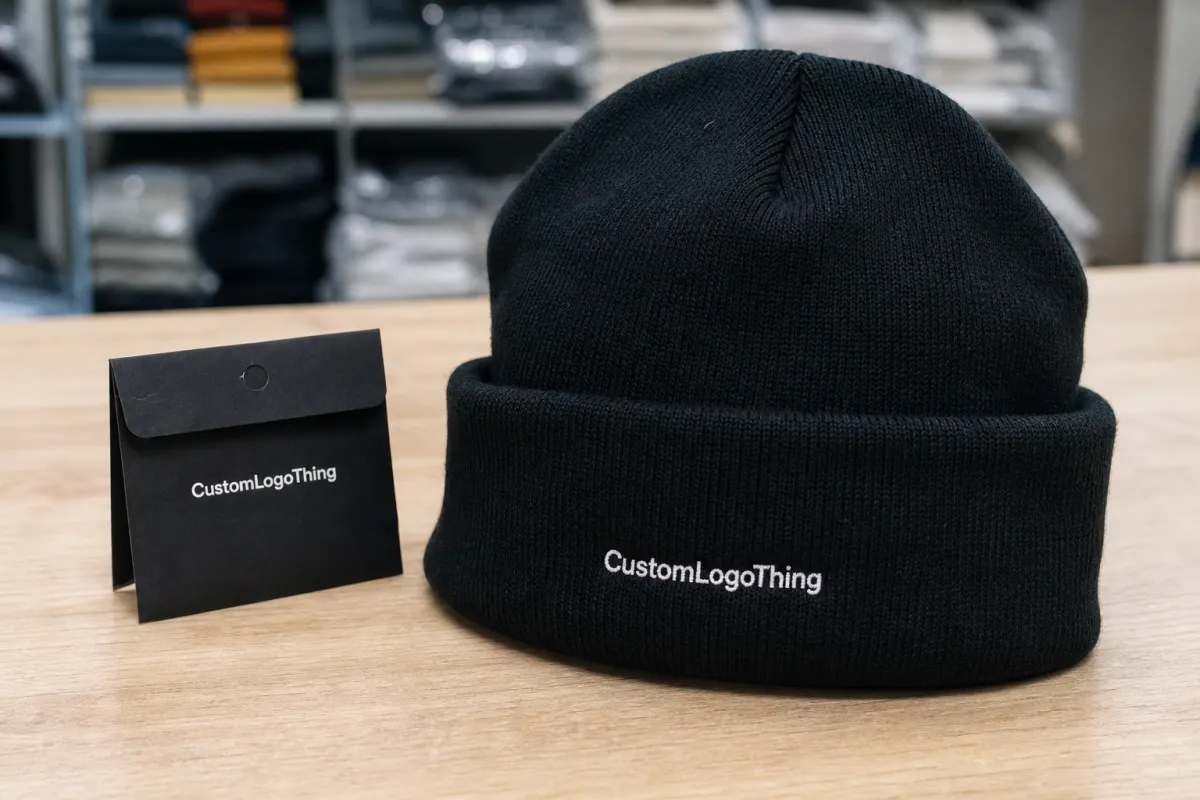
Woven label size, fold style, and placement shape how the beanie reads at first glance. A 30 mm x 40 mm center-fold label on a cuffed beanie gives the brand more presence than a 20 mm side-seam tag on an uncuffed style. Neither is automatically better. They solve different problems. The larger label helps a brand stand out on retail shelves. The smaller one lets the knit stay visually quiet.
Cuffed beanies usually give the best visibility because they present a flatter front panel and a natural stage for branding. Seam-side placement can look cleaner on some minimal styles, but it is easier to lose once the cuff is folded or the beanie is photographed from a slight angle. On stretched styles, even a small placement error can make the label look tilted or too close to the edge.
The planning mistake is simple: locking body color and trim before the woven label spec is final. That creates a false sense of readiness. The order is not truly ready until the artwork, fold, stitch method, and exact position are locked together. Once those pieces are fixed, the rest of the job becomes more predictable, and the buyer has something real to approve instead of a guess dressed up as a sample.
If you are comparing label constructions before selecting the full beanie, our Custom Labels & Tags page is a practical place to start. It helps separate the label decision from the headwear decision, which is usually the cleaner way to manage a bulk order.
Pick the right beanie body before you approve trims
Cuffed beanies are the safest starting point for most brands. They give you a defined front surface, stronger label visibility, and a retail-friendly profile. Uncuffed beanies can feel lighter and more casual, but the branding has less structure to sit on. That matters more than many buyers expect, especially if the logo contains fine detail or thin lines.
Acrylic bodies usually sit at the lower end of the cost range and work well for promo programs, events, schools, and large-volume drops. Acrylic-wool blends cost more, but they usually deliver a softer handfeel and a warmer perception. Recycled yarns can support a sustainability message, yet they often knit with slightly more texture variation. That is not a defect; it is a material reality. If the buyer expects a perfectly uniform surface, recycled content needs to be discussed early.
Knit gauge affects label performance as much as color or fit. A tighter gauge creates a flatter surface, which helps the label sit cleanly and reduces edge warping. A looser knit stretches more and can distort the trim once the beanie is worn. On long rib cuffs, that movement can make a centered label look subtly off even when the placement was correct at the factory.
Fit and use case should guide the spec. Retail buyers usually want better handfeel, cleaner finishing, and packaging that makes the item display-ready. Teamwear buyers care more about repeatability and size consistency. Giveaway programs care most about landed cost and speed. Those goals do not always align, so the safest spec is the one that fits the business model instead of the one that sounds nicest in a sales deck.
Packaging should be part of the discussion before production begins. Individual polybags, hang tags, barcode stickers, and insert cards all change packing time, carton weight, and freight cost. If the beanie uses paper hang tags, FSC-certified stock is a sensible request for buyers who need a documented paper source. If shipping durability matters, the testing guidance from ista.org is useful because a retail product that survives packing pressure is usually the same one that survives distribution. Packaging failures rarely look dramatic in the factory. They show up later as dented cartons, torn labels, and rework at the warehouse.
Woven label specs to lock before production
A label should never be approved from artwork alone. The physical spec matters just as much as the design file. That spec should include finished size, fold type, edge finish, stitch method, and thread count. A woven label that looks sharp on a screen can behave very differently once it is woven at a small size and stitched into a stretchable knit.
The practical checklist is straightforward. Confirm the width and height. Confirm whether the label is center fold, end fold, Manhattan fold, or flat cut. Confirm where the seams will land. Confirm the thread colors with reference codes or physical swatches, not vague language like “cream” or “navy.” Those words are interpreted differently by different mills, and that is how a supposedly simple order ends up with a color mismatch.
Placement needs measurements, not assumptions. A label placed 12 mm from the cuff edge is not the same as one placed 20 mm away once the knit stretches and the cuff settles. Ask for the distance from the seam, the fold line, or the top edge, depending on the style. A single measurement sounds small, but it can prevent a whole shipment from looking slightly crooked in retail.
Fine lettering is another common failure point. Very small type, thin strokes, and stacked text often lose clarity in weaving. If a logo relies on tiny details, it usually needs simplification before sample approval. That can be a hard conversation because buyers want the original artwork preserved exactly. Still, a slightly simplified mark usually reads better on fabric than a perfect digital file squeezed into a label that is too small to support it.
Thread choice matters too. Polyester is common because it holds color well and stands up to wear, while satin-like finishes can look richer but may make tiny details harder to read. Damask woven labels are generally better for sharper detail than heavier, shinier constructions at the same scale. None of this is glamorous, but it is the difference between a label that looks premium and one that looks crowded.
If the proof looks fine but the measurement is vague, approval is premature. You do not have certainty yet; you have a guess.
The best proof is not a standalone label image. It is a mockup on the actual beanie body, shown with the correct fold, stitch direction, and placement in context. That is the point where proportion becomes obvious. A label that feels balanced on a flat artboard can look oversized once it is stitched to a tight cuff. If the supplier also handles broader production, this is the right stage to compare repeat styles inside our Wholesale Programs before the order is released.
Pricing, MOQ, and what actually moves unit cost
Unit cost is not just a function of quantity. It is driven by the label design, yarn blend, number of colors, packaging, setup work, and how many approval rounds the job requires before production starts. A quote with a low base price can turn expensive quickly if every revision carries a fee or if freight was left out of the first conversation.
Separate sample cost from production cost. A sample may run about $35 to $120 depending on the label complexity and the body style. Setup charges often sit in the $20 to $80 range for custom knit or label preparation. Freight is its own line. If a supplier wraps everything into one vague number, compare that quote carefully. “All in” is only helpful when it is truly complete.
| Order type | Typical MOQ | Unit cost range | Best for | Main tradeoff |
|---|---|---|---|---|
| Simple acrylic cuffed beanie with one woven label | 300-500 pcs | $2.10-$3.20 | Giveaways, promo launches, first test runs | Lower cost, fewer decoration options |
| Acrylic-wool blend with custom woven label and private packaging | 500-1,000 pcs | $2.80-$4.10 | Retail, branded merchandising, teamwear | Better handfeel, higher minimums |
| Recycled yarn body with detailed woven label and hang tag | 1,000+ pcs | $3.10-$4.80 | Brand stories, sustainability-led programs | More variable knit texture and tighter approval needs |
The table is directional, not universal. Stitch density, label size, packaging rules, and color count can move the price more than a buyer expects. More colors usually increase setup complexity and can raise the minimum or the unit cost because the weave takes longer to program and run. The savings curve also flattens out after a certain point. Moving from 500 pieces to 1,000 pieces often saves more than moving from 5,000 to 8,000.
If you are comparing suppliers, compare the same product against the same product. Same body. Same label dimensions. Same fold. Same packaging. Same lead time. Otherwise the comparison is meaningless. A cheaper quote for a different spec is not cheaper; it is simply a different order with a different level of risk.
Production steps and lead time for bulk beanie orders
A normal order path usually moves through inquiry, artwork review, digital mockup, sample or pre-production approval, bulk production, inspection, packing, and shipment. If any one of those stages gets muddy, the schedule slips. Artwork causes many of the problems. Slow feedback from the buyer causes a few more. Occasionally the issue is a color target that was never specified clearly enough for production to hit it.
For standard orders, a workable planning window is roughly 12 to 18 business days after proof approval for production, then freight time on top of that. If the label is complex, the knit is dense, or the packing includes custom inserts or multiple SKUs, the schedule can stretch to 18 to 25 business days. Rush runs can sometimes be done in 7 to 10 business days, but they narrow material choices and usually increase cost. Speed always has a price, even when it is not listed as a separate line.
Peak season needs more cushion than most buyers build in. If a launch date is fixed, the order should be placed early enough to absorb at least one round of changes. A missed sell-in window is often more expensive than a slightly higher unit cost. That is one reason beauty Woven Label Beanies Bulk Order Planning should follow the actual ship date, not the date a team hopes everything will happen to align.
Inspection and packing deserve more attention than they get. Ask how cartons are counted, whether color splits are packed separately, and whether mixed assortments change handling time. Mixed colors are possible, but they affect yarn allocation and pack-out complexity. If the first run is meant to move quickly, a simple spec usually performs better than a highly customized one. Variety is easiest after the base program is stable.
One practical rule saves time: if the artwork file is not final, the schedule is not final either. Send vector files, exact color references, the beanie style, the quantity split, and the packaging request together. That gives the factory enough information to produce a real timeline instead of a hopeful estimate that collapses later.
Why a factory that handles labels, beanies, and packing lowers risk
One team controlling the body, trim, and final packing usually means fewer errors. That sounds obvious because it is. If the label is sourced separately from the knit and the packing is handled somewhere else, every transfer introduces another chance for a mismatch in color, placement, or count.
Integrated coordination helps with consistency. The same team can check logo shade, knit gauge, label placement, stitch tension, and carton count before the order leaves the line. That matters because the approved sample only protects the buyer if the bulk run matches it closely enough to be repeatable. “Close enough” is not a useful standard once the goods reach a retailer or distributor.
Repeat orders are where good process really shows up. Buyers do not want to rebuild the spec every time they place the same style again. They want the same label color, the same fit, and the same packing format without having to renegotiate the job. A clean spec sheet and stored artwork save time on the second order, and they reduce the odds of a subtle change slipping through.
This is also where quality control becomes practical rather than theoretical. A factory that understands the difference between a visual proof and a production proof is more likely to catch problems early. That includes things like stretched label distortion, off-center stitching, inconsistent cuff height, and carton counts that do not match the purchase order. The buyer usually sees the finished product; the factory has to see the failure before it leaves.
For shipping-sensitive programs, ask whether cartons are packed to survive standard distribution rather than just leaving the factory neatly stacked. That distinction matters more than it sounds. A carton that looks tidy on a pallet can still crush under transit pressure if the packing method is weak. Better pack-out habits usually mean fewer damaged units, fewer chargebacks, and fewer surprises on arrival.
Next steps to request a clean quote and avoid delays
Send a quote request with enough detail to produce a useful answer. Start with the logo file, preferred beanie style, target colors, quantity split by color, packaging request, and required delivery date. If you already have a reference sample or a competitor piece, include that too. A physical reference gives the supplier something concrete to compare against, which usually produces a more accurate quote than a written description alone.
Ask for the pricing in separate lines: sample, unit cost, setup, freight, and packing add-ons. That makes comparison easier and exposes hidden assumptions. Also ask for a mockup on the actual beanie body before production release. A flat label proof is not enough if the knit structure changes how the trim sits on the cuff.
Confirm reorder rules early. Ask where the artwork will be stored, whether the label color can be matched on repeat runs, and what the minimum reorder quantity will be. If the program may repeat six months later, the first order should be documented as if it will be re-run. That is how a brand avoids relearning the same details every season.
Beauty woven label Beanies Bulk Order Planning works best when the spec, price, and timeline are fixed before the first sample is approved. The strongest orders are not the most complicated ones. They are the ones with clear measurements, realistic timing, and enough margin built into the process to absorb one small correction without collapsing the schedule.
FAQ
How far ahead should I plan a woven label beanie bulk order?
Plan earlier if you need custom yarn colors, a detailed woven label, or private packaging. Standard orders still need time for proofing, sample approval, production, and freight. Rush orders can work, but they narrow options and usually raise unit cost. A short timeline also leaves less room for correction if the first proof needs changes.
What changes the MOQ for beauty woven label beanies?
The main drivers are label complexity, body style, yarn blend, and packaging requirements. More colors or more detailed weaving usually push the MOQ higher. Simple repeat orders often qualify for easier reorder terms than first-time custom runs because the setup is already locked.
Can I mix colors in one bulk beanie order?
Yes, but the total quantity and color split need to be confirmed before quoting. Mixed colors affect yarn allocation, packing, and lead time. The more colorways you add, the less likely you are to get the lowest unit price. Mixed runs can still work well when the order structure is clear from the start.
What files do you need for a woven label beanie quote?
Send a vector logo file, your preferred colors, the beanie style, and the expected quantity. Include label placement notes, packaging needs, and the target delivery date. A reference sample is helpful because it gives the supplier a real benchmark instead of a description that may be interpreted differently.
How do I compare two bulk order quotes without missing hidden costs?
Compare the quote line by line: sample, unit price, setup, freight, and packing. Check that both vendors are quoting the same beanie body, label spec, and lead time. The cheapest quote is not the cheapest order if the sample is wrong or the shipment misses the launch window. A clean quote should let you see the full cost structure without guessing where the missing pieces went.


