Beauty Woven Label Beanies Material Sample Ordering Guide
The beauty woven label Beanies Material Sample guide matters because a label can look perfectly clean on a flat card and still feel scratchy, curl at the edge, or lose stitch clarity once it is sewn into a knit cuff. From a packaging and product buyer point of view, the first impression is not just visual; it is hand feel, edge softness, density, and whether the label still reads clearly after it bends around the beanie.
That is why a material sample is more than a color chip. It is a small proof of yarn choice, weave density, backing, trimming, and finishing, all of which affect how the label behaves on the final beanie. If you are comparing options for a production run, treat the sample as a decision tool, not as a souvenir.
Beauty woven label beanies material sample: what buyers notice first
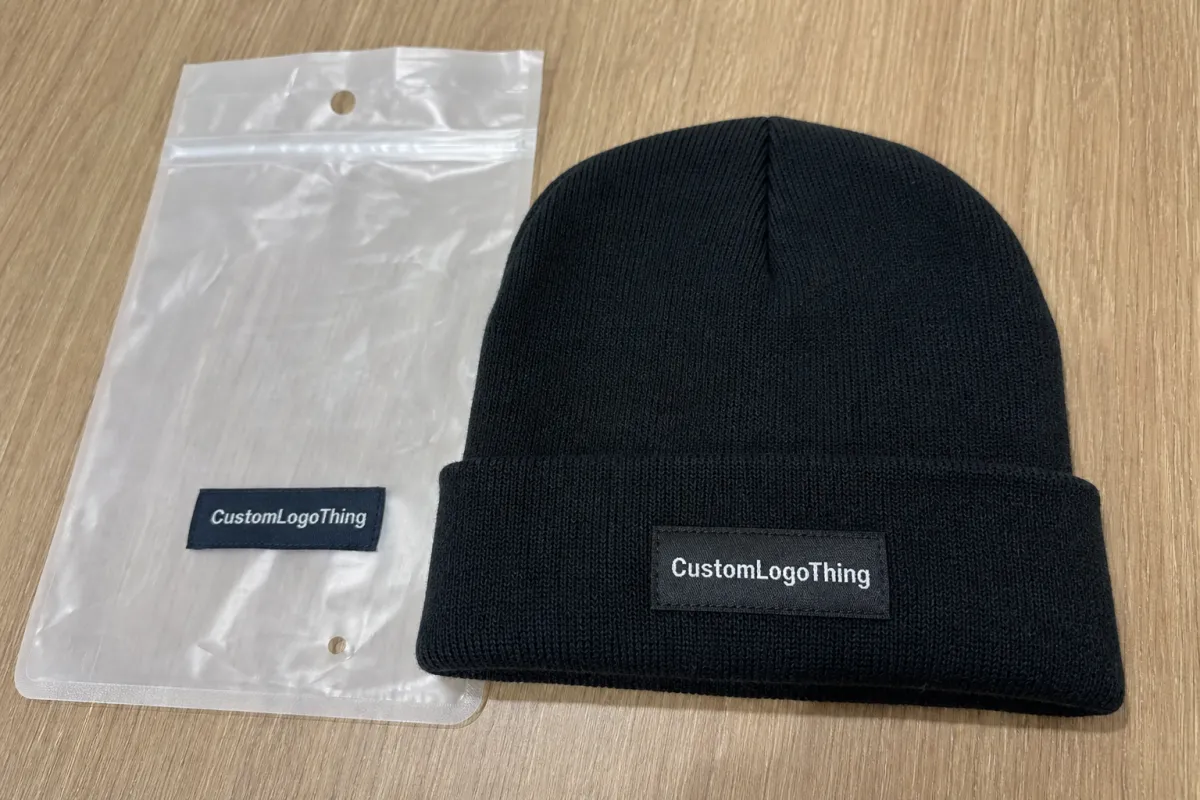
In practice, buyers notice the label with their fingertips before they notice it with their eyes. A woven label that looks sharp in a photo may still have a rough cut edge, a stiff backing, or a weave that feels too dense once it is stitched onto rib knit or jersey lining. The beauty Woven Label Beanies material sample guide starts here because the sample has to answer a basic question: will this feel like a premium finish on the actual hat, or only on paper?
Most buyers judge four things right away: hand feel, edge softness, stitch clarity, and how the label sits on curved fabric. If the beanie is a cuffed style, the label often sits right where fingers brush the surface, so a sharp edge or a stiff fold is easy to catch. If the beanie is a slouch style, the label may move more and reveal problems with trimming or backing that were not obvious in a flat proof.
A real material sample should reflect the actual yarn type, loom density, backing method, and finishing process you plan to use in production. That means it should not be treated like a generic swatch. If the final piece will be sewn onto a stretch knit, the sample should be tested in that same environment, because a woven label can behave very differently once it is pulled, stitched, and washed.
One simple rule helps buyers stay grounded: if the sample does not survive a quick tactile check and a quick on-garment check, it is not ready for approval. The point is not to chase perfection in the abstract; the point is to approve a label that will still look intentional after real use.
How woven label samples translate to finished beanies
A good beauty Woven Label Beanies material sample guide order should help you see the path from the sample card to the sewn label. On a card, a label can appear flatter, cleaner, and more symmetrical than it will on a beanie cuff. Once the label is folded, trimmed, and stitched, thread tension and knit stretch start changing the visual balance. Thin lettering may soften slightly, tight corners may open up, and small icons can lose definition if the weave is too open for the artwork.
That is why I always suggest buyers look at the sample in context. Put it against the actual beanie fabric, not a generic knit scrap. A 25 mm woven tab on a dense acrylic cuff will read differently than the same label on a looser recycled knit blank. The body fabric matters because it changes contrast, drape, and how much the label edges are forced to flex.
If your artwork includes thin lines, small type, or fine symbols, ask whether the sample reflects the same loom setup that will be used in production. A sample built with a different thread count can hide problems. A buyer may approve the proof thinking the logo is crisp, only to see it close up after sewing and realize the lettering has filled in more than expected.
For brands that also order hang tags or woven trims, it can help to compare the sample against the broader Custom Labels & Tags range, because the same artwork may need a different construction depending on whether it is going on a beanie cuff, a garment seam, or a retail insert.
Another practical check is movement. Hold the beanie, stretch it slightly, then release it. If the label twists, puckers, or lifts at the edge, the sample is telling you something useful about backing choice and stitch placement. That behavior will show up more clearly in the hand than in any mockup file.
Material, weave, and finish factors that change the result
The biggest variables in woven label samples are material, weave density, and finishing. Polyester is still the workhorse choice for beanie labels because it holds detail well, resists wear, and usually gives a cleaner edge after cutting. Cotton blend options can feel softer and look a little more natural, but they may not hold fine detail as sharply if the artwork is busy. Damask-style weaving is often the sweet spot for logos that need crisp lines and readable type, because it supports finer detail than a looser weave.
Backing matters just as much as the face of the label. Sew-on labels are common for beanies, but heat-seal, adhesive-assisted, or reinforced backings can change stiffness, edge stability, and how the label sits against skin. If the backing is too thick, the label may feel bulky under a cuff. If it is too light, the label may lift after laundering or stitching. Buyers sometimes approve a sample that looks great in the hand but fails once it is attached to the actual fabric, and that usually comes down to the backing choice rather than the artwork.
Color control is another place where a sample earns its keep. Yarn color, contrast between foreground and background, and the texture of the knit can shift the logo slightly away from what looked right on screen. That is not always a defect; it is just how woven construction works. A small amount of optical softening is normal, but if the brand mark relies on tight contrast, the sample should be checked under daylight and indoor light before signoff.
Sustainability also shows up in the presentation around the label. If your team wants the sample pack to reflect the brand story, ask for kraft paper sleeves, FSC certified backing cards, corrugated cardboard mailers, or recycled materials with post-consumer waste content. For the outer pack, a thoughtful use of biodegradable packaging can make the sample feel aligned with the product, especially for brands already asking for cleaner material choices. The FSC certification standard is a useful reference point if fiber sourcing is part of your approval criteria.
In a tighter production conversation, buyers also ask whether the label will survive shipment and handling in the same way the final goods will. That is where transit thinking matters. If the sample has to travel in a flat pack or be handled multiple times before approval, the packaging and protection should be designed with the same care described by the ISTA transit testing resources, because crushed corners and scuffed surfaces can hide a good label or make a weak one look acceptable.
For a buyer, the right material choice usually comes down to a small cluster of details:
- Fine artwork: choose a tighter weave and a thread system that keeps small letters readable.
- Soft hand: avoid overly thick backings and ask for edge finishing that will not feel sharp under a cuff.
- Durability: favor polyester-rich constructions if repeated wear and washing are part of the brief.
- Sustainability story: ask for packaging and inserts made with recycled materials or FSC certified stock when the brand position calls for it.
Process and timeline for requesting sample approval
In a beauty woven label Beanies Material Sample guide workflow, the first step is simple: send artwork, target beanie style, label size, placement, quantity, and any must-have notes about material or finish. If the label is meant for a folded cuff, say that. If it has to sit flush on a slouch beanie, say that too. The more the sample request reflects the real garment, the less guessing happens later.
A normal sample cycle usually has four stages: initial proof or mockup, physical sample production, internal review, and final approval. If the sample is close but not quite right, a revision round may be needed, especially when the logo has small type or multiple color changes. Simple jobs can move quickly, but custom weave structures or special finishing often need a little more patience.
The most common delays are easy to predict. Unclear artwork slows the first proof. Missing color references force a second question. Late changes to size or backing after the sample has already been made can add another round of work. Those delays are not unusual; they are just expensive if they happen after everyone has already assumed the label was approved.
A sample should answer three practical questions: does it feel right, does it hold up on the knit, and does it still read clean after trimming and stitching?
For timing, a straightforward physical sample often takes about 5-10 business days after artwork confirmation, while a custom weave or special backing can push that to 10-15 business days before shipping. If revisions are needed, add another few business days for rework and review. Production after final approval commonly runs 12-18 business days, depending on order size and current queue, but that range can stretch if the order includes special packaging or multiple label versions.
A sample pack should also be protected well enough to arrive in review condition. For most label jobs, a sturdy corrugated cardboard mailer with a clean kraft paper insert is enough. If the sample needs to present as a premium sales tool, keep the packing simple, neat, and repeatable. The label itself should be the star.
Cost, MOQ, and unit cost factors
Sample pricing is rarely just about the label count. Setup time, loom run time, finishing, and shipping all shape the quote. A basic woven sample may land in the $25-$40 range, while a more production-accurate sample with custom backing, tighter artwork, or extra finish work can move into the $40-$85 range. If a revision is needed, the second sample is often cheaper than the first because some setup work is already done, but not always. The exact number depends on complexity.
MOQ changes the math in a very real way. Smaller runs carry a higher unit cost because the setup burden is spread across fewer pieces. Larger runs lower the per-piece price, especially when the artwork, backing, and trim are unchanged. For woven labels on beanies, I usually tell buyers to think in terms of total project value rather than chasing the cheapest sample quote. A label that saves five cents per piece can cost far more later if it wrinkles, scratches, or loses clarity after sewing.
| Sample path | What it tells you | Typical cost | Best use |
|---|---|---|---|
| Basic visual sample | General shape, color balance, and artwork placement | $25-$40 | Early concept checks |
| Matched production sample | Closer yarn match, real backing, and final edge behavior | $40-$85 | Final approval before run |
| Revision sample | Updated art, color, or finish after feedback | $20-$55 | Corrections and signoff |
Production pricing for woven labels often falls into broad bands that depend on order size. A 1,000-piece run can land around $0.08-$0.20 per label, while 5,000 pieces may slide closer to $0.04-$0.12 each if the artwork is straightforward and the backing is standard. Multiple colors, specialty trims, or premium finishes will raise the figure. If the quote also includes packaging, ask whether the inserts are printed on FSC certified stock or simple recycled materials, because those details can quietly move the total.
That same logic applies when you compare our Custom Labels & Tags offerings against a full beanie program. A slightly higher unit price can still be the smarter choice if it preserves softness, keeps the logo readable, and reduces the chance of a production remake.
Common sample mistakes that cause weak beanie results
The beauty woven label beanies material sample guide is also where buyers catch problems that do not show up in a mockup. The most common mistake is approving color from a monitor and then being surprised when the woven yarn reads a shade lighter or darker in real light. Screens are useful, but they are not textile tools. The yarn has its own personality, and it will always interact with the knit fabric around it.
Another mistake is skipping on-garment testing. A label that looks perfect off the card can behave badly once it is sewn into a cuff, seam, or folded hem. Stitch placement, stretch, and drape can all change the result. Even a label with excellent artwork can look awkward if the beanie fabric pulls it out of square or if the backing makes it stand too rigidly away from the surface.
Finishing details get ignored more often than they should. Buyers focus on the logo and overlook edge cutting, backing thickness, and stitch count. Those details are not cosmetic extras; they are what determine whether the label feels premium or crude in the hand. If the label is exposed to friction near the forehead or along the cuff, edge softness becomes even more important.
Wash and wear testing is the last thing many teams skip, and it is the easiest way to avoid regret. A simple internal check after a few wash cycles can reveal curling, fading, or stiffness that did not show up on day one. Some brands use ASTM-style wash testing or their own repeat-wear protocol, which is a sensible habit whenever the label will live on a garment that gets used hard.
- Do not approve from screen alone: monitor color can hide the true yarn tone.
- Do not skip the actual beanie: stretch and seam placement change the label behavior.
- Do not ignore the finish: edge quality and backing thickness affect comfort and durability.
- Do not skip wash checks: repeated laundering can expose curling or stiffness fast.
Expert tips and next steps for a stronger quote request
If you want a cleaner approval cycle, ask for the sample to be built with the closest possible yarn, weave, and backing to the final run. A placeholder sample can be useful for mood and placement, but it is not enough for a purchase decision. I also recommend reviewing the sample under daylight, warm indoor light, and on the actual beanie body, because each setting shows a different part of the story.
Send one clear spec sheet instead of a stream of small emails. Include size, placement, quantity, finish preference, target budget, and any concerns about hand feel or wear. That keeps the quote aligned with the actual job and cuts down on back-and-forth. It also makes it easier to compare options across our Custom Labels & Tags range if you are deciding between woven labels, printed tags, or another construction.
Good buyers also separate approval from curiosity. If the label already meets the brief, do not keep changing tiny things just because they are possible. Every extra change adds time, and small changes can ripple into weave density, color balance, and cost. Lock the artwork only after tactile testing, then move on.
Next steps that usually save the most time:
- Approve the sample only after touching it on the actual beanie blank.
- Confirm whether the final backing is sew-on, heat-seal, or another option before production starts.
- Ask for the lead time in two parts: sample build time and full production time.
- Keep the final artwork file locked once the sample passes your physical review.
Handled this way, the beauty woven label beanies material sample guide becomes a practical buying tool rather than a guessing exercise. You end up approving a label that feels right, survives handling, and fits the beanie the way the brand intended.
What should I check in a beauty woven label beanies material sample?
Check hand feel, edge softness, stitch clarity, and whether the label stays readable when bent or stretched. Compare it against the actual beanie fabric, then confirm that the backing and finish match the way you want the label applied in production.
How close is a woven label sample to the final beanie label?
A good sample should match the planned yarn, weave density, backing, and edge finish as closely as possible. Small differences can still show up once the label is sewn onto a knit surface, so on-garment testing matters before you approve the full run.
Does the backing change the feel of a beanie woven label sample?
Yes, backing can make a label feel softer, stiffer, or more secure depending on the material and application method. Heat-seal or adhesive-style options often feel different from sew-on constructions, especially near skin, so test them on the actual beanie style.
How much do beauty woven label beanies material samples usually cost?
Pricing depends on setup, weave complexity, finishing, and shipping rather than label count alone. Small custom samples often cost more per piece because the setup work is spread across fewer units, so ask for a quote that separates sampling from production.
How long does the sample and production process take?
Timing depends on artwork readiness, material selection, and whether revisions are needed after the first sample. Simple samples move faster than custom weaves or specialty finishes, and production should not start until the sample has been fully approved on the actual beanie.


