Beer recycled poly mailers Bulk Order Planning looks straightforward on a spreadsheet. Then the first shipment hits a damp dock, the seal lifts, or the bag arrives oversized and scuffed because the film was too light for the route. At that point, the low bid stops looking like savings and starts looking like a repair bill. For beer brands shipping merch, subscription inserts, event kits, or lightweight secondary packs, the mailer is not an afterthought. It is part of the delivery system.
The best buying decisions here are rarely dramatic. They usually come from small, practical checks: does the bag fit the packed item without slack, is the seal wide enough to survive handling, does the print leave room for labels, and will the recycled film hold up in a warehouse that is cold in the morning and humid by noon? Those questions matter more than a pretty mockup. Packaging that works is often plain, but it is plain for a reason.
Why beer recycled poly mailers bulk order planning should start with sell-through, not just price
Beer brands can be tempted to optimize for unit price before anything else. That usually backfires. A mailer that tears, overfills, or prints poorly creates replacement shipments, refund friction, and warehouse labor that never shows up in the original quote. Sell-through is the cleaner lens: if the package reaches the customer intact, stays closed, and arrives with the right presentation, it did its job.
The route is the hidden variable. Carrier sortation is rougher than many teams expect. Cartons rub against pallet corners, parcels get compressed, and soft packaging takes the punishment. A recycled poly mailer needs enough puncture resistance to survive that journey, enough seal strength to stay shut, and a size that keeps the contents from drifting around. The same bag can perform fine for folded T-shirts and fail for a rigid insert kit with sharp edges. One spec does not fit everything.
From a buyer’s standpoint, the real cost is not the mailer itself. It is the cost of damage, rework, and the extra attention required when the wrong format is chosen. If a team is sending beer-branded apparel, gift-with-purchase items, or boxed sample kits, the mailer should protect the outer pack and preserve the order shape. That is the point of buying one at all.
A cheap mailer is only cheap if it survives the route and closes cleanly every time.
For teams mapping the rest of the packaging stack, Custom Packaging Products and Custom Poly Mailers are useful reference points before a spec gets locked. The order should be built around repeatability, not guesswork.
What recycled poly mailers include for beer shipments
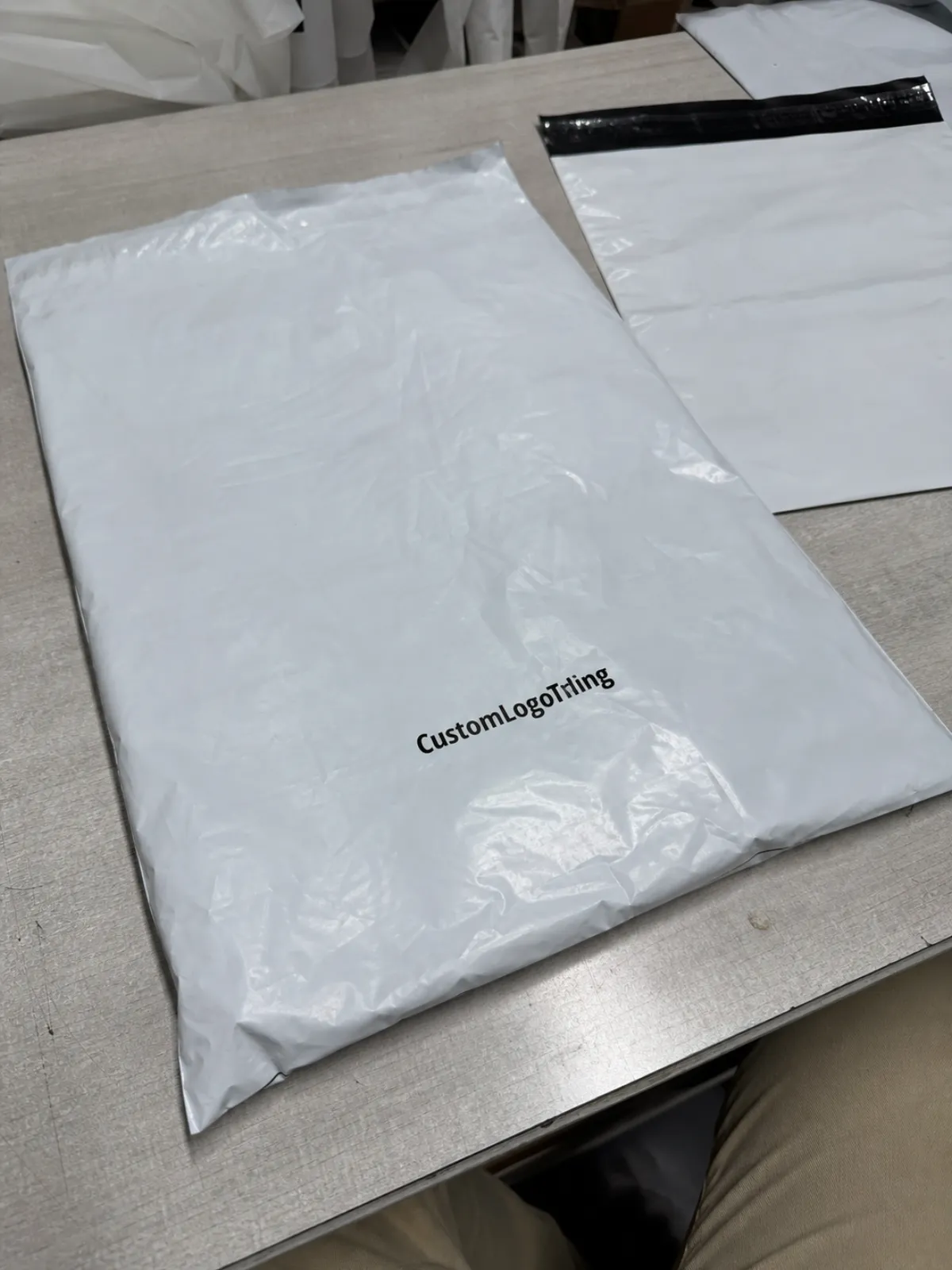
A recycled poly mailer is usually a co-extruded plastic film mailer made with recycled content, a pressure-sensitive peel-and-seal strip, and an opaque finish. For beer brands, that almost always means secondary packaging. It is not a substitute for a proper corrugated shipper around glass bottles, cans, or anything heavy and breakable. Loose beverage contents and mailers are a bad match. The format works best once the product is already protected.
What buyers typically receive in a bulk order is simple enough: flat-packed mailers, carton counts, a defined size SKU, and a print-ready surface if the order is branded. Some suppliers keep the offering narrow, which is not necessarily a flaw. A smaller size range can make reorder discipline easier. Others offer broader size steps so one SKU can handle an apparel tee, a hat, a folded insert, or a small accessory. The more closely the mailer matches the packed item, the less air gets shipped.
In beer merchandising, these mailers tend to fit folded shirts, lightweight promo pieces, accessory packs, subscription inserts that have already been boxed, and internal transfer packs for events or retail support. They are also useful where the contents are already protected and the outer wrap mainly needs to keep dirt, abrasion, and handling marks off the pack.
They are not the right answer for every item. If the contents have sharp corners, if the product can move hard inside the bag, or if moisture is part of the handling environment, a carton or a better protective inner pack is often the safer choice. Packaging that saves a few cents and creates claims later is not efficient. It is deferred cost.
Material specs, size options, and print details that matter
Three specifications decide most of the outcome: film gauge, seal performance, and opacity. Many recycled poly mailers sit in the 2.0 to 3.5 mil range. For beer merch and lightweight pack-outs, 2.5 to 3.0 mil is often the practical middle ground. Lighter folded goods can work in the lower end. Anything with harder edges, more weight, or a less forgiving shape usually deserves thicker film. Recycled content percentages also vary widely, often from about 30% to 80% depending on supplier structure and resin availability. If sustainability reporting matters, the exact number should be documented clearly.
Size causes more problems than most teams expect. Measure the packed item, not the empty product. Then allow just enough room for a clean seal and a flat closure. Too much extra room creates a loose, cheap-looking pack and increases movement in transit. Too little room puts stress on the seam and can cause split corners or seal failure. The best fit is usually the one that slides in without forcing the film but does not rattle once sealed.
Print choices should be made with production and warehouse use in mind. One-color branding is usually the cleanest route because it lowers setup risk and keeps registration simple. Add copy only if it helps the operation: return instructions, handling notes, or a barcode zone that stays unobstructed. Heavy coverage and full-bleed art can look nice on screen, but they often add cost without improving performance. A mailer does not ship better because it is decorated more aggressively.
Opacity deserves more attention than it gets. Darker opaque films hide the contents better and tend to look more finished in fulfillment. Lighter films can still work, but the product should not show through in a way that weakens the presentation. On performance, seal width and puncture resistance matter far more than graphic treatment. If a supplier references testing, ask whether they can speak to transit checks under ISTA methods or similar drop and vibration protocols, and whether the film has been tested in a way that matches parcel handling rather than lab-only conditions.
There is also a practical print detail that gets missed: label space. Many beer brands run inserts, compliance labels, or routing labels on the outside of the mailer. If the artwork crowds the face of the bag, the warehouse ends up fighting with placement. Leave space on purpose. It avoids relabeling and keeps the pack cleaner.
Cost, pricing, and MOQ factors that change unit cost
Price is driven by a few predictable variables: bag size, film thickness, recycled content target, print coverage, and order quantity. Bigger bags use more resin. Thicker film raises material cost. More ink adds setup and production time. Small orders tend to carry a higher unit cost because the setup is spread over fewer pieces. That is normal, not a markup trick.
| Option | Typical Use | Common MOQ | Indicative Unit Cost | Tradeoff |
|---|---|---|---|---|
| Unprinted recycled mailer, 2.5 mil | Light merch, inserts, internal transfers | 1,000-2,500 pcs | $0.11-$0.20 | Lowest setup burden, no branded face |
| 1-color custom print, 2.5-3.0 mil | DTC orders, event kits, retail support packs | 3,000-5,000 pcs | $0.14-$0.26 | Balanced branding and cost |
| Heavier gauge, 3.0-3.5 mil | Sharper corners, heavier kits, rougher handling | 3,000-10,000 pcs | $0.18-$0.34 | Better durability, higher resin and freight cost |
| Custom print with higher recycled content | More demanding sustainability programs | 5,000+ pcs | $0.17-$0.32 | Stronger claim support, tighter sourcing windows |
Those ranges are the kind buyers actually see once dimensions, print, and quantity are real. Freight, carton packing, palletization, and any special handling can move the landed cost enough to change the answer. A quote that looks strong at the factory gate can lose ground once the shipment is loaded, packed for storage, and delivered to a warehouse that charges by space.
Beer recycled poly mailers Bulk Order Planning gets easier when the purchase is broken into thresholds. A 1,000-piece buy keeps cash exposure low but usually lands at the higher end of the price curve. At 5,000 pieces, the unit price often improves enough to justify storage space. At 10,000 or more, savings can be meaningful, but only if the inventory will move before it starts sitting around like dead stock. Packaging should not become the most expensive thing in the room simply because it was bought too early.
Comparing tiered volume options through Wholesale Programs can help separate true savings from temporary quote compression. The right comparison is always landed cost: product price, freight, packing, and storage together. Anything less gives a flattering but incomplete picture.
Production steps, lead time, and delivery windows for bulk orders
Strong production runs start with exact specifications, not with artwork. The normal sequence is simple: confirm finished size, select gauge, review print, approve sample or proof, run production, then pack and ship. If any one of those steps is fuzzy, the schedule slides. Beer recycled poly mailers Bulk Order Planning stays on track only when the approval chain is tight.
Most delays are ordinary, not mysterious. Artwork arrives without the correct bleed. The logo sits too close to the seal area. The team approves a size before anyone has measured the actual packed item. Sometimes a revision is requested after sample sign-off, which resets the clock. None of this is rare. It is the usual cost of moving faster than the details.
Lead time depends on the spec and the origin of the order. A stocked size with light custom print usually moves faster than a fully custom run. Even so, time is still needed for proofing, production, packing, and freight. A realistic custom window is often 12 to 18 business days after proof approval, with extra time if the artwork changes late or recycled-film sourcing shifts. International orders need more buffer. Domestic orders can move faster if the size and film are already established. The schedule belongs to the factory calendar, not the buyer’s wish list.
Production has a few checkpoints worth confirming before the line starts:
- Dimensions - finished width, length, and the usable seal area.
- Material - film gauge, recycled content target, and opacity level.
- Print placement - logo position, ink coverage, and any barcode or label zone.
- Carton pack - pieces per carton, carton dimensions, and outer markings.
- Shipping method - palletized, parcel, or mixed freight.
Claims around recycled content should stay tied to the spec sheet. If the film is 40% recycled content, say 40%. If the supplier cannot document the number, the claim needs to wait. That is also where sustainability language gets sloppy in many packaging programs. A recycled film is not automatically recyclable in every curbside stream, and the product should not be described as something it is not. The EPA recycling guidance is a useful reference for keeping those statements restrained and accurate.
What separates a reliable supplier from a cheap quote
A reliable supplier gives specific answers quickly. A cheap quote gives a price and hopes no one asks what is inside it. That difference sounds minor until production starts and the bags arrive lighter than expected, printed off-register, or packed in cartons that do not match the receiving plan. Beer recycled poly mailers Bulk Order Planning depends on repeatability. If the supplier cannot hold the spec, the order becomes a moving target.
Useful support is practical, not polished. A good supplier should be able to explain which size fits the packed item cleanly, whether the gauge is enough for the route, and how the closure performs after normal handling. They should also be able to explain the gap between sample quality and production quality. Samples are often hand-checked and look better than a full run. Production quality is the test that matters because it has to repeat across thousands of pieces.
Reorder discipline matters almost as much as the first order. The best suppliers keep the final approved spec sheet, carton count, print file, and notes in a way that makes the next order a continuation rather than a restart. For beer brands with seasonal releases or recurring merch drops, that saves time and reduces the risk of a quiet mismatch. A half-inch change in size or a minor print drift can snowball into warehouse friction.
If a supplier cannot tell you the film gauge, seal width, and carton pack without digging through several notes, the quote is not ready.
Trust also shows up in what a supplier does not promise. No one can honestly guarantee zero variation, zero delay, and zero transit damage every time. What they can do is control tolerances, document the spec, lock down approvals, and keep the process from drifting when volume increases. That is the real measure. It sounds less exciting than sales language because it is.
There is one more sign of reliability: the supplier asks annoying questions. What product is going inside the mailer? How will it be packed? Will the item shift? Is the receiving environment damp or dry? Those questions are not slow. They are the questions that keep an order from being underbuilt.
What to confirm before you send the PO
Before a purchase order goes out, confirm the finished dimensions, material spec, print file, quantity, carton count, destination terms, and expected lead time. If the mailer is going to support a recurring launch cycle, request the sample or spec sheet first. One extra approval step is far cheaper than correcting a bad run after the fact.
For beer recycled poly mailers Bulk Order Planning, the cleanest sequence is size first, thickness second, print third, quantity last. That order keeps the conversation grounded in function. Too many teams start with the logo and end up with a bag that is too thin, too large, or too expensive to reorder at scale. Packaging should not behave like a branding exercise detached from operations.
If the product line is still changing, keep the first order conservative and validate the spec in real fulfillment before scaling. A few hundred units of warehouse feedback usually tell you whether the seal is strong enough, whether the film scuffs under handling, and whether the size is actually right. That is a better signal than guessing on a large buy and hoping the warehouse team adapts.
For teams that need a broader view before the PO is signed, the supporting pages on Custom Packaging Products and FAQ can help narrow the decisions without inflating them. Once the spec, lead time, and pricing line up, the order stops being a gamble and becomes a repeatable purchasing step.
How do I plan a bulk order of recycled poly mailers for beer shipments?
Start with the packed product dimensions and the shipping path, then choose the smallest mailer that seals without stress. Get quotes at a few quantities so you can see where the unit price drops enough to justify a larger buy. Confirm lead time before artwork approval, since custom print and recycled-film sourcing can shift the schedule.
What size recycled poly mailer should I use for beer merch or packaged inserts?
Measure the finished packed item, not the empty product, because labels, folds, and closures change the final footprint. Leave enough room for a clean seal, but do not oversize the bag or you end up paying to ship air. Ask for a sample fit if the item is irregular, rigid, or likely to move during transit.
What affects the unit cost in a beer recycled poly mailers bulk order?
Size, film thickness, print coverage, recycled content level, and order volume are the main cost drivers. Higher quantities usually reduce unit cost, but storage and cash flow can offset the benefit. Freight, carton packing, and destination terms also change landed cost, so compare more than the factory quote.
How long does production usually take for custom recycled poly mailers?
Timing depends on proof approval, print complexity, and whether a sample is needed before full production. Simple orders move faster than heavily branded runs, especially when the size and material are already established. Add buffer for revisions so the schedule does not slip because of avoidable back-and-forth.
Can I reorder the same beer recycled poly mailers later without starting over?
Yes, if the size, print file, and material spec are kept clearly in the order record. Reorders move faster when carton counts, shipping terms, and approval notes are documented from the start. Ask the supplier to store the final approved spec sheet so repeat buys stay consistent.
Beer recycled poly mailers bulk order planning works best when the order is built around route, fit, and repeatability instead of the cheapest line on a spreadsheet. That is how a packaging buy stays controlled, protects margin, and keeps the next reorder simple.