Beer Unstructured Dad Hats material Sample Guide for Buyers sounds narrow, but the decision behind it is not. Two caps can share the same logo, color, and closure, then land in completely different places once they are sewn. One will drape with that easy, broken-in curve people expect from a relaxed hat. The other will sit awkwardly, wrinkle at the front panel, or feel cheaper than it looked on screen. That gap usually starts with the material sample, not the mockup.
For brewery merch, taproom retail, festival giveaways, and small apparel drops, the sample is the first real proof that the cap can do the job. It shows whether the fabric has enough body to hold embroidery, whether the crown collapses in a flattering way, and whether the finish works under harsh retail lighting or a phone camera. A buyer who checks only color is guessing. A buyer who checks the sample is managing risk.
The point is not to fetishize a swatch. It is to prevent an expensive bulk order from becoming a compromise. Sample review is where production details become visible: stitch pull, panel symmetry, sweatband comfort, closure quality, and how the brim balances the rest of the cap. If those pieces are right, the final run usually feels intentional. If they are not, no amount of packaging polish will hide it.
"A good sample tells the truth early. If the hand feel, shape, or decoration look off there, the bulk order will not correct itself later."
Packaging can matter here too. A sample that arrives in a simple kraft mailer or an FSC-certified corrugated box says the supplier has thought about protection and presentation, not just product. If your brand story includes recycled materials or post-consumer waste content, ask how the sample ship kit is built and whether the claims are documented. The packaging should support the cap, not compete with it.
Beer unstructured dad hats material sample guide: why the fabric sample matters
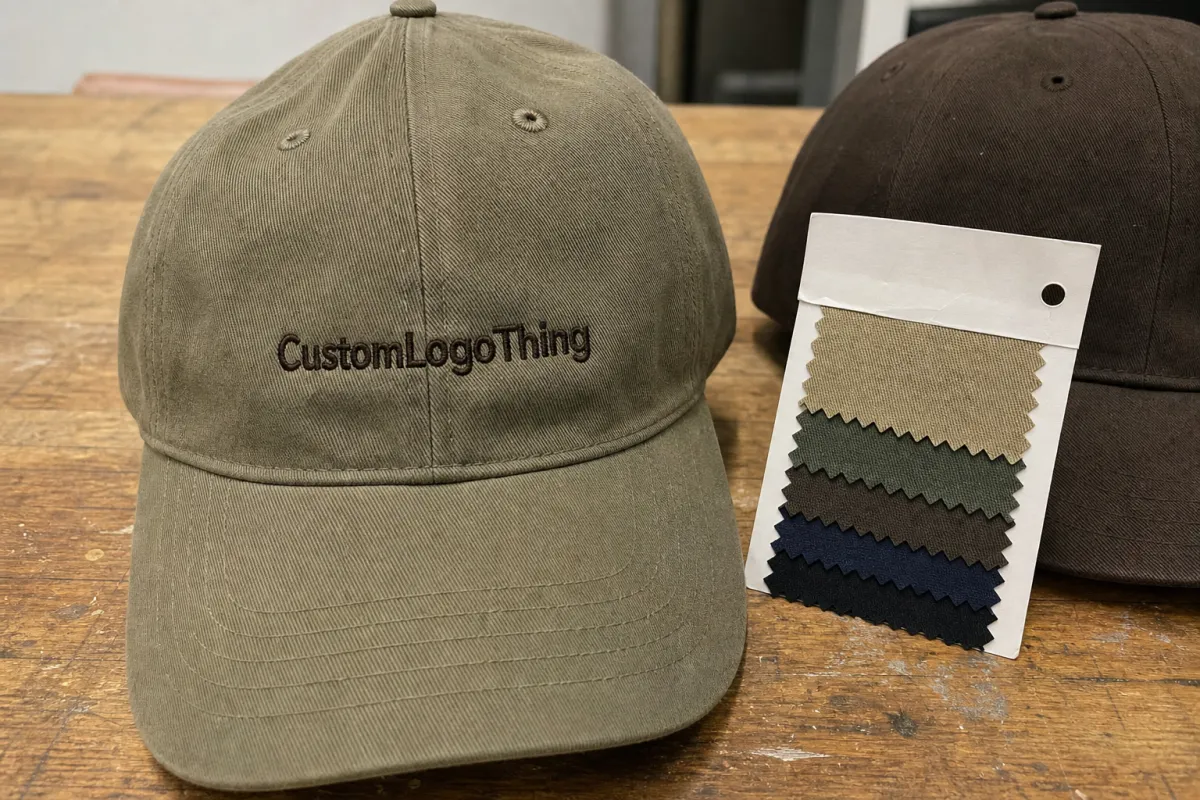
A material sample is the physical reference that keeps everyone honest before production starts. In practice, it may be a fabric swatch, a panel set, or a full prototype that shows the crown, brim, sweatband, and closure in one piece. The important part is that you are not approving an idea. You are approving behavior.
That distinction matters more with unstructured hats than with many other headwear styles. Soft cotton twill can feel approachable and familiar, but a loose weave may collapse faster than expected. A brushed cotton blend might deliver a smoother hand and cleaner surface, yet still react differently once it is cut into panels and stitched with thread tension. What looks close on paper can separate quickly once the cap takes shape.
For beer brands, there is usually a specific mood at stake: laid-back, wearable, lightly vintage, and not too precious. The sample tells you whether the fabric supports that mood or drifts into something unfinished. It also gives you a read on real-world use. A taproom cap has to survive repeated handling, a few spills, and enough wear to look better after the first month. A promo cap has to ship well, stack well, and still look decent after it has been folded, tossed in a bag, and worn on the way to a show.
The sample is also where decoration choices become clearer. Embroidery, woven patches, and printed labels all behave differently depending on the fabric surface. A smooth twill may accept a clean logo with less distortion. A softer brushed face can look richer, but the stitches may sink or pull if the panel does not have enough stability. That is why the material sample is not just a textile check; it is a decoration test.
There is a practical side to the sample request as well. Ask for the exact fabric composition, weight, wash finish, and closure type. If the supplier only sends a vague "same as photo" reply, you still do not know enough. The more specific the sample package, the easier it is to compare one option against another without relying on memory or product photography.
How swatches reveal fit, drape, and decoration behavior
Swatches are small, but they answer a lot of questions fast. The first one is drape. A soft cotton swatch may fold loosely and recover slowly, which often creates the relaxed silhouette buyers want. A firmer sample might hold a cleaner line, but if it feels too stiff in the hand, the hat can lose the easy, worn-in character that defines the category.
The second question is fit behavior. Fabric does not sit on the head in a vacuum. It interacts with crown height, front panel angle, sweatband stiffness, and brim shape. That is why a swatch that feels pleasant in isolation can still lead to a hat that sits too flat or tips forward once sewn. On a sample cap, check the front height, how much the crown caves in after a few wears, and whether the back closure sits comfortably without digging in.
Decoration behavior is the part many buyers underestimate. A dense embroidery fill can distort thin fabric. A patch can make a soft crown buckle if the reinforcement is weak. A woven label can look sharp on one material and slightly puckered on another. Even the same logo can read differently depending on stitch count and fabric recovery. If you plan to sell the hat at retail, that difference matters. Customers may not know why a cap feels "better," but they notice when it does.
Color is another trap. A swatch under office lighting, under daylight, and under warm LEDs can look like three different fabrics. That is not a defect; it is a reminder that headwear lives in multiple environments. Brewery merch often appears on shelves, in photos, and in people wearing it outside. If the color shifts too much, the cap can feel inconsistent even when the dye lot is within spec.
Hand feel should be tested after handling, not just on first touch. Some fabrics seem soft until they warm up or absorb a little moisture. Others start slightly rough but settle into a more comfortable feel. That is why quick rub tests, fold tests, and stretch checks are more useful than a single impression.
Fabric weight, structure, and finish: the key factors to compare
Fabric weight is usually the first thing worth comparing. Light fabrics can feel airy and casual, but they may collapse too easily across the front panel. Midweight cotton or cotton blends usually sit in the sweet spot for Unstructured Dad Hats: enough body to hold shape, enough softness to stay relaxed. Heavier fabrics can feel more substantial and durable, though they can also push the cap toward a flatter, less natural drape.
In practice, a lot of buyer satisfaction comes from this middle zone. Very light materials can look fine on a display hook and disappointing on a real head. Very heavy materials can look premium in a flat lay and stubborn on wear. Midweight options usually photograph well, hold embroidery better, and tolerate small production variations without falling apart visually.
Structure changes the feel more than many teams expect. A truly unstructured crown has little or no internal reinforcement. That gives the softest drape, but it also increases the risk of front panel collapse. Light reinforcement can improve front shape without forcing the cap into stiff territory. Buckram, if used heavily, tends to create a more traditional structured result, which is often the wrong direction for a laid-back beer cap.
Finish is the subtle layer that changes perception. Brushing, garment washing, sanding, and enzyme treatments all alter the surface. Brushing softens the hand and can reduce visual roughness. Garment wash can create a more broken-in look, but it may also introduce tonal variation that needs to be acceptable to the buyer. Sanded finishes can feel premium, though they are not always the best choice for sharp decoration detail. None of these treatments is inherently better. The right one depends on whether you want vintage, clean, or soft-to-the-touch.
Hidden components deserve the same scrutiny as the face fabric. Sweatbands can be cotton, polyester, or a blend. Inner taping affects edge stability and comfort. Closures matter more than they first appear: a brass slider, brass buckle, or fabric strap can shift both the price and the tone of the cap. If the target is retail, those details add up quickly. If the target is promo, the same details may be overkill.
For a quick comparison, this is the kind of table that helps separate "looks good" from "should actually be ordered":
| Option | Typical feel | Approx. sample or unit impact | Best use case |
|---|---|---|---|
| Light cotton twill | Very soft, more collapse | Lower material cost, but less shape retention | Budget promo runs and casual giveaways |
| Midweight brushed cotton | Balanced drape, clean casual line | Moderate cost, strong all-around value | Most brewery merch and retail programs |
| Cotton blend with light reinforcement | Soft but more stable | Often higher by a small margin per unit | Premium-looking relaxed caps |
| Heavier washed canvas | Substantial, vintage feel | Can raise cost and decoration difficulty | Fashion-led drops and limited runs |
Three checks do most of the work here: does the crown hang naturally, does the fabric rebound after handling, and do the stitch lines stay tidy when the panel is flexed. If the answer is yes on all three, the sample is probably close enough to move forward. If not, the issue is not cosmetic. It is structural.
Sample review process and timeline from request to approval
A clean sample process saves time because it narrows the conversation. Start by asking for build details, not a general promise. You want fabric composition, approximate fabric weight, crown depth, brim style, closure type, and decoration method. If available, request both a swatch and a built sample. The swatch tells you how the textile feels; the built sample tells you how the whole cap behaves.
Once the sample arrives, review it in stages. First pass: fabric hand, color, and surface finish. Second pass: silhouette, crown balance, and how it sits on an actual head. Third pass: decoration placement, thread tension, closure comfort, and the way the inner finishing feels against skin. That order helps keep feedback specific. Vague approval notes slow everything down.
Typical timing depends on what you ask for. A basic swatch often takes around 3 to 7 business days if the fabric is already in stock. A full prototype usually lands closer to 1 to 3 weeks, and revised samples can stretch beyond that if a crown shape, wash treatment, or closure has to be changed. Complex embroidery or custom fabric sourcing can push the timeline further. None of that is unusual; it just needs to be planned for upfront.
Shipping needs attention too. Samples can arrive creased, crushed, or marked if they are not packed properly. A good supplier will protect the cap in a corrugated cardboard mailer or boxed kit, sometimes with kraft paper or recycled-content fill to reduce movement. The goal is simple: the sample should arrive looking like the thing you approved, not a transit casualty. If your team uses packaging standards, the same transit logic used in ISTA-style testing is useful here, even if you are not running a formal lab check.
Fast approvals help, but only when the team is actually aligned. If the sample is reviewed under a different light, on a different head size, or without the planned decoration method, the final approval is weak. That is how mismatches happen. Slow down enough to compare the sample against the real order conditions, and the production handoff gets cleaner.
Cost, pricing, and MOQ: what changes the quote
Price is not just about fabric. In a beer Unstructured Dad Hats material sample guide, the quote usually changes with fabric grade, decoration complexity, closure style, packaging requirements, and order size. A simple swatch might cost only a small amount. A full prototype with custom embroidery, sewn labels, and a special wash finish can be several times that because each extra detail adds labor and review time.
For rough budgeting, swatches often sit in the low tens of dollars, while a fully built prototype can land anywhere from roughly $40 to $150 or more depending on the market, the number of components, and the amount of customization. That range is wide on purpose. A plain cap sample is not the same as a cap with custom artwork, special fabric, and branded packaging.
MOQ matters because setup costs are spread across the run. At 500 units, a cap may feel expensive because the factory is still paying for patterning, cutting, and decoration setup. At 5,000 units, the same cap often becomes far more efficient per piece. Buyers sometimes overreact to the first quote without asking what happens at the next volume tier. That is a mistake. Unit pricing often changes more from quantity than from a small fabric upgrade.
Sample fees should be treated separately from production cost. Some suppliers credit the fee back after approval. Others treat sampling as a development charge. Both systems are normal. What matters is knowing whether a second revision is included or billed again. One extra round can be worth it if the first sample is close but not yet right; two or three extra rounds usually mean the brief needs to be tightened.
Packaging can shift the quote too. If the order needs a specific mailer, a branded insert, or FSC-certified corrugated boxes, that should be priced from the start rather than added later. Recycled-content packaging can fit a brewery brand well, but it still has to protect the hat. Eco claims are only useful when the product reaches the customer in good shape.
Here is a useful way to think about the sample ladder:
| Sample type | What you get | Relative cost | Decision value |
|---|---|---|---|
| Swatch only | Texture, color, weight, finish | Lowest | Good for early material screening |
| Panel sample | Some structure, seam behavior, stitch look | Moderate | Useful for decoration and fit checks |
| Full prototype | Complete cap with all components | Highest | Best before bulk approval |
A cheap sample is not always the economical choice. If the swatch misses the drape, if the color is off, or if the decoration puckers, you may end up paying for another round anyway. Spending a little more to verify the right thing up front usually costs less than repairing a bad bulk decision later.
Common mistakes buyers make when judging relaxed cap samples
The first mistake is judging color in the wrong light. Warehouse light, office light, and daylight all distort a fabric differently. A cap that looks muted near fluorescent panels may look rich outdoors. That does not mean the sample is wrong. It means the review method needs more than one environment.
The second mistake is confusing softness with comfort. A fabric can feel pleasant in the hand and still make a poor hat. If the crown folds too easily, if the sweatband traps heat, or if the brim and panel balance feel off, the cap will not wear well. Comfort is a mix of fabric, construction, and shape. You need all three.
The third mistake is ignoring construction details because the surface looks nice. Seam matching, panel symmetry, stitch density, and closure quality are not minor choices. They are the difference between a cap that looks retail-ready and one that reads as a giveaway piece. On a small headwear item, those details are visible from a distance.
The fourth mistake is assuming a prototype scales perfectly. Fabrics vary by dye lot. Sewing tension changes slightly across machines. Even a good sample can shift when moved into bulk cutting. If the order is large enough to matter, ask for a production note on tolerance and, if possible, a pre-production photo set before the full run ships.
The fifth mistake is changing the brief after approval and treating it like a small edit. A logo moved a few millimeters, a closure color changed to match a label, or packaging swapped late in the process can all trigger additional cost. Once the sample is signed off, any revision should be handled as a new decision, not a casual adjustment.
There is one more issue worth calling out: many buyers judge a sample only by how it looks flat on a table. That misses the point. A dad hat is worn, flexed, folded, and handled. Put it on a real head. Bend the brim. Open and close the closure. Wear it long enough to see how it settles. A cap that only looks right in a photo is not ready.
Expert checks and next steps before you place the order
Before approval, run a practical QC check. Compare the sample under daylight and indoor light. Check whether the front panel sits too high, too low, or too flat. Feel the inside for rough edges, exposed stitching, or a sweatband that feels thick in the wrong way. Then flex the brim and close the back hardware a few times. If the finish, fit, and hardware all survive that short test, you are in better shape than most rushed approvals.
Make the checklist short and specific. Fabric weight. Surface finish. Crown softness. Decoration placement. Closure type. Packaging spec. Any must-match color note. That list is enough to create a clear production record without turning the review into paperwork theater.
If the first sample is close but not right, ask for one controlled revision instead of reopening everything. A slightly different fabric, a different closure, or a lighter reinforcement can solve the problem without stretching the timeline too much. This matters when the order is tied to a launch date, seasonal release, or event calendar.
Packaging deserves a final look as well. If the sample came in kraft paper or recycled-content packaging, confirm that the bulk order can maintain the same standard without sacrificing protection. If the supplier uses FSC-certified corrugated cartons or other documented materials, ask for the exact spec so the claim can be described accurately later. Sustainability language should be precise, not decorative.
Handled properly, the sample stage is the control point that keeps the order grounded. It is where a buyer decides whether the hat is genuinely relaxed or just loosely described that way. Use this beer Unstructured Dad Hats Material Sample guide to compare fabric, structure, decoration, pricing, and timing before approval, and you will usually end up with a cap that wears the way it was meant to: easy, durable, and specific enough to feel intentional.
What should I check first in a beer unstructured dad hats material sample?
Start with hand feel, crown softness, and how the fabric hangs when the hat is placed on a flat surface. Then check stitch quality, closure comfort, and whether the material supports the decoration method you plan to use.
Which fabric weight works best for beer unstructured dad hats?
Midweight fabrics usually balance comfort and shape better than very light materials that collapse too easily. Heavier fabrics can feel premium, but they may reduce the relaxed look buyers expect from an unstructured dad hat.
How many material samples should I request before approving a run?
Request at least one baseline sample and one backup option if color, drape, or finish are critical to the order. Compare them side by side in the same lighting so the final choice is based on real differences, not memory.
How do samples affect pricing and MOQ for beer unstructured dad hats?
Sample fees often sit outside the production quote unless the supplier credits them back after approval. MOQ affects unit cost because setup work, cutting, and decoration charges get spread across fewer or more hats.
How long does the sample and approval process usually take?
Timeline depends on fabric availability, sample complexity, and how quickly feedback is returned after review. Simple swatches move faster than fully built prototypes, while revisions can add extra turnaround time.