Book Embroidered Beanies Unit Cost Review for Bulk Orders
The first surprise in a book embroidered beanies Unit Cost Review is usually visual, not financial. A simple embroidered logo on a well-made cuffed beanie can look far more expensive than the invoice suggests. That is not magic. It is the effect of texture, placement, and the fact that knitwear tends to make decoration feel more permanent than print.
Buyers often focus on the per-piece number and stop there. That leaves out the part that matters after the goods arrive: whether the beanie looks clean, holds shape, and feels like something people will actually wear. A slightly better blank or a more disciplined stitch file can change the whole impression. On a shelf, in a mailed kit, or at a trade show table, the difference between “promotional” and “retail-ready” can be just a few choices made early.
The lowest quote is not automatically the best buy; the better order is the one that balances decoration quality, production risk, and repeatability so the landed cost stays useful.
Why embroidered beanies can look more premium at a lower cost than buyers expect
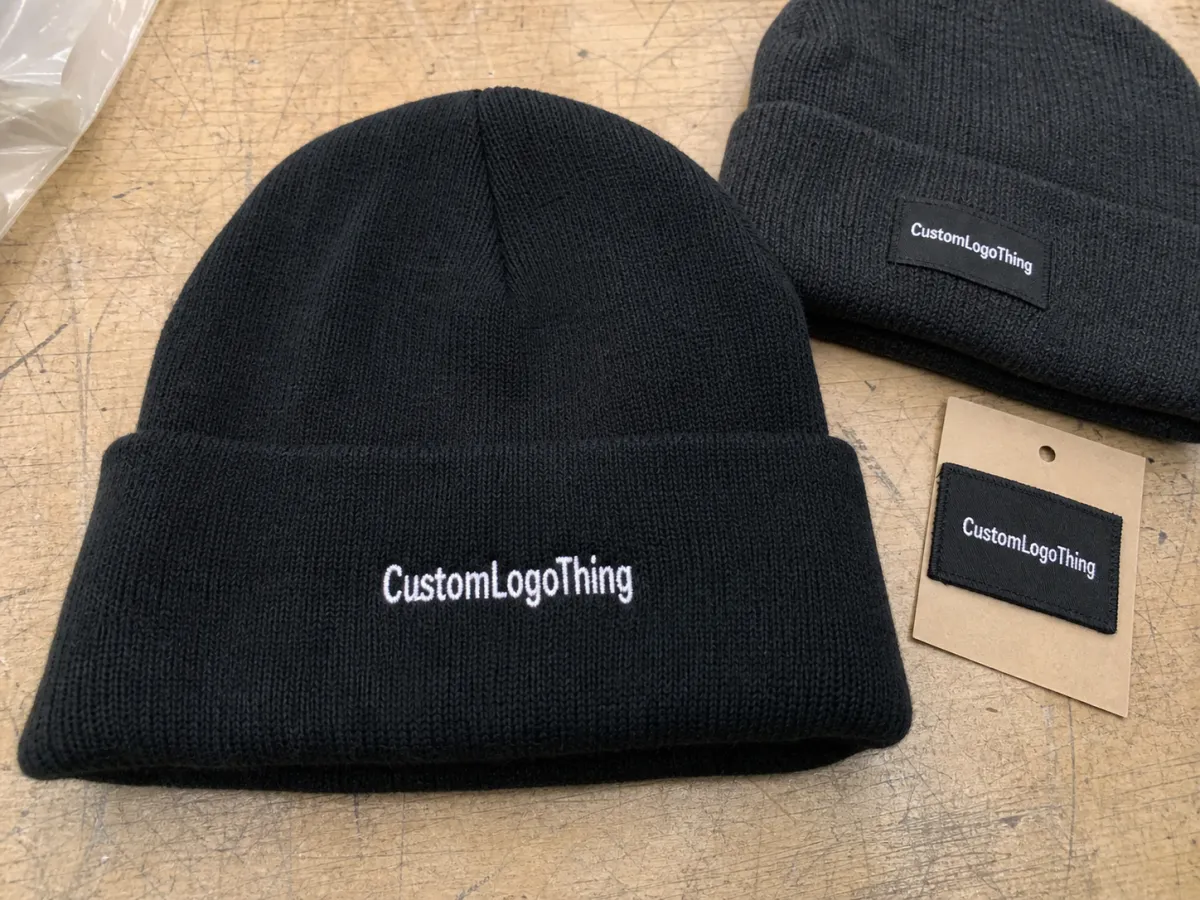
Beanies are one of the few branded products where a modest decoration can carry a lot of perceived value. Embroidery gives the logo relief, and that raised texture reads as durable even before the buyer touches it. A one-color mark on a clean rib knit can feel more substantial than a larger printed graphic on a flatter garment.
The style itself does part of the work. A cuffed beanie gives the logo a stable area and usually the cleanest presentation. The cuff acts like a frame, which helps the branding sit neatly instead of drifting across uneven knit. A tight, centered mark on the front cuff also tends to hold up better in production because it needs less fabric coverage than a large chest-style graphic would on a shirt.
That is why premium-looking results do not always require premium pricing. The simplest solution is often the strongest: a compact logo, a reliable blank, and thread colors that stay close to the brand palette. The buyer gets a product that feels intentional instead of crowded. The factory gets an easier run. Both sides benefit.
- Retail resale: keep the logo clean and readable so the beanie can sit naturally in a display stack.
- Team merchandise: favor a stable cuff and medium gauge knit so the logo stays legible after repeated wear.
- Event giveaways: limit color changes and avoid oversized artwork that increases stitch time without improving impact.
There is also a practical reason embroidered beanies can be cost-efficient. The decoration area is small, the product weight is low, and the blank itself is usually easier to source than more complex apparel categories. That combination keeps production manageable. If the artwork is simple, the unit cost can stay within a promotional budget while still delivering a finished item that looks like a proper piece of merchandise.
Beanie styles, yarns, and embroidery methods that affect the final result
Not every beanie handles embroidery the same way. A cuffed beanie is the most forgiving because it gives the decorator a flat, repeatable target. A fisherman beanie sits tighter and higher, which can make the logo area feel smaller. Slouch styles bring more fabric volume, but that extra drape can shift placement once the hat is worn. Fleece-lined versions add warmth, yet the lining can change how the outer knit sits under the needle.
Yarn choice changes both appearance and production behavior. Acrylic is common for a reason: it is economical, widely available, and usually consistent from lot to lot. Wool blends feel a little more refined and can deliver better warmth, but they often cost more and may need closer quality control to avoid surprises in fit or hand feel. Recycled yarns are increasingly useful for brand programs with sustainability requirements, though they need testing to confirm color consistency and stitch response.
Embroidery method matters just as much as the blank. Direct embroidery is still the most practical choice for most bulk orders because it is durable and relatively efficient once digitizing is complete. Patch application can improve detail on complex artwork, or add a more finished retail look, but it introduces extra labor and usually more setup. Woven labels and small side patches work well when the logo is too fine for thread alone or when the front branding needs to stay understated.
The hard limit is the knit surface itself. Tiny text, thin strokes, tight gradients, and highly detailed crests often need simplification before production. A mockup can look crisp on screen and still become heavy once translated into stitches. For that reason, the best artwork for beanies is usually the artwork that survives simplification without losing identity. Clean shapes outperform clever detail more often than buyers expect.
| Option | Typical use | Typical cost per piece | Setup / tooling fees | Best for |
|---|---|---|---|---|
| Direct embroidery | Simple logo on cuffed beanies | $4.50-$9.00 | $25-$75 digitizing / setup | Most bulk programs and reorder consistency |
| Woven patch + sew-on | Detailed artwork or brand crest | $5.50-$10.50 | $40-$120 patch tooling | Sharper detail and a more finished retail look |
| Custom knit-in beanie | All-over branding in the fabric | $6.50-$14.00+ | Higher pattern setup and sample cost | Large runs where the knit pattern itself is part of the brand |
Core specifications to lock in before you request a quote
Quotes are faster and more reliable when the buyer gives the supplier a complete spec. Start with the basics: beanie style, yarn type, cuff size, color, logo placement, color count, quantity, and delivery date. If any of those are missing, the supplier has to guess, and guessing is how quotes drift away from the actual order.
Decoration area deserves more attention than it usually gets. A large embroidery field can look attractive in a mockup and still create stiffness or puckering in production. On a cuffed beanie, a front logo in the 2.5 to 3.5 inch range is often a practical starting point, but the right size depends on the knit gauge, the stretch of the blank, and how dense the artwork becomes after digitizing.
Fit should also be part of the quote conversation. Adult unisex sizing is the simplest route for mixed groups, but youth sizing may be a better fit for school programs, family retail packs, or smaller-headed wearers. For resale, a more structured crown or slightly taller cuff can improve display value. For uniforms, the priority is consistency across the full order.
Color matching needs to be settled early. If a brand uses strict PMS references, send them before the proof stage, not after. Thread charts are useful, but they are still charts. They do not guarantee that every shade will read exactly the same once stitched into a rib knit surface. A good supplier should tell you where the closest match lands and whether the difference is likely to be visible in normal use.
- Confirm the exact beanie style before asking for pricing.
- Share vector artwork whenever possible.
- Ask for stitch count estimates if the logo has more than one color.
- Specify whether the order is for retail, uniforms, or promotional use.
- Request the shipping destination early so freight is included in the landed cost.
Those details keep the quote honest. They also make supplier comparisons much easier because you are no longer comparing a standard acrylic blank against a heavier premium knit without realizing it. Small differences in spec can change the final number more than people expect.
Book embroidered beanies unit cost review, MOQ, and pricing variables
A serious book embroidered Beanies Unit Cost Review separates real production cost from the number that happens to look best on the page. The main drivers are quantity tier, stitch count, number of thread colors, artwork complexity, and any add-ons such as patches, woven labels, hangtags, or custom packaging. Each of those choices affects labor time, machine setup, or both.
MOQ is where cost perception often gets distorted. Smaller runs carry a higher cost per piece because setup is spread across fewer units. Once the run gets larger, the fixed work is absorbed more efficiently and the price per hat drops. That is why a 100-piece order may look expensive beside a 1,000-piece order even when the beanie itself is identical.
There is also the issue of hidden friction. Sample charges, digitizing fees, revision rounds, rush production, and freight can all move the landed cost more than a buyer expects. A quote that looks favorable before shipping can become less attractive once the real delivery cost is added. This is especially true for low-volume programs, where overhead is harder to dilute.
Typical range example: for a standard cuffed acrylic beanie with a one-color embroidered logo, pricing may land around $4.50-$6.50 at high volume, $5.50-$8.00 at mid-volume, and $7.50-$11.00 or more for smaller runs, depending on supplier MOQ and production setup. If the logo gets larger, uses additional thread colors, or moves to a patch construction, the price rises quickly. Custom knit-in styles sit in a different tier entirely because the pattern work changes the production model.
To compare options clearly, ask for at least three quantity breakpoints. That gives a more honest view of the pricing curve and helps you decide whether it makes sense to order a little extra now or accept a higher unit cost for a test run. In practice, the best option is not always the lowest per-piece price. It is the order size that matches inventory risk, timeline, and brand standards.
Common price influences buyers should expect
- Quantity tier: lower MOQ usually means higher setup weight per piece.
- Stitch count: more stitches take more machine time and can increase unit cost.
- Artwork complexity: tiny text and thin lines often require digitizing adjustments.
- Decoration method: direct embroidery is usually cheaper than patch-based solutions.
- Add-ons: packaging, woven labels, and rush shipping can change landed cost quickly.
Production steps, proof approval, and realistic lead time
The production sequence is simple on paper and less simple once files are missing or artwork gets revised midstream. Most orders begin with artwork review, then digitizing, then a stitch proof or mockup, followed by sample approval if needed, bulk production, inspection, and shipment. A buyer who understands that flow can spot delays early and keep the schedule under control.
- Artwork review: the supplier checks file quality and confirms whether the design is suitable for embroidery.
- Digitizing: the artwork is converted into a stitch file that tells the machine how to sew the logo.
- Proof approval: the buyer confirms size, placement, and thread colors before production starts.
- Sample or pre-production check: useful for new programs or more detailed logos.
- Bulk run: the factory produces the full order once the proof is approved.
- Final inspection and shipping: loose threads, puckering, and color consistency are checked before freight moves out.
Lead time depends on file quality, order size, and factory load. A clean logo with a straightforward placement can move through proofing quickly, but bulk production still takes time. A first order often needs 12-15 business days after proof approval, while larger or more complex runs can extend beyond that. Seasonal demand matters too; once cold-weather orders pile up, even small programs can get pushed behind earlier commitments.
A pre-production sample is worth the extra step when the logo has fine detail, the beanie style is new, or thread color accuracy is important. It is much cheaper to make a correction on a sample than on 1,000 finished hats. Knitwear is forgiving in some ways, but not all. The fabric can shift under stitching, and a logo that looked balanced in digital form may sit too low or too dense in the actual run.
Late changes are the main schedule risk. Replacing artwork after approval, changing placement, or adjusting quantity once production is underway can push the order back and sometimes increase cost at the same time. If the delivery window is fixed, leave room for a revision cycle. That is not overcautious. It is how bulk production stays predictable.
How to choose a supplier that protects quality, budget, and reorder consistency
A dependable supplier should offer more than a low quote. Look for clear specs, realistic timing, transparent pricing, and a working understanding of knit decoration limits. If stitch count, placement, file quality, or thread matching are treated casually at the quoting stage, the weak spot usually shows up later in production or inspection.
Reorder consistency matters more than many buyers realize. The second run should match the first in logo size, placement, and stitch density. That only happens if the digitizing is disciplined and the machine setup is repeatable. A supplier that cannot preserve those basics may still deliver acceptable first-run goods, but the reorder may look slightly different even when the material is unchanged.
Quality control should be specific, not vague. A proper inspection checks loose threads, puckering, thread tension, color mismatch, and size variation. If the order is going into resale or a branded uniform program, those details influence how the customer experiences the product. One crooked logo can undo a clean-looking sample.
Packaging can also affect the outcome. If beanies are going into retail cartons, event kits, or ship-ready bundles, ask how they are packed and protected in transit. Standards from ISTA are useful for thinking about shipping risk, while responsible paper packaging can be supported by FSC certification when inserts or cartons are part of the program. Those details do not change the embroidery itself, but they do affect the condition of the product on arrival.
Communication is another practical filter. A supplier that answers technical questions quickly usually prevents problems later. That matters when the order includes multiple colorways, multiple sizes, or a launch date that cannot slip. Slow responses during quoting often become slower responses when production issues appear.
- Ask for a written spec sheet before production starts.
- Confirm how reorders will match the first run.
- Request photos of the finished sample or stitch proof.
- Verify how the supplier handles loose thread cleanup and final packing.
- Make sure pricing includes freight and any known setup charges.
Next steps for turning a price review into a production-ready order
If the goal is to move from price review to ordering, start by gathering the logo file, preferred beanie style, target quantity, color choices, and delivery date. That package is usually enough to get a meaningful quote instead of a placeholder response. It also gives the supplier a real basis for checking whether the artwork is suitable for embroidery.
Then compare three scenarios: a smaller test run, a mid-tier order, and a larger bulk run. This shows how the unit cost changes as quantity rises and where the MOQ threshold begins to matter. It also reveals whether inventory risk is worth taking in exchange for a lower landed cost. For many programs, the answer is not obvious until the numbers are laid side by side.
Review the proof carefully. Check stitch count, placement, thread colors, and logo proportions before approving production. Once the run starts, changes tend to affect both timeline and cost. A few minutes spent on the proof usually prevents a lot of correction work later.
For buyers using a book Embroidered Beanies Unit Cost Review to choose between suppliers, the most useful frame is simple: compare landed cost, evaluate the sample or proof quality, and check whether the supplier can repeat the same result on the next order. That is the real test. A cheap first order that cannot be reordered cleanly is rarely a good buy.
For most bulk programs, the best outcome comes from a simple logo, a dependable blank, and a supplier that explains the numbers without glossing over the tradeoffs. That combination keeps the order controlled, the finish clean, and the final book embroidered beanies Unit Cost Review tied to actual value rather than the lowest line item.
Frequently Asked Questions
What drives embroidered beanie unit cost the most?
Quantity, stitch count, and logo complexity usually have the biggest impact on price per piece. Thread color changes, patch construction, and rush timing can also raise the final unit cost. Shipping often matters more than expected on smaller orders because the freight gets spread across fewer units.
What MOQ should I expect for custom embroidered beanies?
MOQ varies by supplier and decoration method, but smaller runs usually cost more per piece. Ask for pricing at two or three quantity tiers so you can compare the breakpoints clearly. That makes it easier to decide whether the savings from a larger run justify the extra inventory.
How long does the beanie production process usually take?
Lead time depends on artwork approval, sample needs, and current factory load. A clean file and fast proof approval can shorten the schedule more than almost any other step. In a normal bulk run, proofing may move quickly, while production and packing set the pace.
Can I get a sample before full production?
Yes, and it is especially useful when the artwork is detailed or the beanie style is new to your program. A sample helps confirm stitch density, placement, and thread color before bulk production starts. It is one of the cheapest ways to avoid a bad run.
What artwork files work best for embroidered beanies?
Vector files are best because they keep edges clean during digitizing. Simple logos with clear shapes and limited fine detail usually embroider more cleanly than complex gradients or tiny text. If the design depends on precision, ask the supplier how much detail can survive on knit fabric.
For buyers comparing suppliers, the most dependable path is still the same: confirm the specs, review the proof, and use the book embroidered beanies unit cost review to choose the order size that protects both margin and presentation.

