Most sample delays come from missing decisions, not sewing defects. One brim width is left vague, one logo placement is described as “better centered,” one color is approved from a screen instead of a swatch, and suddenly the schedule stretches by a week or two. That is why the bucket hats Sample Approval Checklist for boutique retail buyers matters: it keeps the buying team, the supplier, and the production floor looking at the same version of the same hat.
Boutique retail has little appetite for drift. A 100-piece order may still require the same artwork setup, trim sourcing, and pattern confirmation as a larger run, which means a loose sample process can burn time faster than it saves money. The buyer is not just evaluating whether the bucket hat looks good. The real question is whether it is commercially repeatable at the agreed price, in the agreed fabric, with the agreed finish.
A clean approval file usually answers five things without forcing anyone to guess: what sample type is being reviewed, which details are fixed, which are still open, who has final authority, and what will happen if the first version misses the mark. That sounds basic. It also prevents the most common problem in small-batch headwear: a nice sample that cannot be produced profitably.
A sample is approved because it matches the spec, the price, and the launch plan, not because it happens to look polished on a desk.
The checklist below focuses on practical buying controls, not theory. It is built around the issues that usually slow bucket hat programs: proportion, decoration placement, fabric behavior, packaging rules, and the hidden costs attached to decoration or special trims. A few millimeters, a few dollars, or a few days may not sound like much on paper. In a boutique assortment, those small changes can decide whether the hat feels considered or off-model.
Bucket Hats Sample Approval Checklist for Boutique Buyers
The first approval question should be simple: what exactly is being signed off? A design sample, a sales sample, and a pre-production sample do not serve the same job. If those categories get blurred, the team starts judging one sample against the standards of another. That leads to inconsistent feedback, duplicate revisions, and a supplier who cannot tell which direction is final.
The best approvals happen when the buyer separates concept from execution. A design sample may only need to prove the silhouette and the decoration idea. A sales sample should reflect the retailable look and handfeel closely enough to support buying decisions. A pre-production sample should be much stricter; it is the last physical checkpoint before bulk is released.
For boutique buyers, the checklist should lock down the following items before comments begin:
- Sample type: design, sales, or pre-production.
- Final measurements: crown height, brim width, circumference, and panel count.
- Decoration method: embroidery, woven patch, print, or mix of trims.
- Approved color reference: Pantone, lab dip, or physical swatch.
- Approval owner: one person with the power to say yes or no.
- Open items: packaging art, carton marks, or optional extras that are not yet frozen.
That last point matters more than many teams admit. If merchandising, operations, and brand all send “final” comments at different times, the supplier ends up reacting to three versions of the truth. The result is usually a second sample, a missed ship date, and a production file that no one trusts.
The checklist should also create a traceable record. A marked-up PDF, a dated email, or a photo set with measurements written in the notes is enough if it clearly shows the approved version. In a small order, that record is not paperwork for its own sake. It is the only reliable way to settle a disagreement once bulk production has started.
Another practical rule: compare the physical sample against the tech pack, not against memory. Bucket hats can fool the eye. A crown that is 5 mm too tall may still look acceptable on a table but changes the silhouette on a head form. A logo shifted by 8 mm can read off-center immediately. In boutique retail, those are not minor flaws; they change how the product reads on shelf.
Sample Specs That Keep Retail Buy-Ins Consistent
Bucket hats are proportion products. The shape has to work from across the room and close up. Crown depth, brim width, seam allowance, and circumference all affect how the hat sits and how the style is perceived. A brim that is too wide can look costume-like. A crown that is too shallow can collapse visually. Even a technically good sample can sell poorly if the profile feels wrong for the boutique’s customer.
Do not stop at naming the fabric. “Cotton twill” is too broad to be useful on its own. A 250 gsm cotton twill and a 320 gsm cotton canvas may both be cotton, but they wear differently, press differently, and price differently. The lighter cloth may feel cleaner and more seasonal; the heavier one may hold structure better but push the hat into a sturdier, less relaxed position. That difference matters if the line is supposed to sit in a premium basics range rather than a utility or outdoor story.
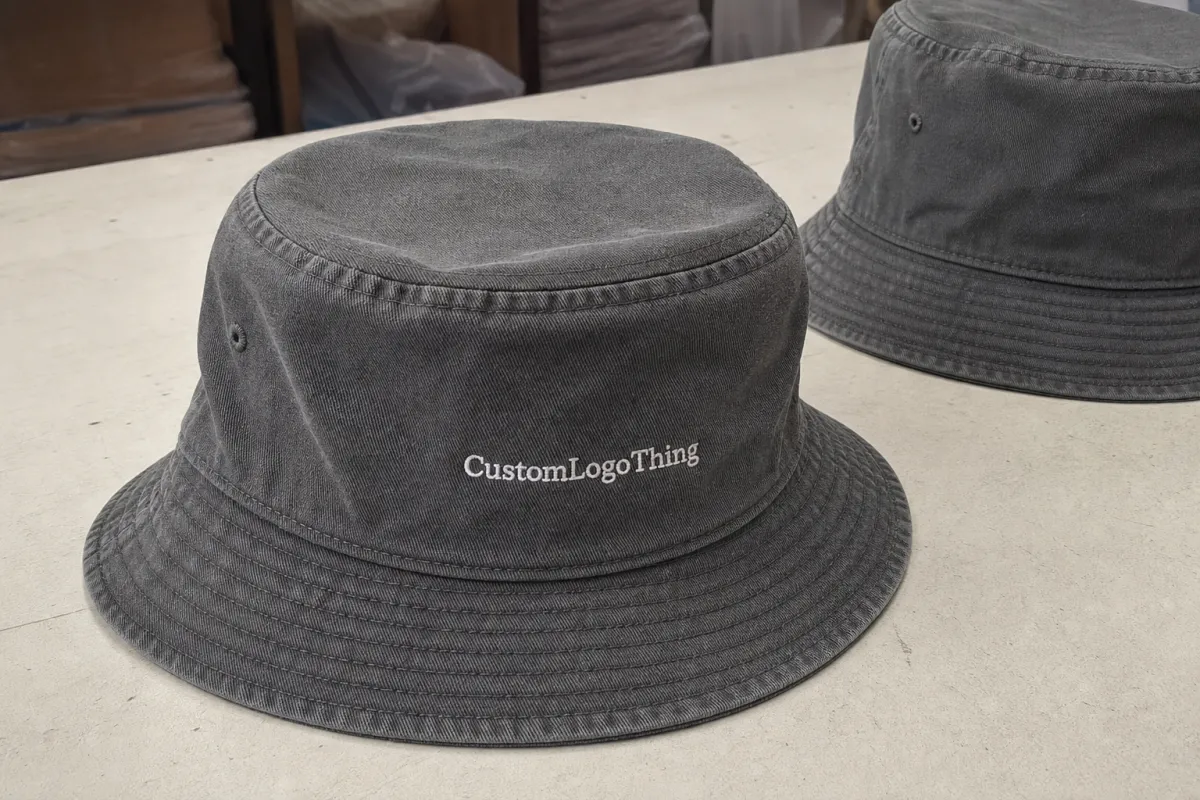
Decoration specifications should be measured, not described in adjectives. Embroidery width, patch size, logo offset, eyelet placement, and label position all need millimeter-level clarity. A factory can often make a “close enough” sample. The problem is that close enough is not a production standard. If the logo is 6 mm low on the sample, that is a measurable issue, not a stylistic preference.
| Sample Type | What It Proves | Typical Buyer Use | Usual Timing |
|---|---|---|---|
| Design sample | Shape, proportion, and decoration concept | Early line review and direction setting | About 5-10 business days |
| Sales sample | Retailable look, color, and handfeel | Buying meetings and assortment decisions | About 7-12 business days |
| Pre-production sample | Final materials, trims, and packing intent | Final check before bulk release | About 10-15 business days |
This is one reason the bucket hats Sample Approval Checklist for boutique retail buyers should treat each stage differently. A design sample can tolerate some color looseness if silhouette is the only question. A pre-production sample cannot be loose on anything that affects the shipped unit. By then, the buyer is not testing a concept. The buyer is confirming the exact product that will land in stores.
Packaging can belong in the spec file too, especially for boutique programs where presentation supports the price point. If the hat ships with a custom swing tag, branded tissue, FSC-certified carton, or a recycled insert card, those details should be listed clearly before approval. A nice sample without the required labels or cartons is not production-ready. It is only half-approved.
For sustainability claims, ask for actual documentation early. If the program uses FSC-certified paper or recycled packaging components, the certification trail should be part of the approval file, not a later correction. The FSC reference point is useful here: fsc.org.
Cost, Pricing, MOQ, and Quote Rules
Many buyers ask for a lower price before the sample is fully defined. That usually creates more noise than value. A proper quote should separate the unit price, sample fee, decoration setup, packaging, and freight so the buyer can see what changes with volume and what does not. If all of those costs are bundled together, it becomes difficult to compare suppliers fairly or explain the number internally.
MOQ directly affects cost. A run of 100 hats almost always carries a higher unit price than 500 hats because setup costs are spread across fewer pieces. For custom logo bucket hats, a realistic boutique range may sit around $4.80-$8.20 per unit at 100 pieces and $3.10-$5.40 per unit at 500 pieces, depending on fabric weight, decoration complexity, and packaging. Sample fees may run from $40-$120 when private-label trims or embroidery are involved. Those numbers are not fixed; they move with materials and labor, and that movement should be visible.
The biggest price drivers are usually stitch count, patch construction, special fabrics, wash treatments, and carton customization. Thread color count can also push setup cost higher than expected. A small tonal logo is not priced like a dense full-front embroidery panel, and a supplier should never pretend otherwise. If the quote does not explain the gap, ask for the breakdown before approval.
Tiered pricing is more useful than a single number. Request pricing at 100, 300, and 500 units. That makes it easier to compare test buys with deeper commitments. It also shows where the factory’s cost curve softens, which often reveals whether the style is viable as a boutique staple or only as a small experiment.
Quote lines that should stay separate
- Unit price for the finished hat.
- Sample fee for one-off development work.
- Decoration setup for digitizing, screens, or patch tooling.
- Packaging cost for labels, polybags, inserts, and cartons.
- Freight terms for sample shipping and bulk shipment.
The approval checklist should also ask how long the quote stays valid. A seven-day validity window is not unusual in fabric-heavy programs, especially when trims or freight rates are moving. If the buyer does not know that deadline, internal approval can land on a stale price and force a second round of sign-off.
Process and Timeline: Sample Request to Final Sign-Off
A clean sampling process usually follows the same order: brief submission, sample build, sample receipt, revision comments, revised sample if needed, final review, and PO release. Each step sounds obvious. The problem is that teams often skip one of them and assume the missing detail will be handled later. It rarely is.
Timing depends on the sample type and the decoration method. A simple design sample may move faster than a decorated sales sample, while a pre-production sample tends to take longer because it is tied to final materials and packing instructions. Buyers should map the sample calendar against internal review dates so the style does not arrive after the merchandising meeting it was meant to support.
| Stage | Buyer Checks | Supplier Output | Risk if Skipped |
|---|---|---|---|
| Brief | Tech pack, artwork, quantity, target cost | Quote and sample plan | Wrong assumptions from day one |
| Sampling | Fit, fabric, trim, logo placement | Physical sample and photo proof | Revision loops and delay |
| Approval | Final comments, sign-off owner, date stamp | Approved reference version | Disputed bulk production |
| Release | PO, payment terms, packing rules | Bulk production start | Price or spec drift |
Merchandising and operations often care about different things. Merchandising focuses on color, price, and sell-through potential. Operations looks at measurements, packing, carton logic, and warehouse handling. That split is healthy, but only if one person owns the final decision. Without a single owner, the factory gets mixed instructions and the schedule starts to wobble.
A dated sign-off is more useful than a stack of loose notes. It tells the supplier which version to build.
If the program includes transport or shelf-readiness testing, the logic from the ISTA framework is worth borrowing, even for simple boutique orders. A structured brim can deform under pressure. A soft crown can flatten in transit. The point is not to over-test every small order. The point is to think about how the hat will actually move from sample room to warehouse to floor.
Fabric, Fit, and Trim Checks Buyers Should Verify
A bucket hat should be tested on a head form or an actual wearer, not judged only while flat. Once the crown curves around a head, the proportions change. A style that looks balanced on the table may sit too high, collapse at the sides, or flare oddly at the brim. Fit issues are often subtle until the hat is worn, which is exactly why the approval sample needs a real fit check.
Fabric selection should match both season and merchandising position. Cotton twill is often used for a cleaner, more elevated basic. Canvas reads sturdier. Nylon can push the style toward sport or utility. Washed denim carries more fashion weight, but it also tends to expose shade inconsistency more quickly. Buyers should ask not only what the fabric is, but what it signals once it is on a rack beside the rest of the collection.
Trim quality changes the perceived value of the entire piece. Stitch density, thread tension, woven label finish, eyelet alignment, sweatband construction, and hardware placement all affect the final impression. A slightly uneven brim stitch line is visible because the brim is the visual frame of the hat. A scratchy sweatband or a crooked size label can make an otherwise acceptable sample feel underdeveloped.
Color should be judged in more than one lighting condition. Warm shop lighting can shift a black hat toward brown, while daylight can reveal undertones that were not visible in the sample room. Boutique floors tend to punish weak color matching. That is one reason the bucket hats Sample Approval Checklist for boutique retail buyers should require daylight review and store-light review before final sign-off.
- Check stretch and recovery at the opening.
- Confirm brim stiffness after light handling.
- Inspect stitching at stress points around panels.
- Compare the sample against the approved reference photo set.
If material claims matter to the program, ask for evidence before approval, not after. A sales sample is not proof of compliance. If the shell fabric, paper insert, or carton must meet a certification standard, the supporting documents should already be in the file when the buyer signs off.
Packaging and Label Details That Affect Shelf Readiness
Packaging is often treated as a side issue because the hat is the main product. That is a mistake. Hangtags, care labels, fiber content, country of origin, barcode placement, and warning copy can all stop a clean receipt if they are wrong or missing. If the label panel is too small for required data, the problem does not go away in bulk. It becomes a compliance issue, a warehouse issue, or both.
Ask how the hat will ship. Folded, stuffed, banded, clipped, or polybagged? Each method changes crease risk and shelf presentation. A soft bucket hat may recover well from folding. A structured style may need stuffing so the crown keeps its shape. If the buyer expects a retail-ready presentation, that requirement belongs in the checklist before the packing plan is written.
Master carton data deserves the same discipline. Carton count, box size, color code, PO number, and destination labels should follow one naming pattern across the order. It sounds administrative, but it makes receiving faster and reduces errors when stores or warehouses need to trace one carton back to the approved sample.
For premium boutique programs, packaging should support the price point without overcomplicating the order. A single swing tag and a simple polybag may fit one assortment. Another may need branded tissue, FSC-certified cartons, or a custom insert card. The decision should happen before sign-off, not after the factory has already priced the lighter version.
At this stage, the bucket hats Sample Approval Checklist for boutique retail buyers should close on shelf-readiness, not just garment quality. The hat has to arrive clean, labeled correctly, packed in the right format, and easy for the receiving team to process. That is what makes a good sample usable in the real world.
Common Rejection Triggers and How to Fix Them Fast
The most common rejection triggers are easy to predict: logo scale is wrong, brim stitching is uneven, trim color is off, structure is weak, or the size and care labels do not match the brief. None of these is mysterious. They usually show up when the original instructions were too loose or the revision language was too vague.
Specific fixes should match specific problems. A placement issue usually needs a corrected artwork map or a new stitch-out. A color mismatch may require a revised Pantone target or a fresh dye lot. Weak brim structure may point to interfacing or insert changes, which can affect both cost and timing. If the buyer knows the correction path early, the supplier can avoid chasing the wrong solution.
Fast fix guide
- Logo scale issue: revise artwork dimensions and request a new stitch-out or patch proof.
- Uneven brim: check panel tension, seam allowance, and pressing method.
- Color mismatch: confirm Pantone reference, lighting condition, and batch dye data.
- Weak shape: adjust interfacing, lining, or brim insert specification.
- Label error: correct copy, barcode data, and placement map before reprint.
Mark the non-negotiables early. If a lower logo, a wider brim, or a different lining color cannot be accepted, say so before the sample is built. Suppliers work faster when they know which details have room to move and which do not. A clear boundary is often more useful than a long comment thread.
Annotated comments are better than vague language. Circle the issue, write the measurement, and state the correction in plain terms. Production teams can act on that quickly. “Move logo 7 mm forward and reduce width by 12%” is work-ready. “Make it pop more” is not.
Next Steps for Faster Approval and Cleaner POs
Send the tech pack, artwork, measurements, and target quantity together. A complete brief saves more time than any follow-up message. The closer the first submission is to a finished packet, the fewer sample rounds the buyer usually needs. That matters because each extra round costs calendar time and usually adds a bit of friction with the supplier too.
Ask for a sample schedule, approval owner, and revision limit before the first round starts. If the supplier expects one design sample and one pre-production sample, that should be visible in the timeline. If a third round is likely because of complex decoration or pending packaging decisions, the buyer needs that information before internal deadlines are set.
Before release, review the sample against the bucket hats Sample Approval Checklist for boutique retail buyers and record every change in writing. Then release the PO only after the approved sample, pricing, MOQ, and timeline all align. That sequence protects margin, keeps the launch date believable, and reduces the chance of a correction after production has already started.
For private-label headwear, the checklist is not busywork. It is a control tool that closes the gap between design intent and what can actually be made at scale. Use it well, and the order tends to move with fewer surprises, fewer revision loops, and a much cleaner handoff into production.
What should a boutique retail buyer check first on a bucket hat sample?
Start with fit, brim width, crown shape, and logo placement. Those four items reveal quickly whether the sample matches the buying plan. Then review color, trim, and label data in daylight and in store-style lighting so the sample is judged in conditions closer to retail.
How many sample rounds are normal before approval?
One design sample and one pre-production sample are common for custom bucket hats when the brief is clear. More rounds usually point to incomplete measurements, moving artwork, or packaging details that were not locked early enough.
What should be included in the approval file for bucket hats?
Include measurements, fabric spec, Pantone references, artwork files, label details, packaging notes, and target quantity. Add dated photo proof or written sign-off so the approved version can be traced later without argument.
How do MOQ and pricing change with custom decoration?
Embroidery, woven patches, and custom labels usually raise setup cost and can increase MOQ because tooling and labor are spread across fewer units. Ask for tiered pricing so you can compare unit cost against expected sell-through at each volume.
How can buyers speed up approval without risking mistakes?
Give one final decision owner, mark non-negotiable details, and use annotated feedback instead of open-ended comments. Lock artwork and packaging early so the factory can move from sample to production with fewer revisions.