Stationery Twisted Handle Paper Bags Unit Cost Review
The first number in a stationery twisted handle paper bags Unit Cost Review is rarely the number that decides anything. A quote can look attractive until the bags arrive slightly undersized, the handles feel flimsy, or the cartons take up more pallet space than expected. Then the real cost starts showing up in labor, freight, rework, and the awkward moment when a customer’s purchase goes into a bag that should have been stronger.
For stationery, gift, and boutique programs, the bag is not just packaging. It is part of the handoff, part of the display, and part of the brand signal. A twisted-Handle Paper Bag that carries notebooks, boxed pens, card sets, or mixed stationery kits has to do three things at once: hold its shape, survive ordinary handling, and look deliberate on the counter. If one of those fails, the unit price stops mattering very much.
The useful way to judge cost is to work backward from use. What is the merchandise weight? How often will the bag be carried? Does the bag need to stand open on the floor or just travel from till to customer? Those details change the spec, and the spec changes the price more than most buyers expect.
Why a Low Bag Price Can Still Raise Your Packout Cost
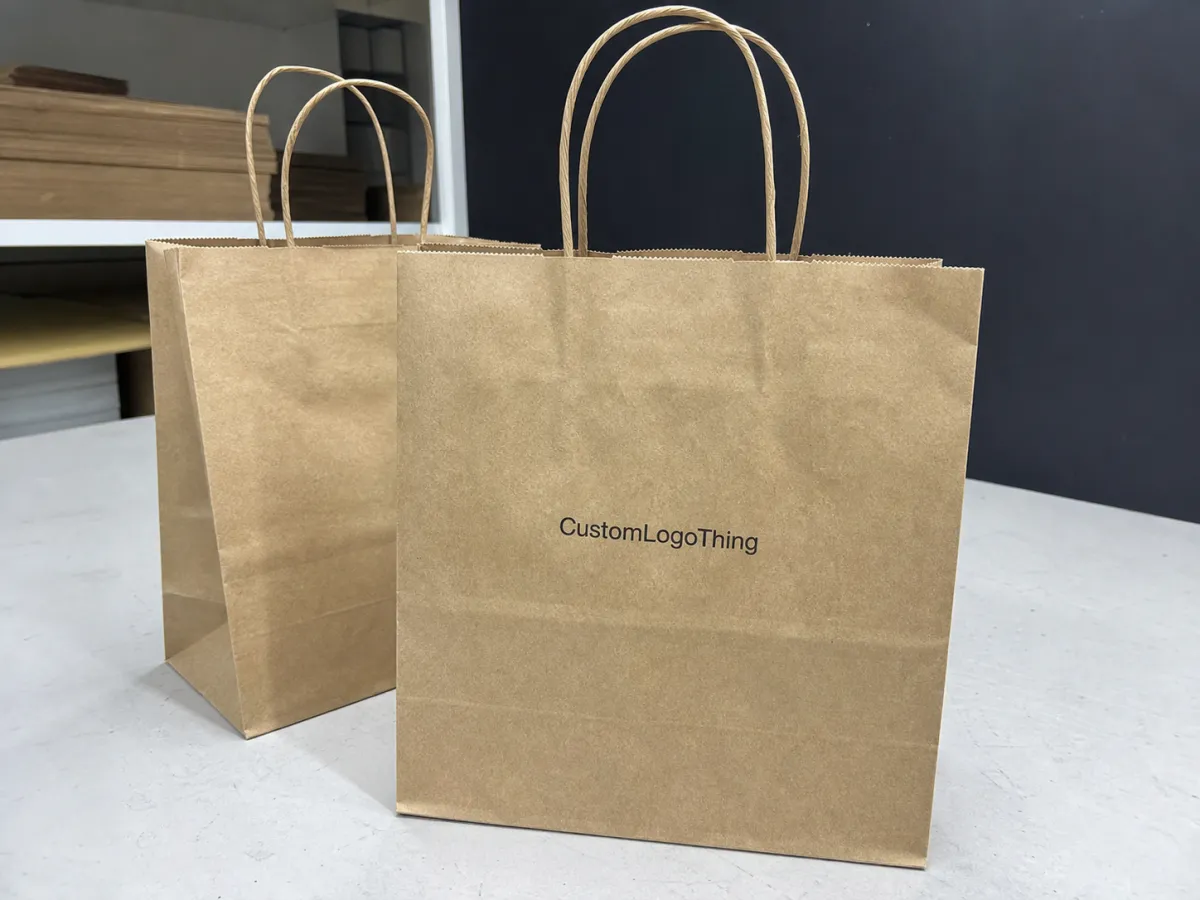
A cheap paper bag is not always a cheap program. The low quote often comes from somewhere specific: lighter paper, thinner handle cord, less glue at the top edge, lower print coverage, or cartons packed so tightly that the handle shape gets crushed in transit. Each of those saves money somewhere in the factory. Each can cost more later.
The hidden expenses are usually practical, not dramatic. A handle pull that fails on the shop floor means a replacement bag. A gusset that refuses to open cleanly slows packing. A bottom panel that bows under load can make a good-looking stationery bundle look careless before it even leaves the store. Multiply that by a season’s worth of transactions and the supposed savings disappear fast.
Labor is the quiet part of the equation. If staff have to restack products, move bags around because the size is wrong, or double-bag heavier kits, the real cost per piece rises well above the quoted amount. Freight can also distort the picture. Oversized cartons and extra air add weight, volume, and storage strain. A quote that ignores those realities is incomplete, even if the line item looks tidy.
“The lowest bag price is not the lowest packaging cost if the bag adds handling time, damage risk, or rework.”
That is why a stationery buyer should compare landed performance, not just ex-factory cost. A slightly higher unit cost can be the better value if it reduces damage, keeps counters moving, and preserves the appearance that the retail program depends on.
What Actually Defines a Quality Twisted-Handle Paper Bag
A well-made twisted-handle paper bag starts with the paper itself. Kraft or coated board can both work, but they behave differently. Kraft has a natural, matte character and usually suits recycled or restrained branding. White kraft gives a brighter print surface and can make small logos and fine line work read more cleanly under store lighting. The wrong substrate can make even good artwork look flat or dull.
The handle is more important than it sounds. Twisted paper handles are popular because they are economical and easy to recycle with the paper body, but their strength depends on the twist density, cord width, glue application, and how the attachment area spreads load across the top edge. If the handle patch is too small or the adhesive is inconsistent, the bag can fail right where the customer grips it.
Side gussets and the bottom structure also matter. A bag that opens square and stands upright is easier to pack, easier to display, and less likely to split under a boxy load. That is especially relevant for stationery items with hard corners: journal sets, boxed pencils, metal pens, or gift bundles with rigid inserts. Rounded products are forgiving. Sharp edges are not.
Print quality is another marker of workmanship. Flexographic printing is efficient for simple logos and solid colors. Offset printing usually gives sharper detail for fine illustrations, gradients, and more delicate branding. Neither method is automatically better; the right choice depends on the art and the quantity. If the print coverage is heavy, the ink behavior, drying time, and scuff resistance all become part of the quality discussion.
Good bags also share small visual traits that buyers notice even if they do not name them: straight handles, even top folds, clean glue lines, consistent color, and a bag body that folds flat without twisting. Those details are not decoration. They are the visible trace of process control.
Size, Paper Weight, Handle, and Finish Specifications
Most pricing disputes start with vague specifications. If the width, gusset, height, paper weight, handle style, print coverage, and carton count are not fixed, two quotes can look comparable while describing very different products. That is not a pricing problem. It is a specification problem.
The right size depends on the product mix. Flat stationery packs, envelopes, and cards can live in a slimmer bag with modest headroom. Boxed notebooks, accessory kits, and mixed retail sets need more depth and stronger sidewalls so the bag does not billow at the gussets or strain at the seams. Too much height can be awkward and waste material. Too little height can stress the handle zone and make the bag feel crowded.
- Width: match the widest item plus a little side clearance so loading is smooth.
- Gusset: allow enough depth for rigid products and stable standing.
- Height: leave enough room for the top to close without overbuilding the bag.
- Paper weight: specify the lightest GSM that still passes a real load test.
- Handle: confirm cord thickness, attachment method, and comfort in the hand.
Paper weight deserves special attention because it drives both feel and performance. Lighter kraft may be acceptable for small card packs or promo literature. Heavier stock is usually safer for boxed stationery kits, multi-item bundles, or retail bags that will be carried a longer distance. A bag that is only slightly too light may still print well and look fine in a photo. Under load, the weakness shows up quickly at the handle patch or bottom fold.
Finish changes the budget too. Uncoated kraft keeps the look simple and natural. White kraft can sharpen branding. Matte or gloss varnish improves scuff resistance and presentation, though it adds cost and may affect recycling claims depending on the full build. A full lamination is usually unnecessary for stationery bags unless the brand is chasing a specific premium effect. More finish is not automatically better. It just adds another process step that needs to earn its place.
For a buyer comparing options, the practical question is not whether a bag is “premium.” The better question is whether the chosen spec supports the merchandise without wasting paper, labor, or freight. That is the difference between a tidy stationery twisted handle paper bags Unit Cost Review and a quote comparison that tells only half the story.
Stationery Twisted Handle Paper Bags Unit Cost Review: MOQ Drivers and Price Breaks
Several factors drive the unit cost at once: bag size, paper grade, number of print colors, coating or varnish, handle type, carton pack count, and destination. Setup charges sit in the background, but they matter a great deal on smaller runs. Printing plates, machine adjustment, sample approval, and packing instructions all add fixed work that gets spread across the order.
That is why MOQ changes the picture. A 2,000-piece run usually carries a higher cost per bag than a 10,000-piece run because the setup is being divided across fewer units. The drop is real, but it is not unlimited. Once the order gets large enough, other costs become more visible: storage, cash tied up in inventory, and the risk that the design changes before the stock is used.
For stationery buyers, smaller programs are common. Seasonal collections, limited-edition notebooks, event packs, and short promotional campaigns do not always justify a very high MOQ. In those cases, it is often better to pay a slightly higher unit price for the right quantity than to buy too much and sit on it.
| Build option | Typical MOQ | Typical unit cost | Best fit | Notes |
|---|---|---|---|---|
| Natural kraft, one-color logo | 2,000-5,000 | $0.16-$0.28 | Flat stationery packs, store carry-out, events | Simple setup and lower print complexity keep cost contained |
| White kraft, two to three colors | 3,000-10,000 | $0.22-$0.42 | Boutiques, gift sets, premium stationery bundles | More color control and additional plate work increase the price |
| Coated or varnished premium bag | 5,000-10,000+ | $0.30-$0.65 | Luxury kits, boxed sets, branded promotions | Higher finishing costs, but a more polished shelf appearance |
If two quotes look far apart, check the basis first. Is one price ex-works and the other landed? Does one include cartons, inner packing, or freight? Was the same paper grade used? Were the handles reinforced the same way? These questions matter because a low number can hide a smaller bag, thinner stock, or a simpler print build. Honest comparisons begin with identical specs, not similar descriptions.
There is also a point where cost savings flatten out. Beyond a certain order size, the price per piece may stop dropping in any meaningful way, while inventory exposure keeps climbing. Buyers who reorder often usually benefit more from a sensible production lot than from chasing the absolute lowest quote on paper.
Production Steps, Lead Time, and Shipping Milestones
Paper bag production follows a fairly predictable path, and every delay tends to come from the same places. Artwork review, proof approval, printing, conversion, handle attachment, folding, packing, carton labeling, and dispatch booking all need to happen in sequence. If the artwork is uncertain, the schedule slips before the first sheet is cut.
Lead time depends on how simple the build is. Straightforward natural-kraft bags with limited print often move faster than multi-color, coated, or color-critical jobs. A practical planning range is around 12-18 business days after proof approval for simple runs, and closer to 18-28 business days for more detailed work. Physical sample approval can add another 3-7 days if the buyer wants to inspect the bag before production starts.
Milestones should be written clearly. Useful checkpoints include artwork receipt, digital proof, sample signoff, production start, quality check, carton completion, and dispatch booking. These are not administrative niceties. They are the points where a project can be corrected before a mistake gets multiplied across thousands of units.
Quality control deserves its own place in the schedule. A decent run should include checks for dimension accuracy, glue coverage, handle alignment, color consistency, and carton count. For heavier stationery packs, some buyers also ask for a simple load test or handle pull test. That is sensible. A bag can look correct while still failing in the hand. The load test catches the difference.
Shipping adds another layer. Flat-packed paper bags are economical, but they still need protected cartons and careful stacking. Crushed corners, bent handles, or mixed carton counts can undo a clean manufacturing run. If the bags are headed to a warehouse, ask how the cartons are labeled and whether overages or shortages are managed by count range or exact count. Small misunderstandings here can turn into receiving problems later.
For buyers who track standards closely, distribution testing references such as ISTA can help frame shipping stress, and FSC is the obvious reference point when paper sourcing and chain-of-custody claims matter. Those details are not marketing fluff. They affect procurement approvals, especially for retailers and brands with documented sustainability requirements.
How to Judge a Reliable Paper Bag Supplier
Reliability shows up in repeatability. A supplier who can make one sample is not necessarily a supplier who can make a clean second run six weeks later. For stationery programs, consistency matters because the bag often sits next to the same product line month after month. If the tone shifts, the handle moves, or the print drifts, the shelf story breaks.
The best indicators are practical. Look for stable GSM control, correct finished dimensions, even glue application, straight folds, consistent handle placement, and carton counts that match the packing list. If those points are handled well, there is a good chance the supplier understands production discipline rather than just quote generation.
“A good paper bag supplier does not only promise strength and color. It delivers the same bag, in the same way, run after run.”
It also helps when the supplier is willing to say no. If the requested paper weight is too light for the product load, the right answer is a heavier stock or a structural adjustment, not a polite yes that later fails at the customer counter. Straight talk saves more money than optimism. That is especially true when the product is delicate, boxy, or sold in a premium retail setting where presentation is part of the sale.
Useful suppliers will explain which changes increase setup cost and which changes are minor. For example, a small artwork tweak may be easy, while a second print color or a special finish can affect the plate count and press time. They should also be able to discuss overage allowances, shortage tolerances, and sample matching without hiding behind vague language. None of that is glamorous. It is the difference between a smooth reorder and a messy one.
What to Send for an Accurate Quote and Sample Match
The easiest way to get a clean quote is to send complete information the first time. The supplier needs the bag dimensions, the product weight, the artwork file, the preferred finish, the quantity break, and the delivery point. If the bags are going to a warehouse, a retail store, or a direct fulfillment center, mention that too. Freight and carton planning are much easier when the destination is specific.
If you are matching an existing retail bag, send a physical sample if possible. Photos help, but they do not always show handle thickness, paper tone, or the difference between a smooth and slightly fibrous surface. A bag can look close on screen and still feel wrong in the hand. Under store lighting, white kraft, natural kraft, and coated stock can all behave differently.
- Bag dimensions with width, gusset, and height.
- Product description with weight and whether the items are flat or boxed.
- Artwork file in the cleanest available format.
- Paper and finish preference such as natural kraft, white kraft, matte, gloss, or uncoated.
- Quantity break so the MOQ and price tiers can be judged properly.
- Delivery point so the freight number is real instead of estimated loosely.
For exact visual matching, a preproduction sample is usually worth the time. Even well-controlled runs can show slight shifts in print density, paper texture, or handle placement. That is normal. The sample is the place to catch it. Once approved, the full order has a much better chance of arriving as expected.
The final check is simple: compare two or three complete specs side by side, not just quoted totals. A solid stationery twisted handle paper bags Unit Cost Review should tell you which bag protects the product, which one fits the budget, and which one creates avoidable friction later. That is the real buying decision.
How do I estimate stationery twisted handle paper bag unit cost before requesting a quote?
Start with size, paper weight, handle type, print colors, and quantity, since those five inputs usually drive most of the price difference. Add shipping destination and carton count so you are comparing landed cost rather than only ex-factory pricing. If two quotes look close, ask whether the same paper grade, handle reinforcement, and finish were used.
What MOQ is typical for custom stationery twisted handle paper bags?
MOQ usually depends on print method, paper choice, and whether the run needs special finishing steps. Smaller runs are possible, but the unit price is usually higher because setup work is spread across fewer bags. If you need several versions, ask whether the designs can be grouped into one production window.
Which paper weight works best for stationery retail bags?
Lighter paper can work for flat stationery sets, but boxed kits and heavier bundles usually need a sturdier kraft or board grade. The safest choice is the lightest paper that still supports the finished load without handle pull-through or sidewall buckling. A sample pack test is the best way to confirm weight and rigidity before a full order.
How long does production usually take after artwork approval?
Simple natural kraft orders usually move faster than multi-color printed bags or special finish jobs. Artwork approval, proofing, and sample signoff can add time before the run begins. Ask for a milestone schedule so you can plan receiving, packing, and launch dates with less guesswork.
Can I match an existing retail bag style exactly?
Yes, if you provide a sample, clear photos, or dimensional details, including gusset width, handle style, and finish. Matching is easier when the supplier knows the target paper tone, print placement, and carton pack format. Color and paper texture may still vary slightly, so request a preproduction sample when the match must be exact.

