Buy Subscription Logo Patch Beanies at Better Unit Cost
For subscriber boxes, promo kits, and recurring merch drops, subscription Logo Patch Beanies unit cost is not a fixed number. It moves with patch construction, yarn weight, MOQ, packing format, and how tightly the spec is controlled from the first quote to the third reorder. The surprising part? On repeat programs, the patch is often not the biggest cost driver. Setup charges, color matching, and pack-out decisions can move the total more than the beanie body itself.
Why Recurring Beanie Programs Change the Math
A one-time beanie order can hide a lot of issues. A recurring program exposes every one of them. If the same hat ships every month inside a subscription box, the real goal is not novelty. It is repeatability. That is why subscription Logo Patch Beanies unit cost should be judged against the next three drops, not just the first proof.
In practice, the cheapest-looking option on a quote sheet is not always the lowest-cost program. A small patch can be inexpensive, but if it needs a custom die, a revised backing, or a more complicated attachment method, the first order may carry extra setup charges that do not show up clearly until later. The same is true for beanie color matching. If the brand wants charcoal in month one and a slightly different charcoal in month four, the buyer may end up paying for re-approval, re-swatching, or a fresh production hold.
That is why recurring buyers usually care less about showroom appeal and more about operational calm. They want a style that can be replenished without re-litigating the spec every cycle. A stable program protects margin because the supplier can keep the same construction, the same patch placement, and the same packaging routine. That stability also makes forecasting easier. If the promo kit ships 500 units a month, a small difference in cost per piece quickly compounds across the year.
From a packaging buyer's point of view, the best offer is the one that keeps the look constant and the quote structure readable. A clean re-order path is worth real money. It avoids late approvals, rush freight, and those awkward corrections that happen when the second run does not match the first.
Patch Styles, Branding Methods, and Wear-Ready Details
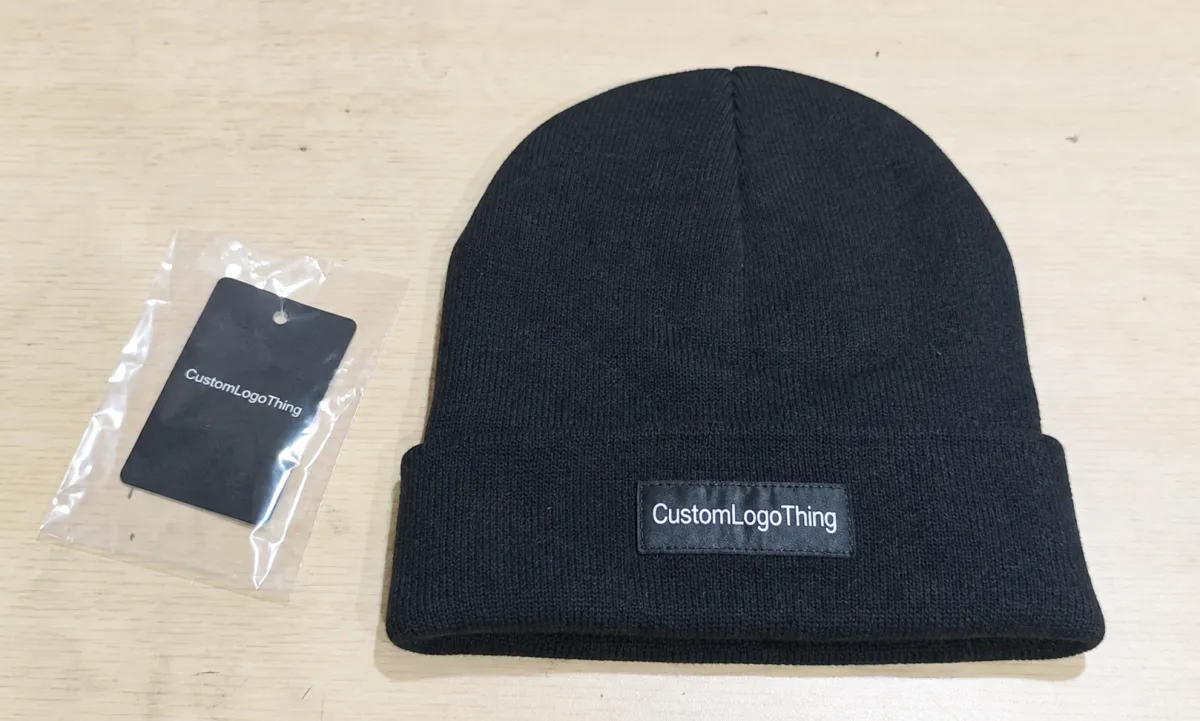
Patch choice changes the look, but it also changes the production path. Woven patches are a good fit for crisp logos and smaller type because they keep fine detail better than a thick embroidered fill. Embroidered patches give more texture and can feel more tactile on a cuff. Leatherette and PVC push the design in a more premium direction, while applique usually creates a softer, more fabric-forward finish. Each option affects lead time, tooling fees, and the final unit cost.
Logo complexity matters more than many buyers expect. Thin lines, tiny text, and subtle gradients often need simplification before they can be made into a patch that reads clearly from arm's length. If the logo is going onto a beanie cuff, the design also needs to survive movement and stretching. A mark that looks sharp in a flat mockup can become muddy once it is stitched, bonded, and folded over a head.
Placement is not cosmetic. Front cuff placement gives the strongest brand visibility and usually photographs best in ecommerce and subscriber inserts. Side cuff placement can feel more understated, which some lifestyle brands prefer. A fold-over position may give the hat a more premium silhouette, but it can also change how the patch sits when the wearer moves. Better buyers think through all three: visibility, comfort, and consistency during packing.
A patch that feels rough on day one will not get a second chance from a subscription customer. The complaint usually starts with comfort, then turns into a return, and then the margin problem becomes visible.
Wearability is not a small detail. Recurring customers notice edge quality, backing softness, and whether the attachment method leaves a stiff ridge against the forehead. Heat-seal, sewn-on, and direct embroidery all behave differently. If the audience is wearing the hat for commute use, outdoor events, or cold-storage work, the finish needs to stay soft enough for long wear. That does not mean compromising the branding. It means choosing a patch and backing system that holds its shape without feeling cheap.
For buyers comparing options, the main question is simple: which patch style keeps the logo legible and the program stable without turning every reorder into a new project? That is where real savings show up.
| Patch style | Typical added cost per piece | Best for | Buyer watch-out |
|---|---|---|---|
| Woven | $0.18-$0.40 | Small logos, clean detail, lower profile | Can look flat if the design needs texture |
| Embroidered | $0.22-$0.55 | Classic merch, visible stitch texture | Fine text may need simplification |
| Leatherette | $0.35-$0.85 | Premium presentation, clean contrast | Can add tooling fees and scuff risk |
| PVC | $0.45-$1.10 | Bold marks, durable outdoor use | Heavier feel and longer mold lead time |
| Applique | $0.20-$0.60 | Soft branded looks, fabric-first brands | Edge finish depends on the seam quality |
Fit, Yarn, Cuff, and Packaging Specifications Buyers Should Lock In
The fastest way to control subscription Logo Patch Beanies unit cost is to lock the core spec before asking for quotes. Start with knit gauge, yarn blend, cuff depth, crown shape, and finished width. Those details affect fit, hand feel, and how well the beanie holds its shape after packing. A half-inch change in cuff depth can alter the look enough to trigger a new proof cycle. That sounds small. On a monthly repeat order, it is not.
Material choice also moves the price. Acrylic is often the most accessible option for general merch because it is consistent and easy to color match. Recycled blends may support a sustainability story and can help with brand positioning, but they may also introduce slightly different hand feel or color behavior. Wool-mix constructions can feel warmer and more premium, yet they usually sit at a higher cost per piece. There is no universal best choice. There is only the best choice for the audience, the climate, and the margin target.
Packaging matters more than many style teams assume. If the beanies are going into a subscription box or fulfillment center, confirm whether the order needs individual polybagging, barcode labels, hangtags, size stickers, or carton markings. Packaging adds labor, materials, and often a little extra scrutiny on receiving. For programs that ship through a distribution network, transit expectations documented by ISTA and sourcing guidance from FSC are worth reviewing before you finalize the spec.
A one-page control document solves a lot of future problems. It should show:
- Exact beanie style and yarn blend
- Patch dimensions, attachment method, and backing type
- Approved Pantone or closest match references
- Cuff placement with a simple measured diagram
- Packaging requirements and carton count
- Reorder approval contact and revision lock date
That control sheet is not paperwork for the sake of paperwork. It is the tool that keeps the second and third runs from drifting. If the spec is clear, the supplier can quote faster, produce with fewer questions, and hold the program close to the original approval.
Subscription Logo Patch Beanies Unit Cost Breakpoints
This is where the quote stops being abstract. Subscription Logo Patch Beanies Unit cost is usually built from the blank knit cost, patch decoration, application labor, packaging, freight assumptions, and any setup charges or digitizing fees. If a supplier gives only a single number, ask for the breakdown. Without it, you cannot tell whether the price is strong or just hiding costs in the wrong place.
MOQ has a real effect on the curve. A 100-piece order often carries a much higher cost per piece than a 500-piece program because the setup burden is spread across fewer units. Once the run gets larger, the gap between sample pricing and production pricing narrows. That is why recurring buyers should ask for tiered pricing, not just one quote. A useful quote should show 100, 250, 500, and reorder quantities so the subscription team can forecast spend accurately.
Here is a practical way to think about the pricing structure:
- Blank knit cost: the beanie body, shaped by yarn blend and stitch density
- Patch decoration: woven, embroidered, leatherette, PVC, or applique
- Application method: sewn, heat-applied, or direct knit integration
- Packaging: polybag, hangtag, barcode, and carton spec
- Setup charges: artwork prep, digitizing, patch dies, or color matching
- Freight assumptions: domestic, ocean, air, and destination terms
A quote only looks cheap until the second order comes back with a different cuff width, a fresh artwork revision, and a new packaging requirement.
For molded PVC or debossed leatherette patches, tooling fees can add $60-$180 before the first production piece is approved. That is normal. The trick is to know whether that fee is a one-time event or something that will come back each season. Buyers should also ask if the patch die can be held for later runs, because retention matters in recurring programs. If the tooling is retained, the re-order path usually gets cheaper and faster.
Below is a realistic pricing frame for a standard cuff beanie with a logo patch. The numbers are directional, not universal, because yarn blend, patch size, and pack-out can move the result.
| Quantity | Typical unit cost | What usually drives the price |
|---|---|---|
| 100 pcs | $7.50-$11.00 | Setup charges, low-volume labor, small batch packaging |
| 250 pcs | $5.90-$8.25 | Better spread of patch and prep costs |
| 500 pcs | $4.75-$6.50 | More efficient production and packing flow |
| 1,000 pcs | $4.10-$5.75 | Lower labor burden per unit, steadier material buy |
The important comparison is not just price. It is consistency. A slightly lower quote that forces a fresh approval on every reorder can cost more in staff time than a cleaner, better-documented program. That is why experienced buyers often choose the supplier that shows the price curve honestly and explains where the extra cents come from.
Process, Timeline, and Production Steps for Reorders
The production path should be straightforward. First comes artwork review. Then spec confirmation. Then a sample or pre-production approval. After that, the factory schedules production, runs inspection, packs the goods, and books shipment. Every one of those steps needs an owner and a deadline. If the team cannot answer who approves the patch art and by what date, the launch calendar is already at risk.
Most delays are predictable. Slow file corrections cause more grief than almost anything else. So do patch revision cycles when the logo was never simplified enough for small-format production. Fit approval can also hold the line, especially when the buyer wants a softer cuff or a looser crown after seeing the first sample. None of this is unusual. It just means the timeline should include buffer.
For a stock-compatible style with an existing beanie body and a straightforward patch, first-order lead times often land around 12-15 business days after proof approval, sometimes longer if the color match is tight or packaging is complex. Fully custom knit and custom patch combinations usually need more time because sampling and corrections take longer. Reorders are where the process gets better. Once the spec is locked, the second and third runs can skip the slowest approval steps.
The best suppliers treat reorder continuity as a production asset. They keep records of the approved patch placement, yarn shade, and carton format. That matters because subscription logo patch beanies unit cost tends to stabilize when the factory is not re-solving the same problems every month. Less back-and-forth means fewer surprises and fewer delays.
A clean reorder workflow usually includes:
- Saved artwork files in vector format
- Locked patch size and placement measurements
- Approved packaging spec and carton quantity
- Reorder trigger date tied to inventory levels
- Named contact for urgent approvals
That structure is boring in the best possible way. It keeps the program moving, and for a recurring drop, boring often means profitable.
Why Buyers Keep Reordering These Beanies
Recurring buyers come back for the same reason procurement teams like predictable cartons: fewer surprises. A good beanie program delivers consistent color, stable sizing, and a patch that lands in the same place every time. Subscriber fulfillment teams notice the difference immediately. So do customers. When the hat looks identical in month three and month nine, the brand feels organized.
That consistency protects margin in a quiet way. Standardized production means fewer rushes, fewer corrections, and less time spent renegotiating the same details. It also makes SKU management easier because the buyer is not tracking a different spec for each season. The result is not only better pricing. It is less internal friction.
There is also an operational upside that gets overlooked. Clean carton counts make receiving faster. Clear labels reduce warehouse mistakes. Stable pack-out lowers customer-service complaints because the same item keeps arriving in the same condition. None of that sounds glamorous. It is exactly what makes repeat programs worth keeping.
Honestly, the strongest sales pitch here is not style. It is reliability. Buyers do not need exaggerated promises. They need clear proofs, transparent pricing, and a supplier who understands that the second and third orders matter more than the first sample. That is especially true for subscription programs, where the product becomes part of a monthly routine.
For teams comparing vendors, the service behavior often tells the real story. Fast replies, clear revision notes, and no hidden add-ons usually matter more than a flashy mockup. If a supplier can keep subscription logo patch beanies unit cost steady while holding the spec tight, that supplier is doing the hard part well.
Next Steps to Launch a Repeat Order Plan
Start with the minimum information needed for a reliable quote: logo file, target quantity, preferred beanie color, patch style, and whether packaging must be retail-ready. That is enough to get the first pass. After that, compare the quotes on the same basis so one vendor is not hiding value in an unclear line item. The goal is not just to buy hats. It is to build a replenishment system that the team can repeat without drama.
Before you request pricing, make a short decision list:
- What is the target MOQ for the first run?
- Which patch style fits the logo best?
- Will packaging include polybags, barcodes, or hangtags?
- What reorder lead time is acceptable?
- Who approves artwork changes after the first sample?
Then ask for tiered pricing, a sample if the patch finish matters, and a clear re-order path. If the plan is truly recurring, decide now how inventory will be replenished and who owns the approval cycle. That is how you keep the buying process from turning into a monthly emergency. It also helps subscription logo patch beanies unit cost stay predictable instead of drifting with each new request.
Buyers who treat the first order as the blueprint for the next one usually get the best result. The quote gets cleaner. The production path gets shorter. The price stays more stable. And the brand gets a repeatable item that does its job every month without eating into margin.
Frequently Asked Questions
How is subscription logo patch beanies unit cost calculated?
It usually combines the base beanie cost, patch decoration, application labor, packaging, freight assumptions, and any setup or digitizing fees. Higher quantities lower the per-unit price, but patch complexity and packaging requirements can still move the final number.
What MOQ gives the best price on recurring beanie orders?
The best MOQ is the one that matches your forecast without forcing excess inventory. Pricing usually improves as quantity rises in clear tiers, so ask for breakpoints at multiple volumes and compare the cost per piece at each level.
Can I keep the same patch and just change beanie colors later?
Usually yes, if the patch dimensions and attachment method stay the same and the base beanie style is compatible. Keeping the patch constant often reduces setup work and helps preserve a lower unit cost on repeat runs.
How much lead time should I allow for the first order?
First orders take longer because artwork, sampling, and approval steps need to be completed before full production starts. If the style is fully custom, build extra time into the schedule so launch dates do not slip while patches or colors are being finalized.
What files do you need to quote a custom beanie with a logo patch?
A vector logo file is best, plus target quantity, preferred beanie color, patch type, and any packaging or labeling needs. The more exact the spec sheet, the faster you can compare quotes and avoid revisions that push up cost or delay production, which is the simplest way to keep subscription logo patch beanies unit cost under control.