Ceramic Soft Touch Poly Mailers Bulk Order Planning
Ceramic soft touch poly mailers Bulk Order Planning starts with a practical question: what does the customer actually handle first? Usually the mailer. Not the insert, not the tissue, not the product itself. The outer bag is the first tactile cue, and that matters more than many teams want to admit. A matte, soft-touch finish changes the first impression fast. It cuts glare, feels less slippery, and gives the shipment a more deliberate look without turning the pack-out into a science project.
That is why this kind of mailer gets used for apparel, subscription boxes, beauty items, and other direct-to-consumer orders that live or die on presentation. The bag has to do two jobs at once. It needs to survive sorting, stacking, and handoffs. It also needs to look like someone cared. If the surface scuffs easily or the print looks uneven from run to run, the whole package feels cheaper than it should.
“Ceramic soft touch” is usually a finish description, not a literal material claim. Buyers use it to describe a dense, smooth matte feel with low reflectivity. That distinction matters because the goal is not a fancy label. The goal is a repeatable mailer that looks controlled in warehouse lighting, photographs well, and holds up across a full production run.
For bulk buying, the real challenge is not choosing a pretty sample. It is making sure the final spec can be reordered without drift. A clean bulk order plan has to cover dimensions, gauge, seal behavior, print limits, freight, and inventory timing. Miss one of those and the quote may look fine while the run itself becomes annoying.
Why a Soft-Touch Mailer Feels More Premium in Transit
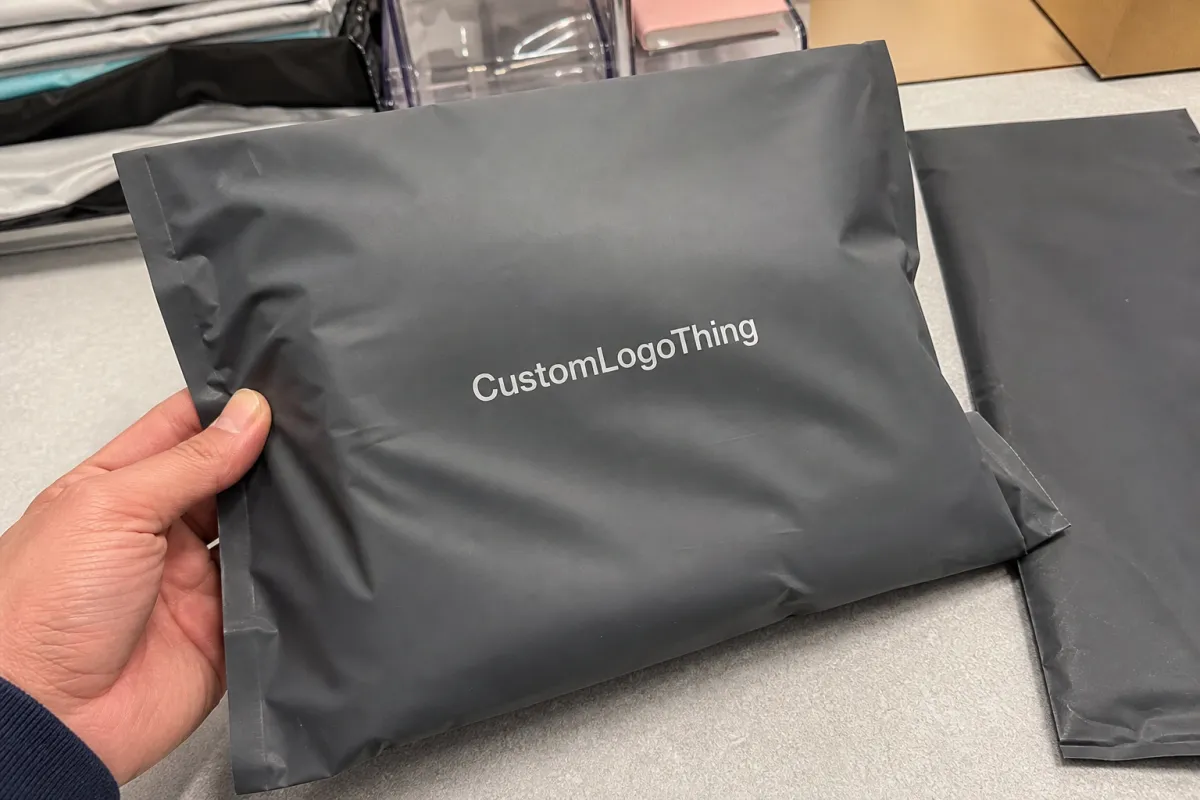
Standard glossy mailers reflect light aggressively. That can make them look cheap, even when the underlying film is perfectly serviceable. A soft-touch finish changes the read immediately. It dulls the shine, softens fingerprints, and makes the surface feel more intentional in the hand.
That tactile difference is not just branding theater. Packages are handled by humans before they are opened. Warehouse staff, sorters, drivers, and receiving teams all see and touch the outer package. A soft-touch finish tends to hide minor handling marks better than a bright gloss film. It also makes dark colors and large solids feel calmer, which helps if the brand uses a restrained visual style.
A mailer can be low-cost and still look premium, but only if the finish, print, and seal hold together after real transit handling.
There is a second reason buyers like this finish: consistency. Customers notice when one shipment looks and feels different from the last one. If the surface sheen shifts from batch to batch, the brand feels less stable. That becomes a problem for repeat orders, especially when the mailer is the only visible packaging element. Ceramic soft touch poly mailers Bulk Order Planning works best when the finish is locked early and treated as part of the brand system, not an afterthought.
Soft-touch surfaces also help in environments where packages sit under harsh lighting. Overhead LEDs, backroom fluorescents, and camera flashes all exaggerate reflection. A matte finish reduces that problem. It does not eliminate every defect, but it makes the package easier to present, photograph, and store without looking flashy in the wrong way.
- Lower glare in packing areas and retail back rooms.
- Less visible handling marks than high-gloss films.
- More controlled presentation for direct-to-consumer orders.
- Better visual consistency across repeat production lots.
Print Surface Details That Affect Color, Grip, and Scuffing
The surface finish changes how artwork behaves. On a soft-touch mailer, color often reads deeper and flatter than it does on glossy film. That can be a good thing. A matte surface makes solids look more sophisticated, and logos can feel more anchored. The tradeoff is that fine detail needs enough contrast to survive handling and stacking.
Thin lines, tiny type, and busy artwork are where many first-time buyers get surprised. A design that looks clean on screen may lose edge clarity once it is printed on a matte-coated plastic film. That does not mean detailed artwork is impossible. It means the print method, color count, and line weight need to match the substrate. Simple logos and bold block text usually perform best. If a brand wants photographic art or very fine gradients, the file prep and press controls need to be tighter.
Scuff resistance matters too. Dark mailers can show abrasion faster than lighter ones, especially if cartons rub during storage or transit. The issue is not always the ink itself. Sometimes it is the surface coating, sometimes the thickness of the print layer, and sometimes the way finished cartons are packed before shipment. A supplier should be able to explain which part of the stack is most likely to wear and how they control it.
Seams and safe zones are easy to ignore until the proof arrives. Artwork that wraps too close to a flap, fold, or seal line can drift once the bag is formed and cut. That is how a centered logo ends up looking off-center on the final product. Buyers doing ceramic Soft Touch Poly Mailers Bulk order planning should review the die line, not just the mockup. The bag structure decides what looks clean in production.
For distribution testing, the ISTA shipping test standards are a useful reference. You do not need to cite them for every run. You do want a supplier who understands what happens after the cartons leave the plant. Real shipping lanes punish weak closures, thin film, and lazy pack-out choices. Lab assumptions rarely survive a rough route.
Size, Gauge, and Seal Specs Buyers Should Lock Before Quoting
Before asking for pricing, lock the basics. Internal dimensions. Film thickness. Flap length. Closure style. If those are still open, the quote is only a sketch. The mailer needs to fit the product with enough room for packaging inserts, folds, or any protective wrap. Too tight, and the bag splits or bunches during insertion. Too loose, and the shipment looks underfilled while wasting freight cube.
Gauge, usually discussed in mils, affects feel and durability. Many retail and DTC mailers land somewhere between 2.5 and 4 mil, depending on product weight and the amount of abuse expected in transit. Lightweight apparel may work at the lower end. Heavier soft goods, boxed kits, or multi-item shipments usually need more film strength. Thicker is not automatically better, though. A bag that is too stiff can be awkward to pack and may not seal as cleanly.
Seal performance deserves equal attention. Some programs do fine with a standard pressure-sensitive closure. Others need stronger adhesive, better tamper resistance, or more puncture tolerance. If the shipment changes hands often, ask for hold tests and closure checks before approving the spec. A mailer that opens early costs more than a stronger one ever would.
Buyers should think about structure before artwork. That sequence saves trouble. First fit the product. Then confirm the seal. Then place the print. Reversing that order creates pretty proofs that do not pack well. The result is a mailer that looks polished in a PDF and annoying on the line.
A good spec sheet for ceramic Soft Touch Poly Mailers Bulk order planning usually includes the finished product size, flap length, thickness, print placement, surface finish, and any special notes about seal behavior or packing orientation. If a reorder is likely, those details should be saved cleanly. Memory is a terrible system for packaging specs.
Pricing, MOQ, and Unit Cost Drivers for Ceramic Soft Touch Poly Mailers Bulk Order Planning
Pricing usually moves in a predictable order: volume first, then size, then print complexity, then finish treatment, then freight. A standard-size mailer with simple branding will usually cost less than a large custom bag with full bleed printing and extra handling steps. That is not a mystery. Setup time, material use, and production complexity are what drive the difference.
MOQ should be treated as part of inventory planning, not just a sales hurdle. A larger minimum can reduce setup cost per unit, but it also increases the amount of stock sitting on a shelf. If the brand sells through unevenly, that extra inventory can become dead weight. If the brand is stable and reorder timing is predictable, the larger run may be the smarter buy. There is no universal answer.
Freight and proofing can also shift the landed cost more than buyers expect. A quote that looks strong on paper may become less attractive once shipping, sample revisions, and reproofs are added. That is why a bulk order should be priced as a full landed program, not just as a factory number.
For teams comparing volume tiers, the table below gives a realistic planning frame. The ranges are broad on purpose. Print count, film thickness, destination, and packaging method can all push the final number around.
| Order Tier | Typical Unit Cost Range | Best Fit | Common Tradeoff |
|---|---|---|---|
| 2,000-4,999 pieces | $0.20-$0.36 each | Launches, pilot programs, seasonal drops | Higher setup cost per unit |
| 5,000-9,999 pieces | $0.14-$0.26 each | Stable mid-volume repeat orders | Needs enough storage space |
| 10,000-24,999 pieces | $0.10-$0.19 each | Established brands with predictable demand | More cash tied up in inventory |
| 25,000+ pieces | $0.08-$0.15 each | High-volume distribution and multi-site use | Less flexibility if artwork changes |
Those numbers are not promises. They are a planning range. A two-color print on a standard size bag is a very different job from a full-coverage custom format with specialty finish and tighter tolerance requirements. If a supplier can only give a vague quote without exact dimensions, quantities, and destination, the number is too soft to trust. Ceramic soft touch poly mailers bulk order planning works better when the request includes the real spec, not just the rough idea.
Process, Timeline, and Approval Steps From Quote to Delivery
The production path is usually simple on paper: quote, artwork review, proof, sample if needed, production, packing, transit. The catch is that every step depends on clean inputs. A missing dimension delays the proof. A bad file format delays the art check. A last-minute change to quantity or print layout can push the job back in line. None of that is unusual. It just means the easiest orders are the ones with the cleanest paperwork.
Lead time depends on the complexity of the job and the state of the spec. A straightforward run may move from final approval to production in about 10 to 15 business days. More complex jobs, custom sizes, or sample-first programs take longer. Transit sits on top of that. Domestic shipping may add only a few days, while cross-border freight, consolidation, or port delays can stretch the schedule enough to matter. If the inventory forecast is tight, that gap is where trouble starts.
Version control is a constant source of delay. A file gets updated after proofing. A flap length changes after the first sample. Someone decides the logo needs a different placement once the order is already in motion. Each change is manageable, but each one costs time and can affect the next order. The cleanest way to avoid that mess is a locked spec sheet and one approved artwork file that everyone actually uses.
If the broader packaging program includes cartons or inserts, fiber sourcing can matter too. The FSC certification network is useful for paper-based components, even though it does not apply to the poly mailer itself. Many brands track those details across the full pack-out, and suppliers who understand the difference tend to handle mixed-material programs more cleanly.
What to Verify in a Supplier Before Repeat Runs
The first order is the easy part. The second order is where the supplier proves whether they can repeat the job. Keep the approved files, the finished dimensions, the finish description, the exact gauge, and any notes about seal behavior. Save the sample if you can. Without that record, a reorder can drift in sheen, print placement, or material feel even if the name on the invoice stays the same.
Quality control should be discussed in plain language. Ask how incoming film is checked. Ask how print consistency is measured. Ask how finished cartons are packed so the outer surface does not scratch itself in transit. Ask what happens if the reorder quantity shifts by 10% or 15%. A supplier with a real process answers those questions directly. A supplier without one usually talks around them.
Response speed matters too. Proofs should come back on time. Schedule updates should be clear. If the buyer has to chase basic status every day, the relationship is already too fragile for repeat runs. Good production support is not about being flashy. It is about giving straight answers before the schedule slips.
For brands that manage multiple packaging categories, keeping one reference sample per SKU helps a lot. It gives the team a physical standard to compare against before signing off on the next run. If the company buys through Custom Poly Mailers, that sample becomes the easiest way to confirm the next shipment matches the last one. A broader Custom Packaging Products catalog can also keep the visual system aligned across mailers, cartons, and inserts without forcing every piece to look identical.
Next Steps for a Cleaner Reorder Plan
Before requesting a quote, gather four things: finished dimensions, quantity target, artwork files, and shipping destination. That short list removes most of the guesswork from pricing. If the timeline matters, include that too. A supplier can only tell you whether the job fits the schedule if they know when you need it.
Then ask for tiered pricing. A small jump in volume can sometimes lower the unit cost enough to justify the extra inventory. Other times the smaller run is smarter because sell-through is uncertain or the design may change next quarter. The right answer depends on demand, storage, and how often the brand refreshes packaging. Ceramic soft touch poly mailers bulk order planning only works well when the order size matches actual usage instead of an optimistic guess.
Lock one final spec sheet that records size, thickness, finish, closure, and print notes. Keep the approved sample with it. Set the reorder trigger now, before stock gets thin and everyone starts improvising. That is how the next order stays fast, accurate, and boring in the best possible way.
What changes the cost most in ceramic soft touch poly mailers bulk order planning?
Quantity tier usually has the biggest effect on unit cost, followed by custom size, print coverage, and finish complexity. Freight, proofing, and late artwork changes can raise the landed cost even if the base quote looks good.
How do I choose the right size for a soft touch poly mailer order?
Start with the finished product dimensions, then add room for any inner wrap, fold, or protective insert. Leave enough flap length for a secure seal so the package closes cleanly without stretching the film.
What is a realistic lead time for bulk soft touch poly mailers?
A simple run can move from proof approval to production in roughly 10 to 15 business days, but complex artwork, sampling, and freight can extend that. Build the full schedule around proofing, production, and transit, not just the factory slot.
Can I reorder the same ceramic soft touch poly mailers later and keep the same look?
Yes, if the approved spec sheet, artwork files, and color notes are saved from the first run. Keeping a reference sample helps confirm that finish, thickness, and print appearance stay consistent across repeats.
What should I have ready before requesting a quote for bulk mailers?
Prepare dimensions, quantity targets, artwork, and shipping destination so pricing and logistics can be calculated accurately. If possible, include your preferred timeline and any durability requirements so the quote reflects the real job.


