The fastest way to make sense of a Chocolate Embroidered Beanies unit cost review is to treat the beanie as a finished decorated item, not a blank hat with a logo added later. Once the quote is broken into the base knit, embroidery setup, stitch complexity, packaging, and freight, the pricing usually stops looking mysterious. That matters because chocolate is one of the few colors that can feel premium without forcing the order into a premium budget band.
Buyers often start with the wrong question: not “How much is a beanie?” but “How long will people actually wear it, and under what conditions?” A dark brown knit handles winter grime better than a pale or bright color, and that translates into more days in rotation. More wear time means more impressions per unit, which is the real metric hidden behind a simple headwear order.
The quote itself is usually shaped more by construction and decoration than by color. A cuffed rib knit with a small front logo is generally easier to price and easier to repeat than a slouch style with dense stitch coverage. Quantity changes the picture just as sharply; the same beanie can look expensive in a 50-piece order and reasonable in a 500-piece run because setup fees stop carrying so much weight.
Why chocolate beanies punch above their weight in winter promos
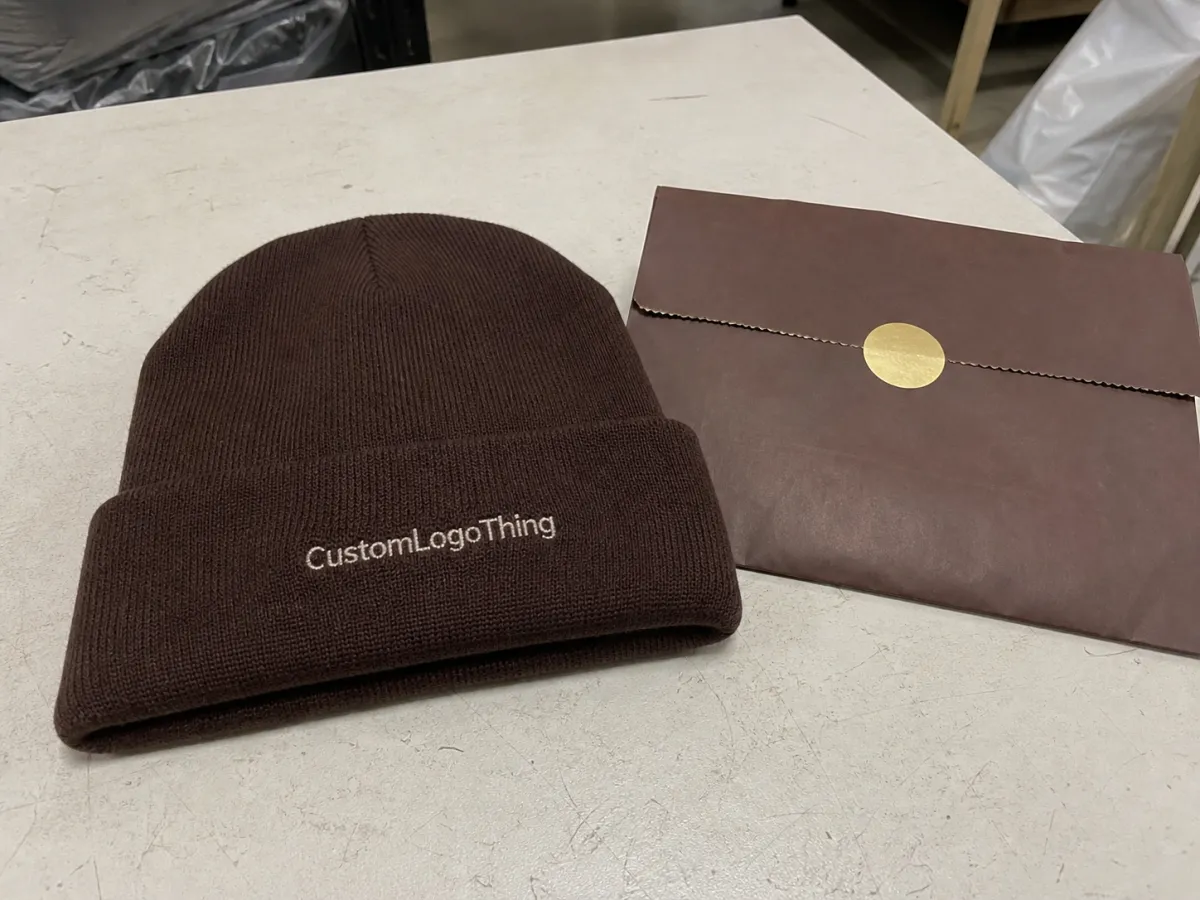
Chocolate works because it sits in that narrow space between practical and polished. It is dark enough to hide light marks, lint, and handling wear, but softer than black when the goal is a merch piece that feels a little less severe. That difference is small on paper and visible in the hand.
For winter campaigns, that matters more than many buyers expect. A beanie that holds up in a cold commute, a site visit, or a weekend event ends up being worn instead of forgotten in a drawer. A promotional item that stays in use for one extra season often delivers better value than a cheaper piece that never leaves the packaging.
Chocolate also gives embroidery a stronger stage than some lighter neutrals. Thread colors show up cleanly against it, especially whites, creams, golds, and saturated accent tones. On the other hand, very dark thread can disappear into the knit if the artwork is too subtle, so the logo needs enough contrast to read from a few feet away.
That is why a useful chocolate embroidered beanies unit cost review should separate aesthetics from economics. A buyer can like the color and still overpay if the logo is too complex, the packaging is over-specified, or the blank is heavier than the use case requires. The goal is not the cheapest hat. The goal is the most usable hat at the lowest practical landed cost.
For internal buying conversations, I usually split the use case into four buckets:
- Staff kits need easy sizing, durable knit structure, and a logo that reads instantly.
- Retail add-ons need cleaner finishing, controlled folding, and tighter presentation.
- Event merch benefits from simpler artwork and lower setup friction.
- Package inserts usually depend on lighter packing and clear case counts.
Once the intended use is clear, the quote becomes much easier to evaluate. A buyer comparing only the sticker price misses the part that matters: whether the item will still look good after the second or third wear, and whether the order can move through fulfillment without extra handling.
Embroidery-first product details buyers should lock in
Start with construction. A cuffed beanie gives the embroidery a stable front panel, which is usually the safest place for a logo. Slouch styles can work, but the looser shape makes placement less predictable and often forces more sampling. A ribbed knit tends to hold its form better than an open, very soft knit, and that difference shows up in how crisp the stitching looks.
Material choice is the next pressure point. Acrylic remains common because it balances warmth, softness, and price better than many alternatives. Acrylic-wool blends feel a touch more substantial and can improve perceived value, but they usually push the blank cost upward. If the order is meant to stay inside a bulk promo budget, this is one of the first places to check.
Embroidery placement should be decided before artwork approval, not after. Front cuff embroidery is the standard because it is visible, repeatable, and relatively easy to size. Crown embroidery can look sharp on certain silhouettes, but knit fabric is less forgiving there. A small side mark works if the design brief wants a quieter, lifestyle result.
Thread color deserves more attention than it usually gets. A chocolate beanie changes how thread reads under office light, retail lighting, and daylight, and the difference is not always subtle. A screen render can hide that problem; a physical thread sample against the actual knit color does not. If the logo has a branded shade, ask for a thread match against the real beanie color before production starts.
Keep logo scale realistic. Knitwear does not reward ultra-fine detail the way a flat woven fabric does. Tiny text, hairline outlines, and crowded gradients can turn into blurred edges or dense stitch patches. A cleaner shape with fewer interior details usually produces a sharper result and a lower chance of revision.
Packaging belongs in the spec sheet, not in a follow-up email. Folded presentation, tissue wrap, hang tags, barcode stickers, and individual polybags all affect labor and materials. Once a product needs to pass through retail, kitting, or warehouse handling, those items are part of the functional quote.
For teams that need a reference on transit and packing expectations, the test methods published by ISTA are useful. If the order needs certified paper inserts or hang tags, FSC is still the most recognizable standard for paper sourcing.
Specs that affect fit, feel, and repeatability
Fit is not solved by “one size fits most.” Buyers should ask for crown depth, cuff height, relaxed width, and stretch range so they know how the beanie will sit on different heads. Too shallow, and the hat rides up. Too deep, and it can read slouchier than intended, even when the pattern was meant to be classic.
Weight and knit density shape the whole product experience. A heavier knit feels warmer and more substantial, which helps if the piece is being compared with higher-tier winter merch. A lighter knit can still work for giveaways or early-season stock, but it usually feels less premium in the hand. The right call depends on whether the order is meant to function as an everyday work item or a limited promo piece.
Repeatability is the quiet test. If the first run uses a slightly tighter knit than the reorder, the same embroidery file can look different even when nothing changed in the artwork. That is why spec sheets need to be specific. “Close enough” is not a production standard when the goal is reordering the same item six months later.
Decoration limits should be discussed before digitizing begins. On knit goods, minimum line thickness, stitch density, and thread color count all matter. More detail usually means more labor, more chances for distortion, and more time spent adjusting the proof. Simpler artwork often wins twice: it looks cleaner and reduces the number of variables in production.
Labeling and carton marking also affect the final cost and the practical value of the order. A retail program may need branded neck labels, barcode stickers, and exact carton dimensions. A fulfillment order may care more about case packs, inner counts, and easy scanning. Those details do not change the look of the hat, but they change how much the hat costs to move.
| Beanie style | Typical fit/use | Embroidery behavior | Budget impact |
|---|---|---|---|
| Cuffed rib knit | Classic promo and staff wear | Stable front panel for logo placement | Usually the easiest to control on cost per piece |
| Slouch knit | Lifestyle merch and retail | More movement, less predictable placement | Can increase sampling time and revision risk |
| Heavier premium knit | Gift sets and higher perceived value | Often holds embroidery better | Raises blank cost, but may support better pricing overall |
Chocolate Embroidered Beanies Unit Cost: What Moves the Quote
A chocolate Embroidered Beanies Unit Cost Review becomes useful only when the quote is split into clean parts. The blank beanie price, embroidery charge, digitizing or tooling fees, sample cost, freight, and any special packing should all be visible on separate lines. If everything is compressed into one number, it is hard to tell whether the supplier is priced well or simply hiding the expensive parts inside a broad total.
Quantity usually has the biggest effect. Setup and digitizing costs need to be recovered somewhere, and small runs do not spread those expenses very far. That is why a 50-piece order often looks expensive on a per-unit basis, while a 500-piece order can look surprisingly efficient even when the decoration itself is identical.
Artwork complexity follows close behind. A single-color logo with a clean outline is faster to digitize and easier to stitch than a design with multiple thread changes, small text, and dense fills. Every extra color or stitch zone adds time. If a design needs to be simplified for knitwear, the adjustment often saves money and improves the finished look at the same time.
Typical pricing bands usually fall somewhere around these ranges:
| Run size | Likely decorated unit cost | Typical setup charges | Notes |
|---|---|---|---|
| 50-99 pieces | $6.25-$10.50 | $35-$90 digitizing/setup | Higher per-piece cost because setup is spread across fewer units |
| 100-299 pieces | $4.50-$7.75 | $35-$90 digitizing/setup | A common range for small corporate orders and event merch |
| 300-999 pieces | $3.40-$6.25 | Lower effective setup impact | Bulk pricing improves, especially with one-color embroidery |
| 1,000+ pieces | $2.90-$5.50 | Often minimal per-unit setup pressure | Packaging and freight usually matter more than the embroidery itself |
Those figures are working ranges, not promises. A thicker blank, a denser stitch file, or retail-ready packaging can move the total upward quickly. A simple cuffed knit with modest embroidery can come in lower. The point is to compare like with like, not a stripped sample quote against a fully packed production order.
There are also hidden cost drivers that should never be overlooked. Tooling fees can appear under different names, but they usually mean the cost of converting artwork into machine-ready embroidery. Setup charges may include digitizing, test runs, and machine calibration. Rush handling, private labeling, individual polybags, and carton changes can all push the total higher than a buyer first expects.
If the quote does not separate the blank from the decoration, the buyer is not seeing the real price yet.
That line is blunt, but it holds up. A good quotation should let the buyer see base cost, embroidery cost, setup, sample charges, freight, and any special packing in plain view. Once those pieces are visible, supplier comparison becomes a numbers exercise instead of a guess.
Production steps and lead time from proof to shipment
The process usually begins with artwork intake. The supplier checks the logo file, confirms placement, reviews the dimensions, and decides whether the artwork needs cleanup before digitizing. Clean vector art moves faster. Low-resolution files, tangled linework, and inconsistent color references slow the front end of the job almost immediately.
Digitizing turns the artwork into a machine-readable embroidery file. Stitch direction, density, underlay, and thread path are mapped at this stage, which makes it one of the most technical parts of the order. It is also one of the easiest places to lose time if the original file is messy or oversized for the knit surface.
After that comes proofing. The proof should be checked for logo size, placement, and color contrast against the actual beanie color, not just the screen version. If a pre-production sample is needed, it should be budgeted into the timeline from the start. Rushing approval tends to create exactly the kind of fixes that slow the order later.
For straightforward orders, standard production often lands around 10-18 business days after proof approval. Larger runs, denser embroidery, or custom packaging can stretch that to 3-4 weeks. Freight is separate. A finished order is not useful if it still needs to clear shipping and receiving before the deadline.
Shipping planning matters as much as the factory schedule. Ground, air, and express freight create very different arrival dates, and the right option depends on the launch window, destination, and carton volume. Buyers who look only at the production calendar often miss the larger problem: the goods may be finished on time and still arrive late.
Before production starts, two approvals should be locked in writing: the visual proof and the placement spec. The proof confirms what the logo should look like. The placement spec confirms exactly where it sits on the garment. If either one is vague, the risk of a misread order goes up fast.
How we keep embroidery consistent across every dozen
Consistency is where a supplier earns trust. The first check is thread matching. If a brand color needs to stay stable across the run, the thread should be confirmed before production starts, not after the first batch is already stitched. The second check is stitch density. Too much density can cause puckering on knit fabric; too little can make the logo look thin and unfinished.
Hooping and machine setup matter just as much. Knitwear moves. It stretches, relaxes, and rebounds, which means the operator has to keep alignment tight from one piece to the next. A beanie is not flat material, and treating it that way is usually how off-center logos happen.
Inline inspection needs to catch loose threads, placement drift, and edge distortion before the full run is completed. The first sample can look perfect while the rest of the production run quietly drifts. That is why one approval is not enough. Good production relies on repeated checks, not optimism.
Carton control is part of the same quality system. Wrong counts, weak labeling, or mixed packing formats can undo an otherwise clean embroidery run once the product reaches fulfillment. For buyers shipping into retail or kitting programs, that is not a minor issue. It is a cost that appears after the goods are already “done.”
The most dependable suppliers tend to be boring in the best way. They keep the logo proportion stable, maintain the same thread behavior on repeat orders, and do not make every reorder feel like a fresh troubleshooting session. That kind of consistency matters more than flashy promises because it keeps the product predictable across multiple seasons.
Quality on knitwear is not one dramatic check. It is a chain of small checks that keep the logo where it belongs and the carton count where it should be.
Next steps to request a quote and lock your order
The fastest quote requests are the most specific ones. Send five things first: a clean logo file, target quantity, preferred chocolate shade, embroidery placement, and any packaging requirement. Add the deadline too. A quote without timing is only half useful.
Ask for a side-by-side breakdown that separates unit cost, setup, sample cost, freight, and rush charges. That format makes supplier comparison much cleaner. It also exposes whether the order is actually affordable once the real production pieces are included.
The approval chain should be clear before production begins. Decide who signs off on the proof, who approves the sample if one is needed, and who gives the final release. If several people are reviewing the same logo detail, a simple handoff rule can save days of back-and-forth.
For a buyer comparing multiple options, the decision should be based on the landed picture, not just the line-item price. Check MOQ, turnaround, decoration quality, packaging readiness, and freight together. A low quote can disappear fast if the setup is higher or if extra packing is needed to make the product usable in the real distribution channel.
That is the real purpose of a chocolate embroidered Beanies Unit Cost Review: to show whether the order fits the budget, the deadline, and the way the product will actually be handed out. If those three things line up, the purchase decision becomes much easier.
What drives chocolate embroidered beanies unit cost the most?
Quantity usually has the biggest effect because setup and digitizing get spread across more pieces. Stitch count, logo complexity, and extra thread changes can raise the decorated unit cost quickly, especially on smaller runs.
How low can the MOQ be for embroidered chocolate beanies?
MOQ depends on the factory, the blank style, and the decoration plan. Smaller runs are possible, but they usually cost more per unit because production setup is harder to absorb across fewer pieces.
How long is the turnaround after artwork approval?
For simple orders, production often takes about 10-18 business days after proof approval. Dense embroidery, custom packaging, or a large run can extend that timeline, and freight should be added on top.
What artwork should I send for a fast quote?
Send a clean vector logo when possible, plus the desired placement, approximate logo size, target quantity, and thread color preference. Including a delivery deadline helps the supplier return a quote that can actually be scheduled.
Can a chocolate embroidered beanie be packaged for retail or gifting?
Yes, but those requirements should be specified early because they affect labor, materials, and carton planning. Ask for retail-ready options only if the beanies need hang tags, folded presentation, barcode labeling, or individual polybags.

