A chocolate Frosted Zipper Bags physical sample checklist is less about aesthetics than risk control. The first sample is where packaging issues stop being theoretical. A bag can look premium under soft light and still fail once it is filled, stacked, dropped, or opened a dozen times. That gap between appearance and performance is where most expensive mistakes begin.
For buyers, brand teams, and production managers, the sample is not a keepsake. It is a working proof. You are checking whether the bag can hold product, protect it, display it, and survive routine handling without changing personality halfway through the job. If that sounds harsh, it should. Packaging is judged in use, not in a photo.
Chocolate Frosted Zipper Bags tend to create a particular kind of false confidence. The frosted finish can make artwork look upscale even when closure strength is marginal or the film is thinner than expected. That is why the sample review has to start with structure, not mood.
Chocolate frosted zipper bags physical sample checklist: what buyers should notice first
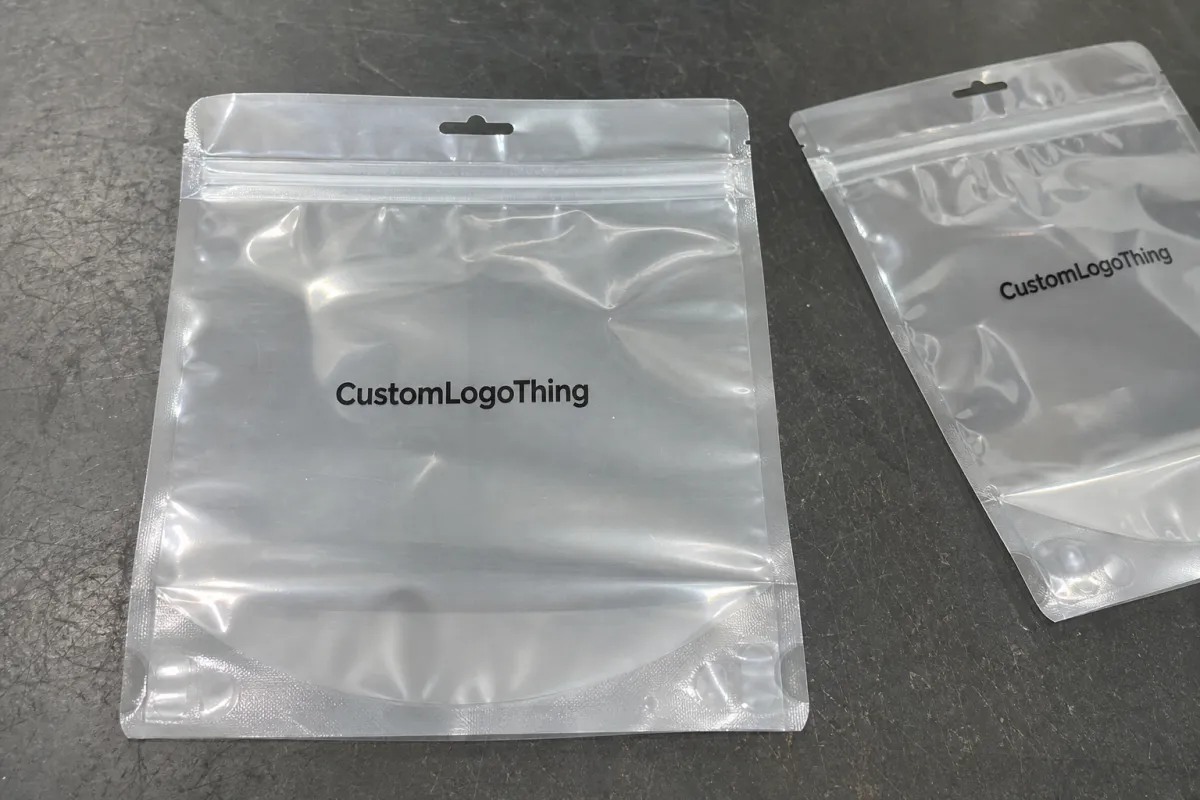
Begin with the variables that affect function. Measure the bag, confirm the zipper style, inspect the seal line, and note the frosted finish consistency before you spend time on color or layout. If the sample cannot match the requested dimensions or the closure feels loose on the first pass, the rest of the review is only context.
Record the exact spec you asked for: width, height, gusset depth if there is one, zipper profile, seal width, film thickness, hanging hole shape, and whether the bag is meant for retail display or secondary packing. A 140 mm by 180 mm pouch with a hang hole does not behave like a 120 mm by 160 mm flat pouch, even if both were described as "small Frosted Zipper Bags" in the quotation.
The use case matters just as much. A shelf-facing pouch can tolerate a slightly softer closure if the visual presentation is the priority. A storage bag or shipping insert usually needs a more dependable zipper and cleaner edge trim. Approve the sample against the actual job, not against a generic idea of quality.
A sample that looks polished but fails after a few open-close cycles is not a good sample. It is a warning dressed up as packaging.
I prefer to review the sample in three passes. First, measure and verify construction. Second, open and close the zipper repeatedly. Third, judge the finish under different lighting. Neutral white light is useful because frosted film can hide print drift, haze differences, and small alignment errors. Warm retail lighting can flatter a weak proof. Warehouse light usually does the opposite.
A short written checklist keeps the decision grounded:
- dimensions match the brief
- zipper engages smoothly and stays locked
- seal line is straight and consistent
- frosted surface is even, not patchy
- trim is clean at the edges
- sample has no strong odor or contamination marks
That list sounds plain, but plain is useful. Buyers who rely on a vague "looks fine" approval often discover later that the bag only looked fine empty, flat, and untouched. The sample stage exists to expose those illusions early.
How a zipper-bag sample proves seal, stiffness, and shelf fit
Once the empty bag passes the first inspection, test it the way it will actually be used. Open and close the zipper 10 to 20 times. Not once. Not twice. Repetition reveals weak tracks, misalignment, and places where the closure starts to lift after the film bends. A zipper can feel perfectly acceptable when the bag is empty and become irritating the moment product goes inside.
Then fill it. Use the real product or a close equivalent in weight, size, and shape. A dense item behaves differently from a light one, and an angular item stresses the walls differently from a rounded one. If the contents are slightly oily, irregular, or top-heavy, those details matter even more. A sample that stays flat on the desk may bow at the center when loaded, and that bowing can change how the zipper closes and how the pouch sits on shelf.
Watch the gusset and bottom behavior after filling. Does the bag stand evenly? Does one corner twist? Does the closure line lean? These are not cosmetic issues. A slight lean can affect stacking, carton fit, or how the brand marks sit across the front panel.
Frost level also deserves a real-world check. Some brands want partial visibility of the contents because texture or color is part of the appeal. Others want a softer, more private finish. The wrong haze level changes the product story. Too much opacity can hide the contents and make the pouch feel heavier than intended. Too little can make the package look less refined than the render suggested.
For transport, it helps to think beyond the bag itself. Packaging teams often borrow from shipping-test logic such as ISTA handling concepts: drop resistance, vibration, and load stability still matter even when the package is soft. If the pouch will travel inside a carton or shipper, judge it as one part of a larger system.
That is where many approvals go wrong. The bag is reviewed on its own, approved in isolation, and only later does someone discover that it does not fit the outer pack, or it collapses too much when stacked with other units. A physical sample should answer the question, "Does this work in the actual package chain?" not just, "Does this look attractive on a table?"
Material, finish, and print cues that separate good samples from risky ones
Spec language is where good samples are made repeatable. Confirm the film thickness, the seal width, the zipper type, and whether the construction uses a single- or multi-layer structure. A frosted zipper bag made from an 80-120 micron film will feel different from a thinner structure, even if the product description sounds almost identical. In practice, a few microns can change stiffness, clarity, and the way the bag folds after filling.
Seal width deserves more attention than it usually gets. For many retail and storage uses, a 6-10 mm seal is common, but the exact number matters less than consistency. A weak or uneven seal line can cause leakage, split corners, or a closure that feels secure on one side and vague on the other. The sample should show the same seal quality from edge to edge.
Print on frosted film needs its own review. Frosted surfaces soften artwork, which can be useful if the brand wants a muted, premium look. The same surface can also reduce contrast, dull saturated colors, and blur small type. Check the print under multiple light sources and at two distances: arm's length and close inspection. If a logo is supposed to read crisp, do not approve it from the back of a meeting room.
Ask which closure was used. A standard press-to-close zipper behaves differently from a heavier profile meant for repeated opening. Hang hole shape, tear notch placement, and side-seal geometry all affect usability. None of those details are decorative. They shape how the bag is handled, displayed, and opened by the end user.
Surface texture can reveal production care quickly. Run a finger lightly over the film. Look for drag marks, dust specks, clouding, or waviness near the trim. A well-made frosted bag should feel consistent, not slick in one zone and rough in another. That unevenness often points to process variation rather than a purely cosmetic issue.
Odor is another small signal that buyers ignore at their own risk. A slight plastic smell is not uncommon in fresh packaging, but a strong or lingering odor can be a problem for food-contact-adjacent, cosmetic, or gift applications. If the bag will sit in a closed carton for weeks, the smell may become more noticeable after packing than it was at the sample stage.
Traceability also matters. Keep the exact sample version, print file revision, and material reference on file. A sample that looks right but cannot be reproduced is only half useful. That is how "approved" becomes "approximately approved," and approximation is an expensive habit in packaging.
If the bag is part of a broader branded system, it can help to verify related materials as well. Cartons, inserts, or labels may need FSC-certified paper if the procurement brief calls for it. That certification does not replace performance testing, but it does matter when the packaging set has to support a clean compliance story.
Cost, MOQ, and quote variables that change sample pricing
Sample cost depends on how much of the production process the factory has to simulate. A stock blank is usually cheap. A printed prototype with custom frosted film, special zipper color, or revised dimensions can cost much more. For many buyers, a realistic budget lands around $35 to $150 for basic proofing and $120 to $350+ for more custom pre-production samples, depending on artwork, tooling, and shipping distance.
| Sample type | Typical cost | Typical turnaround | Best for | Main risk |
|---|---|---|---|---|
| Stock blank sample | $15-$40 | 3-7 business days | Checking size, zipper feel, and basic structure | Does not fully represent print or final finish |
| Digital print prototype | $40-$120 | 7-12 business days | Artwork placement, color direction, and branding | Color can still differ from mass production |
| Pre-production proof | $120-$350+ | 10-20 business days | Near-final approval before the full run | Higher upfront cost, but lower launch risk |
MOQ changes the economics in a less obvious way. A low-MOQ request can still be expensive if the factory must source a special film, set up a unique zipper profile, or prepare print tooling only for a small quantity. The sample itself may be modestly priced, then the setup work pushes the quote upward. That is normal. It is also why "cheap sample" and "cheap project" are not the same thing.
Shipping often adds more than buyers expect. Courier fees of $25 to $80+ are common once the sample is physically bulky or needs careful packing. If the bag is large, printed, or padded for protection, shipping can matter almost as much as fabrication.
I tell buyers to ask for a line-item quote whenever possible:
- sample fabrication
- tooling or plate setup
- print preparation
- courier shipping
- revision or re-sample fee
That breakdown makes comparison easier. Two quotes can look close at first glance and still be completely different once you separate setup costs from actual sample pricing. It also exposes where the supplier expects the project to become more expensive if the size changes, the print coverage expands, or the zipper spec shifts midstream.
Sample process and turnaround: from request to approval
The sample process should begin before the factory cuts anything. Send a brief with dimensions, film thickness, zipper type, print method, color references, finishing notes, and the intended use case. If the pouch has to fit a secondary carton, include the carton size. If the product is heavy, oily, or irregularly shaped, say so upfront. The factory cannot guess the most important constraints and still be expected to get the proof right.
Most delays come from incomplete information rather than slow production. When artwork is still changing, when dimensions are not final, or when the closure type is undecided, the timeline stretches. A practical workflow is brief, artwork review, sample build, internal inspection, revision note, revised sample, final approval. One pass is ideal. Two passes are common. Three usually means the brief was not settled early enough.
Build the review window before the sample arrives. A pouch left unopened on a receiving shelf for a week is not helping anyone. Decide in advance who checks appearance, who checks function, and who owns final approval. Brand teams often care most about shelf impact. Operations teams care about line speed and consistency. Procurement focuses on price and lead time. Those priorities can conflict, so the review should bring them into one decision instead of three separate conversations.
Ask the supplier what can happen in parallel. In some cases, artwork checks and material sourcing can move together. In other cases, they cannot, especially if the bag uses a specific zipper or a custom print method. A good supplier will say where the bottleneck is instead of promising an unrealistically fast turnaround.
Typical sample timelines are often 7 to 15 business days from a complete brief. More complex printed proofs can take longer, and any revision adds extra days for shipping, review, and rework. That is why planning only for the first sample is risky. The second sample is often the one that saves the order.
Common mistakes that make sample approvals expensive later
Approving color from a screen is one of the easiest mistakes to make. Screens help with direction, not final judgment. Frosted film can mute reds, gray out blues, and flatten dark artwork in ways that are hard to predict digitally. If the package matters on shelf, the physical proof should be compared against a printed reference or approved swatch under neutral light.
Another common miss is testing the zipper empty and assuming that is enough. It is not. A closure can feel fine with no load and become difficult once the pouch is full. The same logic applies to seals. A weak heat seal may survive a casual open-close test, then split when the bag is filled tightly or stacked under pressure.
Buyers also forget to test the actual product shape. Granules, powders, snack items, beauty samples, and small hardware each stress the pouch differently. A round item may sit neatly. A square or sharp-edged item can push the film outward and distort the panel. That distortion changes both the look and the handling profile.
These are the mistakes I see most often:
- not defining what must match exactly and what can vary slightly
- ignoring the bag after it is filled
- forgetting to record zipper type and seal width
- approving a sample without measuring it
- assuming one good proof guarantees every production run will behave the same way
The last point deserves extra caution. Even with a solid sample, production variation can happen if material lots change, print settings drift, or handling changes during the run. A good sample is a reference point, not a guarantee. That is why photos, measurements, and written notes matter more than memory.
Some teams align the review with ASTM-style dimensional thinking or ISTA-style handling logic. That does not turn a packaging sample into a lab specimen. It simply gives the review a repeatable method so the next person reaches the same conclusion for the same reasons. Consistency is underrated because it looks ordinary.
Next steps: document specs, compare versions, and approve with confidence
The most reliable approval process is boring in the best way. Use one scorecard for dimensions, zipper action, print quality, haze, seal integrity, odor, trim, and fit with the real product. If two people score the sample differently, the notes should show why. Did one person judge it under warm light and another under neutral light? Did one test an empty bag and the other a filled one? Those differences are useful because they reveal where the sample could be interpreted too loosely.
If a feature is critical to sales, compliance, or pack-out speed, ask for a second sample or a revised proof. That is not overcautious. It is normal risk control. A small issue in zipper feel or print placement can seem minor in a meeting and become costly on the line or in retail.
Compare photos, measurements, and notes before you sign off. Designers, buyers, and operations teams should all work from the same evidence. If the pouch is part of a larger branded system, keep the sample record attached to the purchase order so the production team can see exactly what was approved and why. That paper trail protects the order when revision questions come up later.
For that reason, the chocolate frosted zipper bags Physical Sample Checklist should live with the order file, not only in email. If a revision is needed, everyone can trace what changed, what stayed fixed, and what still has to match. In custom packaging, clarity is cheaper than rework, and rework is usually more expensive than the first sample by a wide margin.
What should I check on a chocolate frosted zipper bag sample first?
Start with zipper alignment, seal strength, and overall dimensions before you judge print or finish. Then test the bag with the real product so you can see whether the shape, stiffness, and closure still perform. Finish by checking the frosted look under different lighting so you know how it will appear on shelf or in photos.
How many physical samples should I request before approving zipper bags?
One sample can be enough for a simple stock pouch, but custom printed or retail-facing bags often deserve a second revision round. If the bag has critical print, size, or zipper requirements, compare at least two versions or one revised proof. The right number is the amount needed to confirm function, appearance, and production repeatability without guessing.
What affects the price of a chocolate frosted zipper bag sample most?
Custom tooling, print complexity, material thickness, and rush shipping usually move the price more than the sample itself. MOQ and whether the sample is a prototype or a pre-production proof can also change the quote significantly. If you need multiple revisions, budget for each round instead of assuming the first proof will be final.
How long does sample production usually take for zipper bags?
Timeline depends on artwork readiness, material availability, and whether the factory is making a first proof or a revised sample. Add time for internal review, because many delays happen after the sample is delivered, not before it is made. Ask for the full sequence upfront so you know the realistic turnaround from request to approval.
What if the sample looks good but fails when I test it with product?
Treat that as useful information, not a setback, because functional failure is exactly what the sample stage is meant to reveal. Record the failure point clearly, such as zipper drag, seal weakness, or panel distortion, so the factory can correct the right issue. Request a revised proof before approving production, especially if product weight, shape, or closure behavior is part of the buyer experience. That is the real value of a chocolate Frosted Zipper Bags physical sample checklist: it turns opinion into evidence before the full order is on the line.

