Chocolate Logo Patch Beanies can look like a simple buy until the quote lands and starts adding little surprises. A proper chocolate Logo Patch Beanies Unit Cost review usually shows the beanie body is only one slice of the bill; patch method, finishing, packing, freight, and order size do the real work. The hat is rarely the expensive part. The details are.
That is why a cheap-looking line item can become an expensive program. If the artwork needs cleanup, the patch method changes, or the pack-out gets upgraded from bulk polybagging to retail-ready presentation, the number moves fast. Nobody likes discovering that after sample approval.
Why Chocolate Patch Beanies Look Cheaper Than They Are
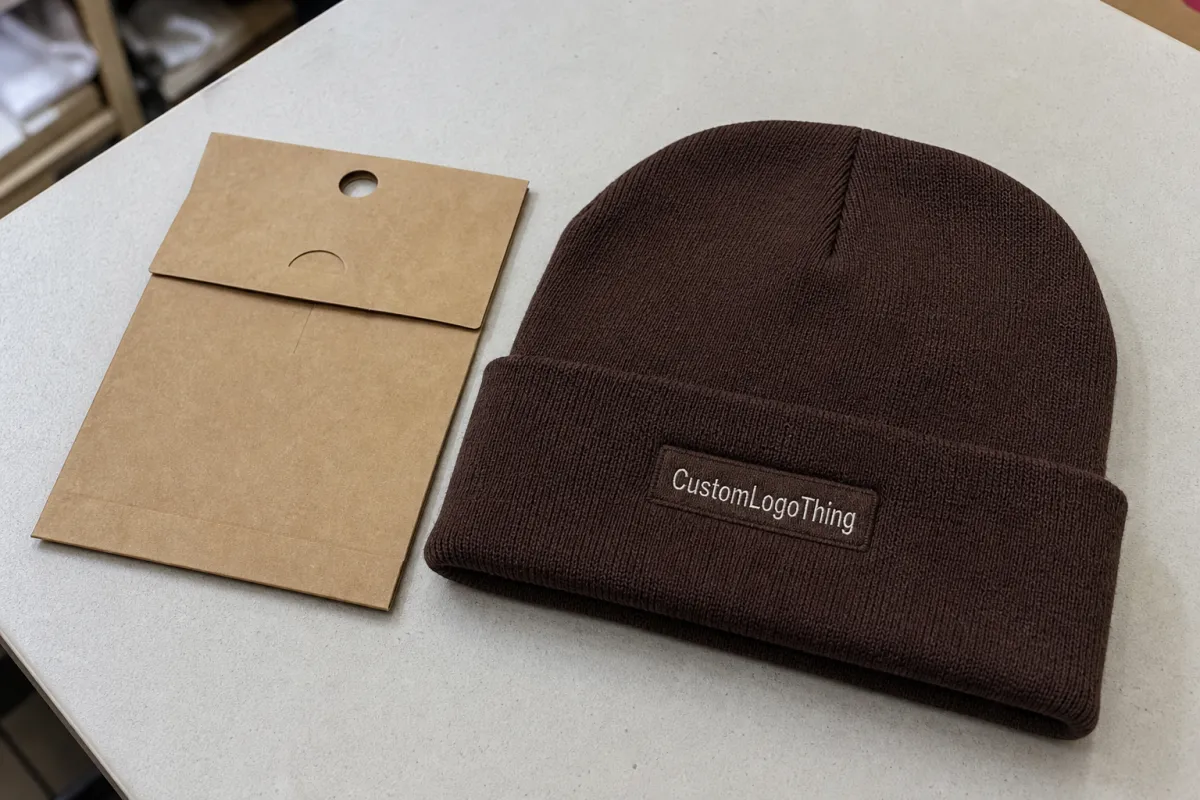
From the outside, a chocolate beanie with a logo patch feels straightforward. Knit the body, add a badge, ship the cartons. Easy. Then the quote arrives with setup fees, decoration charges, packing lines, and freight assumptions tucked in like they were never meant to be noticed. Cute. Not useful.
The right way to review cost is to look at the landed unit cost, not just the factory piece price. Landed cost includes the body, patch production, sewing or heat application, trim cleanup, inner packing, outer cartons, transportation, duty, and any handling charge that appears after someone says, “We forgot to mention that.” If you skip any of those pieces, you are not reviewing cost. You are staring at a partial number and hoping it behaves.
That matters because the same-looking beanie can be built in very different ways. One order might use a woven patch, standard acrylic yarn, and simple fold-and-carton packing. Another might use a molded silicone badge, upgraded yarn hand feel, custom labels, and individual polybags. Same color family. Completely different economics.
The buyer mistake I see most often is comparing only the hat price and calling it a day. A low quote is not a win if the patch peels in transit, the brown shade skews gray under store lighting, or the cartons arrive crushed because packing was treated like an afterthought. Cheap is only cheap if the finished product holds together long enough to be sold.
"A low quote is not a bargain if the patch falls off, the color drifts, or the packing adds surprise charges later."
Good sourcing separates the line items. Ask for the beanie body price, decoration cost, setup charge, sampling fee, packing cost, and the shipping basis. If a supplier gives only one blended figure, the quote is hiding something. Usually several somethings. When the quote is broken out cleanly, the real comparison gets much easier.
That is the practical value of a chocolate Logo Patch Beanies unit cost review: it tells you where margin gets eaten before the order is locked. Once the cost structure is visible, the buyer can decide where to spend and where to simplify.
Patch Type, Fabric Weight, and Fit That Change Buyer Demand
Not every beanie wants the same patch, and not every customer wants the same feel. A cuffed beanie with a firm front panel gives the patch a stable surface. A slouch style drapes more softly, which looks better for some brands and worse for others. That difference sounds small until the logo sits crooked or loses presence because the crown is too loose.
For most winter programs, a rib-knit body gives the cleanest surface for decoration. Mid-gauge knit usually handles a patch better than a very loose construction because the face stays more even and the stitching has something to grab. The classic material choice is still 100% acrylic, mainly because it balances warmth, stretch, and price. Acrylic blends can feel softer or more premium, but they can also change knit behavior enough to affect fit consistency between lots.
Chocolate tones deserve their own caution. Deep brown looks rich in some lighting and flat in others. A sample that looks expensive under warm indoor light can lose depth under warehouse LEDs or bright daylight. If the buy is tied to ecommerce or retail display, ask for both a daylight photo and a close-up of the actual patch against the actual yarn. Mockups are nice. They are also fiction.
| Patch style | Best use | Typical setup cost | Unit cost impact at scale |
|---|---|---|---|
| Woven patch | Small text, sharp edges, flat logo artwork | $20-$60 for basic art prep | Usually +$0.18-$0.40 per piece |
| Embroidered patch | Classic retail look, textured logo feel | $20-$80 for digitizing | Usually +$0.20-$0.45 per piece |
| Faux leather patch | Warm, rugged branding, low-contrast logos | $30-$90 for cutting setup | Usually +$0.22-$0.50 per piece |
| Silicone or TPU patch | High-contrast logo work, modern finish | $60-$180 tooling fees | Usually +$0.35-$0.80 per piece |
Fit changes buyer demand more than most price sheets admit. A snug cuffed beanie tends to sell well in retail because it feels deliberate and giftable. Slouch styles move in streetwear and casual programs, but they also make placement more sensitive. If the patch sits too high, it gets lost. Too low, and the balance feels off.
Fabric weight is another quiet driver. Many standard acrylic beanies land around 90-130 grams, though heavier builds can feel more substantial and hold shape better. That extra weight can help perceived value. It can also make the hat bulky, especially if the cuff is thick or the yarn has too much loft. There is no magic number that works everywhere. There is only the balance between hand feel, warmth, and cost.
Logo Patch Build Details That Protect the Brand Mark
A logo patch can look clean in a digital mockup and still fail on the factory floor if the artwork is too busy. Tiny text, thin outlines, gradients, and hairline details all become fragile once they are compressed into a 45-55 mm patch. Knit texture makes the problem worse. The surface already has enough movement without asking a delicate logo to fight it.
The fix is usually simple: reduce the design until it can survive production. Strong shape. Clear border. Enough negative space. If someone has to squint to understand the mark from normal viewing distance, the artwork is too detailed. A patch on a beanie is not a billboard. It is a small object seen in motion, under imperfect light, by people who are not trying that hard.
For most projects, a patch width in the 40-55 mm range is workable. Cuffed beanies with broader front space can take something larger. Smaller patches can work too, but then the logo has to be brutally simple. Thin type under 2 mm tall often disappears into the knit or loses edge clarity. That is not a production error. That is physics doing its thing.
If the logo needs to read from six feet away, build it for six feet away.
Color matching needs discipline as well. Dark brown bodies can mute low-contrast logos, especially if the patch sits only a shade or two above the base color. Pantone references help, but they do not override material limits. A woven patch, a faux leather badge, and a silicone patch will each render color differently because the surface and process are different. The sample has to tell the truth, not the render.
Backing and attachment method matter more than many buyers expect. Sew-on patches usually hold up better on knit because they anchor through the structure. Heat-applied patches can work on some fabrics, but I would not make them the default for a winter beanie unless the factory has proven the bond strength and edge retention. Curling, peeling, and lift at the corners are the common failure points. Avoid those and the product feels better on day one and day thirty.
Edge treatment also deserves a look. A merrowed border adds structure. A laser-cut edge can look cleaner. Either can work if the logo shape supports it. The goal is not decorative extra credit. The goal is to keep the brand mark readable after folding, shipping, and a week in someone's coat pocket.
What Really Moves Pricing
The price of chocolate Logo Patch Beanies is driven by boring things: MOQ, yarn spec, patch material, finishing, packing, and destination. Not by vague claims about “premium quality.” Not by a supplier saying the order is “very difficult” without explaining why. Real pricing moves in measurable steps.
MOQ matters because setup costs do not shrink just because the order is small. The factory still has to prepare the patch file, review artwork, knit the body, attach the patch, and approve the sample. On a 200-piece order, those fixed costs hurt. On a 3,000-piece order, they spread out and the unit cost starts behaving like a real wholesale number instead of a punishment.
Sample fees typically sit in the $20-$80 range for straightforward development, though more complex patch types can go higher. Molded patches are the biggest swing because tooling can be a separate line item. If a supplier quotes a silicone or TPU badge with no tooling charge shown anywhere, ask again. “Included” often means hidden inside a piece price that looks generous until you compare it properly.
Decoration method also changes cost in small but meaningful ways. Woven and embroidered patches are usually easier to estimate. Faux leather depends on cut shape and finish. Silicone and TPU are more sensitive to tooling and color count. The cleaner the artwork, the easier the pricing. The messier the artwork, the more every step starts charging rent.
| Order tier | Typical quote behavior | Expected unit cost range | What usually changes |
|---|---|---|---|
| 100-300 pcs | High setup impact, weak bulk pricing | $5.50-$9.00 | Sample fees and short-run labor dominate |
| 500-1,000 pcs | Better spread on setup, more stable quoting | $3.40-$5.80 | Decoration and packing start to normalize |
| 2,000-5,000 pcs | Best balance between cost and consistency | $2.20-$4.10 | Yarn, patch, and packing costs flatten out |
Those ranges are broad on purpose. Chocolate yarn shade, patch construction, packing format, and freight destination all push the final number. So does whether the order needs hangtags, fold inserts, barcode stickers, or individual polybags. A quote that looks cheap on the first page can turn into an ordinary quote once all the missing pieces are added back in.
If you want a clean comparison, ask the factory to split out setup, decoration, packing, and shipping assumptions. That one request exposes whether the quote is solid or padded with omissions. It also makes it easier to compare suppliers without rebuilding their math from scratch.
Sampling, Production Steps, and Turnaround That Miss Deadlines
Sampling is where buying plans either get real or fall apart. A normal workflow starts with artwork review, then a digital proof, then a sample patch or full sample, then bulk knit production, then patch attachment, QC, packing, and shipment. Each step can move quickly if the file is clean and the buyer answers questions fast. Each step can stall if the logo keeps changing after every proof.
For a straightforward job, the first proof often comes back in 1-2 business days. A sample usually takes 5-10 business days, sometimes more if the patch needs color matching or a molded surface. Bulk production commonly lands around 12-20 business days after sample approval, but that is still a range, not a promise. Yarn stock, decoration complexity, and seasonal line pressure can all shift the schedule.
Rush orders cost more because they consume capacity. The factory may need to move jobs around, pull materials earlier, or compress the QC window. That can add 10%-25% on the production side, and freight can climb too if the order has to travel on a faster lane. Speed is not free. It just gets billed in different places.
The approval path is cleaner when the buyer keeps the file package tight:
- Send a vector logo file, not a screenshot or a low-resolution image.
- Confirm beanie color, patch style, and target quantity before sampling starts.
- Approve the proof before anyone cuts a sample.
- Review the sample in daylight and check patch placement from a normal viewing distance.
- Lock the bulk order only after the sample is signed off.
Packing deserves its own check. A beanie with a solid patch can still arrive looking tired if it was folded badly or crushed in transit. Retail-ready packing should be chosen on purpose, not as an afterthought. If cartons are headed into a rough distribution path, a reference like the ISTA test procedures is useful for thinking about drop risk and vibration. No one wants to spend time reboxing winter stock that should have been packed correctly in the first place.
There is also a practical difference between a good sample and a good bulk run. The sample can be hand-finished more carefully. The bulk order has to survive production pace. That is why the finishing spec, not just the sample, should be documented clearly before approval.
Repeat-Order Consistency, QC Checks, and Reorder Proofs
Repeat buyers are not looking for novelty. They want the same shade, the same hand feel, the same patch placement, and the same cuff shape that sold last time. That is where a reliable supplier earns the relationship. Less drama. Fewer surprises. Fewer meetings spent pretending the product is a mystery.
QC for this category should focus on what customers actually see and touch first. Check stitch count and knit density. Check patch alignment against the center line. Check color variance under natural light and store light. Check attachment strength. Check finished measurements so the hat does not drift from “snug retail fit” to “oddly floppy” between runs.
A serious factory should keep an approved sample, a production reference sheet, and the exact patch spec used on the first run. That is what stops a reorder from slowly becoming a different product. Without that record, the second batch can drift in shade, patch size, or placement. Not a disaster. Just annoying enough to eat margin and time.
I also like to see the same carton count and inner pack style on repeat orders unless the buyer specifically wants a change. Consistency here saves labor and reduces freight waste. If hangtags or paper bands are part of the order, FSC-certified stock is a sensible option when the brand wants cleaner sourcing paperwork without making the order more complicated.
It helps to document what can vary and what cannot. Yarn shade may sit inside a small tolerance. Patch texture may vary slightly by method. What should stay tight is the visible brand mark, the seam quality, and the placement. Keep those controlled and the reorder behaves like a repeat order instead of a fresh development project.
Good buying is boring. That is not an insult. It means the second order should look like the first one, only smoother. If the supplier can do that, the extra few cents are usually cheaper than chasing the lowest quote and cleaning up the mess later.
Next Steps to Get a Cleaner Quote and Faster Approval
If you want an accurate quote, send five things first: the logo file, target quantity, preferred patch style, beanie color, and shipping destination. That is enough to stop most back-and-forth. Without those details, any price you get is a placeholder wearing a tie.
Then ask for three things in writing:
- One quote with matched specs, not a mixed comparison.
- One sample timeline with approval milestones.
- One MOQ breakdown showing where bulk pricing improves.
If the supplier can, ask for the unit cost split by body, decoration, packing, and freight basis. That makes the real number visible. It also shows whether the factory understands how buyers actually compare programs. I prefer that kind of quote because it removes theater. Everyone has enough theater already.
Keep the artwork realistic. Simple logos usually produce cleaner patches, lower setup charges, and fewer sampling rounds. That does not make the branding look cheap. It makes the product more likely to hold its shape, stay readable, and move through production without drama.
Use this chocolate Logo Patch Beanies unit cost review to lock specs before you request pricing. Once the patch method, MOQ, packing, and delivery point are fixed, the quote gets clearer, the sample moves faster, and the order stops pretending it is more complicated than it is.
What affects chocolate logo patch beanie unit cost the most?
Patch material and decoration method usually move the price more than the beanie body. MOQ, packing style, and shipping destination can swing the final number fast. Simple artwork and standard sizing keep pricing more stable.
What MOQ should I expect for chocolate logo patch beanies?
Most factories price beanies better once the order reaches a practical production run. Lower MOQs are possible, but setup and sampling make each unit more expensive. Ask for tiered pricing so you can see the break points clearly.
How long does sampling and bulk production usually take?
Sampling takes longer when the patch needs color matching or artwork adjustments. Bulk production depends on yarn availability, decoration method, and approval speed. Rush timelines are possible, but they usually increase cost.
Can the chocolate patch color match my brand exactly?
Yes, but material limits still apply on knit and patch surfaces. Pantone references help, but the final look changes with texture and lighting. Request a sample or strike-off if color accuracy matters.
What artwork files do I need for a clean logo patch?
Send a vector file whenever possible so edges and text stay sharp. Thin lines, small type, and gradients often need simplification for patch production. A factory should confirm the smallest readable size before sampling starts.


