A merch table can turn a beanie into a quick decision or a dead stack of inventory. For Logo Patch Beanies Material Options for event merch tables, the first judgment is tactile, not visual. People reach for warmth, softness, and fit before they register the logo. If the knit feels scratchy, the cuff is too tight, or the hat sits awkwardly on the head, the patch is already fighting uphill.
That is why the base material deserves more scrutiny than the mockup usually gets. A good patch on a poor knit still behaves like a poor product. A modest patch on a comfortable beanie often outsells the “premium” version because shoppers notice what they can feel in three seconds. Event merch is a contact sport: touch, squeeze, decide.
The useful question is not which material sounds best in a spec sheet. It is which construction fits the audience, the weather, the table price, and the amount of time you have before doors open. Those four variables eliminate a lot of unnecessary options very quickly.
Logo patch beanies material options for event merch tables: what buyers should judge first
Start with the event, not the product. A winter outdoor activation needs real insulation, a secure fit, and enough stretch to sit comfortably over hair or earbuds. A conference store in a controlled indoor venue usually rewards lighter handfeel and a cleaner fashion profile. The same beanie can look appropriate in one setting and overbuilt in another.
For most Logo Patch Beanies material options for event merch tables, buyers end up comparing four common base knits:
- Acrylic - the standard workhorse, usually soft enough, broad in color range, and the easiest to source at lower prices.
- Acrylic-wool blends - warmer and slightly richer in handfeel, with a better case for colder weather or higher retail pricing.
- Cotton blends - lighter and more breathable, useful when the beanie is more of a style item than a cold-weather necessity.
- Double-layer winter knits - thicker, warmer, and more structured, but more likely to feel bulky indoors or on smaller heads.
That list hides a lot of nuance. Acrylic is often dismissed as “basic,” yet it usually wins on consistency. It holds dye well, keeps repeat orders predictable, and gives enough softness for broad appeal. Wool blends can improve perceived value, but not every audience notices the difference. If the event crowd is buying on impulse, comfort tends to matter more than fiber pedigree.
Texture matters more than many first-time buyers expect. A knit can look clean in a render and still feel dry or prickly in hand. That is a real problem on a merch table, where people are comparing your beanie to tees, drinkware, and other items they can hold immediately. If the hat feels rough, the logo gets less attention. If the handfeel is good, the patch gets a better chance to do its job.
The fastest way to lose a sale is to ask a shopper to overlook the part of the product they touch first.
Color choice also affects sell-through. Black, charcoal, heather gray, and navy stay popular because they match more wardrobes and make patches easier to read. Lighter colors can work, especially for lifestyle events, but they show fit issues and surface imperfections more easily. A clean mid-tone often gives the best balance of contrast and practicality.
For buyers comparing Logo Patch Beanies material options for event merch tables, the safest move is to choose the material that the audience will wear after the event. Not the material that photographs best, and not the one that sounds most premium in a line item. The merch table rewards products that feel easy to take home and easy to wear the next day.
How knit structure, lining, and patch backing affect the final result
Material alone does not decide how a beanie will look. Knit structure changes the way the patch sits, how much the body stretches, and how legible the logo appears from a few feet away. A tighter, flatter knit creates a cleaner surface for fine patch edges. A looser ribbed knit gives more flexibility, but it can distort small text or make sharp corners look soft.
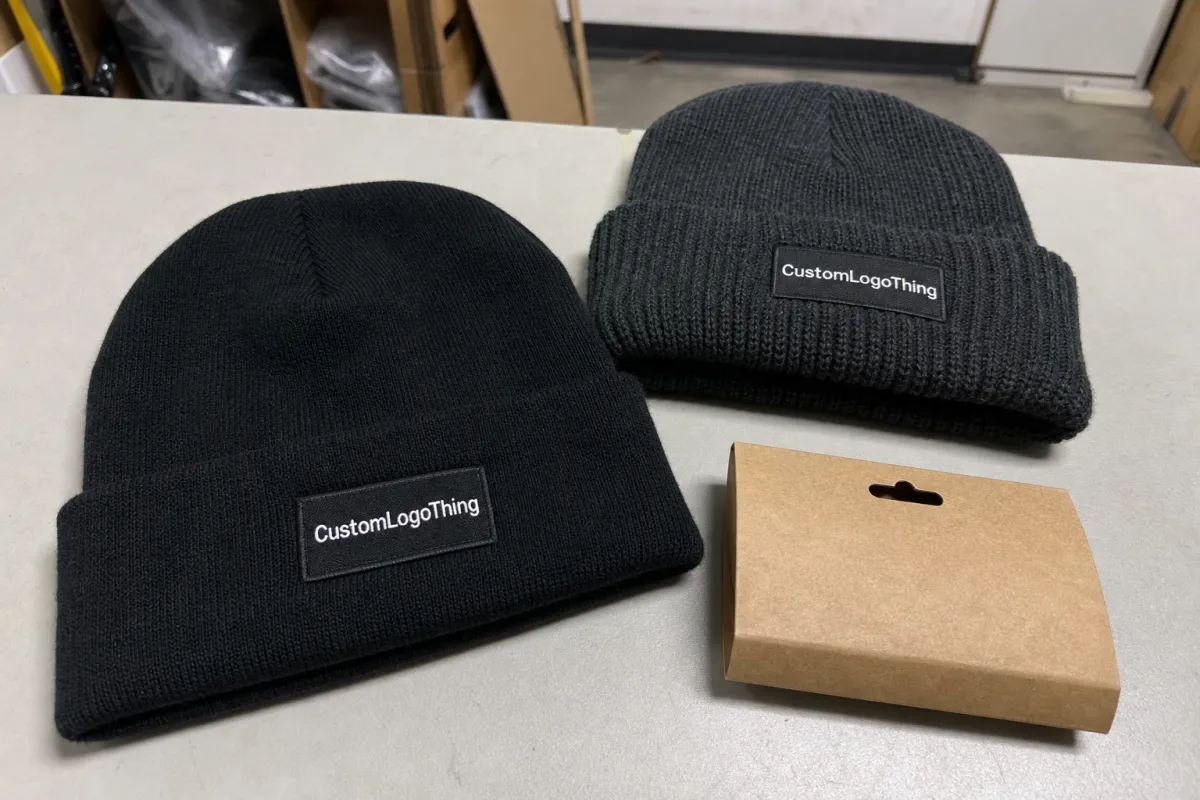
That is why patch size and knit structure need to be planned together. If the beanie has a deep rib or a fuzzy surface, very small logos disappear. The issue is not artistic taste; it is physical resolution. A woven patch with fine detail can look crisp on a flatter acrylic body and muddy on a thicker winter knit. The same logo may need to be enlarged 10-20% just to read clearly on a more textured surface.
Patch backing changes durability and installation. Sew-on patches are usually the safest option for finished merch because they hold well across more knit types. Heat-applied patches can be efficient, but they require the right temperature, pressure, and dwell time. Too little heat and the bond fails. Too much and the surface can glaze or pucker. Adhesive-backed patches are useful for temporary sampling and presentation, but they are not the best choice for final retail goods unless the construction has been tested thoroughly.
Lining is another point where spec choices affect the wearing experience. Fleece-lined beanies feel warmer and often read as more premium, but they can run hot indoors and cost more to sew. A double-layer body boosts warmth without adding a separate lining, though it increases yarn usage and can make the beanie less compact for table display. A ribbed cuff is useful for fit and also gives a cleaner branding zone, which matters more than most buyers realize.
For event merch, the best result usually comes from matching the patch style to the knit behavior. A woven patch pairs well with stable, flatter bodies. Leather or faux-leather patches usually need enough structure beneath them to avoid bubbling. Embroidered patches can work on casual, thicker knits, but detailed scripts and tiny borders are easy to overcomplicate. If the logo depends on fine lines, the surface should help those lines survive, not fight them.
Quality control should include a few practical checks before the full run is approved. Look at patch placement tolerance, edge lift, seam tension around the cuff, and the way the beanie returns to shape after stretching. If the sample leaves a noticeable dent where the patch sits, that is a warning sign. If the cuff twists after one pull, the construction may be too loose for a retail presentation.
Pricing and cost: what actually changes unit cost
Unit cost is shaped by four levers: yarn choice, patch construction, decoration method, and quantity. Color count matters too, but usually less than buyers assume. A one-color body with a single patch is cheaper than a custom-dyed body with multiple yarn colors, even if the logo itself never changes.
Acrylic usually keeps prices down because the material is common, easy to knit, and more forgiving on lead time. Wool blends add cost because the raw fiber is more expensive and the process is less standardized. Cotton blends sit in the middle, though their price can rise if the supplier has to work around a less common gauge or a special dye match. Double-layer builds cost more because they use more material and more time at the machine.
Decoration adds its own economics. A simple woven patch is often cheaper than a heavily stitched embroidered patch with multiple thread colors. Faux-leather can look sharp, but it may need debossing, printed detail, or extra finishing steps. Those finishing steps are where budgets drift. A buyer may think they are changing only the logo treatment, but the factory sees extra setup, extra handling, and extra inspection.
| Build | Typical feel | Approx. unit cost at 500-1,000 | Approx. unit cost at 3,000-5,000 | Best use |
|---|---|---|---|---|
| Acrylic with woven patch | Soft, standard, easy to wear | $2.10-$3.75 | $1.45-$2.35 | Broad audience, budget-conscious event merch |
| Acrylic-wool blend with sewn patch | Warmer, richer, slightly more premium | $2.90-$4.90 | $2.00-$3.30 | Cold-weather events, higher perceived value |
| Cotton blend with patch | Breathable, casual, lighter hand | $2.60-$4.40 | $1.85-$3.00 | Mild-weather promotions, lifestyle branding |
| Double-layer winter knit with premium patch | Heavier, structured, warm | $3.50-$6.50 | $2.60-$4.20 | Outdoor festivals, winter launches, premium merch |
MOQ changes the equation quickly. At 250 to 500 units, setup costs matter a lot. At 3,000 units and above, the factory can spread those fixed costs across more pieces, which is where the price breaks become meaningful. Under 500 pieces, expect less flexibility on custom yarn blends, patch shape complexity, and packaging extras. The quoted price may look decent until a logo revision or packaging request adds a new line item.
Shipping and packaging can move the budget as much as the beanie itself. Plain corrugated cardboard cartons are usually the most economical way to protect finished goods. A simple paper hangtag or kraft sleeve adds presentation without much drama. Once you move into printed sleeves, custom insert cards, or branded retail packaging, the cost climbs and the pack-out time gets longer. That is fine if the event justifies it. It is less sensible if the hats are going straight to a table and not a shelf.
For paper-based packaging, FSC-certified stock is a reasonable ask when the brand wants responsibly sourced materials. Recycled paper and post-consumer waste content can also make sense, provided the carton still protects the goods through transit. For secondary wraps, a biodegradable option may be useful, but only if it does not compromise moisture protection or make the presentation feel flimsy. Good packaging disappears when it should and performs when it must.
Pricing accuracy improves when buyers ask for the same quote across multiple quantities. A useful structure is 250, 500, 1,000, and 3,000 units. That shows where the real breakpoints are and makes it easier to compare materials on equal terms. If the supplier refuses to quote multiple bands, the comparison is probably not ready for decision-making yet.
Industry testing references help keep packaging expectations grounded. The ISTA testing standards are useful for thinking about transit protection, and the FSC system remains the clearest paper-sourcing reference. Fancy packaging only matters if it survives the trip intact.
Process and lead time from concept to delivered cartons
Production usually follows a predictable chain: brief, artwork cleanup, mockup, sample or proof approval, knitting, patch application, inspection, and packing. Every stage depends on the one before it. If the brief is vague, the mockup is slow. If the artwork is messy, the proof cycle grows. If approvals linger, the schedule gets pinned to the calendar instead of the event.
The delays are rarely mysterious. Missing source files force design cleanup. Unclear color references slow down matching. Patch revisions take longer when the logo has too many thin lines or the background is overcrowded. Internal approvals are often the biggest drag of all, especially when three people want to weigh in on a patch that was already close enough for production.
Standard custom beanie runs often take 12-20 business days after proof approval. More complex builds can run 3-5 weeks or longer, especially if they involve special yarns, fleece lining, multiple decoration methods, or custom labels. Shipping time sits on top of that. If the event has a fixed date, the safest assumption is that transit will take longer than the happiest estimate.
Rush production can work, but only when the spec is already narrow and the factory has the right base stock available. Rush does not repair incomplete artwork or undecided packaging. It mainly compresses the calendar, which means any ambiguity becomes more expensive. That is why the strongest schedule tool is a locked spec, not an emergency fee.
Packaging should be decided during the same production window. Confirm whether the beanies will ship flat-packed in corrugated cartons, whether each piece needs a polybag, and whether printed paper inserts are part of the build. For merch-table delivery, ask for carton labels by color and quantity so the setup team can open the right box immediately. That kind of labeling sounds minor until someone is unboxing inventory under a countdown timer.
A spec checklist to use before you request quotes
Before requesting quotes for Logo Patch Beanies material options for event merch tables, define the event environment first. Indoor or outdoor? Cold season or mild weather? Are you selling to attendees, staff, sponsors, or VIP guests? What is the target table price? Those answers determine whether warmth, fashion, or margin matters most.
Then lock the construction in a sensible order. Choose the base knit first. Then decide the patch type, patch size, cuff style, and color palette. Trying to build the beanie around a patch mockup usually creates more revisions than it saves. The product should support the logo, not the other way around.
- Quantity bands: ask for prices at 250, 500, 1,000, and 3,000 units so the breaks are visible.
- Patch method: specify woven, embroidered, leather, faux-leather, or sewn-on finishing.
- Fit: request adult, youth, or unisex stretch sizing if the audience is mixed.
- Packaging: define bulk carton, folded presentation, paper sleeve, or hangtag.
- Labeling: confirm whether you want woven labels, printed care labels, or no interior branding.
- Shipping: provide destination, carton count, and any receiving constraints up front.
Sample approval deserves its own line in the process. Ask what is being approved: body color, knit gauge, patch placement, backing method, or full production sample. A photo proof can be enough for a simple repeat order, but a first-time run usually benefits from a physical sample. Seeing the patch on the actual knit is far more useful than reviewing a tidy digital mockup.
Quality-control questions help prevent small errors from becoming a whole carton problem. Ask how the supplier checks stitch count, patch alignment, color consistency, seam strength, and finished measurements. If possible, request a tolerance range for patch placement and body width. Small differences matter because beanies are worn on heads, not on hangers. A half-inch shift can make a logo feel centered or strangely off.
If sustainability matters, say so early. Ask whether paper inserts can be FSC-certified, whether cartons can use recycled content, and whether the packing method can be simplified without hurting presentation. Minimal packaging is easier to handle and less likely to be damaged in transit. It also reduces the chance that the beanie arrives looking overdesigned for a table display that only needs clarity.
Common mistakes that hurt sell-through at the merch table
The first mistake is choosing a beanie for the climate you wish you had. Heavy winter knits move in cold conditions. In a mild indoor setting, they often sit there. Buyers sometimes order too much warmth because it feels safer, then discover that shoppers prefer something lighter, softer, and easier to wear immediately. Temperature mismatch is one of the quietest ways to strand inventory.
The second mistake is making the logo too busy for the surface. Fine text, thin borders, and crowded badge shapes can disappear on textured knits. If the beanie body is dark and the patch is also dark, the branding loses contrast and becomes hard to read from a distance. A merch-table logo does not need to scream, but it does need to survive a glance.
The third mistake is overbuying premium materials that do not change buyer behavior. Wool blends can feel better in hand. That does not mean every audience will pay enough more to justify them. If the table audience wants an easy souvenir, a well-made acrylic or acrylic-wool blend may deliver better conversion at a lower retail price.
Operational mistakes matter too:
- Skipping sample approval and discovering the patch edge lifts after heat application.
- Ignoring fit and receiving beanies that feel shallow or narrow.
- Ordering only one quantity band and missing a better price break.
- Leaving packaging decisions until production is already underway.
- Sending unclean artwork that needs logo cleanup after the schedule has started.
Another avoidable issue is assuming that a merch table needs variety above all else. It usually does not. Two or three colors are enough for most programs. One core style and one upgraded version often sells better than a cluttered lineup because shoppers decide faster when the range feels edited. Slow decisions are expensive. Confusion is worse.
The best Logo Patch Beanies material options for event merch tables are the ones that match the event without trying to impress every possible buyer. A good table product is soft enough to pick up, simple enough to read, and priced so the purchase feels easy. That combination is more practical than chasing prestige specs that only a producer would admire.
Merch display and sell-through tactics for event teams
Display can change conversion more than many teams expect. Stack by color, not by whatever order the cartons arrived in. Put the softest sample on top so the first touch is the strongest one. Keep signage short and factual: material, warmth level, and price. Long copy slows people down, and the merch table rarely rewards slow movement.
A small assortment usually performs better than a crowded one. Two or three colors are enough for most events. If a premium version is included, make the reason obvious: warmer lining, richer knit, or a more refined patch. The buyer should understand the difference in a single glance. If they have to ask twice, the table is doing too much work.
Practical copy beats clever copy. “Soft acrylic knit,” “winter-weight blend,” “lighter stretch fit,” and “low-profile patch” tell shoppers what they need to know. If sustainability is part of the pitch, keep it concrete. Mention FSC-certified paper, recycled cartons, or minimal packaging only if those details are actually true. Concrete claims build trust because they can be verified later.
Bundling can improve sell-through without turning the table into a discount bin. Pair beanies with scarves, tees, or event-only accessories. Offer a small price break for a two-item set if the margin allows it. That works especially well when the beanie is comfortable but not oversized, because it feels like a piece of the event wardrobe rather than a single random item.
Team setup matters too. Label cartons by color and quantity. Keep extra stock under the table instead of in another room. Put the most sellable option within reach of staff, and make sure the signage sits where a shopper can read it without leaning over the display. Those small details reduce friction and help the product do the work it was built to do.
For merch tables, speed and clarity win. The product has to communicate itself before the conversation starts. That is why material choice, knit structure, and patch execution matter together. A beanie that feels right, looks clear, and packs cleanly is much easier to sell than one that only performs well in a mockup.
What is the best material for logo patch beanies for outdoor event merch tables?
Acrylic or an acrylic-wool blend usually gives the best balance of warmth, cost, and consistent sourcing. Acrylic is easier to keep affordable and works well for broad audiences. Acrylic-wool blends add a little more warmth and a slightly richer handfeel, which helps if the event is cold or the merch is positioned as a step above basic giveaway stock.
Are acrylic or wool-blend logo patch beanies better for profit margins?
Acrylic usually protects margin better because the unit cost stays lower and the supply chain is more predictable. Wool blends can support a higher retail price, but only if your audience is willing to pay for the upgrade. The better choice depends on the target buyer, not the material label alone.
How long does production usually take for logo patch beanies?
Standard custom runs commonly take about 12-20 business days after proof approval, with longer timelines for special yarns, lining, or complex patch work. Shipping adds time on top of production. If the event date is fixed, approval speed matters almost as much as factory capacity.
Which patch style looks best on different beanie materials?
Woven and sewn-on patches usually look clean on flatter knits because the surface stays stable. Leather and faux-leather patches can look premium, but they need enough structure underneath to avoid puckering. Thicker or fuzzier bodies usually need larger patch sizes so the logo remains readable from a few feet away.
What should I ask for in a quote before ordering merch-table beanies?
Ask for pricing at several quantity bands, MOQ, sample cost, production timeline, patch method, packaging, and shipping details. Confirm whether setup, color matching, and artwork changes are included or charged separately. For logo patch beanies material options for event merch tables, the latest safe approval date is often the most useful number in the quote.