For campus retail teams, Clear Resealable Poly Bags for campus bookstores moq planning is less about chasing the cheapest quote and more about keeping inventory presentable, protected, and easy to move. A good bag helps staff pack faster, keeps backstock cleaner, and avoids the usual mess of wrinkled items, dusty shelves, and awkward repacking. Small detail. Real impact.
That is why these bags show up in so many bookstore programs. They are useful for spirit wear accessories, stationery, folded tees, gift bundles, lanyards, and other items that get handled a lot but should still look neat on display. Clear packaging also reduces guesswork for staff and customers. If the product can be seen, checked, and resealed quickly, the register line moves faster and the shelf looks less chaotic.
MoQ planning matters because campus bookstores rarely buy in a straight line. Demand spikes around orientation, homecoming, athletic seasons, graduation, and holiday merchandising. Then it drops. Then it spikes again. A bag spec that fits one season but creates excess inventory for the rest of the year is not a win. It is just a polite way to store regret.
What campus bookstores gain from clear resealable poly bags
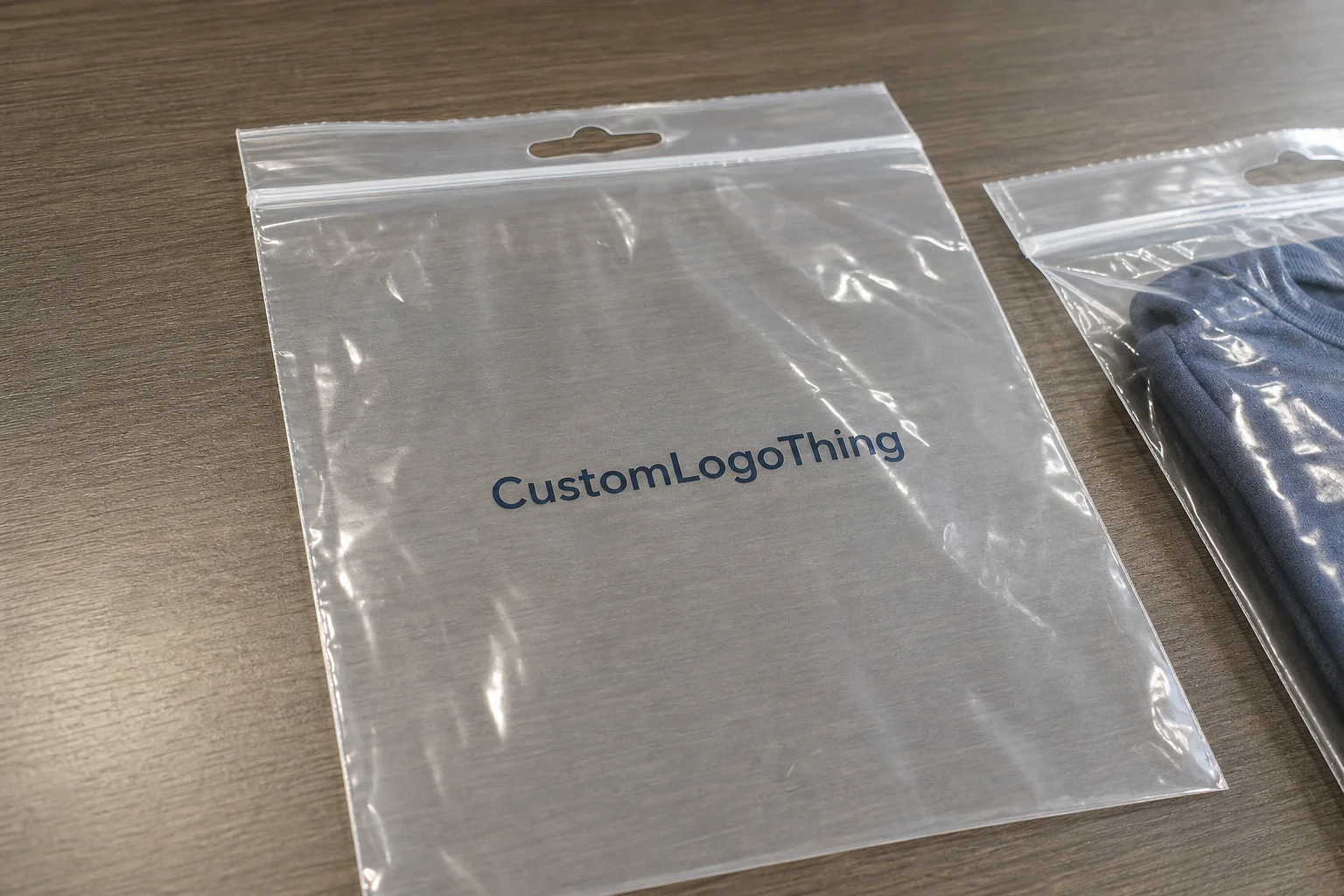
Clear resealable bags solve several retail problems at once. They protect items from dust, scuffing, and repeated handling, while still letting the product show through. That matters in a bookstore, where merchandise is constantly being moved, checked, folded, restocked, and re-bagged by different hands. If the package cannot keep up with that traffic, it does not stay useful for long.
For small merchandise and bundled kits, resealable closure styles are especially practical. Staff can open the bag to inspect an item, then close it again without changing the whole package. That is useful for folded apparel, sticker packs, small electronics accessories, pen sets, and seasonal gift items. Adhesive-only bags work for some uses, but they are not as forgiving when a product needs to be reopened or partially checked.
The visibility angle is not cosmetic fluff. Clear film helps customers confirm color, size, and content without opening every package. That reduces handling, which in turn reduces mess. On a crowded sales floor, faster identification also makes restocking easier. If the product is visible at a glance, the person stocking the shelf does not need to stop and decode every item like it is a puzzle box.
Bookstores also use these bags to make mixed merchandise look more organized. A spirit pack with a lanyard, sticker, and folded tee looks better when the contents are contained in a single clean package instead of loose components stacked in a bin. The same is true for welcome kits, donor gifts, and event bundles. A clear resealable bag keeps the package tidy without hiding what the customer is buying.
“In retail packaging, the best bag is usually the one that makes the product easier to handle and still disappears into the background.”
That last point matters. Campus bookstores are not warehouses. Presentation still counts. The bag should support the product, not compete with it. If the film is cloudy, the seal is awkward, or the closure fails after one use, it becomes a problem instead of a tool.
Product details that matter for bookstore use
Material choice affects how a bag looks, feels, and performs. The most common options are low-density polyethylene, polypropylene, and clear poly blends. LDPE is softer and more flexible, which helps with items that need a little give. Polypropylene usually gives a crisper, higher-clarity appearance, which can be better for presentation. Clear blends sit somewhere in the middle and are often chosen when the buyer wants a balance of clarity, flexibility, and cost.
Closure style matters just as much as material. Press-to-close zippers are the standard choice for retail use because they can be opened and resealed many times. Adhesive lips are more appropriate for one-time sealing, promotional kits, or mail-ready packs. Tamper-evident seals are used when a store needs a visible sign that the package has not been opened since packing. The right option depends on how the bag will be handled, how often it will be reopened, and how visible the seal needs to be.
For print, simple usually wins. One-color logos, school marks, size labels, and barcode-friendly blank panels are the most common requests. A clear bag should keep the product visible. Overprinting defeats the point. If the layout is crowded, the shelf looks noisy and the merchandise gets harder to read, which is exactly the opposite of what the store needs.
Shape and construction affect display as much as storage. Flat bags work well for thin items such as lanyards, patches, stickers, and folded stationery. Gusseted bags provide room for bulkier products like folded shirts, notebook bundles, and gift assortments. If the bag is too small, contents crease or puff awkwardly. If it is too large, the package looks loose and wastes shelf space. Neither option is especially elegant.
Film thickness also deserves a close look. Thickness is usually measured in mils, and that number has real consequences. Thinner bags are cheaper and fine for lightweight accessories. Thicker bags resist punctures better, hold seals more securely, and feel sturdier during repeated handling. For apparel and heavier bundles, a 3 mil or 4 mil bag often makes more sense than an ultra-light option. You may pay more per unit, but fewer split seams and fewer replacement packs usually offset part of that difference.
Surface finish can also change how the bag reads on a shelf. High-clarity film tends to show the product better, but some films scuff more easily or feel stiffer in the hand. That is not a defect by itself. It just means the buyer should match the film to the use case instead of assuming all clear bags behave the same way. They do not. Packaging specs are annoyingly specific for a reason.
Specifications to confirm before you request samples
Before requesting samples, confirm the exact dimensions. Width, length, gusset depth, and usable opening size all matter. A bag that looks close on paper can fit badly in real use if the opening is tight or the contents need more depth than expected. For Clear Resealable Poly Bags for campus bookstores moq planning, inaccurate sizing is one of the fastest ways to create waste.
Thickness should be stated clearly in mils, not guessed from a catalog photo or a vague description like “heavy duty.” Two bags can look nearly identical and perform very differently. A 2 mil bag may be fine for lightweight accessories, while a 4 mil bag is better for packed apparel or items that get handled all day. If the packaging will be used for gift bundles, a little extra thickness often pays for itself by reducing damage and returns.
Print area also needs to be checked before production starts. The logo should not block the product, cover a size mark, or sit so low that it gets hidden by the closure. Ask for a mockup that shows the print relative to the seal and the product inside. That sounds basic because it is basic. Yet it is the kind of detail that gets missed when everyone is focused on price.
If the bookstore packs food-related items, such as café add-ons, event snacks, or edible gift packs, confirm material and ink compliance first. Food-contact requirements are not relevant for every order, but they should never be assumed. The same goes for storage conditions. If the bags will sit in a warm stockroom, near a loading bay, or in a humid environment, ask how the film behaves over time. Heat and humidity can affect clarity, handling, and static.
Static can be a nuisance with lightweight paper goods and thin inserts. It is not always a deal-breaker, but it can make bags stick together or make items cling inside the bag. If your staff has already dealt with that problem, say so early. It is easier to adjust the spec now than to discover the issue after a full production run.
- Measure the actual product, including thickness and any extra packing room needed.
- Choose the closure type based on how often the bag will be reopened.
- Confirm print placement so branding does not block the merchandise.
- Review storage conditions if the bags will sit for weeks before use.
Sample evaluation should test more than appearance. Check whether the bag opens easily, reseals cleanly, and holds its shape when filled. If the product slides around too much or the closure feels weak, that matters more than whether the proof looked good on a monitor.
Pricing, cost, and MOQ planning for campus orders
Price depends on size, material, closure style, print complexity, and volume. Larger bags use more material. Gussets add structure and cost. Printed bags need setup, and more colors usually mean more cost and more approval time. Specialty closures or tamper-evident features can push the price higher still. That is normal. Packaging pricing is not mysterious; it is mostly material plus processing plus a bit of administrative pain.
The useful number is cost per piece, not just the quote total. A lower total can still be a poor buy if the bags are too thin, the print is off, or the MOQ forces you to store far more inventory than you will use. The inverse is also true. A higher quote may be worth it if it reduces damage, improves presentation, or lets the bookstore reorder without changing the spec every time.
MOQ, or minimum order quantity, is where production efficiency meets buyer reality. It exists because setup time, tooling, and press calibration do not change much whether you order 1,000 bags or 10,000 bags. That makes very small custom runs expensive. For campus bookstores, MOQ planning usually comes down to one question: will the store use the same bag across enough departments or seasons to justify a custom run?
If the answer is no, a stock clear bag may be the better short-term choice. If the answer is yes, custom print becomes easier to defend. The point is not to force a custom order just because it sounds polished. The point is to keep the store from buying a nice-looking problem.
| Option | Typical Use | Relative Unit Cost | MOQ Impact |
|---|---|---|---|
| Plain clear resealable bag | Accessories, stationery, light bundles | Lowest | Usually the easiest path to a lower MOQ |
| One-color printed bag | Branded retail packaging, gift sets | Moderate | Usually needs a larger run to offset setup charges |
| Thicker gusseted bag with print | Folded apparel, bulkier bundles | Higher | Better suited to higher volumes because material and print both add cost |
| Tamper-evident clear bag | Controlled merchandise, event kits | Highest | May require specialty production and stricter approval |
Tiered quotes are worth requesting. A buyer should see what happens at 2,500 units, 5,000 units, and 10,000 units before deciding. Sometimes the jump between tiers is small. Sometimes it is huge. That difference tells you whether you are paying for real production efficiency or just buying extra boxes of inventory that will sit around until next semester.
It also helps to ask about reorder pricing separately from first-run pricing. Setup charges are often different on repeat orders, and a bookstore that expects to reorder during the academic year needs to know that up front. The same applies to small quantity changes. Moving from 4,800 units to 5,000 units might barely affect the quote, or it might move the job into a different bracket entirely. No one enjoys finding that out after the budget has already been approved.
For campuses that manage several packaging categories, standardizing bag sizes can reduce cost and simplify inventory. One or two sizes can often cover apparel, stationery, and gift items if the store plans the spec carefully. Fewer SKUs also make ordering and storage less painful. That is not glamorous, but it is practical. And practical usually wins.
Many buyers compare bags alongside other packaging items such as Custom Packaging Products, especially when bookstore branding needs to stay consistent across gift items and apparel. If the packaging plan is broader than one bag line, it helps to map the full list before placing a first order.
Production steps, lead time, and approval checkpoints
The usual process starts with a spec review, then moves to artwork confirmation, sample approval, production scheduling, and final shipment. That sequence is standard for a reason. The spec review locks down size, film thickness, and closure style. Artwork confirmation checks the logo, copy, and print placement. Sample approval confirms fit and appearance. Production scheduling follows once the details are locked.
Problems usually come from missing information, not from the factory suddenly becoming mysterious. Low-resolution artwork slows proofing. Approximate dimensions lead to bad sample fits. Last-minute changes to thickness or closure style can reset the schedule. If the buyer sends a clean spec sheet on the first pass, the job usually moves faster and with fewer revisions.
Digital proofs are useful for layout and text placement. Physical samples matter when the bag needs to be tested for fit, closure behavior, or clarity. If the bookstore is packing a premium set or a signature event bundle, a physical sample is usually worth the time. A screen can tell you where the logo sits. It cannot tell you whether the bag feels flimsy in hand or whether the seal opens too easily.
Lead time depends on order size, print complexity, and whether the bag is a stock item or a fully custom structure. Simple stock bags with light branding often move faster than bags that need special sizing, multiple print colors, or custom closure specs. A common production window is 12 to 15 business days after proof approval, but that is not a promise. Higher volume or more complex construction can extend the timeline. Shipping time still has to be added on top of that.
Campus planning should follow the calendar, not hope. Orientation, alumni weekends, homecoming, athletic events, and holiday shopping all create demand spikes. If the packaging arrives after the rush starts, the order was technically correct and operationally useless. A practical buyer builds in buffer time for proofing, revisions, and transit.
“The smoothest jobs are the ones where the buyer sends dimensions, artwork, volume, and deadline together. Guessing games are not a production strategy.”
If shipping and retail packaging overlap, it can also help to compare these bags with Custom Poly Mailers. They solve different problems, and using the wrong one usually shows up later as wasted time or unnecessary repacking.
Why a custom packaging supplier helps bookstore operations
A good supplier does more than quote a bag. The value is in matching material, seal type, and print method to the actual retail use. A campus bookstore is not a warehouse and not a fulfillment center. The packaging has to look clean on a shelf, open and close easily for staff, and survive repeated handling without turning cloudy or weak.
Layout support matters because clear bags expose everything. That is the point, but it also means the brand can look cluttered fast if the logo is too large or the information is placed badly. A supplier with retail packaging experience can help with logo size, safe zones, and print placement so the product stays visible. Sometimes less ink is the smarter design choice. Shocking, I know.
There is real value in knowing when stock is enough and when custom print is justified. A standard clear resealable bag may solve the immediate need, especially if the bookstore can use labels or inserts for branding. On the other hand, a printed bag may be worth it when the store wants consistent presentation across departments or needs a recognizable package for a signature item line. The right supplier should be able to explain both routes without pretending one answer fits everything.
Recordkeeping matters more than people expect. Campus bookstores do not always reorder on a strict monthly cycle. Some buy by semester. Some buy by event. Some buy when a department suddenly remembers it needs packaging by Friday. A supplier that tracks prior sizes, thicknesses, print placement, and reorder terms can save time and reduce mistakes on the next run. That becomes valuable very quickly once the first order is approved and the second one is due.
Reliable quality control also matters. Before shipment, the supplier should verify dimensions, seal performance, print registration, and film consistency. On clear bags, even a small defect is visible. A smudge, scratch, or crooked print panel looks worse because there is nowhere to hide it. That is the downside of clear packaging. The upside is that quality issues are easier to spot before the order lands in the bookstore.
For buyers, that is the real advantage of working with a Packaging Supplier That understands retail use. The bag is not just a plastic sleeve. It is part of the product presentation, the stockroom workflow, and the reorder plan.
If you are still sorting out the basics, the FAQ page can help with general ordering questions and product terms before samples are requested.
Next steps for a bookstore packaging order
Start with three things: product dimensions, estimated order quantity, and whether the bag needs print or can stay plain. Those three inputs determine most of the quote structure, including likely MOQ, unit cost, and whether the order should be stock-based or custom-made. If those details are vague, every other decision gets slower and more expensive.
Then build a simple use list by department. Apparel, stationery, gifts, and event bundles should be separated before quoting because one bag size rarely fits all of them equally well. Some items can share a standard bag. Others cannot. If the bookstore tries to force everything into one spec, the result is usually a bag that fits nothing properly.
Send artwork files and, if available, a reference sample of current packaging. An older bag can be useful for comparing clarity, closure feel, and print placement. If the current packaging has obvious problems, say so directly. That helps the next version solve a real issue instead of just repeating the same flaw with a shinier finish.
Ask for three things in one request: tiered pricing, sample evaluation, and estimated production timing. That keeps the conversation grounded in actual cost and actual lead time rather than generic sales language. For Clear Resealable Poly Bags for campus bookstores moq planning, that is usually the fastest way to get a quote you can actually use internally.
Finally, confirm reorder timing before the first shipment lands. If the bookstore knows its baseline usage, seasonal spikes, and preferred pack size, the next order becomes easier to place and easier to repeat. That is the part many teams skip. Then the packaging shelf goes empty right when campus traffic starts climbing. Predictable. Annoying. Avoidable.
For a focused quote on clear resealable Poly Bags for Campus bookstores moq planning, gather the measurements, artwork, sample expectations, and quantity tiers first, then submit them together. That gives the supplier the information needed to quote accurately, compare cost per piece, and recommend a bag that fits the product, the shelf, and the budget.
What size clear resealable poly bags work best for campus bookstore accessories?
Choose the bag based on the item’s actual width, thickness, and closure space, not just the product label size. Flat bags suit thin items like lanyards, patches, and stationery, while gusseted bags work better for folded apparel or bundled sets.
How do I estimate MOQ for clear resealable poly bags for campus bookstore orders?
Start with realistic annual usage, then separate one-time event packaging from recurring stock needs. Ask for quantity tiers so you can compare MOQ against lower unit pricing at higher volumes.
Can campus bookstores print a logo on clear resealable poly bags?
Yes, logos can usually be printed within a defined print area without blocking product visibility. One-color or simple branding is often the most cost-efficient choice, especially for retail packaging with repeated reorders.
What affects the turnaround time for custom clear resealable poly bags?
Artwork readiness, sample approval speed, order size, and material availability all affect the schedule. Straightforward specs and quick proof approval usually shorten the production timeline.
How should a bookstore compare pricing across suppliers?
Compare not just the quoted price, but also bag thickness, closure type, print quality, sample policy, and reorder terms. A lower price can be misleading if the bags are too thin, the print is inconsistent, or the MOQ forces excess inventory.


