If you are searching for a Clear Zipper Bags wholesale supplier for tea, the real task is not simply finding a pouch at a low price. The better question is whether the supplier can deliver clarity, zipper reliability, and food-safe consistency in a format that protects tea from packing line to retail shelf. Tea buyers tend to judge packaging by two things very quickly: how well it presents the product, and how well it prevents avoidable quality complaints later.
Clear Zipper Bags make sense for tea because the contents often do part of the selling. Loose leaf blends, herbal infusions, fruit teas, refill packs, and small retail assortments all benefit from a package that lets the customer inspect the product before opening it. The zipper adds a practical second life after purchase, which matters in pantry storage, subscription refills, and repeat-use household packaging. A strong clear pouch can reduce the need for heavy artwork while still leaving room for labels, ingredient panels, barcodes, and batch information.
The format is not right for every tea, though. Products with high dust content, light-sensitive ingredients, or very soft aroma profiles may need stronger barrier properties or partial opacity. A buyer who treats clarity as the only requirement usually ends up revisiting the decision after shelf testing or sample approval.
A clear pouch works best when the tea itself has visual appeal and the packaging structure matches the product’s storage needs.
Why tea buyers choose clear zipper bags when shelf visibility matters
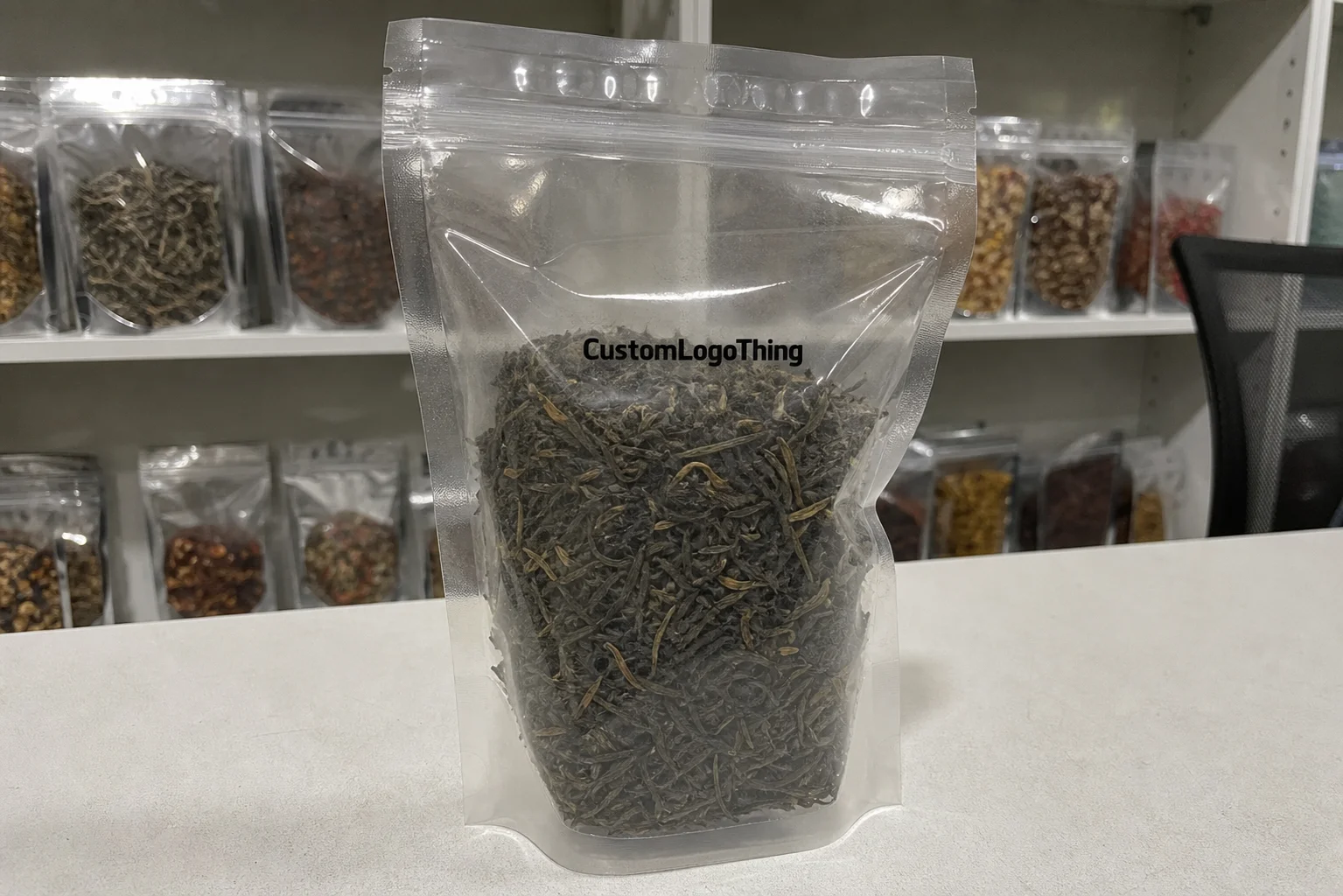
Tea is one of the few food categories where appearance can support the sale without hiding the product. A vibrant chamomile blend, a clean-cut peppermint mix, a fine jasmine green tea, or a dense black tea refill each looks different in the pack, and that difference can help a customer decide faster. Clear packaging gives immediate visual feedback on leaf shape, particle size, and fill cleanliness, which is useful on a retail shelf and even more useful in a market stall or refill bar where the shopper is comparing several SKUs side by side.
That visibility has a practical side beyond aesthetics. Staff can sort products more easily, shoppers can identify variations without opening multiple packs, and buyers can use the bag itself as part of the merchandising strategy. For tea brands with limited artwork budgets, a transparent pouch paired with a good label often creates a cleaner shelf presence than a full-coverage printed film that does not suit the product.
The zipper matters just as much as the clear panel. Once tea is opened, the closure helps slow exposure to humidity and keeps the bag in a usable form for repeat opening and closing. It does not make tea immune to storage conditions, of course, but it does improve day-to-day handling compared with folded paper bags or one-time-seal formats. That difference is especially noticeable for households that buy larger refill sizes and use them over several weeks.
Clear pouches are also well suited to packaging programs where the brand wants a lightweight, practical presentation rather than a heavily printed retail box. Labels, sticker panels, hang tags, and short compliance zones can carry the information that matters without blocking the tea itself. For many buyers, that balance is the point: enough branding to look finished, enough transparency to keep the product visible.
Still, there are tradeoffs. Clear film can show dust, minor scuffs, and filling inconsistencies more readily than opaque packaging. If the tea is a premium product, the supplier must maintain tighter cleanliness and better handling control. If the product is a value line, the pack should still look neat, but the buyer may want to avoid ultra-clear film if the fill itself is visually inconsistent.
Clear zipper bag construction and tea-packaging options
A dependable Clear Zipper Bags Wholesale Supplier for tea should talk about the pouch structure first and the price second. For tea, common constructions include PET/PE laminations and CPP-based structures. PET adds stiffness, clearer panel definition, and better dimensional stability during printing or converting. PE contributes sealability and a softer finished feel. CPP can improve gloss and clarity in certain pouch builds, though the exact result depends on the full laminate, thickness, and converting method.
The pouch style matters too. Stand-up pouches are the most familiar choice for retail because the bottom gusset gives shelf stability. Flat pouches can work for smaller fill weights, sample packs, or sachet-style tea. Bottom-gusset bags give more volume without making the face panel excessively wide, which can be useful for taller tea products or broader blends that need room to settle. For bulk refill use, a slightly wider mouth opening often helps filling speed and reduces powdery spill near the zipper area.
Zipper choice deserves more attention than many buyers give it. Standard press-to-close zippers are usually sufficient for dry tea, especially in small and mid-size retail packs. A reinforced interlocking zipper can feel more secure if the consumer is expected to open the bag repeatedly. Tear notches are a practical addition because they improve first-open performance and reduce the chance of an uneven tear near the seal. Child-resistant designs are rarely required for tea, but the supplier should still confirm whether the destination market has any special expectations.
For tea packaging options, it helps to think in use cases rather than generic pouch names:
- Loose leaf tea usually needs more headspace and a wider fill opening.
- Herbal blends often benefit from stronger aroma protection because volatile notes fade after opening.
- Tea sachets generally fit smaller pouches with less gusset depth.
- Powdered tea needs cleaner sealing surfaces and tighter seal control to reduce leakage.
Optional features can improve retail performance without making the pack complicated. Hang holes help for peg displays. Euro slots fit standard hanging fixtures. Some buyers request a matte-and-clear combination, where one area is finished for label placement and the rest stays transparent. Writable zones are useful for handwritten batch notes, harvest codes, or farm-origin information.
For buyers checking broader packaging standards, recognized industry resources such as the Packaging Institute can help frame terminology and testing expectations, while shipping durability questions often line up with procedures from ISTA. Those references do not replace supplier documentation, but they help buyers ask better questions about performance, transport, and storage.
Size, barrier, and printing specifications for tea bags
Before approving an order, lock down the actual specification. Width, height, gusset depth, zipper placement, film thickness, and seal width all affect how the pouch fills, closes, and presents on the shelf. A bag that looks correct on paper can still perform badly if the zipper sits too close to the fill line or if the seal area is too narrow for the product weight. That is one of the most common mistakes in packaging procurement: approving a nominal size without checking how the filled pack behaves.
Barrier needs should be matched to the tea itself. Moisture-sensitive blends require better protection against humidity, while fragrant teas usually benefit from low oxygen ingress and stable seals because aroma loss is often one of the first customer complaints after launch. Not every tea needs a high-barrier laminate, but a buyer should know the storage conditions, expected shelf life, and distribution route before choosing a structure. A blend that sits in a climate-controlled boutique has very different needs from a refill pack moving through warehouse storage and long transit.
Printing and decoration are usually simpler on clear pouches than on fully printed bags, yet there is still room for brand expression. Many tea brands use front labels, rear ingredient labels, or a small print panel for legal copy and barcodes. Some request a frosted zone for branding or a carefully placed window that keeps the product visible while still leaving space for information. The wrong print layout can make the pouch look busy very quickly, so restraint usually works better than trying to cover every surface.
Common specification points to confirm include:
- Dimensions: width, height, and gusset depth
- Film thickness: specified in microns or mil
- Seal width: affects strength and filling tolerance
- Zipper style: standard press-close, reinforced, or specialty
- Finish: fully clear, high-gloss clear, or clear with matte zones
Food-contact suitability should be verified directly and not assumed from appearance alone. Depending on the market, the supplier may provide declarations or support documents showing suitability for direct food packaging. Buyers should clarify whether the pouch is intended for direct contact or secondary packaging, because that distinction can affect how the order is approved for tea. If the product will be exported, documentation becomes even more valuable, since the same pouch may need to satisfy multiple market expectations.
Sample approval should be treated as part of the spec, not as a courtesy step. A filled sample shows how the pouch stands, how the zipper feels, whether the clear film stays clean under retail lighting, and whether the product settles into the package without crowding the closure. Flat empty bags can hide handling problems that only appear once the tea is inside. If the tea is positioned as premium, a filled sample is the only reliable way to judge the final shelf appearance.
| Option | Typical Use | Strength | Watch Outs |
|---|---|---|---|
| Plain clear stock zipper bag | Refill tea, small retail runs, sampling | Lower MOQ, faster availability | Limited branding and size selection |
| Custom clear stand-up pouch | Main retail tea packaging | Better shelf presence, stable display | Higher MOQ, longer lead time |
| Clear pouch with printed label panel | Branded retail packs | Balances visibility and compliance text | Label quality must match film quality |
| High-barrier clear laminate pouch | Fragrant or moisture-sensitive teas | Improved aroma and moisture protection | Usually higher unit cost |
Pricing, MOQ, and unit cost factors to compare
Price for tea zipper bags is shaped by material structure, bag size, zipper style, print complexity, and whether the order is stock or custom made. A plain stock clear pouch will usually cost less than a custom printed stand-up pouch with a special zipper and a new die line. That sounds straightforward, but buyers still end up comparing quotes that are built on different specs, which makes the price difference misleading.
MOQ tends to rise as the pouch becomes more customized. Stock bags often allow more flexible ordering, while printed or custom-shaped pouches usually require a higher minimum because the supplier has to cover setup, converting, and inspection costs. The more specific the structure, the more the order needs volume to stay economical. In practical terms, a buyer who wants one unique pouch for a niche tea line should expect a higher minimum than a buyer choosing from existing stock formats.
Ballpark unit costs can vary widely, so the landed cost matters more than the quoted piece price. Freight, carton count, packing efficiency, and duties can change the final number significantly. A quote that looks attractive at first can end up more expensive once transportation and warehouse handling are included. For tea brands managing margins tightly, this is often where the real budget pressure shows up.
Here is a practical way to compare quotes:
- Match the exact dimensions, not a similar-looking size.
- Confirm the same film thickness and barrier level.
- Check whether the zipper is the same style and quality grade.
- Ask what documentation and sampling are included.
- Compare freight terms, carton pack count, and lead time together.
The last point matters because the lowest unit price is not useful if the bags arrive late or arrive inconsistently. If the zipper fails, the film clouds, or the dimensions drift from carton to carton, the savings disappear in rejects, relabeling, or customer complaints. In packaging operations, consistency usually matters more than a very small price break.
For buyers handling multiple packaging formats, it can help to compare tea pouches against broader sourcing programs through your Wholesale Programs page. In some cases, combining several SKUs in one sourcing cycle improves freight efficiency and gives better control over reorder timing, even if the individual pouch price does not change much.
Process and timeline: from quote approval to shipment
The fastest way to get a useful quote is to send a short, specific request. Include tea type, target fill weight, bag dimensions if you already have them, print requirements, estimated annual volume, and the delivery date you are trying to protect. If you have a reference pouch, include a photo or sample size. Clear photos and a measured example reduce back-and-forth because they show the shape, fill behavior, and branding space more accurately than a general description.
After the quote is accepted, sample approval usually comes next, especially if shelf presentation is part of the buying decision. That stage is where the buyer checks clarity, zipper feel, seal appearance, fill compatibility, and label placement. If the tea is intended for retail, the sample should also show where the barcode, compliance text, and any batch coding will sit. Skipping this step often leads to avoidable revisions later.
Typical production steps include:
- Material sourcing and incoming inspection
- Printing or lamination, if required
- Converting into pouch format
- Zipper sealing and heat sealing
- Inspection for dimensions, appearance, and closure performance
- Cartoning and shipment preparation
Timeline depends on the order type. Stock bags usually move faster because the material is already available. Unprinted custom bags generally take longer because converting and inspection still have to be completed. Printed custom orders take the most time because artwork approval, proof revision, and production setup all happen before the run can begin. If the shipment is moving by ocean freight, transit time needs to be added on top of manufacturing time, and that can change the launch schedule more than the production itself.
I would always leave room for artwork revisions and logistics delays. Tea launches are often affected by timing more than by packaging quality. If approval happens late, even a well-run production schedule can miss the sales window. A few extra days at the beginning usually prevent a much longer delay later.
What a dependable packaging supplier should prove before you order
A dependable supplier should prove consistency, not just availability. For tea packaging, that means stable dimensions, clean seal lines, clear film quality, and repeatable zipper closure performance across the run. If a supplier cannot explain those basics clearly, the risk is usually higher than the savings.
Communication matters just as much as material quality. Buyers need accurate spec sheets, realistic lead times, and quick clarification when dimensions or artwork need adjustment. Vague answers are expensive because they create confusion during approval, and a small misunderstanding at that stage can turn into a production error that affects the whole batch.
Quality control points worth asking about include:
- Seal integrity for heat-sealed areas and zipper closure
- Panel clarity under normal retail lighting
- Odor neutrality so the pouch does not affect tea aroma
- Carton packing consistency so counts and dimensions remain stable
- Batch tracking for reorders and issue resolution
Production transparency is another good sign. A supplier should be able to explain whether pre-production samples are available, how each batch is inspected, and what happens if a dimension drifts outside the approved range. Buyers do not need a factory tour to make a smart decision, but they do need enough process detail to judge whether the operation is controlled and repeatable.
Documentation also matters. If the tea will be sold through domestic retail or export channels, ask whether the supplier can support food-contact documentation, inspection records, and standard packaging test references. Depending on the product and shipment method, standards and references from organizations such as ISTA or material traceability frameworks such as FSC may matter in the wider packaging program, even when the pouch itself is plastic-based rather than paper.
The right supplier should lower risk, not just quote a low number. If the bags arrive with cloudy film, weak zippers, or inconsistent dimensions, the apparent savings disappear quickly. In packaging, the cheapest unit cost only has value when the pouch performs properly on the filling line and on the shelf.
Next steps to place a tea packaging order with confidence
If you are preparing to buy, start with a short specification sheet. Include the tea product type, fill weight, required dimensions, printing needs, estimated annual volume, and the delivery date you need to protect. That one step makes pricing more accurate and helps separate plain Clear Zipper Bags from branded or printed formats without confusion.
It also helps to request two quote options when the budget is still being defined: one for plain clear zipper bags and another for a branded version with labels or print. That gives you a direct cost comparison between visibility and decoration, which is often the main decision point for tea buyers. In many cases, the right answer is not the cheapest pouch, but the one that balances shelf appearance, barrier needs, and speed to market.
Before approving the order, ask for a sample, a production drawing, and confirmation of food-contact suitability. Then confirm carton pack count, shipping method, and reorder timing so inventory stays steady after the first run. If the order is tied to a launch, that lead-time buffer matters even more because reorders rarely happen on schedule.
The most practical approach is to compare one or two qualified suppliers on exact specs rather than on generic listings. That is how you identify a Clear Zipper Bags Wholesale Supplier for tea who can support the product, the shelf presentation, and the buying schedule without creating avoidable problems later.
FAQs
What size clear zipper bag works best for tea packaging?
The best size depends on fill weight, tea leaf volume, and whether the bag is meant for retail display or refill use. Loose leaf tea usually needs more headspace than tea sachets or compact blends. A supplier should confirm dimensions with a sample fill test before production.
Can a clear zipper bag wholesale supplier for tea add branding?
Yes, branding can be added through printing, labels, stickers, or hang tags. If the bag stays fully clear, many buyers use a printed label panel to keep the tea visible. Printed options usually require a higher MOQ and a longer lead time.
Are clear zipper bags suitable for fragrant or moisture-sensitive tea?
They can be, as long as the film structure and seal quality match the product’s barrier needs. Highly aromatic teas may need stronger barrier materials and reliable zipper closure performance. Ask for material specifications and sample testing before placing a large order.
What affects MOQ for tea zipper bags most?
MOQ is usually driven by whether the bag is plain stock or custom printed, plus size and material structure. Special zipper styles, custom shapes, and printed graphics often raise the minimum order quantity. Plain clear stock bags typically have more flexible ordering options.
How should I compare quotes from different packaging suppliers?
Compare exact dimensions, film thickness, zipper style, food-contact suitability, and freight terms. Check whether the quote includes samples, inspection, and carton packing details. Do not compare price alone; compare the full spec and delivered value.


