Corporate gifting ribbon Handle Paper Bags bulk order planning is where a premium gift either feels finished or looks like the bag was chosen five minutes before dispatch. The handle, board, and pack size are not decoration; they decide whether the bag survives reception desks, courier belts, and event check-in tables without creasing, tearing, or showing cheap attachment points.
Paper bags are easy to order and annoyingly easy to get wrong. The handle fails in public, and everybody notices.
Corporate gifting ribbon handle paper bags bulk order planning
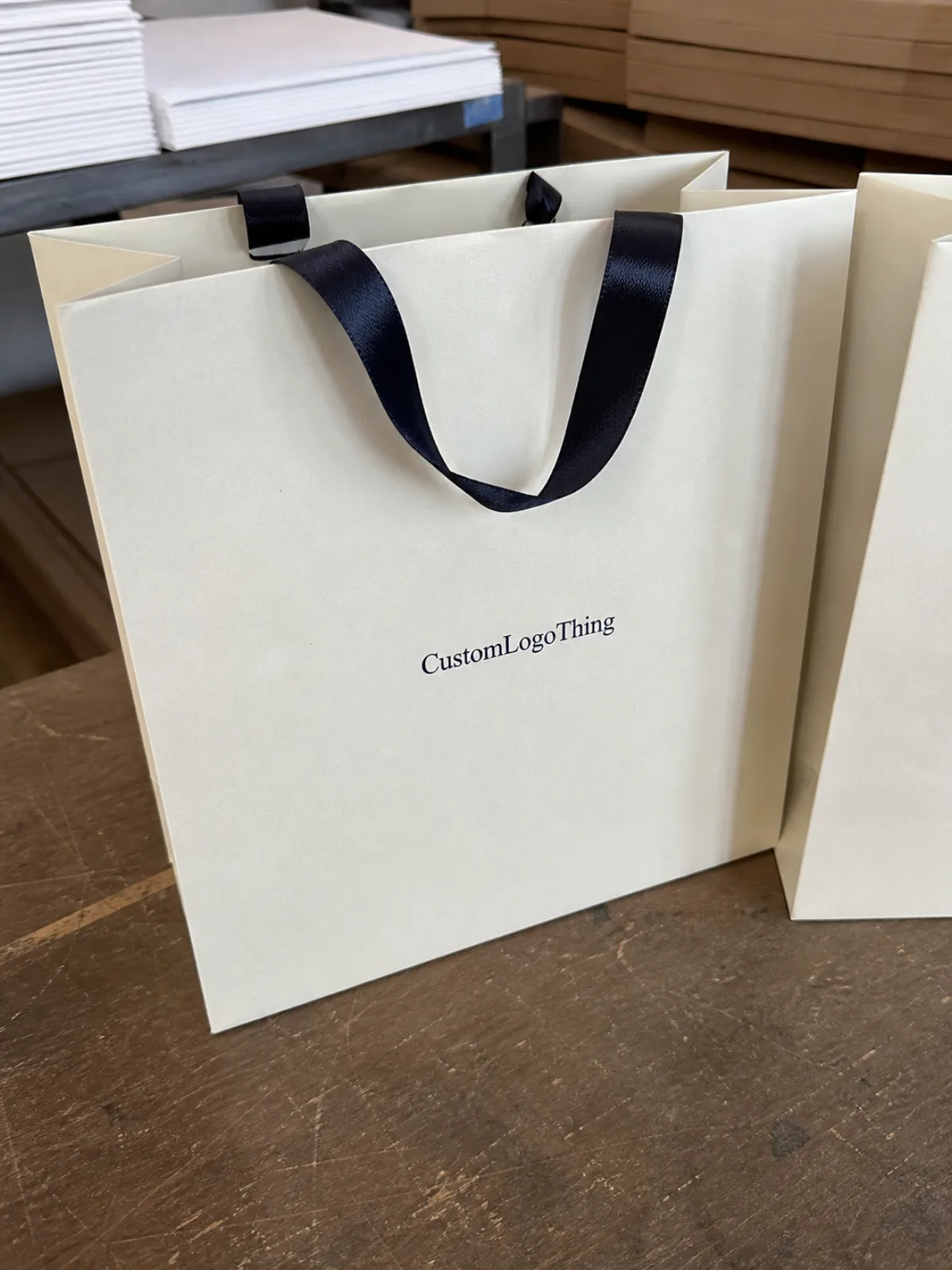
If the bag is part of the gift, not just the carrier, then corporate gifting ribbon Handle Paper Bags bulk order planning needs to start before artwork and well before you chase a low quote. I see buyers reverse the sequence all the time: they pick a logo treatment, then discover the bag is too small for the kit, or too weak for the weight, or too glossy for the brand tone. That is the expensive way to learn basic packaging math.
Ribbon handles send a signal fast. They look more formal than twisted paper handles and less utilitarian than rope handles, but only if the handle length is even, the attachment is clean, and the color is close to the brand reference. A sloppy ribbon handle reads as rushed immediately. There is no hiding it under a fancy logo.
For reception counters, courier handoffs, and event check-in desks, this format works well because it holds shape, photographs cleanly, and looks intentional when stacked. But the bag needs a usable mouth opening, a reinforced top fold, and enough base support to sit upright after the gift is inserted. If the bag collapses the moment the tissue paper goes in, the presentation is already slipping.
For buyer planning, the first questions are simple:
- What exactly is going inside the bag?
- How much does the packed kit weigh?
- Will the bag be carried by hand, shipped, or both?
- Do you need a matte, soft-touch, or gloss finish?
- Is the ribbon handle part of the brand look, or just the best functional option?
In practice, the best bulk orders are the ones where the spec sheet is boring. Exact size. Exact handle color. Exact print count. Less drama. Fewer surprises. Better bags.
Sizes and Carry Weight That Fit Real Gift Kits
Start with the contents, not the concept. A gift box, bottle, catalog, tissue wrap, insert card, and sample pack can all change the usable size. A bag that looks “large enough” on paper can be awkward in real life because the usable internal space is always smaller than the outside dimensions suggest. Handles also pull the sides inward a little, which matters more than people expect.
For most corporate gifting ribbon Handle Paper Bags bulk order planning, I would size the bag around the packed item with at least 10 to 15 mm of side clearance and 15 to 25 mm of headroom if the top needs to close without crushing tissue. If the contents are boxed, leave enough room so the box drops straight in without forcing the gussets open too far. Too tight looks cramped. Too loose looks like the brand guessed.
Weight matters just as much. A light giveaway may only need a mid-weight paper bag, but a boxed bottle set or mixed kit changes the math fast. As a rough buyer rule, bags for lighter event items often work well in the 170 to 200 gsm range, while heavier gift sets usually need 250 to 300 gsm board, plus reinforcement at the top fold and handle anchor points. If the bag carries more than about 1.5 to 2.5 kg, the handle attachment and base construction deserve serious attention, not wishful thinking.
That is where testing helps. Put the actual packed gift in the sample. Lift it. Walk with it. Set it down. Shake it a little. Sounds primitive, but it tells you more than a polished mockup ever will.
Common size mistakes show up fast:
- The bag is tall enough, but the base is too narrow for the gift box.
- The bag is wide enough, but the handle pull makes the top buckle.
- The bag fits one item perfectly, then fails once the insert card and tissue are added.
- The packed weight is acceptable, but the bottom board is too thin for transport.
Use the real kit. Not a concept kit. Not a “close enough” kit. A real one. That is the only way to see whether the handle height, gusset depth, and base strength support the actual presentation.
Paper Stock, Finish, and Print Specs That Look Premium in Bulk
Paper stock should be chosen for load and feel, not just appearance. A thick-looking sample sheet can fool buyers into approving a bag that is too soft at the base or too brittle at the folds. For branded gift bags, art paper wrapped over board is common because it gives you a clean print surface and a controlled premium feel. Kraft can work too, but it changes the brand message immediately. It is warmer and less formal. That may be right. It may also be the wrong signal for executive gifting.
Finish changes everything. Matte feels restrained and polished. Soft-touch feels more expensive, though it will show edge wear if the packing team is rough. Gloss makes color pop, but fingerprints show faster and some brands find it a little loud for corporate use. None of those finishes is automatically best. It depends on the rest of the kit, the lighting at the event, and whether the bag will be reused after the event.
If the logo uses fine lines, tiny type, or a subtle gradient, lock the print method early. Offset printing handles detail well on larger runs. Screen print or hot stamping can look strong for simpler graphics. Digital print is useful for shorter runs and variable artwork, but the color consistency still needs checking against a real sample. There is no such thing as “we’ll fix it in bulk” once the run has started. That is not a plan. That is a problem.
For sustainability claims, keep them factual. If you want FSC-certified board, verify the chain of custody and ask for the proper documentation. The same goes for recycled content claims. For broader packaging and recovery guidance, the FSC site is a good reference point, and the EPA recycling guidance helps buyers sanity-check disposal language before anything goes on the bag.
Useful spec checkpoints:
- Board weight: usually 170 to 300 gsm depending on contents.
- Laminate: matte for restraint, soft-touch for a premium hand feel, gloss for brighter color impact.
- Handle color: confirm against a physical swatch or locked brand code, not just a screen mockup.
- Artwork minimums: keep small text above 6 pt when possible; anything smaller needs a careful proof.
- Attachment: reinforced knot, hidden anchor, or glued tab should be confirmed on the sample, not assumed.
If you are setting up a repeat program, save the exact spec sheet. Otherwise the second order becomes a debate about what the first order was supposed to be.
Pricing and MOQ: What Actually Moves Unit Cost
MOQ is where buyers get emotional for no good reason. Lower minimums are useful for pilot programs, executive events, and one-off campaigns, but they almost always carry a higher unit price because setup, plates, sample work, and print prep get spread over fewer bags. That is normal. It is not a supplier trick. It is arithmetic.
For a mid-size Ribbon Handle Paper bag with a single or two-color print, here is a realistic planning range:
| Quantity | Typical unit price | Good for | Main tradeoff |
|---|---|---|---|
| 300 to 500 | $1.20 to $2.10 | VIP kits, pilot runs, tight event schedules | Highest setup cost per bag |
| 1,000 to 2,500 | $0.72 to $1.35 | Corporate events, repeat gifting, internal programs | Balanced pricing, moderate lead time |
| 5,000+ | $0.38 to $0.88 | Standardized gifting programs and multi-event use | More storage, more freight, more planning |
Those numbers move with bag size, print coverage, finish, handle type, and carton style. Full-bleed artwork costs more than a simple logo. Soft-touch lamination adds cost. Foil, embossing, or specialty handle colors add more. FSC paper can add a small premium, often around 3% to 8%, depending on supply and run size. Freight also matters. A bulky carton plan can erase the savings from a slightly cheaper bag if the goods ship badly.
There are a few cost levers that buyers underestimate:
- Print colors: each added color can add setup cost and proof time.
- Special finishes: foil, UV, embossing, and lamination all add handling steps.
- Handle style: ribbon handles usually cost more than basic twisted handles.
- Carton count: tighter packing saves freight, but only if the bags still ship flat and clean.
- Delivery method: air can rescue a deadline, but it is rarely a friendly line item.
If you are comparing quotes, ask for at least two quantities. Three is better. You want the break point where the unit price drops enough to justify extra inventory without leaving you with a warehouse full of unused bags. If the supplier can also quote your best alternate size, even better. Sometimes a slight dimension change saves more money than a harder negotiation ever will.
For buyers building recurring programs, our Wholesale Programs page is the right starting point. It is easier to price a repeat run than to reinvent the whole bag every time.
Production Steps and Timeline for Approved Bulk Runs
The clean process is straightforward: confirm specs, review the dieline, approve artwork, lock the sample, then release the bulk run. The trouble starts when someone wants to “just make one more change” after the proof is signed off. That one change becomes a day or two, then a week, then a rushed freight quote nobody likes.
For simple runs, a pre-production sample can often be ready in 3 to 5 business days after artwork confirmation. Bulk production usually lands around 10 to 15 business days after sample approval for straightforward specs, and longer if the bag includes specialty finishes, imported paper, or custom ribbon colors. Add time if the order needs multiple approval layers. Marketing, procurement, and a brand manager who is away from their desk can cost real days.
Lead time risk usually comes from three places:
- Artwork changes after proof approval.
- Paper or ribbon stock not being in hand.
- Packaging and shipping details getting decided too late.
If the bags will ship individually or go through aggressive parcel handling, ask how the master cartons are packed and whether they have been tested against common drop and vibration expectations. ISTA-style checks matter because a nice bag that arrives crushed is still a bad bag. For practical shipping standards, the ISTA site is a useful reference for buyers who need to understand why transit protection is part of the spec, not an afterthought.
Build your delivery date backward from the event:
- Final approval date
- Production window
- QC and packing window
- Transit time
- Buffer for rework, customs delay, or reshipment
That buffer is not luxury. It is insurance. Corporate events have a bad habit of staying fixed on the calendar while production keeps moving.
Reorder Controls That Keep Corporate Gift Bags Consistent
The best suppliers do not rely on memory. They keep a saved spec sheet with the approved size, paper weight, finish, handle length, print file version, carton count, and tolerance. That is how a second order matches the first one without a guessing game. If the first run looked right because somebody “remembered the details,” the reorder will eventually expose the gap.
Reorder consistency depends on a few boring but critical controls. First, the color standard needs to be fixed. A Pantone reference is better than a vague description like “deep blue, but slightly softer.” Second, the handle attachment method should be documented. Third, any acceptable variation should be stated up front. A production tolerance of plus or minus 5% to 10% is common in bulk work, but the actual allowance depends on the product, the run size, and the factory process. Do not assume it. Write it down.
Also ask how overruns and underruns are handled. If the order is tied to an event date, missing 300 bags is not a minor issue. It is a problem on the conference table. You want to know whether replacement units can be rushed, whether the supplier keeps a small safety reserve, and whether carton labels match the latest approved spec.
Good vendors also flag artwork issues before the press starts. Bad ones nod politely and send a sample that proves the logo was too small, the background too busy, or the contrast too weak. That is exactly the kind of expensive optimism buyers should avoid.
If your team needs a quick answer on file types, shipping terms, or sampling flow, the FAQ is the fastest place to start before sending a purchase order.
Next Steps to Lock Specs Before You Submit the PO
Before you send the PO, put the basics in one place. Measure the gift kit. Confirm the packed weight. Pick the bag style. Decide whether ribbon handles are part of the brand story or simply the best functional option. Then ask for a dieline, a sample photo set, and a written spec sheet so everyone is approving the same version.
Here is the clean checklist I would use for any corporate gifting ribbon Handle Paper Bags bulk order planning job:
- Finished bag size and gusset depth
- Paper stock and board weight
- Finish type
- Handle color, width, and attachment style
- Logo placement and print method
- MOQ, price breaks, and overrun tolerance
- Production window and shipping method
- Delivery date with a realistic buffer
Once those items are fixed, the quote becomes useful. Before that, it is just a number with extra confidence attached. That confidence is cheap. The rework is not.
If the order is for a recurring program, save the approved bag as the master reference and reuse the same spec sheet every time. That is how you keep the color stable, the handle height consistent, and the freight plan predictable. It also saves you from explaining to finance why the “same bag” somehow became a different bag.
Get the fit right, and the bag supports the gift instead of competing with it. That is the real goal of corporate gifting ribbon handle paper bags bulk order planning: clean presentation, controlled cost, and a delivery that shows up looking exactly like the approval. Nothing magical. Just disciplined packaging.
What is the usual MOQ for ribbon handle paper bags in corporate gifting?
Most bulk programs price better once you move past very small runs because setup costs stop dominating the unit price. If you need repeat orders, choose an MOQ that leaves a cushion for samples, damage, and last-minute event additions.
Which paper weight works best for corporate gifting ribbon handle paper bags?
Use heavier stock for boxed gifts, bottles, or mixed kits that stress the base and handle attachment. Mid-weight paper is usually enough for lighter event giveaways and keeps the bag from being overbuilt and overpriced.
Can you match ribbon handle colors to our brand on a bulk order?
Yes, but the cleanest match comes from confirming a physical color reference or a locked brand code before production starts. Expect small variation if the handle material, print method, or paper finish changes the way color is read.
How long does production take after artwork approval?
Lead time depends on stock availability, print complexity, and whether you need a pre-production sample. Simple runs move faster; custom sizes, special finishes, or heavier cartons need more time for setup and packing.
What do you need to quote corporate gifting paper bags accurately?
Send the bag size, quantity, paper stock, finish, handle style, logo file, and delivery destination. If you want a useful quote, include the target event date too, because shipping choice changes the final price and schedule.