A proper cuffed knit Beanies Unit Cost Breakdown starts with the uncomfortable truth that the blank hat is rarely the whole story. The beanie body is only one part of the final number. Setup, decoration, labels, testing, and packaging can outweigh the knit itself, especially when the order is small or the artwork changes midway through quoting.
That is why a quote only makes sense when the spec is locked. Yarn, cuff height, logo method, label placement, packaging, and quantity all affect the price. Change one detail and the number moves. Change three and you are no longer comparing the same product.
For a 100-piece launch, a 500-piece staff order, and a 1,000-piece retail reorder, the same cuffed beanie can behave very differently on paper. The line items may look familiar, but the factory is still counting knitting time, setup labor, and waste. Buyers who ignore those mechanics usually end up overpaying for small runs or underestimating freight and finishing on larger ones.
There is also a common trap in quote comparisons: one supplier may include tags and bagging, while another leaves them out. One may quote embroidery only, while another includes a patch, a spec sample, and carton labeling. If the builds are not identical, the price spread is not very useful.
Cuffed knit beanies unit cost breakdown: what actually moves the price
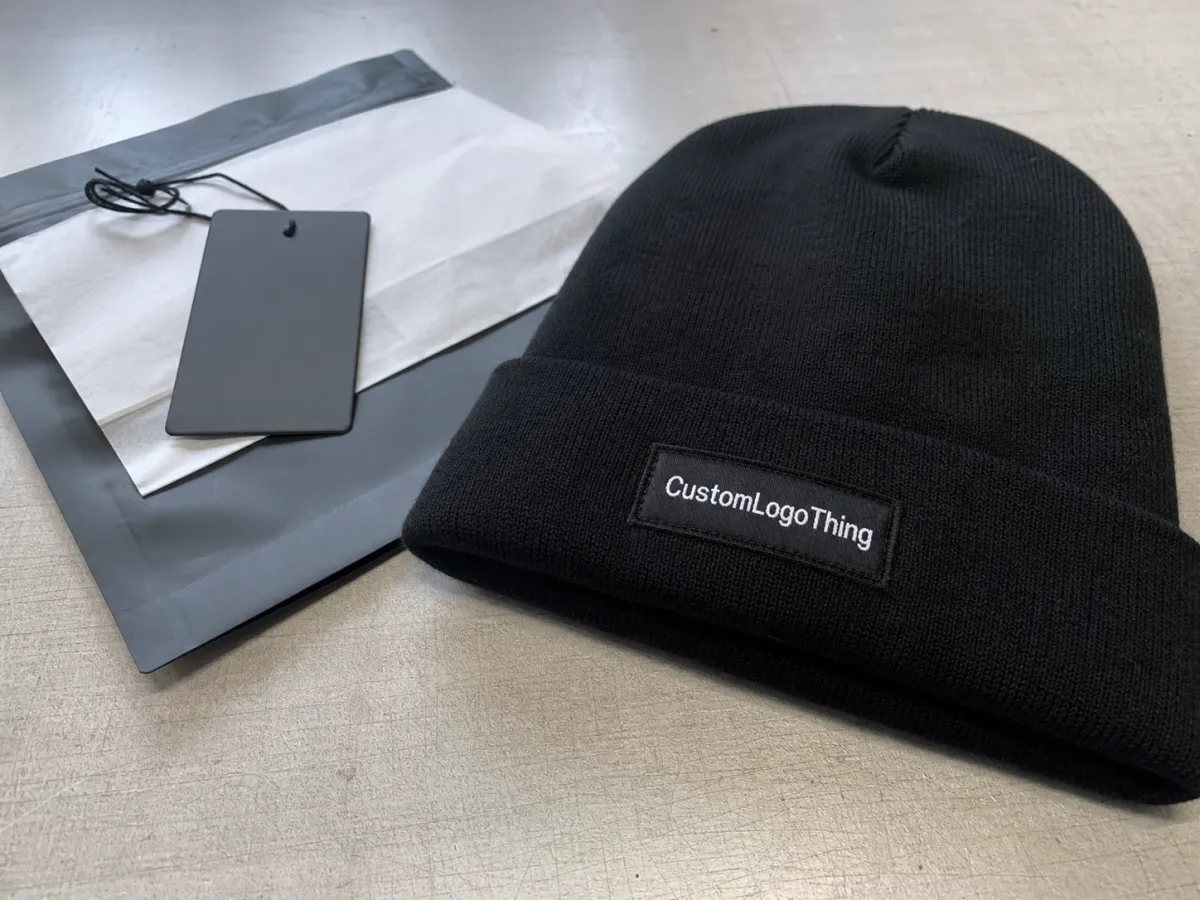
A buyer asking for a Cuffed Knit Beanie quote is really buying four things: the knitted body, the cuff, the branding, and the work around those pieces. The first two are obvious. The last two are where most of the cost surprises live.
The cuffed style helps because it creates a flat, stable branding area. That matters for embroidery and labels, and it is one reason cuffed knit hats stay popular in bulk programs. The cuff also adds a bit more yarn and knitting time than a bare pull-on cap, but that is usually not the main expense. On low quantities, setup charges and decoration labor tend to matter much more than the hat body itself.
For a small-run order, the unit price can land 40% to 90% higher than the same spec at a larger quantity. That is not a quality difference. It is the fixed cost of approvals, digitizing, machine setup, and packaging spread across fewer pieces. Buyers often focus on the base beanie cost and miss that the real bill is built from several smaller charges.
The blank beanie is usually the cheap part. The expensive part is the work the factory has to repeat: approving the spec, setting up the job, and handling the finishing.
Clean quoting depends on clean inputs. If the factory has to estimate the yarn count, the logo position, the label type, or the carton packout, the quote usually gets padded. If artwork changes after approval, time gets lost and the invoice can shift. A useful quote should show what is included and what is not, line by line. Buyers do not need vague “premium” language; they need a number they can defend internally.
When people search for pricing on this product, the useful terms are simple: unit cost, bulk pricing, MOQ, and cost per piece. Those phrases keep the conversation tied to the actual build instead of generic sales talk that sounds polished and tells you almost nothing.
What buyers get with a cuffed knit beanie
A cuffed knit beanie is a double-layer knit hat with a folded brim. That cuff gives the cap a more structured look, adds warmth around the ears, and creates a branding zone that holds up well under embroidery, woven labels, or sewn patches. For most buyers, that is the practical appeal.
The product fits different programs, and the program changes the spec. Promo giveaways usually want a simple acrylic body, a small logo, and a low entry price. Retail merch usually needs better hand feel, cleaner stitch definition, and tighter finishing. Uniform or corporate use sits between those two, with a stronger focus on consistency and repeatability than on fashion detail.
Color tolerance matters more than people expect. Knit fabrics are not painted surfaces. A charcoal gray from one dye lot can read slightly warmer or cooler than another. If exact matching matters, ask for a strike-off or lab dip before bulk production. If a close visual match is acceptable, say so early. That small decision can save both time and cost.
Thickness is another real buying choice. A heavier knit feels more substantial and often photographs better, but it can raise yarn use and machine time. A lighter knit may reduce cost, yet it can feel thin in hand. That is where buyer expectations and end-customer expectations need to align. A beanie meant for a quick giveaway does not need the same structure as one sold through a store.
The cuff is especially useful because it gives decoration a stable surface. Logos on the cuff tend to stay readable. Logos on a stretchy crown can distort, especially if the design is too large or too dense. For that reason, Cuffed Knit Beanies remain one of the safest bulk choices when the brand mark has to look clean without driving production risk.
Yarn, gauge, and finishing specs that change the quote
Yarn choice is one of the clearest drivers in a cuffed knit beanies Unit Cost Breakdown. Standard acrylic is usually the baseline because it is widely available, holds color well, and keeps the quote predictable. Wool blends cost more, but they often feel warmer and less synthetic. Recycled yarns can be a smart fit for sustainability-led programs, although they are not always the cheapest option and they can introduce supply consistency issues if the yarn source is unstable.
A practical pricing spread looks like this: moving from standard acrylic to a wool blend may add roughly 15% to 35% to the base beanie cost, depending on fiber mix and finish. Recycled content often adds about 10% to 25% when sourcing is steady. Anti-pill treatment can add a smaller bump. None of these changes sound dramatic on their own, but they stack quickly once the order includes decoration and packaging.
Gauge matters next. A tighter knit usually gives the hat a cleaner face and a more retail-ready appearance, but it takes more machine time and sometimes more yarn. A looser knit can lower the price, though it may also reduce structure and warmth. That tradeoff is fine for a casual promo item. It is less attractive for a shelf-ready assortment where hand feel and shape retention matter.
Finishing details can be deceptively expensive. A woven side label, inside size tag, custom hang tag, fold-and-bag packing, or special sticker placement each adds a small amount of labor. A lot of small amounts becomes a meaningful cost. Those items are often quoted separately because they happen at different points in production and each one has its own setup or handling step.
Two spec items deserve more attention than they usually get:
- Cuff height affects branding space, yarn use, and how balanced the hat looks on the head.
- Crown height affects fit, profile, and the total knit time needed to finish the cap.
Neither is cosmetic in the narrow sense. A short cuff can make the logo feel cramped. A tall crown can add material without improving the product. Small spec adjustments are where experienced buyers save money without making the beanie look cheap or unfinished.
For paper inserts, transit packaging, or sustainability claims, check what can actually be documented. FSC-certified paper hang tags are a sensible retail option, and shipping-heavy programs benefit from carton and transit testing standards such as ISTA. For broader material and waste guidance, the EPA remains a practical reference point. Standards matter because they keep packaging claims, material choices, and shipping realities in the same lane.
Pricing, MOQ, and unit cost tiers by order size
Higher quantities almost always lower unit cost because the same approval work, digitizing, and setup fees get spread across more hats. That principle never changes. What does change is how steeply the price falls once the order passes a supplier’s preferred MOQ.
Some suppliers quote a low MOQ to win the order, then recover margin through tooling fees, extra handling, or packaging add-ons. Others give a cleaner per-piece number but ask for a larger minimum. Neither model is automatically bad. The useful comparison is total landed cost for the exact build you want, not the prettiest headline price.
Here is a working range for a standard cuffed acrylic beanie with simple branding. These are market ranges, not guarantees, because yarn choice, decoration, and freight all move the final number.
| Order size | Blank beanie cost per piece | Simple embroidery add-on | Typical total cost per piece | What usually drives the price |
|---|---|---|---|---|
| 100 pcs | $3.40-$5.90 | $0.85-$1.60 + $45-$95 setup | $4.60-$7.20 | Setup charges, small-run labor, packaging minimums |
| 500 pcs | $2.10-$3.35 | $0.55-$1.05 + $45-$95 setup | $2.85-$4.40 | Better material rates, lower decoration cost per piece |
| 1,000 pcs | $1.55-$2.55 | $0.40-$0.80 + $45-$95 setup | $2.10-$3.20 | Efficient machine time, spread-out tooling fees, stronger bulk pricing |
Samples should be treated separately. A custom knit beanie sample or pre-production proof often costs $25 to $75, and more if the spec is unusual or the logo needs extra manual work. If the supplier credits that amount back to the bulk order, good. If not, it should still be budgeted honestly. A sample is a cost of reducing risk, not a free gift.
Rush orders deserve their own line in the plan. A surcharge of 10% to 20% is common when the factory has to reshuffle capacity or compress a finishing step. If a deadline is fixed, say so before the quote is approved. A surprise deadline does not make production faster; it only makes the price less pleasant.
Freight also belongs in the real cost picture. A quote that looks attractive ex-factory can stop being attractive once cartons are landed, especially if the packout is bulky or the destination is far from the production base. For buyers comparing multiple suppliers, the better question is not who is cheapest, but who gives the lowest landed cost for the spec that will actually ship.
Decoration choices and the real cost tradeoffs
Decoration is where many quotes split apart. The beanie body may be identical, but the branding method changes labor, setup, and durability. A simple one-color logo is easy to manage. A small multi-color graphic with tight edges is a different production problem.
Here is a practical comparison of the common options.
| Method | Best for | Typical setup | Cost impact | Buyer watch-out |
|---|---|---|---|---|
| Embroidery | Clean logos, team wear, retail basics | Digitizing fee plus stitch approval | Moderate | Too much detail can distort on stretch fabric |
| Woven patch | Sharper branding, premium feel | Patch tooling and attachment setup | Moderate to higher | Extra handling can slow production |
| Sew-on label | Simple retail branding, low-profile look | Label spec and sewing setup | Lower to moderate | Works best when the logo is simple |
| Jacquard knit-in logo | Integrated branding at scale | Knit program setup | Efficient at higher volume | Not always the cheapest at low MOQ |
Embroidery is usually the easiest choice for a simple logo, especially if the design uses one or two thread colors. The cost rises when the stitch count rises, so oversized logos and tiny text both deserve caution. On a stretchy cuff, dense stitching can pucker or warp the fabric. If the mockup looks crisp but the sample looks crowded, the problem is usually too much detail packed into too little space.
Woven patches and sewn labels fit brands that want a cleaner apparel finish. They can look more premium than direct stitch, but they add steps and handling. That additional labor is not a flaw. It just needs to be priced correctly. A good quote should reveal whether the patch is sewn on, heat applied, or attached in some other way, because each method carries different labor and quality risks.
Jacquard knit-in logos make sense when the order is large enough to justify the knit program and the artwork is simple enough to translate into stitches. They can be efficient, but they are not a solution for every graphic. If the logo has small lettering, gradients, or too many colors, the result usually gets busier rather than better.
A useful rule is to match the decoration method to the way the hat will be sold or distributed. A promo item does not need the same finish as a retail SKU. A uniform issue does not need the same branding treatment as a higher-end seasonal drop. Overbuilding the decoration to satisfy a pricing spreadsheet is one of the easiest ways to waste budget.
Process and lead time from spec sheet to shipment
A clean order usually moves through six steps: inquiry, quote confirmation, artwork review, sample or mockup approval, bulk production, inspection, and shipment. If a supplier skips those steps in the conversation, they are probably skipping them in production too. That is not efficiency. It is a delayed problem.
Lead time usually stretches for three reasons: artwork changes, color approval delays, and decoration approval. Those delays are predictable, which means they are manageable. A beanie order with locked specs can move faster than one where the logo is still under review. That sounds obvious because it is, yet it is one of the most common reasons orders miss a retail window.
A realistic timeline for standard custom knit beanies is often 12 to 15 business days after proof approval for simpler runs, and closer to 3 to 5 weeks for custom yarns, special labels, or more complex decoration. Shipping time sits on top of that. If the product has to arrive for a seasonal launch, event, or uniform rollout, the calendar needs cushion.
Some parts of the schedule can be compressed. Sample approval can move quickly when the logo is clean and the color is already agreed. Artwork revision can be reduced when the buyer sends vector files and exact placement notes. What cannot be compressed easily is knitting time, especially on larger volumes or tighter gauges. The machines work at the pace they work.
Inspection should never be treated like a formality. For bulk knitwear, the checks that matter are size consistency, cuff symmetry, stitch uniformity, logo placement, and packaging accuracy. A beanie that is half an inch off spec might be acceptable for a handout. For retail or branded apparel, that same variation can create a real quality issue.
Buyers who want lower risk often ask for carton photos, measurement checks, or pre-shipment inspection against agreed tolerances. That is a sensible habit. It is cheaper to catch a recurring flaw before freight than after a warehouse opens hundreds of hats and finds the same mistake repeated across the lot.
How disciplined knit production keeps quotes predictable
Predictable quotes come from predictable inputs. Stable material sourcing, locked specs, and repeatable decoration methods keep the cuffed knit Beanies Unit Cost Breakdown from drifting halfway through the order. If the yarn count changes or the logo spec changes after approval, the price should change too. That is fair. What should not happen is random repricing because the job was never defined properly.
Documented approval matters more than many buyers expect. Once the spec sheet is signed off, the supplier should build to that document, not to a memory of an email thread. That protects both sides and reduces the chance that a “small tweak” turns into a new setup charge.
Quality control on bulk knitwear should focus on the details that affect sell-through: size consistency, cuff symmetry, stitch evenness, logo placement, and packaging accuracy. A beanie that measures slightly off spec may still work for a handout. For retail, the margin for variation is much smaller. A loose stitch line or a crooked label becomes visible the moment the hats are unpacked.
Repeat orders are usually easier to price. If the yarn, fit, logo file, and decoration method are already approved, the supplier can reuse the setup more efficiently. That often improves both unit cost and lead time. Buyers with recurring seasonal stock should treat the first order as the baseline and record the actual approved spec carefully, because that is what makes the next reorder behave predictably.
From a practical buying angle, the best supplier is not the one with the most polished pitch. It is the one that can explain the quote, separate fixed charges from variable ones, and identify which parts of the build are stable and which ones will move the price. That is the difference between a quote you can trust and a number that only looks good until the invoice arrives.
Next steps to get an accurate unit quote
If you want a real quote, send the details that actually move the number. Quantity, logo file, decoration method, color target, packaging requirement, and deadline are enough for a supplier to work from instead of guessing.
Ask for two scenarios: one at your minimum acceptable quantity and one at a higher tier. That makes the MOQ effect obvious and shows where bulk pricing starts to improve. A quote that only gives one quantity is incomplete. It may be useful as a ballpark, but it is not enough to make a solid buying decision.
Compare like for like only. A lower number with a different yarn blend, fewer stitches, or weaker finishing is not savings. It is a different product. Buyers lose time when they compare a retail-ready cuffed beanie to a bare promo cap and treat those as interchangeable.
Send clean vector artwork if you have it. If not, send the best file available and state the smallest acceptable logo size. The faster the spec is locked, the faster the quote comes back without revisions. That matters because revisions are where cost and lead time tend to creep.
For paper inserts, hang tags, or retail packaging, decide early whether you want FSC-certified stock and simple packaging or something more custom. Packaging changes affect both cost and timeline. For transit-heavy programs, ask how the goods will be packed and whether the carton profile fits the shipping method.
Handled that way, the cuffed knit beanies unit cost breakdown stops being guesswork. It becomes a straightforward buying tool: clear spec, clear quantity, clear decoration, clear price. That is the kind of quote that holds up when it reaches purchasing, finance, and the warehouse all at once.
FAQ
What affects cuffed knit beanies unit cost the most?
Quantity, decoration method, and yarn choice usually move the price the most. On smaller orders, setup fees and label or patch changes can matter more than the blank beanie itself. The more the spec changes, the more the quote tends to move.
How does MOQ change cuffed beanie pricing?
Lower MOQs usually mean higher unit costs because setup is spread across fewer pieces. Some factories will accept a small run, but the quote may have less room for discounting and fewer spec options. Higher volumes usually unlock better material rates and lower decoration cost per piece.
Which decoration method gives the lowest unit cost?
A simple one-color embroidery or a clean woven label often keeps costs under control. Jacquard knit-in logos can be efficient at scale, but they are not always the cheapest option at low quantity. The lowest price depends on logo size, stitch count, and how much setup the method needs.
Can I reduce knit beanie costs without hurting quality?
Yes. Simplify the logo, limit color changes, and choose a practical yarn instead of a premium blend. Keeping the spec consistent across the order avoids rework and extra approval time. The goal is not the cheapest possible quote; it is a clean beanie that still performs well.
What should I send to get a fast cuffed knit beanie quote?
Send the logo file, target quantity, color preference, decoration method, and any packaging requirement. Include your deadline so the supplier can confirm the right lead time instead of guessing. The faster the spec is locked, the faster the quote comes back without revisions.

