Buyer Fit Snapshot
| Best fit | Custom Bottle Labels With Logo projects where brand print, material claims, artwork control, MOQ, and repeat-order consistency need to be specified before quoting. |
|---|---|
| Quote inputs | Share finished size, material target, print colors, finish, packing count, annual reorder estimate, ship-to region, and any compliance wording. |
| Proofing check | Approve dieline scale, logo placement, barcode or warning zones, color tolerance, closure strength, and carton packing before bulk production. |
| Main risk | Vague material claims, crowded artwork, missing packing details, or unclear freight terms can make a low unit price expensive after revisions. |
Fast answer: Custom Bottle Labels With Logo: Design, Cost, and Fit should be specified like a repeatable production item. The safest quote records material, print method, finish, artwork proof, packing count, and reorder notes in one written spec.
Production checks before approval
Compare the actual filled-product size with the drawing, then confirm tolerance on folds, seals, hang holes, label areas, and retail display edges. Reserve space for logos, QR codes, warning copy, and material claims before decorative graphics fill the panel.
Quote comparison points
Review material grade, print process, finish, sampling route, tooling charges, carton quantity, and freight assumptions side by side. A quote is only useful when the supplier can repeat the same color, closure quality, and packing count on the next order.
Custom Bottle Labels With Logo: Design, Cost, and Fit
A bottle gets judged fast. In a retail aisle, a tasting room, a gift set, or a subscription box, people usually decide whether to pick it up before they read the back panel or try what is inside. That is why Custom Bottle Labels with logo carry so much weight early in the buying process: they make the first impression, signal care, and tell the buyer that the product was put together on purpose rather than thrown together in a hurry.
For packaging teams, that matters because the label is doing several jobs at once. It has to hold branding, product details, surface performance, and often compliance information in one compact space. The right custom bottle labels with logo can help a small brand look established, help a seasonal product stand out in a crowded cooler or shelf set, and help a private-label line stay consistent across retail packaging, promo kits, and gift assortments.
There is also a psychological side to it. People read material cues faster than they admit. A matte film with clean typography can feel calm and premium. A bright gloss finish can make the same bottle feel lively and more retail-ready. Clear labels can turn the container itself into part of the design. All of that happens before the cap comes off, which is why custom bottle labels with logo influence value long before the product is opened.
Custom Bottle Labels With Logo: Why They Stand Out Fast
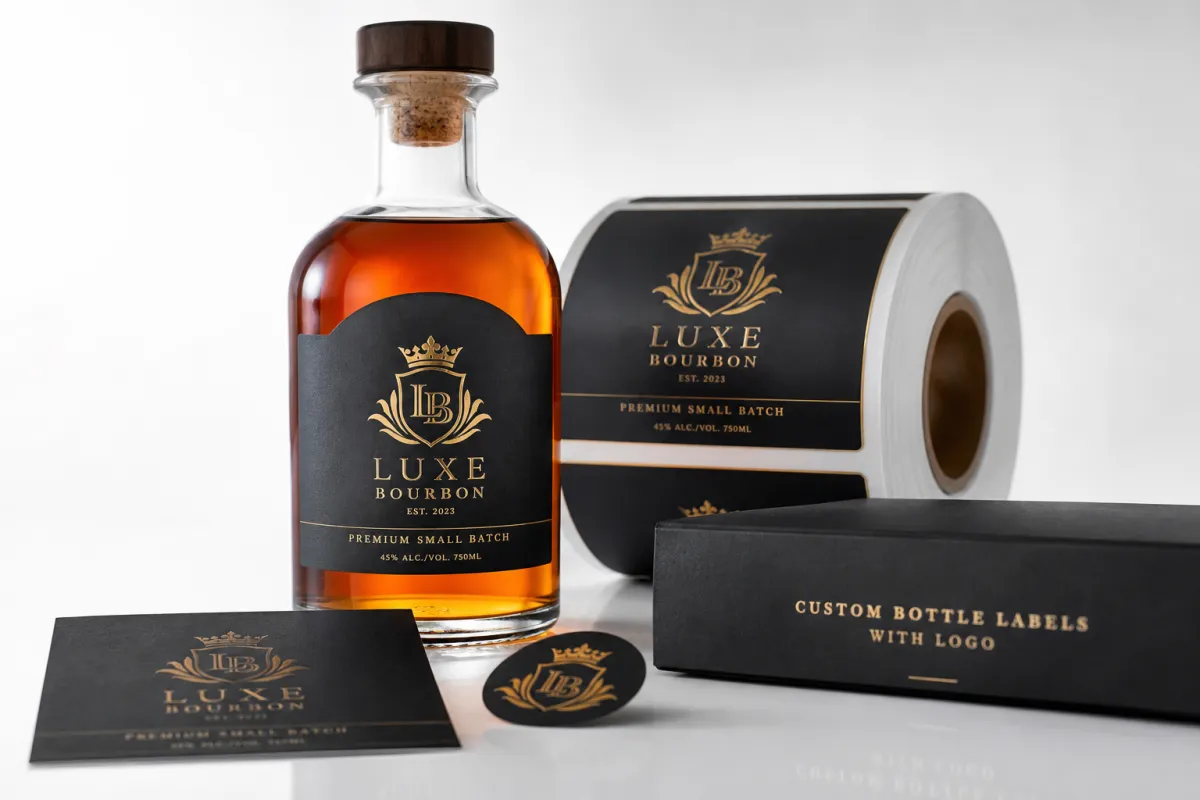
A bottle lives or dies by visibility. If the label is hard to read, the logo is poorly placed, or the finish fights the bottle shape, people move on. That happens in beverage aisles, beauty shelves, tasting rooms, and even corporate gift programs. Custom bottle labels with logo work because they turn an ordinary container into branded packaging with a clear job: identify the product and make it feel worth picking up.
The logo is not decoration. It is recognition. A plain bottle can hold a good beverage, a useful serum, or a quality condiment, but without a clear brand mark it often feels unfinished. Custom bottle labels with logo help smaller operations look more stable, and they help larger teams keep brand presentation consistent across multiple SKUs. That consistency matters more than many buyers expect. Repeated use of the same logo shape, type treatment, and color palette can make a product family feel connected even when the contents differ.
I have seen Labels That Looked polished on a computer screen fall apart on a real bottle because the art was designed too tightly around the logo and not enough around the container. A good mockup can be helpful, sure, but the bottle itself always gets the last word. That is why designers and buyers who understand packaging tend to think in terms of fit, not just graphics.
People also respond to finishing details in ways they do not always name. The same liquid can look cheaper or more premium depending on label stock, finish, and how the logo sits on the bottle. A matte white film with restrained typography can suggest a clean, modern product. A gloss label with stronger contrast can give the package a brighter, more energetic retail look. Clear labels can make the bottle part of the design. That is why custom bottle labels with logo shape perception before the customer ever opens the cap.
From a packaging standpoint, the label is often the fastest way to explain what the product is, who made it, and why it belongs in the buyer's basket. That matters most in busy channels where shelf time is short and attention is scattered. The bottle shape, closure, and liquid color all play a role, yet the label usually does the first selling.
A label that reads clearly at arm's length usually performs better than a label that only looks impressive in a mockup. On a real shelf, clarity beats clutter.
Teams planning custom bottle labels with logo usually end up asking the same practical questions: Which material survives the environment? How much will it cost at the volume we need? How long will the order take? How do we keep the logo in the right place on the bottle instead of drifting, wrinkling, or lifting at the edge?
How Custom Bottle Labels With Logo Are Planned and Printed
The workflow for custom bottle labels with logo starts with the bottle itself, not the artwork. A label that looks excellent on a flat screen can fail on glass or plastic if the radius, taper, or shoulder curve has not been accounted for. The practical sequence is straightforward: measure the bottle, define the print area, build the dieline, place the artwork, approve the proof, print the labels, finish them, and ship them in a format that matches the application method.
That first measurement step matters more than many teams realize. The label panel needs enough width to wrap without awkward overlap, and enough height to avoid the shoulder or base curve. On a round bottle, even a small miscalculation can create a seam that looks crooked or a logo that stretches. On a tapered bottle, the top and bottom edges often need a more conservative shape so the label lies flat. With custom bottle labels with logo, the dieline is not a formality. It is the map that keeps the layout honest.
Print method affects the order too. Digital printing is common for flexibility, quick changes, and shorter runs because it avoids the expense of plates. That makes sense for launches, seasonal products, test markets, and multi-SKU projects. Larger repeat orders may use other production methods depending on volume, color targets, and finishing needs. The point is not that one method always wins. The point is that custom bottle labels with logo should match the run size, artwork complexity, and schedule.
Finish matters almost as much as print quality. Gloss can sharpen color and help the logo stand out under retail lighting. Matte can feel more restrained and premium. Soft-touch can add a velvety hand feel that works well on beauty or specialty food packaging. Clear materials let the bottle show through, which can be useful for beverages or skincare where transparency supports the brand story. With custom bottle labels with logo, finish is part of the message, not an afterthought.
Application is the final practical step. Small batches are often labeled by hand, which gives flexibility but demands consistency from the team applying them. Medium-volume runs may use simple label applicators to keep placement centered and reduce labor. Higher-volume lines may rely on automated application equipment, especially when speed and repeatability matter. If the labels are being applied by hand, the adhesive and backing release should be chosen with that workflow in mind. Custom bottle labels with logo can be beautifully printed and still create problems if they are awkward to apply.
For buyers comparing label suppliers with other packaging categories, it helps to think of labels as part of a system. The bottle, cap, fill process, secondary packaging, and shipping conditions all affect performance. That is why some teams coordinate Custom Labels & Tags alongside Custom Packaging Products so the graphics, materials, and timeline align across the whole pack.
Key Factors That Affect Custom Bottle Labels With Logo Quality
Material choice is the first quality decision. Paper labels can work well for dry environments, indoor retail, and lower-cost projects, especially when moisture is not a concern. Film labels, such as polypropylene or polyester-based stocks, are usually better for refrigeration, damp handling, or products that may be wiped down. Textured papers can support a craft or premium look, while clear stocks can create a cleaner, modern appearance. For custom bottle labels with logo, the stock should match the actual use case, not just the mood board.
Adhesive selection is just as important. A label on a smooth glass bottle stored at room temperature has very different needs from a label on a curved plastic bottle that lives in a cooler or a shower caddy. Temperature, condensation, oils, and surface energy all affect how well the adhesive bonds. If the product will be chilled, sprayed, or handled with wet hands, the adhesive needs to be tested under those conditions. Many issues blamed on print quality are really adhesion problems. That is where custom bottle labels with logo either succeed quietly or fail early.
Shape fit is the next checkpoint. Round bottles are common, but they are not simple. A slight taper, a narrow neck, or an aggressive shoulder can change how the label lands. Square bottles and faceted containers need careful placement so edges do not catch. Small sample vials, dropper bottles, and cosmetic jars leave very little room for error, which makes the label size and panel positioning even more critical. With custom bottle labels with logo, a label that is 2 mm too tall can suddenly feel too large once it meets the actual bottle.
Compliance and readability also belong in the quality conversation. A good-looking logo does not help if the ingredient panel is cramped, the barcode is unreadable, or warning text gets lost in low contrast. Food, beverage, and cosmetic labels often need space for product identity, contents, directions, batch coding, and legal statements. If the bottle is sold in retail channels, the label should remain legible under real store lighting, not just in a studio mockup. Many brands assume the logo is the hero and everything else can squeeze around it. In reality, custom bottle labels with logo work best when the entire information hierarchy is planned with discipline.
Durability is not a single feature. It is the result of print method, coating, adhesive, liner, and application method working together. A glossy laminate can improve scuff resistance. A moisture-resistant film can help the label survive condensation. A strong adhesive may keep the label in place during refrigerated storage, but if the bottle surface is oily or dusty, the result can still fail. That is why experienced buyers test the whole assembly. The label is not just ink on a substrate; custom bottle labels with logo are a system built for a specific environment.
For teams that want to sanity-check material choices, the Packaging & Processing Professionals resource at packaging.org is a useful reference point for packaging terminology and broader industry context. If the package is headed into rough transit, the ISTA test framework is also worth a look because it helps teams think about distribution stress, not just shelf appeal.
| Label Option | Best Use | Moisture Resistance | Typical Relative Cost | Notes |
|---|---|---|---|---|
| Uncoated or coated paper | Dry products, short shelf life, indoor displays | Low to moderate | $ | Good for simple branding, less ideal for cold storage or wet handling |
| BOPP or polypropylene film | Beverage, bath, beauty, refrigerated products | High | $$ | Often the practical choice for custom bottle labels with logo that need durability |
| Clear film | Minimalist branding, transparent bottles, premium looks | High | $$$ | Lets the container show through, but artwork contrast must be planned carefully |
| Textured specialty stock | Craft beverages, premium gifts, artisan lines | Low to moderate | $$$ | Visual character is strong, but performance depends on coating and environment |
If a label needs to survive ice buckets, condensation, or warehouse humidity, many teams choose a film stock and then test the full package before the order scales up. That approach costs less than reprinting an entire run because the first batch failed in storage. It also protects brand presentation, because damaged labels make even good products look careless. Strong custom bottle labels with logo are never about one feature in isolation; they are about fit, finish, and function acting together.
Custom Bottle Labels With Logo: Cost and Pricing Drivers
Pricing usually comes down to four things: quantity, size, material, and complexity. A small run of custom bottle labels with logo almost always costs more per unit than a larger order because setup and proofing are spread across fewer pieces. The same pattern shows up across most product packaging categories. The more the line runs, the more efficient the job becomes.
Setup costs are easy to underestimate. Artwork prep, dieline adjustments, proofing rounds, material sourcing, and finishing setup all take time. If the order includes multiple bottle sizes or several SKU versions, the cost can rise quickly because each variation needs its own attention. For a buyer, the key difference is between the one-time setup charge and the per-label cost. That gap explains why a 1,000-piece order can feel expensive while a 10,000-piece order may look much better on paper. With custom bottle labels with logo, volume matters more than people expect.
Special finishes add another layer. Foil accents, emboss-like effects, spot gloss, metallic stocks, or Custom Die Cuts can make a label feel more premium, but they also increase cost and sometimes production time. Whether that spend is justified depends on the product margin and the channel. A premium beverage, skincare serum, or gift-format item may benefit from the upgrade because the shelf impact is visible. A back-of-house sample may not need it. That is why custom bottle labels with logo should be priced against commercial value, not just unit price.
Hidden costs often show up in the workflow rather than the quote. Extra proof revisions can delay launch. Late artwork changes can trigger rework charges. Multi-SKU projects can require more careful inventory control. If the bottles are already filled and the labels are wrong, the cost is not only reprinting; it can be manual relabeling, wasted labor, and a delay in shipping. On a packaging budget, those mistakes are far more expensive than a slightly better material choice at the start. Good custom bottle labels with logo reduce waste, and that matters to the bottom line.
Here is a practical way to think about value: if a label upgrade adds a few cents per bottle but improves shelf presence, reduces moisture failure, and lowers rework risk, it may pay back quickly. Compare that against the margin on the product itself. On a high-margin specialty item, a better label can make economic sense even at a higher unit cost. On a commodity item, consistency and low waste may matter more than luxury finishes. Either way, custom bottle labels with logo should be bought with a clear sense of their role in the brand and in the production line.
The table below shows how buyers often compare options in rough terms. These are planning ranges, not quotes, because size, finish, and order volume can shift the final number materially.
| Order Profile | Typical Unit Range | What Drives the Price | Best Fit |
|---|---|---|---|
| Short run, simple paper label | $0.08-$0.18 per label | Setup spread across fewer units, basic finish | Test products, small retail batches, promotional bottles |
| Mid-volume film label | $0.05-$0.12 per label | Higher quantity, moisture-resistant stock, standard finish | Beverage, bath, beauty, refrigerated goods |
| Premium label with specialty finish | $0.12-$0.30+ per label | Foil, special coating, custom die shape, extra proofing | Premium retail, gifting, limited editions |
One caution: buying only on the cheapest quote can backfire. A lower-cost label that fails in a fridge, wrinkles on application, or forces a relabel can erase the savings very quickly. I would rather see a buyer spend a little more on a label that sticks, reads well, and fits the bottle cleanly. That is usually the better business decision for custom bottle labels with logo.
Step-by-Step Timeline for Ordering Custom Bottle Labels With Logo
A clean timeline starts with the brief. Before any artwork moves, the supplier should know bottle dimensions, material type, quantity, print method, application conditions, and whether the labels need to survive moisture, refrigeration, or repeated handling. The best orders for custom bottle labels with logo usually arrive with the practical details already assembled: exact bottle size, logo files in vector format, final copy, barcode needs, and a clear launch date.
From there, the proof stage is where most delays can be avoided. A proof should confirm label size, logo placement, type hierarchy, color expectations, and the relation between the artwork and the bottle surface. This is the moment to catch issues like a barcode too close to the seam, a legal panel too tight, or a logo that looks fine on screen but crowded on the actual container. For custom bottle labels with logo, proofing is not administrative busywork. It is where expensive errors get removed before production starts.
A practical production sequence often looks like this:
- Project brief and bottle measurements.
- Artwork preparation and dieline setup.
- Proof review and approval.
- Print production and finishing.
- Inspection, packing, and shipment.
- Application test on the actual bottle.
Timeline depends heavily on how clean the files are. If the artwork is already final, in vector format, and matched to the dieline, the process moves faster. If the project needs illustration cleanup, copy changes, or new bottle measurements, the schedule stretches. Material availability also matters. Specialty stocks, clear films, and custom finishing can add lead time. A straightforward run of custom bottle labels with logo can move quickly, but a premium label with multiple revisions can take longer than the buyer initially expects.
Typical planning windows often fall somewhere like this: a few business days for proofing if the artwork is ready; roughly 12-15 business days from approval for standard production; longer if the order includes specialty materials, heavy finishing, or unusual shapes. Those ranges are not universal. They depend on supplier capacity and how quickly approvals come back. Still, they keep a launch plan realistic. With custom bottle labels with logo, the schedule usually slips at the approval stage, not during the printing step.
There are also a few ways to speed things up without cutting corners. Submit the bottle photo and exact measurements early. Send final copy instead of draft copy. Decide on finish before the proof is built. If there is a compliance requirement, say so up front rather than after the first proof. Teams that do that usually save days, sometimes more. For custom bottle labels with logo, the cleanest timeline is the one where everyone knows the bottle, the environment, and the end use before the first file is opened.
For shipment stress, some teams also evaluate packaging against distribution standards such as those published by ISTA. That does not mean every label must be tested to a formal lab protocol, but it does mean the product should be treated as part of a broader shipping system. Labels that scuff in transit or peel after temperature swings can create a brand problem long before the bottle reaches the shelf.
Common Mistakes With Custom Bottle Labels With Logo
The most expensive mistake is designing for the mockup instead of the bottle. A flat proof can hide curvature, taper, and shoulder issues that appear instantly on the real container. If the label is too wide, it may wrinkle at the seam. If it is too tall, it may creep into the shoulder or bottom edge. If the logo is placed too close to a trim line, it can feel chopped or off-center once applied. I have seen otherwise smart teams lose weeks because custom bottle labels with logo were approved before the actual bottle was checked.
The second common error is choosing the wrong stock for the environment. Paper can be perfectly fine for a dry bottle stored on a shelf, but it may fail quickly in a refrigerator, cooler, or humid bathroom setting. Oil-rich products need another layer of caution. A label can look great on day one and then lift or cloud after a few uses if the adhesive and coating were mismatched. That is why the label spec should reflect the storage and handling conditions, not just the visual brief. Custom bottle labels with logo are practical objects first and marketing assets second.
Typography is another trap. Small text, weak contrast, and compressed spacing can ruin readability. A gorgeous logo cannot rescue a back panel that is too dense. The same is true for barcode placement. If the barcode is squeezed too close to a curve or wrapped edge, scanners may struggle. That creates avoidable friction in retail packaging and distribution. The smartest custom bottle labels with logo designs leave enough breathing room for the logo, the legal copy, and the machine-readable elements that keep the product moving.
File prep errors are easy to miss but costly. Low-resolution images can blur the logo. Missing bleed can create white edges after trimming. Incorrect color setup can shift the brand palette. Last-minute version changes across SKUs can produce mismatched inventory. Every one of those mistakes sounds small until it lands on a finished bottle in a sales channel. That is why buyers should insist on clean source files and a proof process that catches what a laptop screen will not. With custom bottle labels with logo, file discipline is part of cost control.
Then there is the purchasing mistake that seems sensible at first: buying on the lowest unit price alone. That usually ignores the cost of reprints, relabeling labor, damaged reputation, and slower launch timing. A label is a small item, but a bad one can affect the whole product story. In branded packaging, cheap is not always cheap. Better to compare durability, fit, finish, and schedule alongside price. That is the more reliable way to buy custom bottle labels with logo.
For environmentally minded teams, material selection can also intersect with certification and sourcing goals. If recycled content or responsible fiber sourcing matters, the FSC framework is one place to understand responsible forest stewardship claims. That does not solve every packaging question, but it helps teams ask better questions before approving a label substrate or secondary pack.
Expert Tips and Next Steps for Custom Bottle Labels With Logo
The strongest orders usually begin with a simple checklist. Have the bottle photo, exact dimensions, closure type, final logo files, ingredient or product copy, barcode needs, and storage conditions ready before requesting a quote. If the product will be chilled, sprayed, or handled frequently, say so early. That one detail often changes the stock and adhesive recommendation. Custom bottle labels with logo are easier to get right when the environment is defined from day one.
I also recommend asking for a short test run or material sample whenever the bottle is unusually curved, glossy, cold-stored, or likely to be handled in wet conditions. A sample on the actual bottle tells you more than a render ever will. It shows how the label lays, how the logo reads, and whether the edge catches during application. That kind of field check is especially useful for beauty products, beverage lines, and any product that sits inside broader Custom Packaging Products programs where consistency matters across the shelf.
Finish choice should match brand position, not trend pressure. Matte often signals restraint and can feel premium without shouting. Gloss usually pushes color and contrast, which can be a good fit for energetic or youthful brands. Clear stock can look modern and spare, but only if the printed elements are strong enough to hold up against the bottle color and fill color. The same formula can feel entirely different once the finish changes. That is why custom bottle labels with logo deserve the same attention you would give to a carton or rigid box in a broader Custom Labels & Tags program.
It also helps to compare at least two or three label options before committing. Look at total cost, not just unit price. Compare the way each option behaves on the bottle. Compare application speed if your team is labeling by hand. Compare how the logo reads from three feet away. Compare how the finish looks under store lighting. That kind of comparison turns the decision into a packaging strategy choice rather than a guess. For custom bottle labels with logo, the cheapest line item is not always the best outcome.
Here is the practical action plan I would use: confirm the bottle spec, choose the environment, approve the dieline, review the proof carefully, test the label on the real container, and place the order only after the fit is proven. That sequence protects budget and schedule. It also protects the brand. In packaging, the most polished results usually come from a boring process done well. Custom bottle labels with logo are no exception.
If you are building a product line that needs branded packaging across bottles, cartons, and inserts, think about the label as part of the larger package branding system. When the label, box, and outer pack all speak the same visual language, the product feels more complete and more trustworthy. That is where custom bottle labels with logo stop being a finishing touch and become a commercial asset.
FAQ
What materials work best for custom bottle labels with logo in refrigeration?
For chilled or damp conditions, a moisture-resistant film such as polypropylene or polyester usually performs better than paper. Pair that with an adhesive designed for cold, wet surfaces, and test the label on a chilled bottle before ordering in bulk. Condensation changes how labels behave, so a room-temperature sample is not enough. If the bottle may sit in ice buckets, coolers, or humid storage, avoid uncoated paper.
How do I choose the right size for custom bottle labels with logo?
Measure the actual label panel on the bottle, including curvature, taper, and the space near shoulders or seams. Leave enough margin so the logo does not get crowded after wrapping and trimming. A dieline is better than a flat mockup because it shows where the label will really land. If the bottle is unusual, ask for a sample fit before final approval.
Why do custom bottle labels with logo cost more for small orders?
Smaller runs spread setup, proofing, and production prep across fewer labels, so the unit price rises. Specialty materials, extra finish steps, and multiple SKU versions also push the cost up. As volume increases, the per-label cost usually drops because the setup is distributed more efficiently. That is why order size has such a direct effect on pricing.
How long does it take to produce custom bottle labels with logo?
Timing depends on artwork readiness, proof approval speed, quantity, and material availability. Simple orders can move quickly, while special finishes or revision-heavy jobs take longer. A realistic planning window is often a few days for proofing and roughly 12-15 business days from approval for standard production, though this can vary. The fastest path is to send final artwork, exact bottle specs, and print requirements from the start.
What should I check before placing a custom bottle labels with logo order?
Confirm bottle dimensions, label placement, finish, adhesive type, and the storage environment. Review text accuracy, barcode placement, and logo resolution before approving the proof. If the product will face moisture, oil, refrigeration, or repeated handling, request a test sample first. That one step can prevent reprints and protect the launch schedule.
Custom bottle labels with logo are a small part of the package, but they carry a large share of the customer's first impression. Get the fit right, Choose the Right stock for the environment, and match the finish to the brand, and the bottle starts doing real work for the product instead of sitting there like an afterthought. The clearest next move is simple: measure the actual bottle, verify the use conditions, and test the label on the real container before you approve production. That is how custom bottle labels with logo become easier to trust, easier to recognize, and much easier to sell.

