A custom coffee Paper Bags Bulk Order is more than a unit-price conversation. It is a freshness decision, a shelf-life decision, and a production decision all at once. Coffee begins to lose aroma the moment oxygen, moisture, and weak seals have a path into the pack, so the bag has to protect what is inside while still presenting the brand clearly and consistently.
Volume changes the stakes. A small order can absorb a mistake that would be costly in a larger run. Once the quantity climbs, weak seal integrity, inconsistent print, missing label fields, or a bag that feels flimsy in transit show up fast and affect every case shipped. That is why experienced buyers treat coffee packaging as a repeatable manufacturing spec, not a decorative purchase. The same discipline that goes into custom printed boxes or label programs matters here too, because the packaging has to work on the filling line, in the warehouse, and on the shelf.
What coffee buyers usually want is simple: a bag that fills cleanly, holds its shape, survives shipping, and keeps the product presentable through the sell-through window. The best options do all four without driving cost or lead time out of range.
Custom Coffee Paper Bags Bulk Order: What Changes at Volume
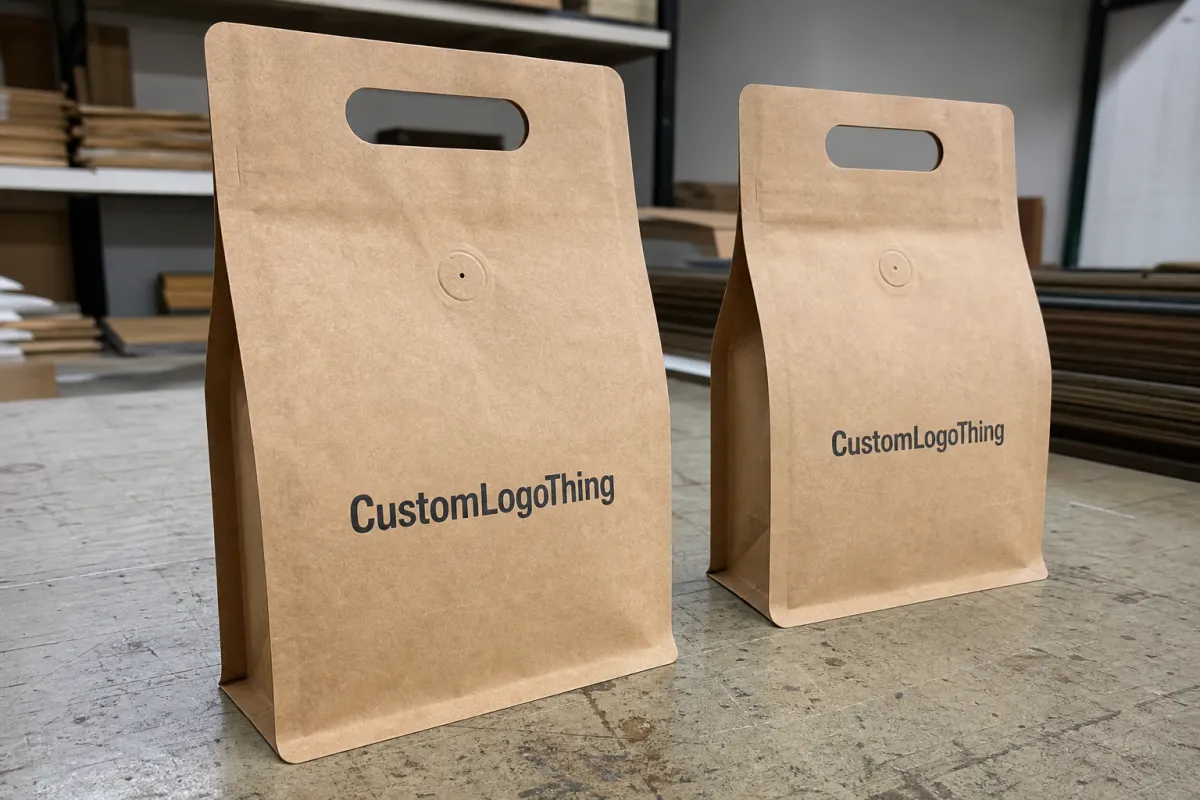
Buying in bulk changes the economics, but it also changes the risk profile. In a short run, a slight color shift, a valve that sits a few millimeters off-center, or a seal that feels a little soft may not be a major issue. In a larger run, those same problems repeat across every unit and become expensive to correct. A Custom Coffee Paper Bags bulk order should be handled as a controlled production program, not a one-off purchase that happens to be bigger.
The main cost benefit is familiar: setup charges, tooling, plate costs, and press time are spread over more units, which usually lowers the per-bag price. The less obvious benefit is order stability. Once the dieline, artwork, and material stack are approved, reorders are faster and cleaner because the most common questions have already been resolved. That matters for roasters with multiple roast profiles, seasonal blends, or private-label work that needs the same packaging language across several SKUs.
There is also a practical sales effect. Customers may not know how to read barrier specs, but they can tell when a bag feels sturdy, closes properly, and reaches them in good condition. Retail buyers notice the same things. A bag that slumps on the shelf, scuffs easily, or arrives with split seams undermines the product before the coffee is even tasted. Good packaging is quiet, which is exactly what it should be.
“The right coffee bag has to do three jobs at once: protect the product, move efficiently through filling and shipping, and present the brand without fuss.”
That standard keeps the discussion grounded. A bulk order should be judged by performance first and appearance second, not the other way around.
Paper Construction, Liners, and Barrier Options
Paper alone does not protect coffee well enough for most retail or wholesale programs. The outer layer gives the look and feel, but the inner structure carries the barrier performance. Buyers usually end up choosing between kraft paper, coated paper, or a paper-based laminate that includes a functional liner. Each has a different tradeoff between appearance, cost, print quality, and protection.
Kraft paper gives a natural, matte look that fits minimalist branding and origin-forward coffee programs. It can be a strong choice when the pack is meant to feel earthy and straightforward. Coated paper offers a smoother print surface, which helps with tight typography, dark solids, and clean color blocking. Laminated paper structures go further by adding stronger moisture and oxygen resistance, which is useful when shelf life needs to be more predictable or when the coffee will move through a long distribution chain.
The barrier question matters because coffee is sensitive to oxygen and humidity. If the oxygen transmission rate or moisture vapor transmission rate is too high, the bag can look correct and still underperform. That risk increases in warm storage, humid climates, and longer retail cycles. Not every brand needs the highest barrier available, but every brand does need a barrier that matches the actual market and turnover speed.
One-way degassing valves are common for coffee packed soon after roasting. They allow gas to escape without letting outside air rush back in. That keeps the bag from swelling and reduces stress on the seams. On a production line, a valve also helps the bag fill more predictably because the structure stays neater during packing. For the customer, it signals that the coffee was packed fresh rather than sitting in a plain pouch with no functional protection.
Bag style matters too. Flat bottom bags offer strong shelf presence and stack well in retail displays. Stand-up pouches are efficient for most specialty coffee programs because they present branding cleanly and store well in cartons. Gusseted bags can be a practical option for warehouse efficiency, though they do not always give the same front-facing impact. Windowed formats help shoppers see the product, but the window reduces print area and can complicate barrier planning. That tradeoff should be made deliberately, not by default.
| Build | Best Use | Typical Cost Impact on 5,000 Units | Operational Notes |
|---|---|---|---|
| Kraft paper with PE liner | Shorter shelf life, straightforward branding | Baseline to +$0.02 per unit | Accessible entry point, moderate barrier, easy to spec |
| Coated paper with metallized liner | Retail packaging with stronger freshness protection | +$.03 to +$0.07 per unit | Better print surface, stronger aroma retention, slightly tighter process control |
| Laminated paper with high-barrier film | Premium coffee bags with longer shelf-life expectations | +$.06 to +$0.12 per unit | Best protection, more setup sensitivity, higher material cost |
Those figures are only useful as a working range. Actual pricing shifts with bag size, print count, region, freight, and whether the order includes a zipper, valve, or special finish. Buyers who need documentation for material claims should ask for available support such as FSC chain-of-custody references for paper sourcing where applicable. For shipment stress, ISTA-style transit testing is one of the cleaner ways to check whether the pack survives vibration, stacking, and drop handling before the order is fully committed.
Size, Closure, and Print Specs That Keep Filling Fast
Size affects more than appearance. If the bag is too small, the fill can stress the seal and make the pack look overstuffed. If it is too large, the headspace becomes awkward and the bag can look underfilled even when the weight is correct. The right fit depends on roast density, bean type, and whether the product is whole bean, ground coffee, or a flavored blend that needs a little more room.
For most buyers, the starting sizes are familiar:
- 8 oz: good for sampler packs, seasonal releases, and gift programs.
- 12 oz: common for specialty retail coffee.
- 1 lb: practical for core SKUs and wholesale coffee.
- 2 lb: useful for cafes, foodservice, and repeat customers.
Closure choice should match how the bag is sold and handled. Heat seal is the cleanest and most reliable option for freshness and cost control, especially for wholesale shipments. Zippers add consumer convenience and can raise perceived value, but they introduce another component and another point to check during production. Tin ties are familiar and easy to open, yet they are not the strongest choice if shelf life is the priority. Tear notches look minor, but they affect opening behavior and reduce the chance that customers damage the bag while trying to get into it.
Print specifications deserve the same level of attention. Large solids, metallic inks, and special coatings can slow the run or increase waste if the artwork does not respect the printable area. Logos should stay inside the safe zone, barcodes need to be readable at the chosen size, and ingredient text should be checked against the actual dieline, not just a mockup on screen. If a bag carries roast notes, origin information, recycling marks, or regulatory copy, those elements need to be placed before approval, not fixed afterward.
Sampling is not a formality. A flat sample or pre-production proof is the easiest way to catch problems with headspace, panel alignment, zipper placement, and overall fit. A bag that looks fine in a digital proof can behave very differently once paper grain, laminate stiffness, and seal lines are all in play.
Cost, Pricing, MOQ, and Quote Drivers
A Custom Coffee Paper Bags bulk order should be quoted by structure, not by rough estimate. The main drivers are size, paper and liner combination, valve, zipper, finish, print colors, and order quantity. A plain kraft bag with one-color print prices very differently from a laminated pouch with a soft-touch finish, a valve, and a zipper. That sounds obvious, but quote sheets often hide those details unless the buyer asks for them line by line.
Minimum order quantity usually rises as the build becomes more complex. Simpler bags can sometimes be produced in smaller batches, while a specialized structure with added features may need a larger run to be efficient on press. Higher quantities usually bring down the unit rate because the fixed setup cost is spread across more bags. That is why a 10,000-piece order can occasionally cost less per unit than a 5,000-piece order, even though the total invoice is larger.
Buyers get the best comparison when they request a clear breakdown:
- Tooling or plate setup: one-time charges that should be visible before approval.
- Printing: ink count, finish, and any special process that changes the run.
- Material stack: paper type, liner, valve, zipper, or window construction.
- Freight: shipping can move landed cost more than expected.
- Sampling: samples and proofing should be identified separately.
The useful number is landed cost per packed pound, not just the bag price. A lower quote that creates more waste, slows the line, or produces more complaints is not actually cheaper. Coffee packaging has to hold up in a real operation, and the price should reflect that. In practice, custom coffee paper bags Bulk Order Pricing behaves more like a supply-chain choice than a simple print job.
When comparing quotes, it helps to ask what changes if the quantity doubles and which feature actually drives the jump. A supplier that can explain the pricing clearly is easier to work with than one that only offers a bottom-line number.
Production Steps and Lead Time From Proof to Shipment
The path from inquiry to shipment should be mapped before artwork is approved. A clean workflow usually starts with size, structure, closure, quantity, and print count. After that come artwork review, proofing, sample confirmation, production, quality checks, and packing. If any of those steps is vague, the schedule slips. If the buyer and supplier are both clear on the sequence, the order usually moves faster and with fewer surprises.
For a standard run, lead time often falls into three stages. Prepress and proofing can take 1 to 3 business days when the files are complete. Production often takes 10 to 15 business days after approval for a straightforward order. Freight is separate and depends on destination, carton count, and the chosen shipping method. More complex structures, special finishes, or new tooling can extend the schedule. That is normal and should be planned for early.
The biggest delays are usually avoidable. Late artwork changes, missing barcode files, unclear closure requirements, and back-and-forth over the dieline can add days very quickly. If the program involves multiple roasts, different languages, or region-specific labeling, those details should be gathered before the first proof. Each round trip between buyer and supplier adds time, and it rarely improves the result.
“A proof is not just a picture. It is the production instruction, the measurement reference, and the approval record in one file.”
That approach reduces reprints and helps the production team work from a stable target. If the artwork is signed off against the actual material, the fill line, and the closure location, the final bag is much less likely to surprise anyone. For brands working around launch dates, that predictability often matters more than chasing the lowest possible quote.
Quality Control, Food Safety, and Reorder Consistency
Good packaging can fail quietly when QC is weak. The checks that matter most are seal strength, print registration, pouch shape, drop resistance, and color consistency from lot to lot. A bag can look acceptable on a desk and still perform poorly after transport or warehouse handling. That is why inspection checkpoints and production records matter just as much as the material spec.
Food-contact compliance should be part of the conversation from the beginning. Not every buyer needs the same paperwork, but every buyer needs traceability. Retail accounts, wholesale partners, and private-label programs may ask about materials, inks, and batch records. A converter that can provide organized documentation is easier to manage than one that treats paperwork as a last-minute favor.
Repeat orders are where a lot of weak suppliers slip. The second run should match the first in size, color, barrier, and print placement. A minor change in paper tone or seal finish can make one coffee line look different from another, especially when multiple origin coffees sit side by side. If a brand sells several SKUs at once, consistent packaging protects the line from looking fragmented.
For transit performance, ISTA-style drop and vibration testing is one of the best ways to catch issues before a launch. For closure and seal verification, standard heat-seal and peel tests can show whether the bag will hold up under normal handling. None of that replaces a physical sample review. It supports it.
Controlled production is better than ad hoc sourcing because it turns packaging into a repeatable asset. Once a bag has been approved, that approved version should become the reference for future runs. That is how brands keep the packaging reliable, even when order volume changes or the team changes hands.
Why Coffee Brands Reorder From a Packaging Partner
Coffee brands do not usually reorder because the bag was decorative. They reorder because the result was repeatable. The same structure. The same print behavior. The same delivery window. That consistency is what turns packaging from a one-time purchase into part of the operating system.
A good partner also stores the information that matters later. Approved samples, dielines, spec sheets, color references, and closure notes should be easy to find so the next reorder does not start from zero. That matters when a team changes, a seasonal blend launches quickly, or a wholesale account asks for a small variation. In practice, archived specs can save more time than a discount ever will.
Responsiveness matters too. When retail calendars move or a roast sells faster than expected, the packaging schedule has to keep up. Many roasters who already manage Custom Packaging Products or custom printed boxes prefer a single packaging relationship because it keeps the specifications aligned across formats. The benefit is not just convenience. It reduces the chance that different vendors interpret the same brand differently.
For recurring programs, Wholesale Programs are often the cleaner route because they make it easier to standardize sizes, print counts, and reorder quantities across multiple SKUs. If you are working through early questions, the FAQ page can help narrow the basic spec before the quote request is built.
Packaging is a supply-chain decision with branding attached, not a branding decision with supply-chain issues attached. That distinction matters. The best coffee bags support margin, shelf readiness, customer trust, and repeat ordering without creating extra work for the filling line or the warehouse.
What to Send for a Fast Quote and Clean Approval
If you want an accurate quote, send the spec rather than a rough idea. The supplier needs pack size, fill weight, bag style, print count, closure type, and target quantity before any number means much. If the order includes multiple roast profiles or seasonal versions, list each SKU separately so MOQ and pricing stay clear.
Artwork should go with the request. Provide logo files, Pantone references, barcode artwork, ingredient text, and any compliance notes. If the bag needs a matte finish, a window panel, or a valve in a specific position, say so early. A quote built from incomplete information is usually the wrong quote, even if it looks attractive at first glance.
Before approval, ask for three things:
- A sample or flat proof that shows the final layout and structure.
- A written spec sheet with dimensions, material stack, and closure details.
- A realistic delivery window that separates proofing, production, and freight.
That checklist keeps the discussion factual and helps the order move downstream without a lot of correction work. If the supplier can confirm structure, cost tier, and timeline in writing, the job is much easier to manage.
For any brand planning a custom coffee Paper Bags Bulk order, the best starting point is a locked spec sheet, clean artwork, and one clear approval path. That is what makes the packaging easier to price, easier to reorder, and easier to keep consistent over time.
What MOQ should I expect for custom coffee paper bags bulk order projects?
MOQ depends on size, print complexity, and whether the bag includes a valve, zipper, or special finish. Simpler constructions can often run at lower minimums, while more complex builds usually need higher volume to stay efficient. If you have multiple SKUs, ask for MOQ by SKU rather than assuming the whole order shares one threshold.
Can a custom coffee paper bags bulk order include a one-way valve and zipper?
Yes. Many coffee bags are built with both features when freshness and consumer convenience matter. The extra components can affect cost and lead time, so they should be included in the first quote request. If shelf life is a priority, ask for barrier and seal guidance at the same time.
Which size works best for 12 oz, 1 lb, and 2 lb coffee bags?
The right size depends on roast density, bean type, and whether the bag uses a zipper or valve. A spec sheet should confirm fill weight, headspace, and finished dimensions before artwork is approved. A sample or dieline is the safest way to avoid overfilled bags and weak seals.
How long does a custom coffee paper bags bulk order usually take?
Lead time depends on artwork approval, material availability, and the production schedule. Clean files and fast proof approval shorten the timeline more than almost any other factor. Add extra time if the job needs new tooling, a new structure, or a complex finish.
What should I send to get an accurate coffee bag quote?
Send pack size, quantity, bag style, print colors, closure type, and any barrier or valve requirements. Include artwork files and notes on whether the bags are for retail, wholesale, or direct-to-consumer use. For a clean comparison, ask the supplier to itemize tooling, freight, and sample costs separately.
A well-built coffee package is easiest to manage when the specification is clear from the start. That is what keeps the order repeatable, the cost understandable, and the reorder process steady.

