For winter apparel brands, Custom Cuffed Beanies are attractive because they combine broad fit, visible branding, and manageable production cost. The actual quote depends on cuff height, yarn choice, decoration method, packaging, and how much risk the first run carries. If the beanie is part of a larger assortment, the Wholesale Programs and Custom Packaging Products pages help show how it fits into a broader line.
Why cuffed beanies outperform many winter add-ons
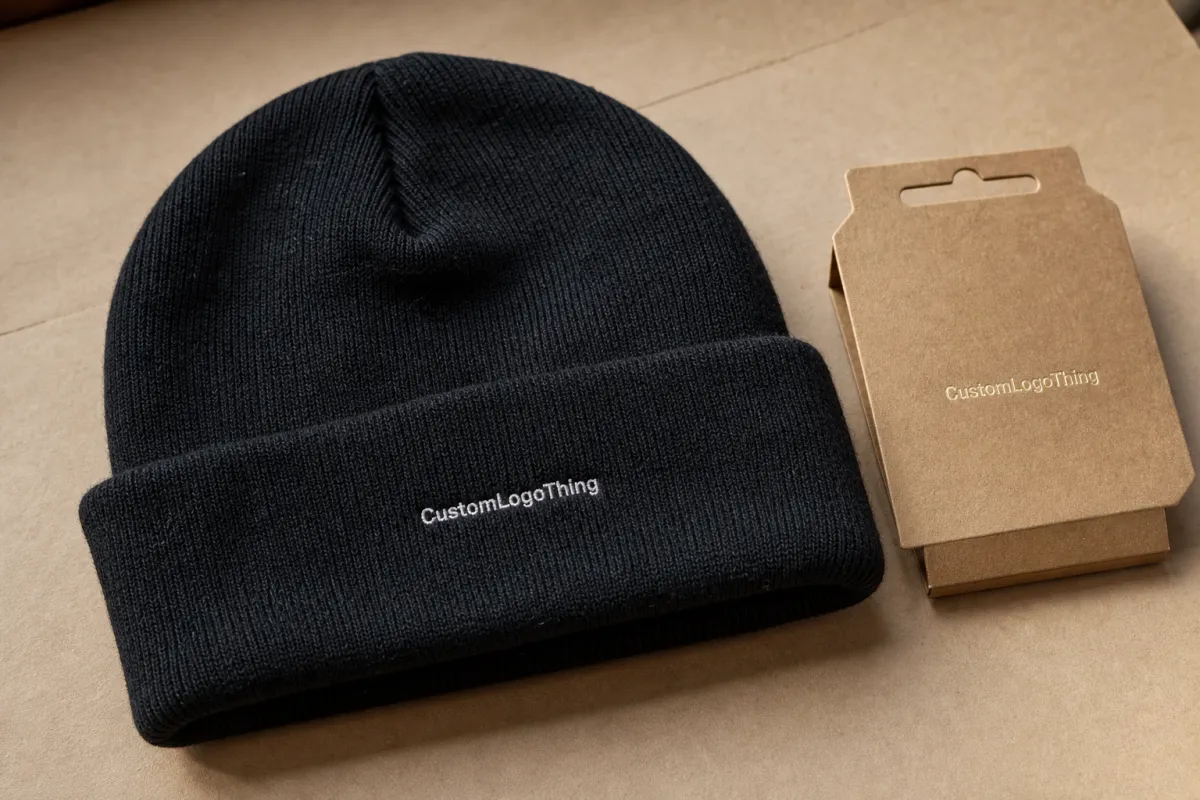
Cuffed beanies outperform many seasonal accessories because they are easy to size, easy to brand, and easy to reorder. They avoid the fit complexity of gloves or scarves and still give buyers a large, readable decoration area.
They also work across channels. A beanie can sell as an impulse item, a bundle add-on, or a core wholesale staple. That flexibility is why Custom Cuffed Beanies Wholesale Pricing for winter apparel brands often stays within a range that supports repeat orders.
The lowest quote can become the most expensive one if the beanie stretches out, pills early, or carries a decoration that cracks or flattens after a few wears.
The practical test is simple: the product needs to look good, hold shape, and arrive on time. If it misses any one of those, savings can disappear into markdowns or replacement stock.
Style choices that affect fit, feel, and sell-through
The best cuffed beanies look simple only after several decisions have already been made. Cuff height changes the proportion, crown depth affects fit, and stretch recovery determines whether the hat snaps back or starts to look tired.
Decoration changes the economics as much as the look. Flat embroidery is durable and familiar. Woven patches handle detail better. Woven labels and sewn tags work well when the brand wants a quieter finish. Each option changes labor, setup, and finishing cost.
| Decoration option | Typical cost effect | Best use case | Buyer takeaway |
|---|---|---|---|
| Flat embroidery | Often adds $0.35-$1.20 per unit | Simple logos, premium retail | Durable and clean, but best with restrained artwork |
| Woven patch | Often adds $0.45-$1.40 per unit | Detail-heavy artwork, sharper contrast | Useful when the logo needs more definition at a distance |
| Woven label or sewn tag | Often adds $0.20-$0.75 per unit | Minimalist branding, larger runs | Efficient for brands that want a quieter finish |
Color choice affects sell-through too. Black, charcoal, navy, and oatmeal tend to move well because they work across many assortments. Bright colors can work, but they usually suit limited drops or campaign-specific releases.
Sample review should be strict. Check cuff proportion, seam behavior, stitch density, and how the logo behaves when the knit is stretched. A sample that looks fine on a table can reveal a warped logo or loose cuff once it is worn.
Material, stitch, and decoration specifications to confirm
Before approving a style, ask for the full spec set, not just the headline quote. Yarn type, knit gauge, cuff construction, measurement tolerance, packaging format, and logo placement all affect the final result.
Acrylic remains common because it is affordable, warm enough for most markets, and consistent to knit at scale. Blends can improve softness or recovery, but they can also change cost and color behavior.
Knit density deserves attention because it affects both shape retention and decoration quality. Tighter knits usually support cleaner embroidery. Looser knits can feel softer, but they are more likely to distort the logo.
Decoration placement needs measurement, not guesswork. A folded cuff changes the visible logo area, and stretch-fit construction can enlarge or compress artwork once worn. If the artwork is detailed, request a pre-production proof or a matching production reference.
If the order includes hang tags or inserts, specify paper stock early. For brands that care about responsible sourcing, an FSC-certified paper supplier can keep packaging aligned with the rest of the program. If the beanies are packed for parcel shipment, transit testing aligned with ISTA standards can help catch crushed packaging or loose fold issues before freight leaves the dock.
Custom cuffed beanies wholesale pricing, MOQ, and unit cost drivers
Custom Cuffed Beanies Wholesale Pricing for winter apparel brands comes down to a short list of variables: quantity, decoration method, yarn choice, packaging, sampling, and the number of colorways in the run. Two quotes can look similar and still land far apart once those pieces are compared line by line.
MOQ is the first lever. Smaller orders absorb setup costs less efficiently, so the per-piece price is usually higher. Larger runs spread those costs out and often improve labor efficiency.
Tiered pricing is the easiest way to compare offers. Ask for pricing at 300, 500, 1,000, and 3,000 units if possible. That shows the real breakpoints and helps decide whether a test order or a replenishment order makes more sense.
Typical wholesale pricing for a basic acrylic cuffed beanie with simple embroidery often sits around $2.20 to $4.50 per unit at moderate volume. More complex decoration, heavier yarn, specialty labels, or custom packaging can push the same style into the $4.50 to $7.00 range or higher. Freight, duties, and packaging can change the landed number again, so the useful comparison is total cost to your warehouse.
| Quote element | Why it matters | Buyer check |
|---|---|---|
| Unit price | Defines the base margin | Confirm which quantity tier it assumes |
| Setup or sample fee | Hits small runs hardest | Ask whether it is credited on production |
| Packaging and labeling | Changes retail presentation and labor | Check whether tags, sleeves, and cartons are included |
| Freight | Can erase a low headline quote | Compare landed cost, not only ex-factory price |
Packaging deserves the same scrutiny as decoration. Folded retail bags, barcodes, size stickers, and custom printed boxes for gift sets add cost, but they can also support a higher shelf price. If the beanie is a boutique item, presentation may justify the expense. If it is a promo item or a high-volume basic, a simpler pack-out protects margin.
Production process and lead time from approval to delivery
The production flow is usually predictable: quote review, artwork confirmation, sample or mockup approval, production scheduling, knitting, decoration, finishing, inspection, and shipping. Problems usually show up before the goods are packed, not after.
Lead time depends on a few hard constraints. Yarn availability can tighten or loosen a schedule. Proof approval can stall if files are incomplete. Packaging can add days or weeks if the order includes custom printed cartons, sleeves, or hang tags.
For most winter programs, a standard production window of 20 to 35 days after approval is common, with longer timelines for highly customized runs or busy seasonal periods. Sampling can add one to two weeks depending on how many revisions are needed.
Rush production is possible, but it usually trades away options. The yarn palette may narrow, decoration may need to simplify, and custom packaging may need to be replaced with a standard pack-out. Brands that understand that trade-off make better decisions under pressure.
What separates a reliable wholesale supplier from a cheap quote
A cheap quote is easy to produce. A reliable one takes more work. The difference shows up in the questions a supplier asks before production starts. If they want cuff height, artwork size, yarn shade, pack-out format, and delivery timing, they are usually trying to reduce error before it becomes expensive.
Consistency matters because winter brands often reorder their strongest styles. If the second run drifts in color, stitch density, or label placement, the line starts to look uneven.
Good suppliers also communicate clearly when there is a problem. If a yarn lot shifts slightly, they say so. If a patch needs a size adjustment, they show the proof. If packaging needs revision, they explain the effect on cost and timing.
That is why buyers should compare performance history alongside price. Sample response time, proof quality, and wholesale terms all signal how a vendor will behave once the order is live. For recurring production, case studies and process details are often more useful than a polished sales sheet. See our Case Studies for examples of how brands evaluate fit, finish, and turnaround under real order pressure.
What to send for a fast quote and cleaner first order
The fastest way to get a useful quote is to send a complete brief. Include quantity, preferred decoration, color count, packaging requirements, delivery target, and reference images or an existing sample. A vague request usually gets a vague answer.
It also helps to state the sales channel. A beanie for e-commerce may need different packaging than one sold through boutiques or used in promotional bundles. That affects the pack-out, labeling, and how much attention should go into presentation.
Set substitution rules before sourcing begins. If a specific yarn shade is unavailable, is a close alternative acceptable? If custom printed boxes delay the schedule, is a branded sleeve enough? Decisions like that remove friction later and keep the order moving.
Before approving, review the quote line by line. Check the unit cost, MOQ, sample policy, production timing, and whether freight is included. Ask whether artwork changes after approval create a new setup fee, whether sample costs are credited on production, and whether the supplier can hold repeat pricing for replenishment.
The cleanest first order usually follows a simple sequence: send a complete spec sheet, request tiered pricing, confirm the timeline, and approve the sample only after the fit and decoration have been checked in hand. That approach is practical because it reduces unknowns before the order scales.
What affects custom cuffed beanies wholesale pricing the most?
Quantity has the largest effect because setup costs spread out as volume rises. Decoration method, yarn type, packaging, and the number of colorways can also move the price quickly.
How high is the MOQ for custom cuffed beanies wholesale orders?
MOQ varies by material and decoration complexity. Simpler builds often start lower than highly customized runs, so it helps to ask for tiered MOQ options instead of one fixed number.
How long does wholesale production usually take for cuffed beanies?
Lead time depends on sample approval speed, yarn availability, packaging, and the production queue. A straightforward order can move faster than a fully custom one.
Which decoration looks best for winter apparel brands on cuffed beanies?
Embroidery is a common choice for a durable, premium look. Woven patches and label applications also work well when the logo needs more detail or the brand wants a more restrained finish.
What should I include in a quote request for bulk cuffed beanies?
Share quantity, preferred color, logo file, placement, packaging needs, and delivery deadline. Add sample references if you have them so Pricing, Lead Time, and finish options are easier to compare.
For winter apparel brands, the right decision balances price, fit, decoration quality, and inventory risk. That is the real job behind custom Cuffed Beanies Wholesale Pricing for winter apparel brands: choosing a product that sells cleanly, arrives on time, and supports the rest of the line.

