Buyer Fit Snapshot
| Best fit | Custom Die Cutting Service for Boxes projects where brand print, material claims, artwork control, MOQ, and repeat-order consistency need to be specified before quoting. |
|---|---|
| Quote inputs | Share finished size, material target, print colors, finish, packing count, annual reorder estimate, ship-to region, and any compliance wording. |
| Proofing check | Approve dieline scale, logo placement, barcode or warning zones, color tolerance, closure strength, and carton packing before bulk production. |
| Main risk | Vague material claims, crowded artwork, missing packing details, or unclear freight terms can make a low unit price expensive after revisions. |
Fast answer: Custom Die Cutting Service for Boxes: Board, Finish, Dieline, and Unit Cost should be specified like a repeatable production item. The safest quote records material, print method, finish, artwork proof, packing count, and reorder notes in one written spec.
Production checks before approval
Compare the actual filled-product size with the drawing, then confirm tolerance on folds, seals, hang holes, label areas, and retail display edges. Reserve space for logos, QR codes, warning copy, and material claims before decorative graphics fill the panel.
Quote comparison points
Review material grade, print process, finish, sampling route, tooling charges, carton quantity, and freight assumptions side by side. A quote is only useful when the supplier can repeat the same color, closure quality, and packing count on the next order.
Custom Die Cutting Service for Boxes: What to Know
When a carton is off by just a few millimeters, the whole package can start working against itself: corners crush, inserts shift, and a product that was supposed to feel secure ends up sliding around as if the box were built for something else entirely. I have seen that happen on a packing table more than once, and it is usually the moment people realize that structure matters just as much as graphics. That is where a Custom Die Cutting service for boxes earns its keep, because the job is not only to create a shape, but to make sure the shape actually behaves the way the product needs it to once it reaches packing, shipping, and the customer’s hands.
From a packaging buyer’s point of view, a nice-looking mockup is only the beginning. The carton still has to live through board thickness variation, score memory, transit vibration, humidity, and the kind of repetitive handling that happens on a busy line. A Custom Die Cutting service for boxes turns a flat idea into a repeatable structure, and repeatability is what keeps product packaging from turning into waste, rework, and avoidable complaints. A box that works once is a sample; a box that works every time is the one you can actually build a program around.
Die cutting is easy to describe and harder to do well. A Custom Die Cutting service for boxes manages the die cutting lines, the score depth, the perforations, the windows, the locking tabs, and the way a board folds under pressure. That gives packaging teams the freedom to build retail packaging, e-commerce shipping cartons, subscription kits, and high-end branded packaging that feels deliberate the moment someone opens it. When the structure is right, the box does half the selling before the insert card even gets read.
The conversation also reaches far beyond the outline of the box. A custom die cutting service for boxes affects material usage, press efficiency, graphic alignment, pack-out labor, and the unboxing experience, which is why it belongs near the start of packaging design. Waiting until the artwork is finished usually means the structure has to catch up later, and that is where problems tend to multiply. If the dieline is treated as an afterthought, the project usually pays for it in time, scrap, or both.
Custom die cutting service for boxes: why fit beats guesswork
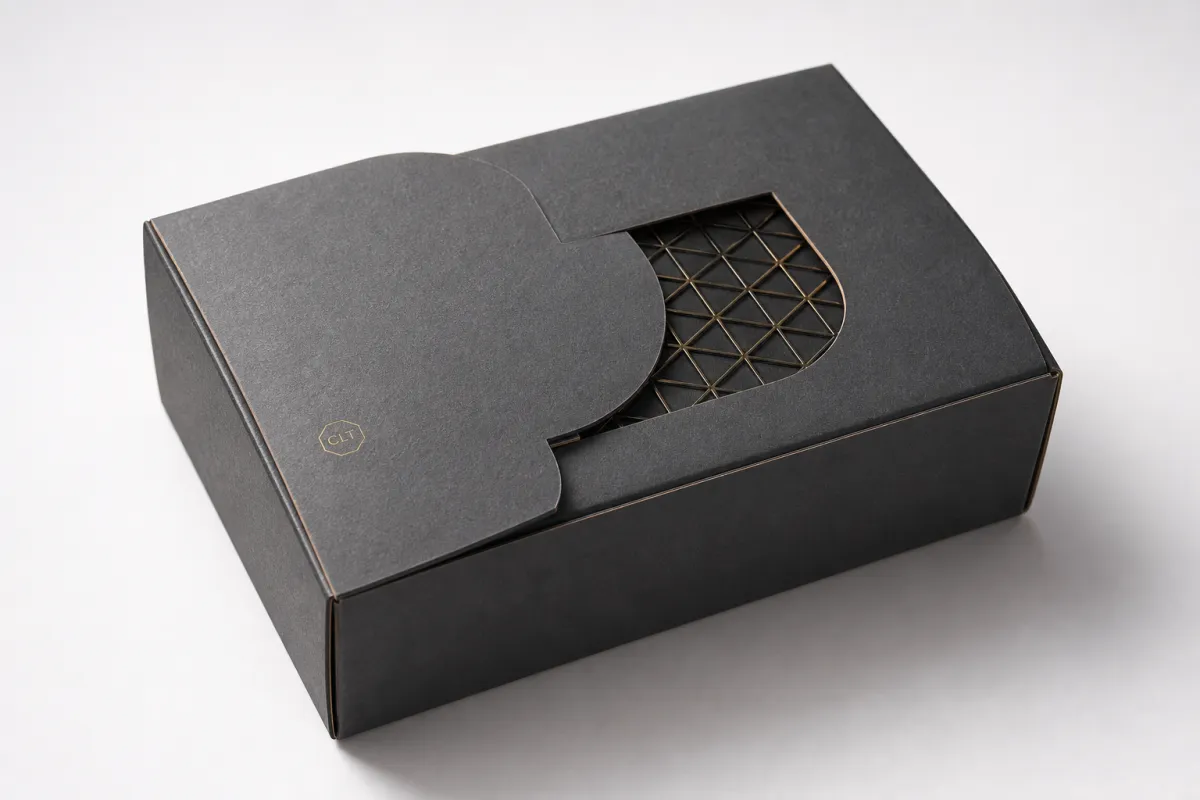
A custom die cutting service for boxes starts with a simple truth: a carton can look perfect in a drawing and still fail at the bench if the measurements ignore how board behaves in production. A 200 mm panel in CAD is not the same thing as a 200 mm panel after scoring, folding, gluing, shipping, and stacking. That difference is where guesswork breaks down and real manufacturing begins. Even a small change in board caliper can alter the way a flap closes, so a dimension that seems fine on-screen can feel kinda wrong in the hand.
The die itself is usually a steel-rule die, built with cutting rules, scoring rules, and often dedicated features for perforation or window removal, all mounted in plywood or composite board. The steel rule cuts the sheet, the score rule creates the fold line, and the layout controls how the blank releases from the press. A custom die cutting service for boxes makes those operations repeatable, which matters when the box has to close cleanly every time instead of only once in a sample room. The better the die construction, the less the line has to fight the material later.
For fragile goods, fit is more than a convenience. A custom die cutting service for boxes can reduce movement inside the carton, which lowers abrasion, corner wear, and product damage during transit. For shelf-facing items, a crisp cut and clean score help the panels meet tightly at the seam, which gives the package a more deliberate look. For pack lines, a structure that opens, folds, and locks the same way each time can save seconds per unit, and those seconds become labor cost quickly. That is the sort of small efficiency that is easy to miss in the quote and hard to ignore on the floor.
I keep seeing the same pattern: the artwork gets the attention first, and the structure gets asked to catch up later. A custom die cutting service for boxes works best when it sits in the same conversation as board grade, closure method, and shipping method. If the carton is meant to hold a fragile jar, a display piece, or a set with an insert tray, the die layout should be built around that use from the start. Once the product, the opening motion, and the transit path are clear, the rest is a lot less guessy.
In real production, a custom die cutting service for boxes is the bridge between visual intent and manufacturing reality. A window can show the product, a tuck flap can speed up assembly, and a locking bottom can improve stack strength, but each of those choices changes the cut path and the score behavior. That is why experienced packaging teams treat die cutting as a structural decision, not just a fabrication step. The structure is doing work whether anyone notices it or not.
A clean dieline is not just a technical file. It is the point where branding, shipping performance, and pack-line efficiency all have to agree.
How a custom die cutting service for boxes works
The flow is usually straightforward, even when the details get technical. A custom die cutting service for boxes often begins with a review of the dieline, whether that file comes from the brand, the designer, or the converter. The layout is checked for size, score placement, tab geometry, bleed, and any structural areas where print and construction might collide. Once that is cleaned up, the toolmaker can build the die board and prepare a first sample cut. That first pass is where the practical questions start answering themselves.
That sample matters more than most people expect. A custom die cutting service for boxes should uncover problems early, not after thousands of sheets are already committed to the press. During sample review, the team checks fold direction, closure tension, product clearance, and whether the carton locks without tearing. If the box includes an insert tray or nested parts, the fit gets checked again with the actual product in place instead of a dummy block. I have watched a carton that looked perfect in a PDF fail because the closure tab was just a hair too stiff; that is exactly the sort of thing the sample is there to catch.
Behind the scenes, the process is driven by CAD files, registration marks, nesting logic, and fold lines tuned to the board caliper. CAD tells the cutter where the blank begins and ends, and it also helps manage waste and press efficiency. Nesting determines how many blanks fit on the sheet, while registration marks keep print and cutting aligned. A custom die cutting service for boxes that ignores those controls is inviting drift, waste, and a longer approval cycle. If the print and the cut do not agree, the whole job gets fussy very quickly.
Common cutting setups include flatbed cutting, rotary cutting, and hybrid systems. Flatbed cutting is flexible and works well for intricate shapes, windows, and short to medium runs. Rotary cutting is built for high-volume repetition because it moves quickly and keeps dimensions tight once the tooling is dialed in. Hybrid setups appear when a custom die cutting service for boxes needs both detail and throughput, such as a folding carton with a complex locking feature and a larger run size. In practice, the “best” system is the one that matches the geometry and the run length instead of forcing one process to do everything.
The converter also needs solid input before the die is built. If you are requesting a custom die cutting service for boxes, send the final box dimensions, board grade, product weight, insert requirement, print layout, finishing plan, and packing method. If the carton ships flat, ships pre-glued, or needs to run on an automated pack line, say that up front. Those details influence the cut and score layout, and they can save a round of changes that nobody wants later. A few extra lines in the brief can spare a whole week of rework.
- Final size: outside dimensions, inside clearance, and any tolerance that matters for the product.
- Material: corrugated flute, paperboard caliper, or specialty stock for premium retail packaging.
- Product data: weight, fragility, and whether the item has sharp edges or pressure points.
- Decoration: print coverage, foil, embossing, window film, or other finishing that affects layout.
- Operations: hand assembly, machine insertion, shipping format, and pallet pattern.
For shipping performance, it helps to compare the structure against recognized transit testing methods. The packaging industry often uses ISTA test procedures to evaluate parcel and distribution durability, and those tests give far better feedback than a vague promise that the box should hold up. If the cartons are part of a fiber-sourcing program, FSC is the reference many brands use for responsible forest material claims.
A custom die cutting service for boxes is most useful when the file, the material, and the production plan all speak the same language. That is the difference between a one-off sample and a structure that can actually be produced at scale without surprise costs.
Key factors that affect box structure, fit, and durability
Material choice is the first big variable in a custom die cutting service for boxes, and it changes more than most people expect. Corrugated board comes in different flute sizes, from the finer E flute to the more protective B or C flute, while paperboard comes in different calipers and surface finishes. A thinner board can give a cleaner crease for premium retail packaging, while a heavier board can deliver better crush resistance and stack strength. The right choice depends on whether the box sits on a shelf, moves through parcel networks, or protects a product in bulk shipping. There is no single “best” board; there is only the board that matches the job honestly.
Grain direction matters too. A custom die cutting service for boxes needs to account for how the paper fibers run, because folds across the grain behave differently from folds with the grain. If the score fights the grain, the carton may crack, spring open, or refuse to fold neatly. That can become a real problem for custom printed boxes that need sharp visual edges and a tight, premium closure. It is one of those details that sounds small until the first sample starts splitting at the corner.
Then there is the geometry of the cut itself. Scoring depth, cut pressure, and tolerance control all matter, especially when the carton includes tabs, tuck flaps, thumb notches, locking bottoms, or insert pockets. A custom die cutting service for boxes should leave enough room for the material to flex without leaving the score too weak. If the pressure is too high, the fibers can crush; if it is too light, the fold line resists and the carton fights back during assembly. The press has to be tuned to the board, not the other way around.
End use changes the spec dramatically. E-commerce boxes need shipping strength and predictable closure, while shelf-facing retail packaging needs presentation, fast setup, and graphic alignment. Subscription packaging often lands in the middle, where the box needs enough structure to protect the contents but still has to feel polished at opening. A custom die cutting service for boxes should reflect that use case, not only the outer dimensions. You are not just sizing a container; you are sizing a workflow and a customer moment.
Environmental handling matters as well. Humidity can soften certain boards, stacking weight can deform a weak panel, and transit vibration can loosen a closure that looked fine in the sample room. If a box is going to be opened and closed more than once, the score has to survive repeated handling. A custom die cutting service for boxes that ignores those real conditions may produce a carton that looks good at approval and fails after the first distribution cycle. That is the kind of failure that shows up as complaints, returns, or both.
For a practical benchmark, many buyers rely on a mix of ASTM methods and internal handling tests before they sign off on a structure. The exact standard depends on the channel and the product, but the point stays the same: visual fit is not enough. A custom die cutting service for boxes should be judged by how it performs under pressure, not only by how it photographs. A carton that passes the eye test but fails the drop test is still a bad carton.
What to compare before locking a spec
- Board caliper: enough stiffness for the product without making folds too bulky.
- Flute or fiber structure: matched to crushing risk, print appearance, and assembly speed.
- Closure type: tuck, lock, glue, or insert-based depending on pack-line needs.
- Surface finish: coated, uncoated, soft-touch, or matte depending on presentation goals.
- Decoration options: embossing, foil, and windowing should be checked against the die layout early.
A custom die cutting service for boxes becomes much easier to control once those factors are pinned down. That is also where strong package branding starts to show up, because a cleanly cut panel, a precise window, or a crisp embossed logo can make the box feel intentional before the customer reads a single word.
Custom die cutting service for boxes: cost and pricing drivers
Pricing in a custom die cutting service for boxes usually comes down to five things: tooling complexity, setup time, material choice, finishing steps, and how much manual handling the design requires. A simple square carton with basic scores is much easier to run than a shaped folding carton with a window, an insert tray, and a specialty coating. Even when the outside dimensions are similar, the labor and tooling can be very different. That is why two quotes can look close on paper and still represent very different jobs.
Low quantities often look expensive on a per-unit basis because setup time has to be spread across fewer cartons. A custom die cutting service for boxes may involve press calibration, sample approval, plate or die preparation, and waste during the first run. If the order is small, those fixed costs land on a smaller number of units. That does not make the quote wrong; it just means the math is honest. Small runs can still be the right choice if the carton is tied to a launch, a seasonal test, or a premium presentation.
Minimum order quantity, changeovers, waste rate, and rush scheduling can all move the price. A custom die cutting service for boxes that requires special board stock may also cost more because the material has to be sourced, delivered, and acclimated before production starts. If the design includes embossing, foil, or a complex print build, the converter may need additional steps that add both time and cost. That is normal. The useful question is not whether those costs exist, but where they come from. If you know the driver, you can decide whether the extra spend is actually buying something useful.
Here is a practical way to compare quotes: give each supplier the same dieline, the same board spec, the same quantity, and the same finishing details. Then ask them to quote setup, tooling, sampling, and production separately. A custom die cutting service for boxes only looks cheap when two proposals are not actually talking about the same carton. I have seen more than one “low” quote turn into a higher final bill once the hidden setup work showed up.
| Cutting option | Best for | Typical tooling/setup | Illustrative unit cost at 5,000 pieces | Notes |
|---|---|---|---|---|
| Flatbed die cutting | Short runs, intricate shapes, window cartons, prototypes | $150-$500 | $0.18-$0.40 | Flexible and detail-friendly, with more hands-on setup. |
| Rotary die cutting | Higher-volume cartons with repetitive geometry | $400-$1,200 | $0.12-$0.28 | Fast once set, but less forgiving on highly complex shapes. |
| Hybrid setup | Jobs needing detail plus efficient repeat production | $250-$900 | $0.16-$0.35 | A good middle path for many custom printed boxes. |
Important callout: those ranges are only a planning tool. A custom die cutting service for boxes can move outside them if the board is specialty, the print coverage is heavy, the tolerances are tight, or the run requires extra handling. A $0.20 difference per unit sounds small until it reaches 50,000 cartons, so the real comparison should include labor, freight damage, and how efficiently the carton fits the product.
Cheap tooling is not always cheap packaging. If the structure needs a second sample, a board change, or a handwork fix, the savings disappear quickly.
If you are comparing suppliers, it helps to look beyond the quote and into the production ecosystem. The team behind Custom Packaging Products can help narrow the right carton family, while Manufacturing Capabilities gives you a better sense of what the line can handle before a spec is approved. That matters because a custom die cutting service for boxes should fit the plant as well as the product.
Process and turnaround: from dieline to finished boxes
A custom die cutting service for boxes usually moves through a predictable chain: discovery call, spec review, dieline cleanup, die build, sample cut, approval, production, inspection, and shipment. When each step is clean, the job stays orderly. When one step changes late, the schedule can shift. That is why experienced teams spend so much time on the front end. It feels slower at first, but it avoids the expensive kind of speed later.
Timeline usually expands in a few common places. A custom die cutting service for boxes can stall if the artwork changes after the first proof, if the structure needs another sample, or if a special board has to be sourced. Tool availability matters too. If the die shop is already booked, the build may wait even when the rest of the project is ready. Press scheduling, finishing queues, and freight timing also affect how long the order takes to leave the plant. Nobody loves that part, but it is real and it needs to be planned for.
For simple folding cartons, a realistic lead time is often around 10-15 business days from proof approval to shipment, assuming the material is standard and the sample approves quickly. More complex structures, specialty finishes, or larger quantities can push that to 15-25 business days or more. A custom die cutting service for boxes with custom inserts, multiple windows, or tight registration may need an extra round of sampling to get the structure and appearance right. That is not a delay in the abstract; it is the normal cost of getting the carton correct.
Planning ahead pays off during launches and seasonal peaks. If the box has to support a retail reset, a holiday rollout, or an e-commerce campaign, build in enough time for sample approval and final sign-off. A custom die cutting service for boxes is much easier to manage when the deadline is realistic. A one-week emergency rarely leaves room for thoughtful structural work, and rushed packaging usually shows stress in the folds and corners. If you have ever watched a team hand-tape a shipping fix at 5 p.m., you already know how quickly a short schedule can get expensive.
From a buyer’s point of view, the best way to protect timing is to give the converter a complete brief up front. That brief should include the final quantity, the product dimensions, the target ship date, the assembly method, and any compatibility requirements for automatic packing or fulfillment equipment. A custom die cutting service for boxes can move quickly when the first quote is based on a real spec instead of a loose idea. Clear input on day one usually beats a fast apology on day ten.
What a clean timeline usually includes
- Initial brief with exact dimensions, quantity, and product weight.
- Dieline review with score placement, tabs, and print safe zones.
- Die build and sample cut for fit and closure review.
- Approval of the physical sample, not just a PDF.
- Production run, inspection, and final shipment.
One practical habit: ask for the approved sample to be documented and retained as a reference. A custom die cutting service for boxes is easier to repeat when the agreed structure is saved alongside the print spec, board spec, and finish spec. That way, the next reorder starts from a known good carton instead of a fresh guess. It also gives you a cleaner baseline if a future revision needs to be compared against the original.
For brands working on product packaging that has to feel polished at first touch, this process matters just as much as the artwork. A box that arrives late or assembles poorly can damage the launch more than a small print adjustment ever will.
Common mistakes to avoid with custom die cutting service for boxes
The most common mistake is designing the box to exact product dimensions and forgetting that board has thickness, memory, and fold behavior. A custom die cutting service for boxes needs clearance for the material itself, plus some room for inserts, coatings, and assembly tolerance. Build the carton too tight and the product can jam on the line or crush the structure during closure. Build it too loose and the product moves around, which the customer notices immediately. That balance is easier to miss than people think, especially when the product itself is the star and the carton is treated like a container only.
Another common error is placing important artwork too close to score lines, seams, or tuck flaps. Those areas distort more than flat panels do, and they wear faster during packing and shipping. A custom die cutting service for boxes can cut beautifully and still leave the design looking off if the graphics are not planned around the structure. That is especially true for custom printed boxes with dense branding, fine type, or barcode placement near fold lines. A logo that straddles a seam can go from sharp to awkward in a hurry.
Skipping a physical sample is risky in a very ordinary, factory-floor way. A custom die cutting service for boxes can look perfect in PDF form and still fail once the real board, the real adhesive, and the real product are introduced. The sample shows whether the box stacks well, whether it closes without tearing, and whether the pack line can work at a normal rhythm. I would rather find a bad score line on a bench than after a pallet has already shipped.
Structure choice is another place where teams get tripped up. A style can look elegant and still be awkward to assemble, weak in transit, or too labor-heavy at volume. A custom die cutting service for boxes should match the reality of the operation. If workers need to fold hundreds of cartons by hand, the structure should be intuitive. If the box has to run through a machine, the design needs to respect the machine’s limits. That is where many attractive ideas get pared down into practical solutions.
It is also easy to overcomplicate a carton with too many special features. Windows, inserts, embossing, foil, tear strips, and locking flaps can each add value, but every one of them also adds a tolerance stack that has to be managed. A custom die cutting service for boxes should answer a purpose. If the feature does not improve protection, presentation, or assembly, it probably does not belong in the spec. Fancy for the sake of fancy usually becomes a maintenance problem later.
The cleanest box is not always the fanciest one. It is the one that protects the product, packs quickly, and repeats without complaint.
Here is the short version: a custom die cutting service for boxes works best when the design team, the packaging buyer, and the converter all agree on what success looks like. If those groups are not aligned, even a good die can turn into an expensive lesson. If they are aligned, the job gets simpler, faster, and a lot less frustrating.
Expert tips and next steps for better box die cutting
The simplest way to improve results is to build a one-page packaging brief before you ask for quotes. Include the product dimensions, weight, quantity, target ship date, assembly method, storage conditions, and any special handling needs. A custom die cutting service for boxes can move much faster when the first conversation is grounded in facts instead of broad ideas. The brief also gives you something concrete to compare across vendors, which makes the decision less subjective and a lot less dependent on polished sales language.
If the box is important enough to carry your brand on its own, ask for a sample or pilot run that checks fit, stackability, closure strength, and machine compatibility. A custom die cutting service for boxes should not be approved on appearance alone. If the box has to open a certain way, nest into a tray, or pass through an automated pack station, those details need to be tested before full production starts. That one step catches the kinds of issues that are annoying at sample stage and expensive at scale. The good news is that it also gives the team a shared reference point, so nobody is arguing from memory later.
Vendor comparison should include more than price. A custom die cutting service for boxes is easier to trust when the supplier communicates clearly, returns samples that are cleanly cut, and documents the approved spec for repeat orders. Tolerance control matters. So does the willingness to explain why a board choice or score adjustment is necessary. If the answers stay vague, the carton probably will too. Clear answers are not a luxury here; they are part of the service.
Packaging teams also get better results when they treat the box as part of the brand system, not just as a shipping container. A cleanly die cut panel can improve package branding; the right structural choices can support retail packaging; and the right finishing can make the box feel more like a product experience than a utility item. A custom die cutting service for boxes is the structural backbone of that experience, which is why the die should be planned alongside the print and finish, not after them. Once the structure is settled, the rest of the design has room to do its job.
Here is a practical next-step sequence that works well in real projects: gather the measurements, pick the box style, request an apples-to-apples quote, review the sample, then lock the final spec. Once that is done, repeat orders get much easier. The custom die cutting service for boxes already has a known target, which cuts down on debate and speeds the next run.
If you are balancing beauty, protection, and cost, that is the right order to follow. A custom die cutting service for boxes should help you build a carton that fits the product, supports the operation, and keeps the brand looking sharp without creating avoidable waste. The more precise the brief, the better the outcome, and the fewer surprises you will have after the first pallet arrives. Start with the product, the shipping method, and the opening experience, and the die layout gets a whole lot easier from there.
A custom die cutting service for boxes is not only a fabrication step; it is a packaging decision that shapes cost, labor, shelf appeal, and damage risk all at once. Keep the conversation tied to structure, board, sample approval, and the real production path, and the custom die cutting service for boxes becomes a practical tool instead of a source of guesswork.
What does a custom die cutting service for boxes include?
It usually includes dieline review, die board creation, sample cutting, production cutting, scoring, and any necessary perforations or windows. A good provider also checks material choice, fit, and finishing details so the final box folds correctly and protects the product. In a well-run custom die cutting service for boxes, the sample is not just a formality; it is the proof that the structure will behave the way the brief promised. If the sample needs adjustment, that is part of the process, not a sign that something went wrong.
How long does custom die cutting for boxes usually take?
Timing depends on die complexity, sample approval, and production queue, but the longest delays usually come from changes after the first proof. If you need a faster turnaround, provide final artwork, exact dimensions, and quantity early so the converter can schedule tooling and press time. A custom die cutting service for boxes often runs in about 10-15 business days for simpler jobs once approval is locked, though more complex work can take longer. Specialty materials, add-on finishes, or a heavily packed production calendar can stretch that window further.
Is a custom die cut box more expensive than a standard size?
Often yes at first, because tooling and setup costs are spread across the order, but custom sizing can reduce wasted filler and improve product protection. The right comparison is total packaging cost, including material use, labor, shipping damage, and how efficiently the box fits your product. A custom die cutting service for boxes can look pricier on the quote and still save money in the warehouse or during fulfillment. If the box removes a few seconds of hand packing or cuts down on breakage, the math changes fast.
What files should I send for a custom die cutting quote?
Send the dieline if you have it, along with product dimensions, weight, board preference, print requirements, and estimated quantity. If you do not have a dieline yet, share a rough sketch or sample box reference so the packaging team can help build the structure. That gives the custom die cutting service for boxes enough information to judge fit, board usage, and the likely tool shape before the first proof is made. A clear brief usually gets a clearer quote.
How do I choose the right material for die cut boxes?
Match the board to the use case: shipping boxes need more strength, retail boxes need cleaner presentation, and insert trays may need tighter tolerances. Ask about flute size, caliper, and grain direction so the final structure holds up during folding, packing, transit, and repeated handling. A custom die cutting service for boxes can only perform as well as the board it is given, so material choice is part of the engineering, not an afterthought. If you are unsure, test two board options against the same sample so you can compare how they fold and close in the real hand, not just on a spec sheet.

