Buyer Fit Snapshot
| Best fit | Custom Eco Friendly Shipping Labels projects where brand print, material claims, artwork control, MOQ, and repeat-order consistency need to be specified before quoting. |
|---|---|
| Quote inputs | Share finished size, material target, print colors, finish, packing count, annual reorder estimate, ship-to region, and any compliance wording. |
| Proofing check | Approve dieline scale, logo placement, barcode or warning zones, color tolerance, closure strength, and carton packing before bulk production. |
| Main risk | Vague material claims, crowded artwork, missing packing details, or unclear freight terms can make a low unit price expensive after revisions. |
Fast answer: Custom Eco Friendly Shipping Labels: Material, Adhesive, Artwork, and MOQ should be specified like a repeatable production item. The safest quote records material, print method, finish, artwork proof, packing count, and reorder notes in one written spec.
Production checks before approval
Compare the actual filled-product size with the drawing, then confirm tolerance on folds, seals, hang holes, label areas, and retail display edges. Reserve space for logos, QR codes, warning copy, and material claims before decorative graphics fill the panel.
Quote comparison points
Review material grade, print process, finish, sampling route, tooling charges, carton quantity, and freight assumptions side by side. A quote is only useful when the supplier can repeat the same color, closure quality, and packing count on the next order.
Custom Eco Friendly Shipping Labels: A Practical Guide
Custom eco friendly shipping labels look tiny on a spec sheet. Then you stand next to a packing line and watch the liner waste pile up. That is the part most teams miss. A thousand shipments a week turns a little label into a very visible stack of trash. So no, the label is not “small” in any meaningful operational sense. The waste is where the real story lives.
From a packaging buyer’s point of view, the job stays pretty simple: pick a label that prints cleanly, sticks where it should, and cuts waste without slowing fulfillment. Good custom eco friendly shipping labels do exactly that. Bad ones just move the problem around and make you pay for it twice. Charming, right?
For brands that care about branded packaging, product packaging, and ecommerce shipping, labels are one of the easiest places to reduce waste without making the packout ugly or hard to run. If you already use Custom Labels & Tags, Custom Packaging Products, or Custom Shipping Boxes, this is the small-format detail that can pull the whole system together instead of making it look pieced together by three different people on three different deadlines.
I’ve seen teams obsess over a box finish and then approve a shipping label in about eleven seconds. That’s backwards. A label can wreck the customer experience, clog a warehouse printer, or undermine an environmental claim faster than a fancy box ever could. So yes, the label matters. More than people want to admit.
“If the label fails in transit, the environmental claim is dead on arrival. A label that peels off becomes waste twice.”
What custom eco friendly shipping labels are and why they matter
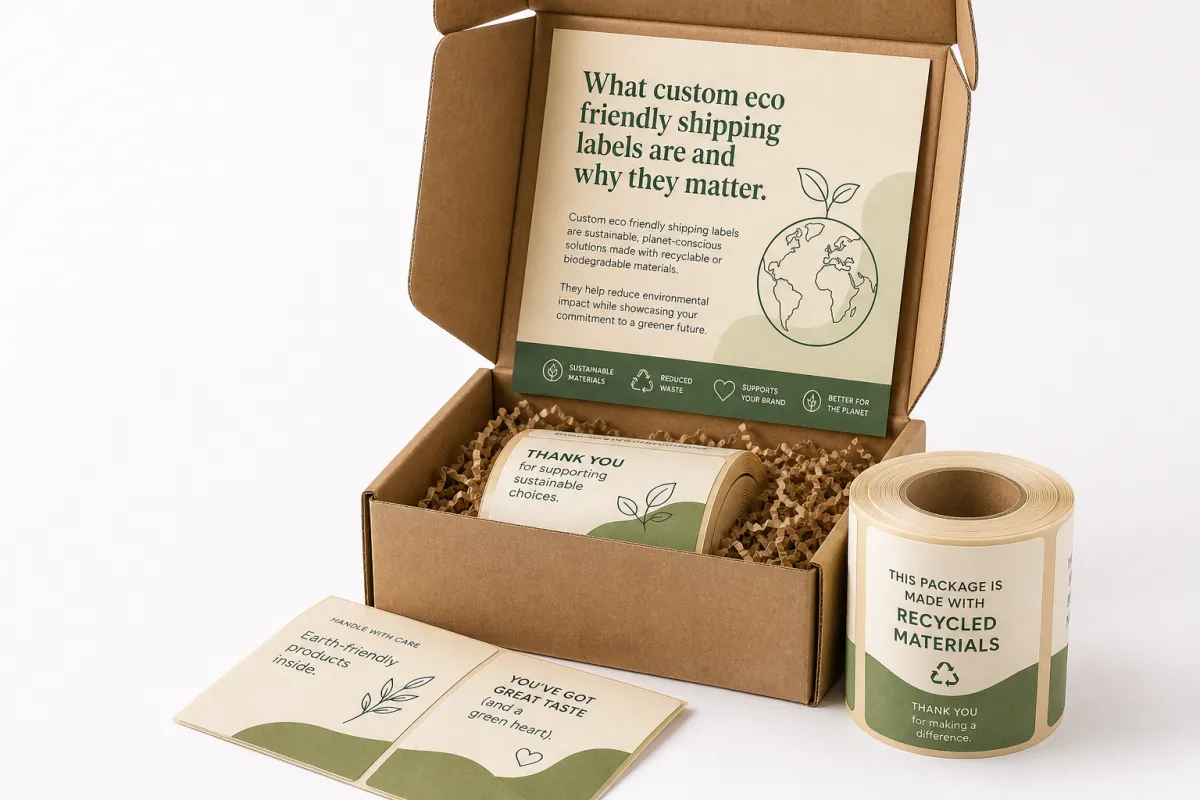
Custom eco friendly shipping labels are shipping labels built with lower-impact materials, smarter adhesive choices, and less waste in production or disposal. That can mean recycled paper facestocks, FSC-certified paper, linerless formats, or a film label that lasts longer and reduces reprints because it handles moisture and abrasion better. The point is not to sound virtuous. The point is to ship a package without creating more trash than necessary.
One thing many teams overlook: the liner often creates more waste than the label face. In pressure-sensitive labels, the silicone-coated liner gets peeled off and tossed every time. On a busy fulfillment line, that adds up fast. Custom eco friendly shipping labels usually solve a system problem, not a material problem in isolation.
Real eco performance depends on evidence, not vibes. Look for actual material descriptions, recycled content percentages, FSC chain-of-custody documentation, and disposal guidance that matches the application. The FSC standard matters if you want paper from responsible sources, and the EPA’s recycling guidance is useful when you’re checking whether a paper label and corrugated box can go through the same recovery stream in your area. Local recycling rules still matter, though. A label that looks recyclable on paper can behave differently in real collection systems.
Custom eco friendly shipping labels show up in ecommerce shipping cartons, subscription boxes, warehouse pick-and-pack lines, retail returns, and branded packaging that needs to look clean on arrival. They also matter in retail packaging programs where consistency has to hold across multiple SKUs. If your packaging design uses custom printed boxes for the product and a generic shipping label on top, the mismatch shows. Fast.
Three things make these labels worth the effort:
- Lower waste from recycled facestocks, linerless construction, or fewer misprints.
- Better sourcing story for brands that need proof instead of a green color palette.
- Less friction in order fulfillment when the label spec fits the printer and package surface.
The best custom eco friendly shipping labels are usually the least dramatic ones. Standard sizes. Clear print. Reliable adhesive. Nothing flashy. That is what keeps them on the package and out of the landfill.
How custom eco friendly shipping labels work in production
Every label starts as a stack of decisions. Facestock, adhesive, liner, and print method all affect performance, recyclability, and cost. If one piece is off, the whole spec starts acting expensive. Custom eco friendly shipping labels are no different.
Facestock is the top layer people see and print on. For most shipping programs, that means paper. Recycled paper and FSC-certified paper are common starting points because they work with standard branding, they accept thermal transfer or inkjet printing well, and they are easier to recover than plastic films in many carton-based applications. If the package is heading into cold storage, a freezer, or a damp environment, a film or moisture-resistant construction may be necessary even if it does not win any green-point beauty contests.
Adhesive decides whether the label stays put. Permanent acrylic adhesives are common for corrugated boxes. Removable adhesives can help on return merchandise or short-term applications. Freezer-grade and high-tack adhesives exist for colder or rougher surfaces. For custom eco friendly shipping labels, the trick is to avoid over-specifying adhesive chemistry just because the option sounds premium. You want enough hold, not a lifelong grip on a box that will be recycled.
Liner is where a lot of waste hides. Standard pressure-sensitive labels use a release liner, usually glassine or PET. Linerless systems reduce that waste but require compatible dispensing equipment and careful testing. They show up often in high-volume shipping operations and a lot less in small or variable workflows. If your labels run through a warehouse printer all day, linerless can cut waste in a way you can actually measure. If your setup is small or unpredictable, the equipment cost may eat the environmental win before it leaves the room.
Print method changes the spec too. Direct thermal labels are convenient because they do not need ribbons, but they can darken over time and are not ideal for long storage or heat exposure. Thermal transfer labels use a ribbon and tend to last longer. Laser and inkjet work well for smaller runs or office-style workflows. The right choice depends on your printer model, label usage window, and the package surface. Custom eco friendly shipping labels only work if the print method matches the way your team actually packs orders. That sounds obvious. It still gets missed all the time.
Production usually follows a familiar sequence:
- Artwork is checked for size, bleed, and barcode clarity.
- A material and adhesive are selected for the use case.
- The supplier prepares a proof or sample roll.
- The label is die-cut or slit to spec.
- The run is printed, wound, packed, and shipped.
That sounds ordinary because it is. Ordinary is where quality lives. In packaging design, the flashy spec is often the least useful one. If you are already buying custom printed boxes, custom eco friendly shipping labels should feel like part of the same system, not a random add-on.
Another practical point: match the label to the package surface. Glossy mailers, rough kraft boxes, cold-chain cartons, and coated retail packaging all behave differently. A label that sticks beautifully on one surface can fail on another. That is why testing matters, especially if your ecommerce shipping mix includes both branded packaging and plain transit cartons.
For buyers who want a packaging benchmark, the standards conversation is not fluff. ASTM language often appears around material performance, ISTA standards are common in shipping and transit testing, and FSC helps verify responsible paper sourcing. None of those standards makes a bad label good. They just help you ask sharper questions before you place an order.
And yes, material choice changes economics. Recycled Paper Labels often stay close to standard paper pricing. Specialty liners, freezer adhesives, and compostable claims usually cost more because the production path is narrower and the material path is less common. That is normal. Nobody needs to pretend otherwise.
Custom eco friendly shipping labels: cost and pricing factors
Pricing for custom eco friendly shipping labels is mostly a math problem with a few sharp edges. The biggest drivers are material grade, adhesive type, size, shape, color count, finish, quantity, and print method. If a supplier gives you a vague quote without those details, they are either guessing or hoping you will not notice the difference later. Neither is a great look.
For small runs, digital printing usually makes more sense. You pay more per unit, but setup stays lighter and the minimum order is smaller. For larger runs, flexographic printing usually wins on unit cost because the setup gets spread across more labels. That is the same math you see in Custom Shipping Boxes and other custom printed boxes programs: the more units you buy, the more setup pain gets diluted. Nothing mystical. Just math.
Here is a realistic way to think about pricing for custom eco friendly shipping labels:
| Label option | Typical use | Approx. unit range at 5,000+ | Main tradeoff |
|---|---|---|---|
| Recycled paper, one-color print | Standard shipping cartons | $0.04-$0.09 | Low cost, but limited moisture resistance |
| FSC-certified paper, custom shape | Branded packaging and retail packaging | $0.06-$0.12 | Better sourcing story, modest setup premium |
| Linerless shipping label stock | High-volume order fulfillment | $0.07-$0.15 | Less liner waste, but equipment compatibility matters |
| Moisture-resistant film | Cold-chain or rough transit | $0.08-$0.18 | Better durability, weaker recyclability story |
| Specialty compostable claim stock | Brand-led programs with disposal rules | $0.12-$0.25+ | Higher cost and tighter application constraints |
Those numbers are not a promise. They are a sane planning range for custom eco friendly shipping labels when the specs are straightforward. Add complex die-cuts, heavy color coverage, metallic ink, variable data, or unusual adhesives, and the price climbs. Add a rush schedule, and the pricing gets less charming fast.
There are places where eco choices cost less than people expect. Recycled paper facestocks are often close to conventional paper. Standard label sizes reduce waste and simplify production, which helps cost. Fewer colors can also help. If your packaging design can live with one or two ink colors instead of four, the label budget usually breathes easier.
There are also places where the greener option is plainly more expensive. Specialty liners and linerless equipment, compostable materials that need validation, and freezer-safe adhesives can push costs up because the supplier has fewer ways to source and run them efficiently. That is not a rip-off by default. It is what happens when a spec gets more demanding.
When you compare quotes, do not stop at unit price. Compare the full landed number:
- Setup fees for plates, dies, or file preparation.
- Proof and sample charges if the supplier does not include them.
- Freight, especially on large rolls or cartons.
- Waste cost from bad samples, printer jams, or reprints.
The cheapest custom eco friendly shipping labels on paper can become expensive fast if they jam your printer or fail on corrugated board. I would rather pay a penny more per label than spend an afternoon untangling warehouse chaos. Most operations feel the same after the first reprint cycle.
For brands balancing package branding and product packaging budgets, the label should be part of the system, not a line item that gets judged in isolation. If the label supports a cleaner unboxing, a clearer returns process, and fewer damaged shipments, it can pay back in ways that do not show up on the quote sheet.
Step-by-step process and timeline for custom eco friendly shipping labels
The cleanest ordering process for custom eco friendly shipping labels starts with the use case, not the artwork. If you know the package surface, printer type, storage conditions, and shipment speed, the rest gets easier. Skip those questions, and the supplier has to guess. Guessing is not a production strategy.
Start with a basic spec sheet:
- Label size and shape.
- Printer type, including model if possible.
- Package surface such as kraft carton, coated box, mailer, or poly.
- Exposure conditions like humidity, cold, heat, or rough handling.
- Print content such as logo, barcode, shipping fields, or variable data.
Once that is defined, material selection becomes a lot less vague. Standard recycled paper labels for custom eco friendly shipping labels might be perfect for dry warehouse-to-consumer shipments. If you ship refrigerated goods or you pack in a humid dock area, the answer changes. That is why a good supplier should ask annoying questions. The annoying questions save money later.
Timeline depends on complexity. Simple stock-material custom eco friendly shipping labels with straightforward artwork can sometimes move from proof approval to shipment in about 7-12 business days. Add custom shapes, specialty adhesives, heavy ink coverage, or material testing, and 12-20 business days is more realistic. If you need rush production, expect to pay for it. Compressing proofing and manufacturing usually costs extra because it squeezes the setup window.
Proofing is where a lot of cheap mistakes die, which is exactly where they should die. A proof can catch barcode sizing errors, alignment issues, and adhesive mismatches before they become a warehouse problem. If you are testing a label on actual cartons, even better. Sample on the box or mailer you really use, not on a neat white sheet that never touches your shipping line.
For larger programs, the workflow should feel deliberate:
- Request samples of the shortlisted custom eco friendly shipping labels.
- Apply them to the actual carton or mailer.
- Run them through the warehouse printer at normal speed.
- Let them sit through temperature and humidity swings if possible.
- Check barcode readability after handling and transit simulation.
That last step matters more than people think. A label can look perfect on day one and still fail after a week in a hot truck or a cold storeroom. For transit-heavy programs, some teams follow the same logic used in shipping qualification: test, observe, adjust. ISTA standards are often part of that conversation because the point is not a pretty sample; the point is field performance.
Approval delays are another hidden timeline issue. Sometimes the label is ready, but legal wants a material claim checked, operations wants printer validation, and marketing wants the logo a little larger. That is normal. It just means you should build in time for internal sign-off before the run starts. Custom eco friendly shipping labels are cheaper when the file gets approved once instead of three times.
Here is the practical day-one checklist I would want before quoting:
- Artwork file in vector format if available.
- Finished size and bleed requirements.
- Printer make and model.
- Approximate annual quantity and first order quantity.
- Package type and surface texture.
- Any required certifications, recycled content targets, or disposal claims.
For companies managing order fulfillment at scale, this is also where labels should be thought about alongside Custom Poly Mailers and custom printed boxes. The whole shipping system either works together or works against itself. Packaging design is not just what sits on the shelf. It is also what survives the truck.
Common mistakes when ordering custom eco friendly shipping labels
The biggest mistake is greenwashing by accident. Teams ask for something “earth-friendly” and get a label description that sounds nice but says almost nothing. Custom eco friendly shipping labels should come with real material detail: recycled content, FSC status, adhesive type, liner type, finish, and disposal guidance. If the answer is basically a mood board in words, keep moving.
Printer mismatch is another expensive one. Direct thermal and thermal transfer are not interchangeable. Laser and inkjet are not interchangeable either. A label that looks right but does not run right can jam equipment, smear barcodes, or peel in transit. That creates rework, and rework is the silent tax on every order fulfillment team.
Temperature and humidity get ignored far too often. Labels applied to cold cartons can fail differently from labels applied to room-temperature cartons. Rough corrugate textures also reduce bond strength. If your operation ships from a humid dock, stores goods in a cooler, or uses recycled kraft cartons with more surface variation, test those conditions before ordering a full run of custom eco friendly shipping labels.
Here are the failure modes I see most often:
- Lifting edges from weak adhesive or dusty carton surfaces.
- Smearing from the wrong print method or poor ink/ribbon match.
- Cracking or curling on poor-quality facestocks.
- Dead inventory from buying the wrong size or wrong spec in bulk.
- Reprints because the proof was approved without real-world testing.
Overordering the wrong spec is a sneaky mistake. Yes, bulk pricing is better, but a mountain of unusable labels is still a mountain of unusable labels. Underordering is the other trap. It forces emergency reprints, rush freight, and a messy stopgap solution that usually costs more than doing it right the first time. Custom eco friendly shipping labels only look affordable when the quantity matches the actual demand curve.
Another common error is picking the greenest-sounding option instead of the one that fits the shipping environment. A compostable claim sounds great in a deck. It is less exciting if the labels need to survive condensation, abrasion, or long transit. In those cases, a recycled paper label or an FSC-certified paper label may be the more practical environmental choice because fewer labels fail and get thrown away.
The packaging buyer’s test is simple: does the label reduce impact without creating operational noise? If the answer is no, the spec is wrong. That is true whether the label sits on retail packaging, ecommerce shipping cartons, or branded packaging used for direct-to-consumer fulfillment.
Keep the decision grounded. Ask for documentation. Ask for sample performance. Ask what happens at the end of life. And if a supplier cannot answer those questions cleanly, the custom eco friendly shipping labels they sell are probably more marketing than material.
Expert tips for better custom eco friendly shipping labels
Start with one or two standard label sizes. That sounds boring because it is boring, and boring is efficient. Standard sizes reduce setup complexity, make inventory easier to manage, and help procurement avoid a warehouse full of slightly different rolls that all do the same job badly. For custom eco friendly shipping labels, simplicity usually lowers both waste and spend.
Keep the artwork simpler than you think you need. Lower ink coverage often means less cost, faster production, and easier recycling outcomes for paper-based labels. That does not mean your package branding has to be dull. It means the design should do its job with restraint. One strong logo, clear shipping data, and good hierarchy often beat a busy label that tries to impress a buyer and only impresses the scrap bin.
Ask for samples on the exact carton or mailer you ship from. Not a similar box. Not a random test sheet. The actual thing. That one step catches more problems than most teams like to admit. If the label performs on your package, in your printer, under your operating conditions, you are close. If it only looks good in a sample photo, you are not close at all.
Better sourcing comes from better questions. Here are the ones worth asking:
- What is the recycled content of the facestock?
- Is the paper FSC-certified?
- What adhesive chemistry is used, and what temperature range does it handle?
- Is the liner recyclable, or is linerless available?
- What printer types are approved?
- Can you provide disposal guidance in writing?
That list sounds technical because it is technical. Packaging design should be technical. A nice-looking label that fails in the field is just decorative friction. I would rather have plain custom eco friendly Shipping Labels That work than a clever spec that creates repeat issues in order fulfillment.
Think in systems, not in single items. If the label works with the carton, the carton works with the mailer, and the whole setup supports ecommerce shipping without extra waste, the whole program improves. That is where branded packaging gets better too. The customer sees a clean, consistent package, while the warehouse sees fewer failures and fewer reprints. Everybody wins except the scrap bin.
That is also why it helps to look at labels alongside the rest of your packaging mix. If you are already planning custom printed Boxes for Retail packaging or shipping, a label refresh can be folded into the same procurement cycle. Fewer supplier conversations. Fewer file handoffs. Fewer chances to make a mess.
One more practical tip: if you ship multiple SKUs, use a label matrix. Define which label spec goes with which product family, carton type, and shipping lane. That sounds a little obsessive until the first time a summer shipment leaves with a label that was only tested in a dry warehouse. Then it sounds sensible.
Next steps for custom eco friendly shipping labels
If you want custom eco friendly shipping labels that actually improve the operation, start with an audit. Look at the current label spec, the amount of liner waste you generate, the number of reprints you burn through, and the failure points in transit. Once you see where the waste lives, the next move gets clearer. No drama. Just a better spec.
Before you request quotes, gather three things: label size, printer type, and the package surface the label must stick to. Those three inputs strip a lot of noise out of the buying process. Without them, you are comparing guesses. With them, you are comparing real options.
When the quotes arrive, compare more than unit price. Look at setup fees, proof costs, freight, sample charges, and lead time. A slightly higher quote can still be the cheaper option if it cuts reprints, protects the product, and reduces delays in order fulfillment. Cheap is not cheap when the label fails.
My preferred rollout is small and controlled:
- Test one SKU with the new label.
- Run it through normal packing conditions for at least one shipping cycle.
- Check adhesion, barcode readability, and print quality after transit.
- Compare waste, rework, and operator feedback against the current spec.
- Expand only after the label survives the real world.
If you are making a broader packaging move, this is a good time to coordinate labels with Custom Poly Mailers and other branded packaging items so the whole shipment looks and performs like one system. The strongest programs do not treat labels as an afterthought. They treat them as part of the package experience.
Custom eco friendly shipping labels are one of those purchases that can quietly improve both sustainability and operations if you stay practical. Keep the spec honest. Keep the testing real. And make one controlled switch first, not a full warehouse gamble with custom eco friendly shipping labels.
If you only do one thing after reading this, make it a real-world sample test on the exact carton or mailer you ship today. That one step will tell you more than a glossy spec sheet ever will. Then you can pick the label That Actually Works, not the one that just sounds good in a meeting.
Are custom eco friendly shipping labels recyclable?
Sometimes, but the answer depends on the facestock, adhesive, liner, and the carton they are applied to. Paper labels on recyclable corrugated boxes are usually the easiest path, while plastic films and heavy coatings need more scrutiny. Ask the supplier for written disposal guidance instead of trusting loose marketing language.
What are the cheapest custom eco friendly shipping labels to buy?
Usually a standard-size recycled paper label with one-color print and a common adhesive is the lowest-cost eco option. Bulk orders lower the unit price, but specialty liners, custom shapes, and premium finishes push the price up fast. The cheapest label is not always the cheapest total cost if it causes jams, reprints, or returns.
How long do custom eco friendly shipping labels take to produce?
Simple orders on stock materials can move quickly once the artwork is approved. Custom shapes, special adhesives, or material testing add time because proofing and setup take longer. Build in extra time for samples and internal approval if the labels must work with warehouse printers.
What materials are best for custom eco friendly shipping labels?
Recycled paper and FSC-certified paper are strong starting points for most standard parcel shipping jobs. Choose moisture-resistant or synthetic options only when the environment demands it, such as cold storage or heavy condensation. The best material is the one that balances impact, print quality, and real-world performance.
Do custom eco friendly shipping labels work with thermal printers?
Yes, if the label stock is specified for the printer type and heat level. Direct thermal labels and thermal transfer labels are not the same thing, so the supplier needs to know the printer model. Always test a sample roll before committing to a full production run.

