custom Frosted Zipper Bags for cosmetics refill brands solve a packaging problem that sounds simple until a launch depends on it. The pouch has to carry a premium look, protect the formula, survive repeated handling, and still support a refill model that customers understand immediately. Frosted film helps because it softens the visual noise. Fingerprints, scuffs, and formula residue are less obvious than they are on clear plastic, and the package keeps its composure longer once it leaves the carton.
That matters in beauty, where the package is often judged before the product is opened. A refill pouch sits in a strange middle ground: it needs to feel lighter and less wasteful than rigid packaging, but it also has to feel intentional enough to belong on a retail shelf or in a bathroom cabinet. If the design leans too far toward utility, it can look cheap. If it leans too far toward luxury, the refill story can feel hollow. Frosted Zipper Bags are one of the few formats that can hold both ideas at once.
The best use cases are usually dry powders, cleansers, bath additives, concentrates, and sample or travel-size programs. Those are the products where resealability, moisture protection, and presentation all matter at the same time. The package is not only a container. It is part of the product experience, and for refill brands, that distinction decides whether the model feels credible or improvised.
Why frosted zipper bags are a strong fit for refill cosmetics
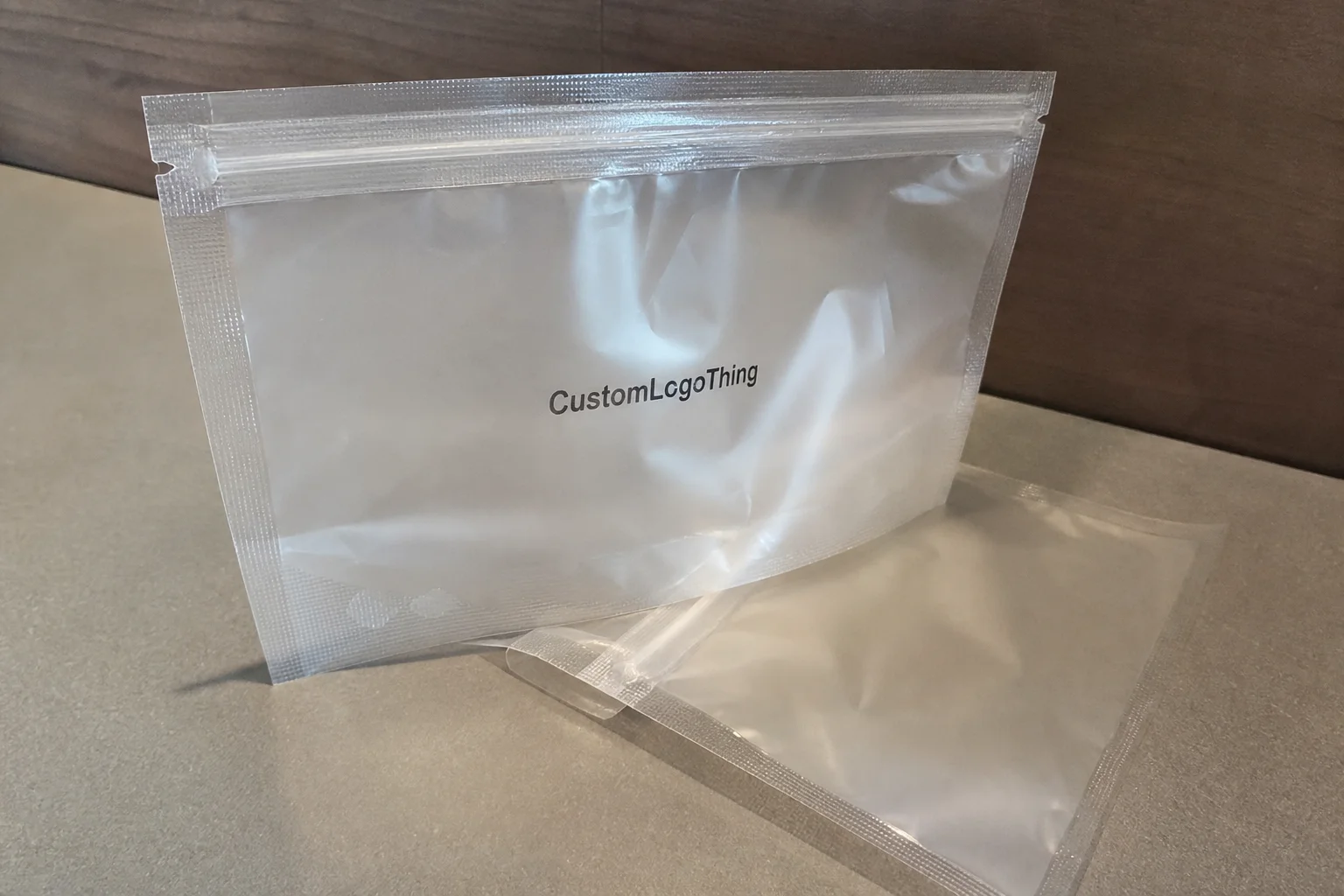
Refill cosmetics create a specific packaging tension. Customers want reduced waste, but they still expect a package that feels deliberate, sanitary, and easy to store. Frosted Zipper Bags answer that tension better than many first-time brands expect. The surface finish hides minor imperfections, the resealable zipper supports repeated use, and the bag format keeps material use lower than a rigid jar or bottle.
That combination is more than aesthetic. A customer refilling a face powder or body scrub is often handling the pouch in a bathroom, a tote bag, or a travel kit. The package may be opened, closed, packed, unpacked, and stored more than once before it is fully empty. If the zipper is weak or the film marks easily, the customer feels the failure immediately. The formula may still be fine, but the package will have already damaged the impression of quality.
Brands also like frosted pouches because they soften formula visibility without hiding everything. That is useful for products where color variation is normal from batch to batch. It is also useful when the brand wants a cleaner front panel and does not want every panel to fight for attention. A restrained layout usually looks more expensive than a crowded one, especially on a textured surface.
In practical terms, custom Frosted Zipper Bags for cosmetics refill brands tend to work well for:
- Dry powders that need moisture control and clear labeling.
- Body care refills sold in travel-friendly or partial-use sizes.
- Cleanser concentrates and other flexible formulas that do not need rigid packaging.
- Sample programs where the package must look presentable after multiple openings.
The retail signal matters too. A frosted pouch reads as more considered than a generic clear bag, but it does not carry the weight or cost of a molded container. That makes it especially useful for newer refill brands that need to look established before they have the volume to justify more expensive packaging systems.
There is a second reason this format keeps showing up: it gives the brand room to control what the customer notices first. A pouch with a frosted finish can hide the rough edges that tend to expose a rushed launch, while still leaving room for branding, directions, and batch information. For packaging teams, that control is valuable because it reduces the gap between the intended brand story and the object in the customer’s hand.
How custom frosted zipper bags for cosmetics refill brands work
The structure is usually straightforward, but the build details matter more than they look in a quotation. Most Frosted Zipper Bags use a frosted polyethylene film or a laminated structure with a frosted outer layer, then add a resealable zipper track and, depending on the product, a heat seal, tear notch, euro slot, bottom gusset, or side gusset. Each change affects filling behavior, shelf presence, and shipping performance.
Frosting is not only about appearance. It can help mask the visual variation that naturally appears in powders, creams, and concentrates. A slightly uneven fill, a small color shift, or a hint of residue is less distracting on a frosted surface than on a clear one. That does not eliminate the need for quality control. It just reduces the amount of visual noise the customer sees immediately.
Print choices shape the final perception more than many brand teams expect. A single-color logo, a white ink underlay, or a matte finish can create a sharper result than a heavily printed pouch. Sparse graphics tend to work well on frosted film because the texture already adds interest. Overprinting usually makes the bag feel busier, not richer.
The use cycle is simple. The pouch is filled, sealed, shipped, opened by the customer, resealed after use, and stored until the next refill cycle. That repeated use is what makes the zipper important. A sachet or single-use pack does not support that behavior. The closure either holds up or the package stops serving the refill model.
A pouch can look correct in a mockup and still fail in the hand. The zipper may not close cleanly, the film may scuff too quickly, or the pouch may distort once filled. Those are packaging failures, not cosmetic preferences.
For teams comparing formats, it helps to look at the pouch alongside other custom printed boxes or cartons in the range. Sometimes the pouch does the functional work while a carton handles shelf blocking, legal copy, or secondary presentation. In a refill program, that split can improve line speed and make the overall system easier to manage.
Design choices that affect barrier, shelf life, and feel
Film thickness changes more than durability. It affects puncture resistance, stiffness, and the way the bag sits in the hand. A thin film can reduce cost, but it may not survive sharper granules, rough transport, or repeated handling in a bag. A heavier structure feels more stable, though it can make small pouches look less refined if the size and artwork are not balanced well.
Barrier should be matched to the formula rather than assumed from the package style. Moisture protection matters for powders, salts, and some bath products. Oxygen protection becomes more relevant for formulas with sensitive actives or ingredients that can oxidize. Aroma retention matters for fragrance-forward products. The right build depends on what the product actually needs, not on what the rendering looks like.
Zipper quality deserves the same level of scrutiny. A poor closure is not a minor issue. Customers read it as instability, even when the formula itself is perfectly fine. If the zipper feels inconsistent after a few openings, confidence drops fast. In beauty packaging, the package and the product are usually judged together.
Dimensions and gusset depth also deserve attention. A pouch that is too tight can distort print, leave too little room for a reliable seal, and make filling harder. A pouch that is too large wastes material and may ship inefficiently. For refill programs, the most useful size is usually the one that matches actual fill weight and headspace, not the one that looks neat in a mockup.
Some brands want sustainability messaging to carry the package. That should be handled carefully. A frosted pouch can feel more restrained and modern, but that does not mean it is recyclable in every market or compatible with every municipal stream. The structure matters more than the story. For broader packaging guidance, the Packaging School and industry resources at packaging.org are useful reference points, but the final confirmation has to come from the exact film build being quoted.
If outer cartons are part of the system, paperboard can help support the brand story without overloading the pouch with every claim. FSC-certified paperboard is a practical option for brands that want the broader packaging program to feel coherent.
Before artwork begins, the core specs should already be settled:
- Film thickness: often 2.5 to 5 mil, depending on product and handling.
- Barrier need: moisture, oxygen, aroma, or a combination.
- Closure style: standard zipper, press-to-close, or extra-tight reseal.
- Fill method: manual, semi-automatic, or automated.
- Print area: full coverage, partial front panel, or restrained branding.
That list sounds basic because it is. It also prevents most of the expensive mistakes.
Cost, pricing, MOQ, and what drives unit cost
The main pricing drivers are predictable: pouch size, material structure, print complexity, zipper type, and order volume. Higher volumes usually lower the per-unit price because setup, proofing, and production prep are spread across more units. Smaller runs are possible, but the unit cost rises quickly and the options narrow.
For many brands, the cost structure makes the most sense in tiers. A simple frosted pouch with one-color branding will price very differently from a multi-panel design with white ink, a thicker laminate, and a matte finish. Add a custom shape, hang hole, or special zipper and the quote climbs again. That is not arbitrary mark-up. It reflects extra production steps.
| Specification | Typical MOQ | Indicative unit price | Best fit |
|---|---|---|---|
| Simple frosted PE pouch, 1-color print | 3,000 to 5,000 units | $0.18 to $0.30 | Basic replenishment, trial runs, low-complexity branding |
| Frosted laminated pouch, matte finish, 2-color print | 5,000 to 8,000 units | $0.24 to $0.42 | Mid-tier retail packaging, stronger shelf presentation |
| Heavier barrier build, white ink, multiple panels | 8,000 to 10,000+ units | $0.32 to $0.60 | Premium branded packaging, moisture-sensitive formulas |
Those numbers are directional. Freight method, proofing, sampling, and rush charges can move the real total enough to matter, especially on smaller orders. A sample charge of $80 to $250 is common for more customized builds, and expedited production can add 10 to 20 percent depending on the supplier and the schedule. Brands often focus too much on base unit cost and not enough on landed cost, which is where the budget actually gets decided.
A better comparison is to ask for pricing across multiple volume breaks. The difference between 5,000 and 10,000 units may justify a longer inventory cycle, or it may not. That depends on storage, cash flow, forecast confidence, and how fast the refill line is moving. The number only becomes useful when it is tied to a real demand plan.
If your team is still comparing formats, the Custom Packaging Products page is a useful benchmark for pouch styles alongside related packaging options. That is often where the economics become clearer. A simpler print can reduce cost, but a heavier structure may lower damage rates and reduce repacking later.
Process and timeline: from dieline to production steps
The production workflow should be predictable. It usually runs through brief, sizing, dieline confirmation, artwork placement, proof review, sample approval, production, quality check, and shipping. The brands that move quickly are usually the ones that settle dimensions early and supply clean vector files. The brands that drag are often still adjusting copy after artwork has already been routed.
Delays show up in the same places again and again. Artwork revisions cost time. Regulatory copy changes cost time. Barrier changes after formula testing cost even more time. A digital mockup is useful, but it cannot tell you how the zipper feels after repeated closures or how the pouch behaves once it is actually filled. A physical sample is the real test.
For custom frosted zipper bags for cosmetics refill brands, a realistic lead time for a standard run is often 12 to 15 business days after proof approval, with more customized builds taking longer. If sampling, translation, or formula testing is involved, the full cycle can stretch into several weeks. That is normal. Rushed packaging work usually becomes expensive packaging work.
Distribution testing matters if the pouch is going into e-commerce or a rougher shipping lane. If the package is part of a cartonized packout or a retail sleeve, test plans should reference recognized methods such as ISTA protocols or ASTM D4169 distribution checks. Those standards help teams talk about drop resistance, vibration, and transit damage with something more concrete than guesswork.
There are a few ways to compress turnaround without cutting corners:
- Finalize dimensions before artwork starts.
- Send vector logos and editable copy.
- Assign one decision owner for proof approval.
- Test the sample with the actual product and fill weight.
If the refill system also uses paper cartons, hang tags, or shipping inserts, align those components early. FSC-certified paperboard can support the wider packaging story without forcing the pouch to do all of the communication work on its own.
Common mistakes refill brands make with pouch specs
The first mistake is choosing the frosted look before the performance spec. A pouch can look elegant in a render and still fail on barrier, puncture resistance, or zipper durability. That risk is higher in cosmetics refill packaging because customers often read a packaging failure as a formula issue. Usually the formula is not the problem. The structure was simply not matched to the use case.
The second mistake is underestimating headspace. Too little room above the fill line can distort graphics, make the pouch look overfilled, and create seal issues on the line. Too much headspace can make the bag feel undersized and waste material. The right balance usually comes from testing, not from a drawing.
Validation gets skipped more often than it should. Fill tests, drop tests, and closure-cycle testing are not formalities. They show what happens after the customer opens and closes the zipper several times, or after a parcel takes a hit during transit. That is not a theoretical edge case. That is the normal life of a refill pouch.
Artwork is another source of avoidable delay. Missing barcodes, vague copy, or last-minute label changes can stall production because the pouch has to carry instructions, batch data, or compliance language. Clean files speed up the job. Sloppy files push the schedule back.
The final mistake is operational. Some pouches look great but are awkward for automated filling or unstable in fulfillment. If the bag cannot run at the speed the line needs, the packaging becomes expensive no matter what the quote says. A spec that slows operations is not a good spec.
Two checks catch most problems early:
- Run the pouch with the actual product, actual fill weight, and actual closure method.
- Have operations, design, and QA review the same sample before approval.
Expert tips and next steps for a cleaner launch
Start with a one-page spec sheet. It sounds plain because it is. List size, fill weight, product type, print count, zipper preference, target order volume, and whether the pouch must stand upright or can lie flat. That single page saves time in quoting and prevents the vague back-and-forth that slows packaging projects down.
Test the pouch in realistic conditions. If the product fills manually, use that method for the sample review. If the line is semi-automatic, replicate that as closely as possible. A design review on a desk is useful, but it is not enough. The package needs to be judged under the same handling conditions it will face after approval.
Standardizing a small family of pouch sizes is often smarter than chasing one-off dimensions. Refill brands tend to launch with a single SKU and then add variants. If the sizes are planned as a system, tooling and artwork can be reused more easily, which lowers friction on reorders and keeps the product family visually consistent.
Think about the afterlife of the bag. Will it sit on a shelf, travel in a tote, or live in a bathroom cabinet? Those habits affect the ideal structure more than many teams realize. A pouch built for retail display may not feel right as a travel refill, and a bag built for storage may look too plain on shelf.
The most reliable launch path is still the least glamorous one: compare two or three specs, request sample proofs, validate zipper and barrier performance, then place the first order with enough time to correct problems before volume matters. The pouch should be treated as part of the refill system, not as a decorative extra. That is how the packaging starts to earn its place.
For brands trying to make the refill concept feel premium without losing practicality, custom frosted zipper bags for cosmetics refill brands are a strong option. They balance shelf appeal, resealability, and production efficiency in a way that fits real beauty operations. The best results usually come from matching material structure, zipper quality, print coverage, and fill workflow before the first run goes to press.
Frequently Asked Questions
What size custom frosted zipper bag works best for cosmetic refills?
The best size depends on fill weight, formula behavior, and how much headspace is needed for sealing. Powders, creams, and concentrates all sit differently in the pouch, so the right answer is usually found by testing a few sizes with the real product before placing a full order.
Do frosted zipper bags protect refill cosmetics from moisture?
They can, but only if the film structure and seal are built for the product’s sensitivity. Dry formulas usually need less barrier than moisture-sensitive powders or fragrance-forward products. Ask for the exact material build rather than assuming all frosted bags perform the same way.
What is a normal MOQ for custom frosted zipper bags for cosmetics refill brands?
MOQ depends on size, print count, and material structure. Simpler pouches often support lower minimums, while highly customized builds usually need higher volumes to stay economical. It helps to request quotes at several quantity tiers so you can compare unit cost against storage and cash flow.
How long does production usually take after approval?
Standard runs are often ready within 12 to 15 business days after proof approval, while more customized projects can take longer. Sampling, copy changes, and barrier testing can stretch the schedule, so the best way to keep the timeline under control is to finalize dimensions and artwork early.
Can custom frosted zipper bags for cosmetics refill brands use recycled content?
Often yes, but recycled content, recyclability, and barrier performance do not always line up neatly. Ask for the exact structure, then confirm whether it fits your shelf-life requirements, line speed, and packaging claims before committing. The right answer is usually material-specific.


