custom knit Hats With Logo bulk order sounds simple until you start asking what the hat has to survive: stretch, weather, friction, washing, and repeated wear by people who are not thinking about your brand while they put it on. That is the real standard. A beanie is not a desktop giveaway. It has to work outside, fit a range of heads, and still carry the logo clearly after the cuff gets adjusted a dozen different ways.
That practical requirement is why knit hats keep showing up in staff uniforms, winter event kits, retail lines, school fundraisers, and team merch. They are useful first and promotional second, which is why people actually keep wearing them. For buyers, the calculation is less about novelty and more about whether the decoration method, yarn, and fit hold up in the real world. If those pieces line up, bulk pricing starts to make sense quickly.
One more reason these orders perform well: the hat gets seen outside. That means the brand impression happens on sidewalks, at games, in parking lots, and on transit, not in a drawer. The item keeps working long after the event ends. A good knit hat can outlast several cheaper promotional items simply because the wearer wants it on cold days.
A beanie that gets worn twice a week does more brand work than a stack of items nobody keeps. That is not a theory. It is just how winter apparel behaves.
Why custom knit hats with logo bulk orders keep getting worn
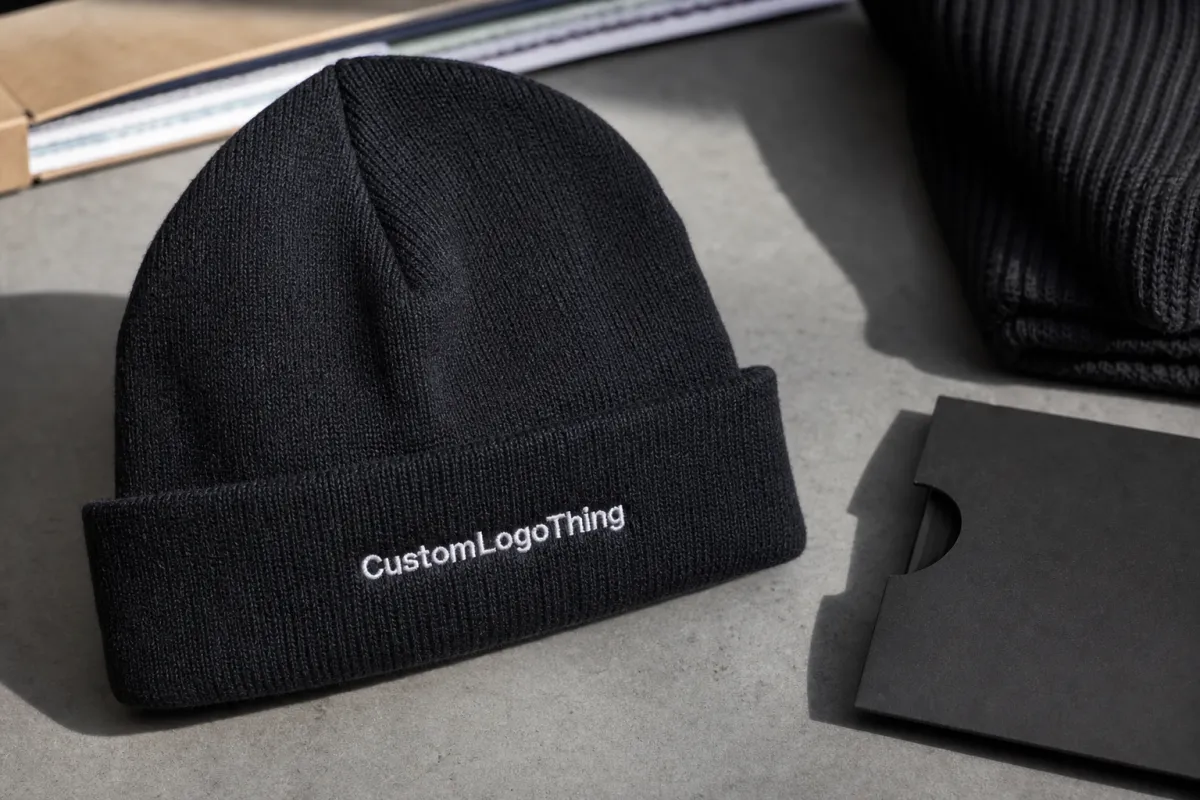
The strongest use cases are the most practical ones. Outdoor crews need warmth. Staff uniforms need something that looks consistent without being fussy. Sports teams want a compact item that players and fans will actually wear. Retail buyers want a piece that feels current enough to sell and durable enough to avoid returns. If the hat solves a real need, the logo gets repeated exposure for free.
That repeated use is exactly why a basic custom beanie often outperforms lower-cost promo items. A pen can disappear in a desk drawer. A tote can sit in the back seat. A knit hat gets pulled on in the cold, shoved into a bag, rinsed out, and worn again. The closer the hat feels to a normal wardrobe item, the better it performs as branded merchandise.
Bulk economics help too. Most of the cost sits in setup: art prep, knit program setup, decoration setup, and in some cases packaging setup. Once the run is approved, the factory can repeat the same pattern across the order. That lowers the unit cost compared with one-off production and explains why custom knit Hats with Logo bulk order requests are common for seasonal campaigns and repeat programs.
If the hats are part of a broader merch kit, treat packaging as part of the product. A folded beanie in a plain polybag behaves differently from one boxed with inserts, tags, or labels. The presentation changes the perception. For buyers who pair the hats with Custom Packaging Products, the packaging plan should be locked before production starts, not after.
Useful orders usually have one clear purpose: employee warmth, event visibility, retail resale, or fan loyalty. If the purpose is vague, the spec becomes vague too. That is where revisions and avoidable cost creep in.
Choose the right knit body, cuff, and decoration method
Start with the hat style, not the logo file. A cuffed beanie gives the cleanest front area for decoration and is still the safest choice for most bulk programs. Uncuffed styles look a little sleeker, but they offer less structure for a logo. Slouch beanies feel more retail-driven and casual. Pom styles add seasonal energy and are often better for fan merch or holiday campaigns. None of these is universally better; they solve different problems.
For most custom Knit Hats With Logo bulk order projects, cuffed hats are the most practical starting point. They fit a wider range of head sizes, the cuff gives the logo a stable surface, and the final result is easier to read at a glance. If the hats are going to employees, volunteers, or event staff, cuffed usually wins. If they are going into retail, a slouch or pom style may sell better because it feels less like a uniform.
Decoration method has an even bigger effect on how the hat reads. The same logo can look sharp or muddy depending on how it is applied.
- Embroidery works well for simple logos, bold text, and lower detail counts.
- Woven patches preserve finer edges, smaller type, and cleaner contrast.
- PVC patches add a thicker, more dimensional look for strong branding.
- Jacquard knit builds the design into the fabric, which is useful for repeat patterns or fully custom identities.
Embroidery is usually the lowest-friction option for custom Knit Hats with Logo bulk order pricing. Woven patches cost a bit more, but they save logos that would lose detail in thread. Jacquard knit has the most integrated look, but it also requires more setup, more color planning, and usually higher minimums. That tradeoff matters. The cleanest result is not always the cheapest route, and the cheapest route is not always the most readable one.
| Style or method | Typical MOQ | Common unit price range | Best use | Setup impact |
|---|---|---|---|---|
| Cuffed beanie + embroidery | 100-250 | $2.40-$4.75 | Staff wear, events, simple logos | Low to moderate |
| Cuffed beanie + woven patch | 200-500 | $3.80-$6.25 | Retail merch, sharper detail | Moderate |
| Fully custom jacquard knit | 300-1000 | $4.90-$8.80 | Brand collections, repeat patterns | Higher |
| Pom or slouch style | 150-500 | $3.50-$7.50 | Retail, lifestyle, seasonal promotions | Varies by decoration |
Material choice also changes how the hat feels and how much it costs. Acrylic is common because it is affordable, warm, and holds shape well. Polyester blends dry faster and can feel lighter. Wool blends usually feel better in hand and provide more warmth, but they add cost and sometimes introduce care concerns. For outdoor staff, the basics matter most: fit, warmth, and resilience. For retail, tactile feel and finish may matter just as much.
If these hats are part of a larger branded set, check how the style works alongside packaging, inserts, and other merch. A beanie with premium presentation should feel related to the rest of the kit. Otherwise the product and the packaging look like they came from different orders, which weakens the whole package.
Logo size, stitch count, and color limits that protect legibility
Knits are not flat surfaces. They stretch, compress, and distort just enough to expose weak artwork. Thin fonts, hairline strokes, tiny details, and crowded layouts often disappear once the hat is worn. That is the most common mistake on custom knit hats with logo bulk order projects: the logo looks fine on a screen and then loses clarity on fabric.
Simple art performs better. A strong icon, a short wordmark, or one bold line of text usually survives the knit texture more cleanly than a busy design. Fewer colors also help. High-contrast combinations read better because the knit surface already adds visual noise. If the logo only works at presentation size, it is probably too delicate for a beanie.
A practical test helps here. If the logo is hard to read at arm’s length in a mockup, it will probably be hard to read on the actual product. Add breathing room around the mark, avoid tiny stacked type, and respect the decoration area. A wider cuff gives you more visibility and more margin for error. Narrow cuffs can still work, but every millimeter counts.
Ask for these details before production starts:
- Vector file in AI, EPS, or PDF format
- Final logo size in inches or millimeters
- Pantone or thread color references
- Minimum line width for embroidery or knit detail
- Decoration position: cuff, front panel, side, or all-over knit
Color count matters more than many buyers expect. Two to four colors are usually straightforward. Beyond that, the production gets more complicated, especially in jacquard knit. That does not mean every logo has to be flattened into one color. It means the color budget should go where the mark actually needs it. If a color does not support recognition, it is probably spending money without improving the hat.
If the logo depends on tiny type to make sense, the hat is doing too much work. Simplify the artwork and the result gets cheaper, clearer, and easier to approve.
For retail presentation, think beyond the logo alone. Hangtags, folding style, and carton presentation all affect how the item is perceived. A clean product tag and consistent packing can make the hat feel more credible on shelf. That is where packaging stops being decorative and starts affecting sell-through.
Pricing, MOQ, and what actually changes your unit cost
For custom knit hats with logo bulk order pricing, the biggest cost drivers are construction, decoration method, yarn choice, color count, and packaging. Buyers often focus on the decoration first, but the base hat and finishing requirements can move pricing just as much. A stock beanie with a simple logo will usually sit near the low end. A fully custom jacquard knit with multiple colors and retail-ready packing can land several dollars higher per unit.
The MOQ follows the same logic. Stock blanks are easier to source, so the minimums are lower. Custom knit patterns need yarn planning, machine setup, and more inspection time, so the floor rises. Patch-decorated hats tend to sit in the middle because the blank can stay standardized while the patch carries the brand-specific detail.
| Order type | Typical MOQ | Typical unit cost | Lead time | Notes |
|---|---|---|---|---|
| Stock beanie + simple embroidery | 100-250 | $2.40-$4.75 | 7-12 business days after proof approval | Fastest route, limited style control |
| Stock beanie + woven patch | 200-500 | $3.80-$6.25 | 10-15 business days | Good detail, solid retail look |
| Fully custom knit with simple logo | 300-1000 | $4.90-$8.80 | 15-25 business days | More brand integration, higher setup |
| Custom knit with premium packaging | 300-1000 | $5.50-$10.00+ | 18-30 business days | Best for retail packaging and kits |
There are a few easy ways to keep the price under control without damaging the product. Limit the yarn palette. Keep decoration to one location if you can. Use standard packaging unless the presentation truly needs more. Choose one label format and one folding method for the whole run. Every extra variation adds labor, and labor is what quietly inflates the quote.
Shipping terms matter too. A quote should include carton count, destination zip code, and whether the goods are going to a warehouse, office, store, or fulfillment center. Omitting freight details is a classic source of surprise costs. If the hats are part of a merchandise bundle, say that early. Packing a hat with inserts or Custom Printed Boxes changes the workflow and should be priced in from the start.
For paper inserts or hangtags, FSC-certified stock is a reasonable ask. If you need shipping protection or retail logistics guidance, standards from ISTA are useful as a reference point. They are especially helpful for orders that will be handled multiple times before they are sold.
The cleanest quote usually comes from one exact spec, not three maybes. One hat style. One colorway. One decoration method. If you want alternates, ask for them side by side so pricing differences are visible instead of assumed.
Production steps, approvals, and lead time expectations
A proper custom knit hats with logo bulk order follows a predictable sequence: artwork review, mockup, proof approval, production, inspection, and shipment. The steps are ordinary. The delays usually happen in the handoffs. A low-resolution logo gets sent in, a thread color changes, the decoration size is revised, and the order sits while everyone waits for a new approval.
Most of the timeline gets lost before the first hat is knitted. That is why fast approvals matter. The faster the buyer confirms the art, the sooner production can start and the less likely the run is to drift off schedule.
Typical lead time depends on the construction:
- Stock beanies with embroidery: often 7-12 business days after approval
- Stock beanies with woven patches: often 10-15 business days
- Fully custom knit runs: often 15-25 business days or more
- Retail-ready or kit-packed orders: add time for folding, labeling, and pack-out
Rush orders can be possible, but they usually narrow your options or raise the price. The factory can sometimes speed things up with stock blanks or simpler decoration. That works if the deadline matters more than full customization. It does not work if the buyer expects a complex, fully custom knit with premium packaging in a few days. Those expectations do not match the production reality.
Address changes and late shipping instructions cause avoidable delays as well. If the order is shipping to multiple locations, confirm that before production begins. If it is going into a warehouse or fulfillment center, the carton count and labeling format should be locked in early. A warehouse should not have to guess how the product is supposed to be received.
For repeat programs, save the approved artwork, yarn references, packing format, and carton spec. That makes the next order easier to quote and easier to produce. The second run should not need to rediscover the same decisions the first run already solved.
If you need a broader view of order support, our Wholesale Programs page is a useful reference point for reorders, mixed quantities, and seasonal drops.
How to compare suppliers on sample quality, packing, and consistency
Price alone is not enough. A low quote means little if the knit density is thin, the logo shifts off-center, or the color match drifts from sample to run. For custom knit hats with logo bulk order purchases, the sample is where quality becomes visible.
Inspect the sample for knit density, seam finish, stretch recovery, and logo placement. Hold it at arm’s length. Fold the cuff. Pull the body gently and see whether the decoration still reads cleanly. If a patch lifts at the edge or embroidery sinks into the fabric, the production run will probably repeat that flaw unless the supplier addresses it before bulk production begins.
Packing format matters too. Bulk cartons work well for giveaways and warehouse distribution. Folded units with tags are usually better for retail. Polybagged products fit e-commerce and fulfillment workflows. Barcode labels help when the order has to move through inventory systems. That is basic product packaging work, and it belongs in the quote.
Good suppliers are usually comfortable discussing tolerance ranges. Knit goods vary a little in stretch and shape, so there should be an honest answer about what counts as acceptable. Poor suppliers dodge that conversation or hide behind vague promises. If they will not show sample photos or explain the production details, that is a warning sign.
Before paying a deposit, ask for these checkpoints:
- Photo proof of the decoration placement
- Confirmation of MOQ by style and color
- Packaging format and carton count
- Approved thread or yarn match
- Inspection and shipping timeline
If the hats are part of a larger branded program, ask how they fit alongside the rest of the merchandise. A retail program with apparel, inserts, and Custom Packaging Products should feel consistent from carton to shelf. That is where branded packaging earns its keep. It makes the whole program feel deliberate instead of patched together.
For general process questions, the FAQ page can save time before a quote is even requested. That is usually the fastest way to clear up terminology, packaging questions, and minimum-order details.
Next steps for a faster bulk quote and cleaner first run
If you want a faster quote on custom knit hats with logo bulk order work, send the right details the first time. Not after three rounds of back-and-forth. Not after the mockup comes back. The cleaner the spec, the fewer surprises once production starts.
Have these details ready:
- Hat style: cuffed, uncuffed, slouch, or pom
- Quantity by color or size if applicable
- Vector logo file
- Decoration method preference
- Delivery zip code
- Target deadline
- Packaging requirements, if any
Send one reference image with the logo artwork. That helps the supplier understand the brand feel, not just the file format. If mockup approval is required, ask for it before the deposit. If the MOQ matters, confirm whether it applies to each color or to the full run. That one detail changes pricing more often than buyers expect.
For repeat orders, keep a record of what worked: yarn choice, cuff width, decoration size, and carton format. The next run should begin from the approved spec, not from scratch. That is the easiest way to reduce friction and improve consistency across seasons.
My blunt advice is simple: choose the hat people will actually wear, keep the logo bold enough to read, and keep the packaging aligned with the way the product will be used. If those three pieces are handled well, the order does its job. Every unit gets more wear, more visibility, and less chance of ending up in a drawer.
What is the usual MOQ for custom knit hats with logo bulk order?
MOQ depends on whether the hat is stock-based, fully custom knit, or decorated with a patch. Stock beanies usually allow lower minimums, often around 100-250 units. Fully custom knit patterns usually need more, sometimes 300-1000 units. Ask separately for minimums by style and color so setup rules are clear before you commit.
How long does a custom knit hats with logo bulk order usually take?
Lead time is usually a mix of proof approval time and production time. A simple stock beanie with embroidery can often ship in 7-12 business days after approval. Fully custom knit runs usually take longer, especially if you add special packaging or multiple revision rounds. Rush options may exist, but they usually narrow your decoration choices or increase cost.
Is embroidery or a woven patch better for knit hats?
Embroidery is best for bold, simple logos that need a clean look. Woven patches are better when the logo has smaller type or sharper detail. If the mark is highly detailed, a patch usually preserves more of the original artwork. Choose based on the logo, not preference alone.
Can I mix colors or styles in one bulk order?
Sometimes yes, but the answer depends on the factory setup and the MOQ rules. Mixing colors within one hat style is usually easier than mixing multiple constructions. Every extra variation can affect price, approval time, and inventory planning. Ask for the exact split before you commit.
What affects the price per hat the most?
The main drivers are knit complexity, decoration method, yarn choice, and color count. Packaging and custom labeling can also move the price more than buyers expect. If you want a cleaner quote, give one exact spec instead of several maybes. That is how you keep a custom knit hats with logo bulk order quote useful and honest.

