Anyone asking for a knit hats with logo Unit Cost Breakdown is usually trying to answer a practical question: what does one beanie really cost, and which parts of the order are fixed versus variable? That is a sensible question, because custom knit headwear rarely prices like a simple off-the-shelf accessory. Setup, artwork prep, decoration method, packaging, and freight all influence the final number, and the first small run almost always carries a heavier share of those costs than a larger reorder.
That is where many buyers get surprised. A quote can look fine at first glance, then turn out to be built around a low quantity, a premium decoration method, or a packaging choice that adds more than expected. None of that means the pricing is inflated. It usually means the order was under-specified. A clear brief matters because beanies are sold by the piece, but produced by the batch.
For schools, breweries, clubs, outdoor crews, and event teams, the goal is rarely just the lowest unit price. Buyers usually want warmth, a logo that stays readable, and a product that can be reordered without reworking the whole file package every time. A giveaway piece for a one-night event and a retail-style beanie meant to hold up through an entire season do not belong in the same cost conversation. The right build depends on the use case, the decoration, and the quantity bracket.
Why Bulk Beanies Get Cheaper Faster Than You Expect
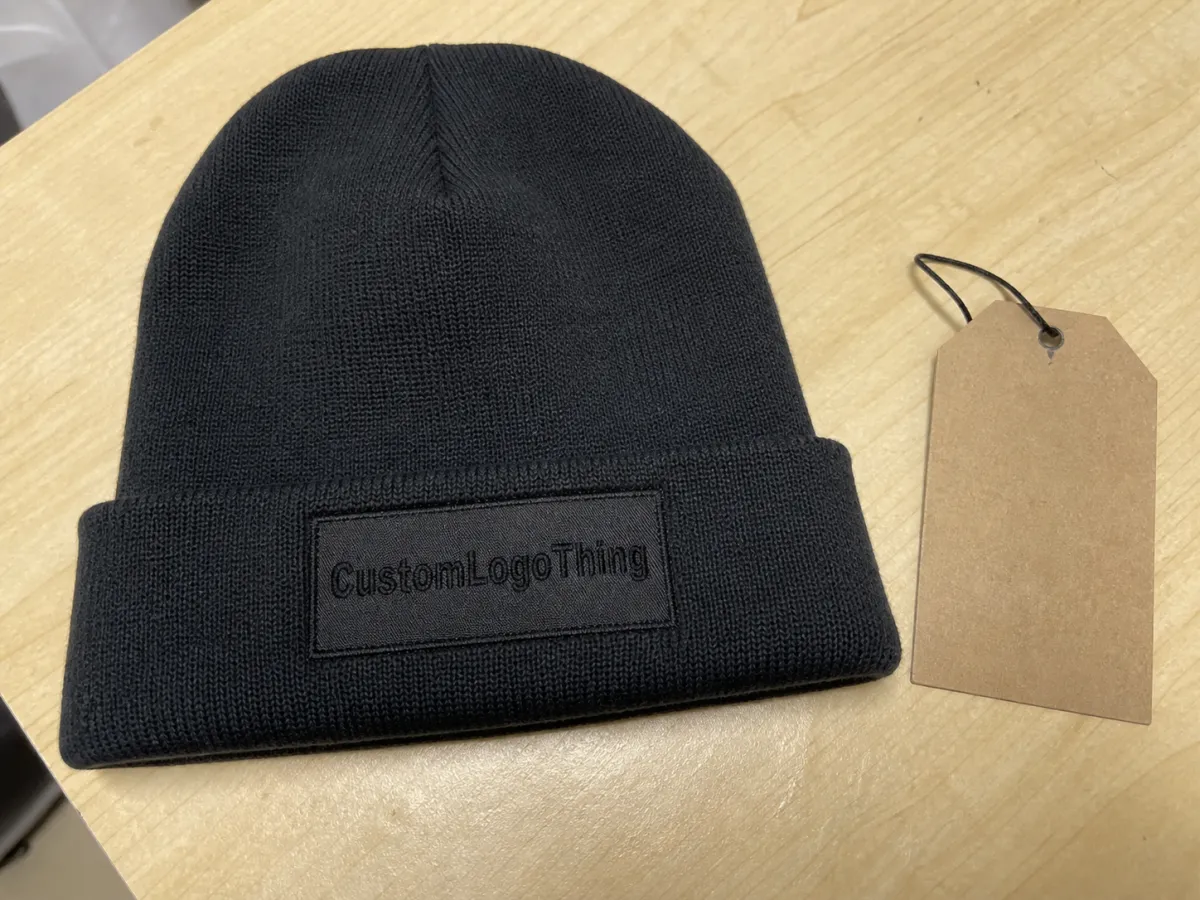
Beanie pricing often drops more sharply as volume increases than first-time buyers expect. A 50-piece run might land somewhere around $7.50 to $12.00 per piece, while 200 pieces of the same style can settle closer to $4.25 to $7.00, depending on the yarn, the decoration, and whether the order includes packaging or premium details. The blank hat may not change much. What changes is how the fixed costs are spread out.
That spread matters because setup costs do not care about quantity. Artwork cleanup, stitch file preparation, knit machine programming, color matching, sample review, and production proofing happen before the first finished hat is packed. If those costs total $120, they add $2.40 per piece on a 50-unit run and only $0.60 per piece on a 200-unit run. The same work is being done either way; it simply becomes less visible at scale.
Quantity is not the only lever, either. One extra yarn color, a pom, a fleece lining, or a more complex patch can move the quote more than a modest increase in volume. Buyers sometimes focus on the order count and overlook how much a second decoration color or a custom attachment changes the labor profile. On a small order, that detail can matter more than adding another 25 units.
The practical lesson is simple. If the goal is a clean staff piece or event giveaway, a straightforward build often gives the best value. If the goal is a polished retail item that can be reordered later without changing the look, the more expensive choice may actually be the safer one. The cheapest quote is only a win if the hat fits the job and the logo survives production clearly.
“The least expensive beanie is often the one that holds the logo clearly and can be reordered without a reset.” That is not flashy, but it is usually true.
For buyers comparing a one-time promotion against a restockable program, the price curve should be read as a production model, not a sales trick. Once the file is approved and the build is stable, future runs tend to move more predictably. That consistency is where the real savings show up.
Beanie Styles, Materials, and Decoration Choices
Style sets the tone before the logo ever appears. A cuffed beanie is the most flexible choice because it gives a stable decoration zone and tends to keep logos readable from a distance. Slouchy beanies feel more casual and can work well for lifestyle brands, though they are not always the best fit if the logo needs to sit in a precise location. Ribbed beanies hold shape well and stretch comfortably. Pom beanies add personality, but they also add cost and can change the way the hat reads on the head. Fleece-lined beanies make sense for colder climates or outdoor work, though they push the price higher and are not the right answer for every budget.
Material selection affects feel, warmth, and cost. Acrylic remains the most common budget-friendly option because it is easy to source, soft enough for most uses, and generally stable in bulk production. Wool blends feel more premium and usually retain warmth better, but they come with higher cost and more care sensitivity. Recycled yarns support sustainability messaging and can help a brand position the product more intentionally, although the price tends to be higher and the supply chain can be less forgiving. Cotton blends are comfortable in milder weather, but they are not always the best choice for a true cold-weather beanie.
Decoration method is where a lot of the unit cost spread appears. Jacquard knit-in logos build the art directly into the fabric, which works well for bold, simplified graphics and repeat orders. Embroidery is straightforward and easy to understand, but it does have limits: tiny text, thin outlines, and fine gradients can disappear or distort. Woven patches are a strong middle ground when the logo needs cleaner detail without turning the whole hat into a custom knit pattern. Leather patches bring a premium feel, though the design must be simple enough to read in a restrained material system.
Thin lines, tiny typography, gradients, and overly complex artwork should be treated with caution. A knit-in design handles bold shapes and contrasting blocks of color better than delicate detail. A patch often preserves edges more cleanly. Embroidery can work well, but only if the logo size is generous enough for the stitch count to behave. Buyers sometimes ask for every decoration method to perform equally well. It will not. Matching the artwork to the method usually matters more than chasing the most technical-looking option.
If the order will be sold retail or distributed with sustainability claims, packaging and labeling should be part of the conversation early. FSC-certified paper hang tags are a reasonable choice if the supplier can source them cleanly, and the finish should match the rest of the product rather than look bolted on. If you want to verify basic packaging standards, resources like fsc.org and packaging.org can help buyers understand the terms without overcomplicating the brief. The point is not to add theater. It is to make sure the materials, cost, and presentation all line up.
| Option | Typical Cost Impact | Best For | Main Tradeoff |
|---|---|---|---|
| Acrylic cuffed beanie | Lowest base cost | Giveaways and staff use | Less premium feel |
| Wool blend beanie | +15% to +35% | Retail and colder climates | Higher care expectations |
| Jacquard knit-in logo | Strong at higher quantities | Bold logos, repeat orders | Less fine-detail flexibility |
| Woven or leather patch | Moderate add-on | Sharper logo detail | Extra component and application step |
Specs Buyers Need Before Requesting a Quote
A fast quote starts with a complete brief. Quantity tiers should come first, because pricing makes more sense in brackets than in single numbers. If you are comparing options, send 50, 100, and 250 pieces, or the closest tier structure that fits your likely order. After that, include the logo file, the hat style, the target deadline, the shipping ZIP, and whether the order needs a retail-ready look or only a simple staff finish.
Stitch count and logo size deserve more attention than many buyers give them. A small front emblem is easy to manage. A large panel graphic with multiple color transitions is not. More movement in the artwork means more machine time, more room for distortion, and a higher chance that a busy logo will look better on a screen than it does on a finished hat. This is why setup and digitizing charges can change with artwork complexity rather than only with product type.
Placement also affects labor. A centered cuff patch is simple to repeat. A side placement that must line up with the fold adds another layer of attention. A woven label sewn into a seam asks for different handling again. Then there is color matching. Pantone precision can be useful, but exact matching often adds cost and may not be necessary for internal use or event giveaways. For retail, color expectations are tighter and mistakes are more visible.
Small extras can move the quote more than expected. Polybags, hang tags, barcode stickers, retail inserts, and custom packaging all add line items. So do artwork corrections if the source file is low resolution or built in a format that does not translate cleanly to production. A second sample round can also add cost if the first proof is close but not approved. In most cases, “close” is not cheap.
Buyer checklist before quote approval
- Quantity tiers: 50, 100, 250, or the bracket structure you want priced.
- Decoration method: knit-in, embroidery, woven patch, or leather patch.
- Logo file: vector art preferred, with clear color references and readable sizing.
- Beanie style: cuffed, slouchy, pom, ribbed, or fleece-lined.
- Packaging needs: bulk packed, polybagged, tagged, or retail ready.
- Deadline and ship-to ZIP: both affect timing and freight cost.
A buyer who sends that information in one message usually gets a cleaner, faster answer. There is less back-and-forth, fewer assumptions, and a better chance of receiving a quote that can actually be compared apples to apples. That is also how a knit hats with logo Unit Cost Breakdown becomes useful instead of becoming a string of numbers no one trusts.
Knit Hats With Logo Unit Cost Breakdown
Here is the part most buyers want first. A realistic knit hats with logo Unit Cost Breakdown includes the blank beanie, decoration, setup or digitizing, packaging, freight, and sometimes import duty. A quote that ignores those categories is not necessarily wrong, but it is incomplete. The missing pieces usually reappear later, and they are easier to absorb when they were expected from the beginning.
For a standard acrylic cuffed beanie, the production math often looks something like this:
| Quantity | Blank Beanie | Decoration | Setup / Digitizing | Packaging | Estimated Unit Cost |
|---|---|---|---|---|---|
| 50 pieces | $1.75-$2.50 | $1.50-$3.00 | $1.50-$3.00 | $0.20-$0.60 | $5.50-$9.10 |
| 100 pieces | $1.55-$2.25 | $1.20-$2.50 | $0.75-$1.50 | $0.18-$0.50 | $3.68-$6.75 |
| 250 pieces | $1.35-$2.00 | $1.00-$2.00 | $0.30-$0.80 | $0.15-$0.40 | $2.80-$5.20 |
Those ranges are practical, not fixed rules. A knit-in jacquard logo can be efficient at higher quantities because the decoration is built into the run. Embroidery may be the safer route for smaller orders if the logo is simple and the buyer wants to avoid the complexity of a fully custom knit pattern. A woven patch often sits in the middle. Add a pom, fleece lining, or a premium yarn blend and the total moves upward quickly.
A useful comparison is to hold the budget steady and change the build. Suppose the project has roughly $750 to spend. That budget could buy about 150 basic acrylic beanies with a simple embroidered logo, or it could buy 80 to 100 fleece-lined or wool-blend hats with patch decoration and stronger packaging. Same budget, different outcome. The first option gives more units and a lower cost per piece. The second gives more shelf presence and a stronger retail impression. Neither is wrong. They just serve different purposes.
First-time buyers usually get tripped up by the hidden add-ons. Rush orders can add 10% to 25% depending on the schedule. Art revisions cost money if the source file needs cleanup. Extra sample rounds are not free. Retail packaging can add anywhere from a few cents to a dollar per piece, depending on how elaborate the finish gets. Freight should usually be quoted as its own line item so the product cost can be judged honestly.
MOQ shapes the whole structure. If a supplier sets 100 units as the minimum for a custom knit pattern, that is usually tied to machine efficiency and setup time rather than arbitrary policy. If you only need 36 pieces, embroidery or a patch build will often be easier to place. That is why MOQ and unit price should be discussed together. Separating them tends to create confusion, and confusion is expensive.
For a clean comparison, ask for line-item pricing instead of a single total. You want to know whether the quote includes sampling, setup, packaging, and freight, and whether the number assumes one logo location or multiple placements. A transparent quote makes the Knit Hats with Logo unit cost breakdown straightforward. A vague one usually hides the costly part in a place you will not notice until approval time.
Production Steps and Lead Time From Proof to Delivery
The production path is usually simple on paper: quote, artwork proof, approval, knitting or decoration, finishing, inspection, packing, and freight. The real schedule depends on how quickly the artwork is clarified and how many adjustments happen before the order is released. A clean file can move quickly. A messy brief can slow down every later step.
For straightforward reorder-style work, lead times often fall around 12 to 18 business days after proof approval. Fully custom knit patterns, additional colors, or premium finishes can push that closer to 18 to 30 business days. International freight extends the calendar further, and customs is one of those factors that cannot be rushed with optimism. Shipping time is shipping time.
The main delays usually come from proof revisions, sample approval, or last-minute changes to color and placement. Buyers sometimes approve the mockup and then decide the logo should be a little larger, the cuff should be a different color, and the hang tag should be rewritten. Those are not small edits in production terms. Each change can trigger another proof cycle and another wait.
Rush orders can be useful, but they are not a smart way to save money. They are an emergency option for fixed events and already-final artwork. A rush schedule usually limits style choices and can raise the price noticeably. The more custom the beanie, the less room there is to compress the timeline without increasing risk.
Shipping deserves more attention than it usually gets. A beanie order may finish in the factory and still miss the deadline if freight is slow or customs backlogs appear. If the hats are needed for a specific event, build a buffer into the schedule. A few extra days can protect the project from a long chain of avoidable stress. For cross-border shipments, more cushion is better.
Inspection is not glamorous, but it saves money. A good quality check looks at logo placement, stitch consistency, color variation between lots, seam alignment, count accuracy, and packing condition. Poms should be centered. Patches should sit straight. Embroidery should not pull the fabric enough to warp the cuff. The best inspection reports are boring because boring means the order was handled correctly.
If the product is entering a broader distribution channel, packaging and transport expectations should be treated as part of product quality, not as an afterthought. Resources from organizations like ista.org can help buyers understand transport testing and packaging basics without overcomplicating a normal apparel order. Not every beanie shipment needs lab-style validation, but the packaging still needs to protect the product and preserve presentation.
What to Send for a Fast Quote and Smart Reorder
If you want a clean quote and a smoother reorder later, send the essentials in one message: quantity tiers, logo file, preferred beanie style, target unit cost, deadline, and shipping ZIP. If packaging matters, include that too. The more decisions are made upfront, the less room there is for guesswork in the quote.
Ask for three pricing options rather than one. A basic version, a mid-range version, and a premium version make the tradeoffs visible. Without that comparison, it is too easy to judge a quote only against a budget number and miss the cost difference between a simple staff beanie and a retail-ready piece. The second number may not look as friendly, but it often tells the better story.
For reorders, consistency is where the savings show up. A supplier that keeps files organized, records approved colors, and notes the decoration method clearly can repeat an order without rebuilding the whole project from scratch. That matters more than people think. The first order is only half the work; the ability to restock cleanly is what turns a one-time purchase into a usable program.
Before approving the purchase order, confirm the style, color, decoration method, packaging, shipping method, and the final knit hats with logo Unit Cost Breakdown. If the sample matched the approved proof, say so in writing. If the quantity changed, note that as well. Clear approval is cheaper than revisiting the same details after production has already started.
The best beanie orders are usually the least dramatic ones: clear art, realistic quantity, sensible lead time, and no surprise revisions halfway through. That is how the budget stays stable, the bulk pricing remains useful, and the finished hats look like they were planned that way from the start.
What changes knit hats with logo unit cost the most?
Quantity tier usually has the biggest effect because setup gets divided across more units. Decoration method comes next, especially if the logo needs extra stitch work, several color changes, or patch construction. Packaging, freight, and rush timing can also move the number quickly if they are not decided early.
What is the lowest-cost logo method for custom knit beanies?
For simple artwork and larger runs, a knit-in jacquard logo can be efficient because the design is built into production. For smaller orders, a single-color embroidery or a patch often keeps pricing more predictable. The cheapest method is not always the best choice if the logo has fine detail or needs a more premium finish.
What MOQ should I expect for knit hats with logo?
Common minimums often start around 24 to 100 pieces depending on the style and decoration. Fully custom knitted builds usually need a higher MOQ than patch-only or embroidery-based beanies. The more colors and custom construction you add, the more likely the minimum will rise.
How long does production usually take after approval?
Simple decoration orders usually move faster than fully custom knit patterns. Proof approval, sample review, and freight are the main timing variables, not just the factory run itself. Busy seasons and international shipping can stretch the schedule, so it is wise to build in buffer time.
Can I get a sample before placing a bulk order?
Yes, and that is often worth doing when the logo placement, yarn color, or fit needs confirmation. Sample fees are usually separate from production pricing, so that line item should be discussed early. A sample can prevent expensive mistakes in color, size, and final logo appearance.


