Buyer Fit Snapshot
| Best fit | Custom Kraft Bags with Rope Handles projects where brand print, material claims, artwork control, MOQ, and repeat-order consistency need to be specified before quoting. |
|---|---|
| Quote inputs | Share finished size, material target, print colors, finish, packing count, annual reorder estimate, ship-to region, and any compliance wording. |
| Proofing check | Approve dieline scale, logo placement, barcode or warning zones, color tolerance, closure strength, and carton packing before bulk production. |
| Main risk | Vague material claims, crowded artwork, missing packing details, or unclear freight terms can make a low unit price expensive after revisions. |
Fast answer: Custom Kraft Bags with Rope Handles: Film, Print, MOQ, and Carton Packing should be specified like a repeatable production item. The safest quote records material, print method, finish, artwork proof, packing count, and reorder notes in one written spec.
Production checks before approval
Compare the actual filled-product size with the drawing, then confirm tolerance on folds, seals, hang holes, label areas, and retail display edges. Reserve space for logos, QR codes, warning copy, and material claims before decorative graphics fill the panel.
Quote comparison points
Review material grade, print process, finish, sampling route, tooling charges, carton quantity, and freight assumptions side by side. A quote is only useful when the supplier can repeat the same color, closure quality, and packing count on the next order.
Custom Kraft Bags with rope handles can look almost disarmingly simple. That simplicity hides a lot of decision-making. A bag That Feels Premium at checkout can still fail in transit, in storage, or in a customer's hand if the paper weight, handle anchor, or base structure is too light for the job. From a packaging buyer's perspective, this is not just a paper bag. It is retail packaging, product protection, and brand presentation packed into one object.
Brands reach for them in boutiques, gifting, events, and takeaway packaging because kraft reads honest before it reads expensive. Compared with thin carrier bags, Custom Kraft Bags with rope handles create a cleaner first impression and usually carry better, especially when the paper grade and handle material are matched with care. If you are comparing them with branded packaging or even custom printed boxes as part of a larger launch kit, the bag specification deserves the same scrutiny. Our Custom Packaging Products page is a useful place to compare formats side by side.
Artwork matters. It just does not rescue weak construction. A polished print on a flimsy bag still looks flimsy, and customers notice that faster than most suppliers admit.
What Custom Kraft Bags With Rope Handles Actually Are
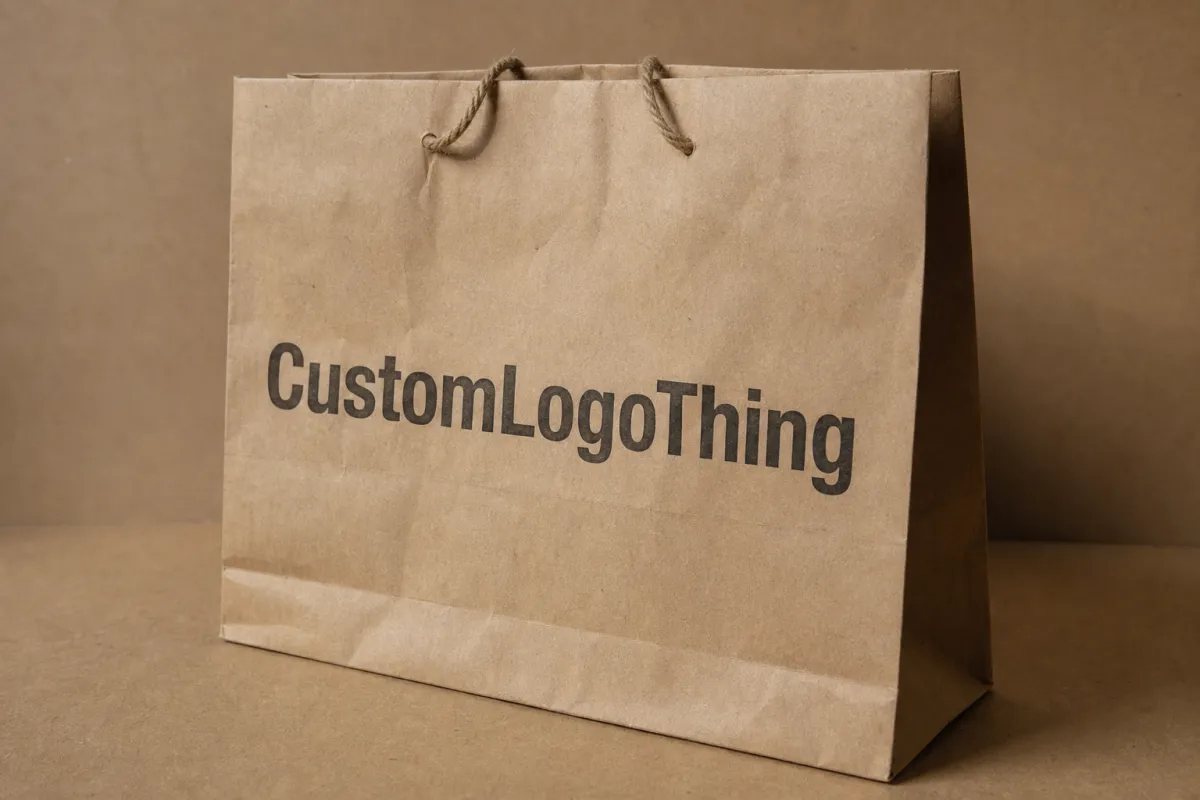
At the simplest level, custom kraft bags with rope handles are kraft Paper Shopping Bags fitted with corded handles for carrying. The rope may be cotton, polyester, paper rope, or twisted paper depending on the look, feel, and price target. The body is usually brown or white kraft paper, sometimes recycled kraft, sometimes virgin kraft, chosen for strength, finish, and the brand story the bag needs to tell. The structure makes the bag useful. The print makes it recognizable.
That structure usually has five parts: the outer paper, the side gussets, the base, the top rim or fold reinforcement, and the handle anchoring. Undersize any one of those and the bag starts to misbehave. Thin paper creases easily. Weak handle anchors pull. A soft base sags under boxed goods. The bag may still look attractive on a shelf, then collapse the moment someone loads it. That is the expensive surprise.
Most buyers choose custom kraft bags with rope handles because they sit in a useful middle ground. They look more polished than a basic die-cut bag or thin carrier, yet they are usually faster to source and easier to print than rigid packaging. For many retail programs, that makes them a practical route to a stronger checkout presentation without jumping straight into premium custom printed boxes. Apparel, candles, cosmetics, gift sets, and event kits all fit comfortably here.
There is also a practical reason procurement teams like them: the bag format is familiar enough to quote quickly, but flexible enough to support different brand tiers. A bakery launch may need a lighter build with paper rope and one-color print. A jewelry boutique may want a heavier kraft stock, cotton rope, and foil detail. Same object, different economics. That is part of the appeal.
One rule is worth keeping close: a kraft bag is not a print surface first. It is a carrying structure first. A good supplier will ask about product weight, contents, and shipping conditions before talking about colors or finishes. If those questions never come up, the supplier is quoting a bag, not engineering one.
A rope handle is load-bearing, not decorative. Treat it like trim and the bag will correct you in public.
How Custom Kraft Bags With Rope Handles Are Built
The build stack is where most performance and cost decisions are made. Paper grade comes first. Standard kraft bags often sit in the 120-200gsm range, though that is only a starting point. A 120gsm bag can work for light apparel or paper goods. A 170-200gsm bag usually feels firmer and keeps its shape better. Once the contents get heavier, base construction and handle reinforcement matter as much as the paper itself.
Material choice changes both appearance and behavior. Virgin kraft tends to look cleaner and more consistent in color. Recycled kraft usually has a more natural, textured appearance and can support sustainability claims, but the surface can be rougher and less predictable for fine detail. Coated kraft improves print clarity and color density, though heavier coating can flatten the natural paper feel that many brands want. That tradeoff is normal. Packaging rarely gives you every advantage at once.
Handle style is the next major decision. Cotton rope feels soft and premium in the hand. Polyester rope usually offers stronger consistency and better durability, which matters if the bags will be reused or packed tightly for shipping. Paper rope keeps the material story closer to paper-based packaging and can suit eco-focused programs, though it may not feel as plush as cotton. Twisted paper handles still have a place, especially for lighter retail packaging where the price target is tighter and the design does not need a luxury cue.
Handle attachment is where quiet failures tend to hide. Common options include internal knotting, glued reinforcement patches, folded top rims, and punched openings with eyelets or reinforced inserts. The stronger the anchor, the less likely the handle is to pull through under repeat use. If the bag is carrying dense items such as bottles, boxed food, or stacked jars, ask how the handle is attached and what load test was used. Vague answers usually mean a vague spec.
Printing behaves differently on kraft. Flexographic print is common for simple graphics and larger runs. Offset print gives better detail and color consistency on smoother stocks. Screen print handles bold art and spot colors well. Foil stamping, embossing, and debossing can add premium cues, but they also turn into clutter fast if the design is already busy. On kraft, restraint usually wins. A strong logo, one or two confident colors, and well-spaced layout often outperform a crowded design trying to imitate luxury by force.
Finish choices matter too. Matte is the default for many kraft programs because it preserves the natural paper feel. Gloss can make colors pop, but it also softens that earthy look some brands are chasing. Embossing makes a logo feel tactile. Hot foil can work beautifully for fashion, gifting, and beauty packaging. On rough kraft, though, too many finishes can make the sample look like three different ideas arguing in one sheet. Pick one or two premium signals and stop there.
There is a production logic behind all of this. Bag factories do not build around design theory; they build around folds, stress points, and machine tolerances. A beautiful reference image means very little if the gusset width is too tight for the product stack or the base score is too shallow for the load. The best-looking kraft bag is usually the one whose engineering disappeared into the background because it was specified correctly.
Cost, Pricing, MOQ, and Quote Drivers
Pricing for custom kraft bags with rope handles is shaped by several variables that move together. Size is the obvious one. Larger bags use more paper and need more structure. Paper thickness matters because heavier board raises material and forming costs. Handle type changes both the unit price and the labor time. Print coverage affects plates, setup, and ink usage. Special finishes add handling steps. Reinforcement at the mouth or base adds material and production time. Each of those can move the number more than a buyer expects.
Minimum order quantity, or MOQ, is another pressure point. Smaller runs usually cost more per unit because setup and labor are spread across fewer bags. A 1,000-piece order can make sense for a launch or seasonal event, but the unit price is usually higher than a 5,000-piece or 10,000-piece run. Lower unit cost usually comes from a stable size and a locked spec. Flexibility has a price tag. Packaging does not hide that very well.
For practical budgeting, simple unPrinted Kraft Bags with rope handles generally land at the lower end, while custom printed rope-handle bags with color, reinforcement, or premium finishes rise quickly. Freight matters too. Carton pack count matters as well, because denser packing can reduce shipping cost per bag while increasing crush risk if the cartons are stacked badly. Sample charges, color matching, and rush fees are also part of the total. They do not shout, but they still affect the final quote.
The cleanest way to compare suppliers is to force every quote onto the same spec. Same dimensions. Same paper weight. Same handle material. Same print count. Same finish. Same packing method. Without that, you are not comparing pricing. You are comparing assumptions with different confidence levels.
| Build type | Typical MOQ | Typical unit price at 5,000 pcs | Best for | Notes |
|---|---|---|---|---|
| Plain kraft, twisted paper handle, 120-150gsm | 1,000-2,000 | $0.22-$0.45 | Light retail, events, giveaways | Good value for low-weight items, but it will show strain faster with heavier contents or premium gifting. |
| Recycled kraft, cotton rope handle, 150-180gsm, 1-2 color print | 1,000-3,000 | $0.38-$0.75 | Boutiques, branded packaging, mid-tier retail | Balanced appearance and strength. This is often the easiest spec to approve internally. |
| Coated kraft, cotton or polyester rope handle, full-color print, foil or embossing | 3,000-5,000 | $0.85-$1.80 | Luxury gifts, beauty, premium launches | Sharp presentation, but artwork and finish decisions need tighter control. |
| Heavy kraft with reinforced mouth and base, strong rope handle, custom insert | 3,000+ | $1.10-$2.20 | Dense products, bottles, high-end retail | Best when the bag must hold weight without stretching, tearing, or deforming. |
Practical range: for many standard branded runs, buyers often land around $0.35-$0.90 per unit at 3,000-5,000 pieces, depending on print coverage, reinforcement, and freight. That is not a promise. It is a realistic planning band. Smaller quantities, heavier paper, and premium finish work can push the number up quickly.
If a quote looks too low, ask what was left out. Handle quality, paper thickness, reinforcements, and freight are common omissions. Sometimes all four disappear from the first estimate. A low quote without a spec sheet is just a number trying to sound confident.
A supplier who prices aggressively on paper weight and handle type may still be useful, but only if the omission is intentional and disclosed. The problem is not a lean price. The problem is hidden compromise. A bag that saves a few cents and fails after two carries is expensive in the wrong way.
Production Process and Lead Time
The production path is usually straightforward if the buyer stays organized. It begins with a brief: size, use case, quantity, artwork, paper preference, and shipping timing. Artwork review and dieline confirmation come next. Then sample making or digital proofing. Then approval. Then production. Then quality control, packing, and delivery. The order sounds plain. That is a good sign. Packaging should be plain during production and dependable in use.
Delays often appear in the same few places. Artwork does not fit the dieline. Pantone references are missing or inconsistent. A handle stock changes and the factory asks for approval on a substitute. The sample gets approved late because five people need to weigh in. None of this is unusual. It is ordinary project friction. Ordinary friction still burns lead time.
Simple orders usually move faster because there are fewer moving parts. A standard kraft bag with one or two colors, a common size, and a common handle can move through production faster than a fully customized premium build. Once special finishes, custom size changes, thicker board, or heavier freight packing enter the picture, the timeline stretches. A realistic planning window for many custom runs is often 12-20 business days after proof approval, with extra time needed for large quantities, complex print, or international shipping.
Sample validation matters because the first full run should not become a paid experiment. A production sample or pre-production prototype lets you check the paper feel, handle grip, print color, and bottom strength before hundreds or thousands of bags are made. A photo cannot tell you how the bag behaves under a real load. A sample can.
Retail timing can be the hidden problem. A bag that arrives after launch does not help the campaign. Build buffer time for revisions, freight delays, and late artwork changes. If the bags support a seasonal event or store opening, it is usually smarter to order early with a slightly safer spec than to chase a cheaper quote that lands after the window has closed.
There is also a coordination issue that shows up in multi-location programs. If the same bag will be used across stores, pop-ups, and e-commerce packouts, ask how cartons are labeled and whether batches can be kept consistent. One color shift or one handle substitution can create avoidable inconsistency across a rollout. The fix is usually simple: better specification upfront.
Step-by-Step: How to Order the Right Bag Spec
Start with use case. That sounds basic, which is exactly why people skip it. Retail merchandise, gift packaging, takeaway food, and event giveaways need different dimensions and different strength targets. A candle store bag does not need the same build as a wine bag or cosmetics bag. A boutique apparel bag does not need the same bottom reinforcement as a jar-filled food gift pack. The contents decide the structure, not the logo.
Measure the product stack rather than guessing the bag size from memory. Height, width, and depth all matter. A bag that is too shallow forces the top to flare awkwardly. A bag that is too wide wastes paper and can look limp. A bag that is too short creates handle strain and ugly creasing. Buyers often like the idea of one universal size. In practice, two or three sizes usually work better, especially if the range includes both flat items and boxed goods.
Choose the handle based on feel and load. Rope handles are popular because they feel more substantial than thin twisted paper handles. Cotton rope gives a softer hand feel. Polyester rope handles may last better in repeated use. Paper rope can align with paper-based branding. Think about whether the bag is meant for one carry home, several uses, or extended reuse by the customer. That answer should shape the handle spec right away.
Lock the print area around the actual dieline. Logos, barcodes, recycling marks, and safety text should not land in a fold, near a handle anchor, or too close to a gusset crease. If the design wraps around the side panel, check the seam area carefully. Good artwork still gets damaged by lazy layout. Packaging design is not just decoration. It is placement, visibility, and respect for the structure.
Ask for a sample or prototype. Handle it. Fill it. Lift it. Check the top edge for distortion. Check the base for sagging. Check the print for registration issues. A few minutes of real testing is worth more than a page of polished email language. If the sample fails, adjust the spec before production. That is the point of the sample.
- Define the contents and the likely weight range.
- Choose dimensions based on the product stack, not the artwork.
- Select paper weight and reinforcement level.
- Pick the rope handle material and attachment style.
- Approve the dieline and print layout.
- Test a filled sample before mass production.
If you are building a broader package branding system, align the bag with labels, cartons, tissue, and inserts. A retail program feels stronger when the bag, box, and wrap look like they belong to the same brand family. If you need more formats in one place, our Custom Packaging Products catalog helps compare bag and box options together.
That sequence sounds fussy until a buyer has been burned by a bag that was beautiful in a mockup and wrong in hand. Most failed packaging specs are not dramatic failures. They are small mismatches that compound: a handle a little too narrow, a gusset a little too shallow, a finish a little too glossy for the paper. The process above catches those before they become inventory.
Common Mistakes That Make Bags Look Cheap
The first mistake is paper that is too thin for the contents. A bag can look premium in a mockup and still wrinkle, buckle, or tear if the paper weight is too light. That risk rises when the contents are dense or the customer is likely to reuse the bag several times. Thin paper gives itself away quickly. Buyers usually spot the weakness before the first complaint lands.
The second mistake is poor proportion. Oversized logos, cramped side panels, and handles placed too close to the top edge all make the bag feel rushed. The bag may still function, but the visual balance suffers. Kraft works best when the print has room to breathe. That does not mean empty space for the sake of minimalism. It means giving the logo, margins, and handle zone enough separation that the bag looks intentional.
The third mistake is color choice. Brown kraft changes how inks appear. Dark inks can look rich if the print method suits the paper. Pale inks can disappear. Fine gradients often shift or flatten. White ink may need an underbase. Metallics can lose impact on rough surfaces. If the design depends on delicate color transitions, test on the actual paper before approving the full run. Screen mockups are not proof. They are a persuasive picture of something that still needs to survive production.
The fourth mistake is ignoring the load. A beautiful bag that cannot hold bottles, boxed goods, or dense retail products is not premium. It is decorative. That works for some uses, but not if the bag is meant to replace a stronger shopping carrier. Ask for a load test, or at least a sample fill test with the real product weight. The handles should not stretch, the base should not bow, and the top should not distort after one lift.
The fifth mistake is poor storage and handling. Kraft bags do not enjoy damp warehouses, crushed cartons, or careless stacking. Humidity can warp the paper. Rough carton handling can bend the rim. If the bags arrive flat but look tired on the packing table, the issue may not be production at all. It may be the storage environment. Packaging lives inside a supply chain, not in a display case.
One more subtle failure shows up often: trying to make the bag do too much. Too many finishes. Too many colors. Too many messages. Too many badge-style claims squeezed onto one small front panel. The result starts to look like a committee meeting. Simpler usually sells better, especially on kraft.
There is a quiet pattern behind most of these mistakes. Buyers often optimize for the sample, not the real use case. A sample photographed under studio lights can hide weak anchoring, shallow base construction, or poor print contrast. Once the bag is filled, the truth appears quickly. That is why a practical test matters more than a polished rendering.
Sustainability, Recycling, and Compliance
Kraft bags often get chosen because they look more paper-forward and easier to position as recyclable-friendly than plastic-heavy packaging. That is directionally true, but the details still matter. Paper fiber, handle material, coating, ink system, and adhesive all affect how the bag should be described and how it may move through local recycling streams. Local rules vary, so broad claims need to stay specific and honest.
If sustainability is part of the brief, ask for the content breakdown. Is the kraft recycled content? Are the handles paper-based or synthetic? Is there a plastic lamination? Is the adhesive water-based or something else? Are coatings needed for scuff resistance? Those answers determine how strong the environmental story really is. A bag that looks green but is assembled from mixed materials is still a mixed-material bag.
For sourcing language and responsible forestry references, the FSC standards pages are a useful reference point. If the bags need to survive transit, carton pressure, or distribution handling, ISTA testing guidance is worth knowing. It is not glamorous work, but it is better than discovering a weak build after the bags have already been shipped around the country.
From a compliance angle, keep the claims tight and supportable. If you say recycled, know the content percentage or the supplier basis. If you say recyclable, understand the local market context. If you say FSC-certified, make sure the paperwork matches the claim. Buyers do not need marketing fog. They need packaging design that fits the supply chain and the retail environment it will actually face.
There is a brand side to this too. Sustainable package branding works better when the materials and the message agree with each other. A kraft bag with a huge glossy foil logo and a vague eco claim can feel contradictory. A cleaner design, honest material description, and careful finish choice usually look more credible.
One more practical point: a sustainability claim should never create a durability problem. Some buyers switch to lighter paper to sound greener, then pay for it in returns, replacements, and damaged presentation. A credible program balances material claims with real-world performance. That balance is what separates a thoughtful packaging choice from a shallow one.
Expert Tips and Next Steps Before You Place the Order
If you want the quote to be useful instead of decorative, send a proper brief. Include the use case, exact dimensions, target quantity, paper weight, handle material, print colors, finish, and delivery window. If the bag will carry heavy items, say so early. If you need matching retail packaging across a bag and insert set, say that too. A complete brief saves time on both sides and usually produces a tighter price.
Ask for a spec sheet, not just a price. The spec sheet should show paper gsm, handle construction, reinforcement points, dimensions, print method, and packing details. If a supplier cannot produce that level of detail, the quote is too vague to compare properly. The lowest number on the page is not the best value if it hides the wrong build.
Request a side-by-side sample comparison if you are choosing between two or three builds. One might use paper rope, another cotton rope, another a heavier board. Place your real product into each sample, then lift and carry them. The difference is usually obvious in less than a minute. A slightly higher unit price can still be the cheaper choice if it prevents customer complaints and replacement costs later.
Check carton counts and storage conditions before the order lands. Flat-packed bags are supposed to stay flat, clean, and dry. If your warehouse is humid or your launch room is cramped, make sure the packing format fits that reality. Also confirm whether the cartons are labeled by size, color, or batch. That detail sounds minor until someone is sorting thousands of bags the night before a store opening.
Finally, tie the order to a real production calendar. If you need the bags for a launch, event, or retail relaunch, work backward from the delivery date and give yourself revision buffer. Custom packaging should support the campaign, not threaten it. That is a low bar, yet many projects still miss it.
A final field note: if you are ordering custom kraft bags with rope handles for a mixed assortment, build around the heaviest SKU in the range, not the lightest. Teams often spec to the average product and then wonder why the bag looks tired on the one item customers notice most. A bag that can carry the worst case will usually handle the rest without complaint.
Final Take
Custom kraft bags with rope handles perform best when the buyer treats them as a structural product with a branded surface, not a pretty accessory. Get the paper weight right. Match the rope handle to the load. Keep the print clear and deliberate. Compare quotes on the same spec. Test a filled sample before approval. That is the boring process that keeps the finished bag from looking cheap or failing in use.
If you want the bag to support your retail packaging rather than fight it, custom kraft bags with rope handles remain one of the smartest options in the lineup. The actionable takeaway is straightforward: define the contents first, then choose the paper, handle, and reinforcement around that real weight and size. Do that, and the rest of the specification becomes much easier to defend internally.
Questions Buyers Ask Most
How much weight can custom kraft bags with rope handles hold?
It depends on paper weight, handle attachment, and whether the bottom is reinforced. Light retail items usually work in standard builds, while heavier products need thicker board and stronger handle anchoring. Ask for a load test or a sample fill test before you commit to production.
Are custom kraft bags with rope handles recyclable?
Most kraft paper bags are recyclable, but mixed materials can change how local recycling rules apply. Paper rope and paper-based reinforcements are usually easier to handle than plastic-heavy parts. If sustainability matters, ask what the handle, coating, and adhesive system are made from.
What affects the price of custom kraft bags with rope handles the most?
Size, paper thickness, handle type, print coverage, and special finishes drive most of the cost. Lower quantities usually raise unit cost because setup fees are spread across fewer bags. Shipping and rush timing can matter more than people expect.
What is the usual lead time for custom kraft bags with rope handles?
Simple orders move faster than complex, fully customized builds. Artwork approval, sampling, and freight all add time, so the fastest factory quote is not always the fastest delivery. Build buffer time into your launch plan so a late proof does not derail the schedule.
Can I print full-color artwork on custom kraft bags with rope handles?
Yes, but kraft paper changes how colors look, especially soft tones and fine gradients. High-coverage art may need a different print method or a white underbase to stay readable. For the cleanest result, keep the design bold and test it on the actual kraft stock first.

