Buyer Fit Snapshot
| Best fit | Custom Poly Mailers with Tear Strip projects where brand print, material claims, artwork control, MOQ, and repeat-order consistency need to be specified before quoting. |
|---|---|
| Quote inputs | Share finished size, material target, print colors, finish, packing count, annual reorder estimate, ship-to region, and any compliance wording. |
| Proofing check | Approve dieline scale, logo placement, barcode or warning zones, color tolerance, closure strength, and carton packing before bulk production. |
| Main risk | Vague material claims, crowded artwork, missing packing details, or unclear freight terms can make a low unit price expensive after revisions. |
Fast answer: Custom Poly Mailers with Tear Strip: Design to Delivery should be specified like a repeatable production item. The safest quote records material, print method, finish, artwork proof, packing count, and reorder notes in one written spec.
Production checks before approval
Compare the actual filled-product size with the drawing, then confirm tolerance on folds, seals, hang holes, label areas, and retail display edges. Reserve space for logos, QR codes, warning copy, and material claims before decorative graphics fill the panel.
Quote comparison points
Review material grade, print process, finish, sampling route, tooling charges, carton quantity, and freight assumptions side by side. A quote is only useful when the supplier can repeat the same color, closure quality, and packing count on the next order.
Custom Poly Mailers with Tear Strip: Design to Delivery
A packing line runs on seconds, not theory. One bag seals cleanly, stacks neatly, and slips into the rhythm of the workflow; another catches, wrinkles, or forces a worker to reach for tape. Multiply that by 500 orders and the difference starts to show up in labor, damage, and morale. That is the real appeal of Custom Poly Mailers with tear strip. They protect soft goods, carry a brand’s visual identity, and open in a way that feels deliberate rather than improvised. For apparel, subscription shipments, and other lightweight items, custom poly mailers with tear strip can improve both speed and presentation without slowing fulfillment.
Packaging rarely acts alone. It sits inside a larger system that includes labor time, return rates, shipping weight, storage space, and the customer’s first tactile impression. A mailer is not just a shell around a product. It is part of the product packaging story, and that story can influence whether a shipment feels cheap, polished, or forgettable. Brands already using Custom Packaging Products or Custom Poly Mailers often add the tear strip because it solves a practical problem while quietly improving the opening moment. In that sense, custom poly mailers with tear strip do two jobs at once: they help the packer and they help the customer.
There is also a simple economic reason they keep showing up in procurement meetings. Rigid packaging brings more material, more freight weight, and more cube in storage. A mailer is usually the better tool when the item is soft, low-profile, and already protected by an inner bag or sleeve. Apparel, accessories, bedding, and subscription kits often fit that profile. A shirt does not need a fortress. It needs protection, speed, and a clean arrival. That sounds obvious, but a surprising number of packaging specs still overbuild the job and then call the result “premium.”
“The customer notices the opening experience fastest when the package fights back.”
Once the job is broken into parts, the choice gets easier: what the product is, how it is packed, how it ships, and how the customer should feel when opening it. Those four answers usually expose the right specification quickly. From there, Custom Poly Mailers with tear strip become less of a purchase category and more of a design decision with operational consequences.
What Are Custom Poly Mailers with Tear Strip?
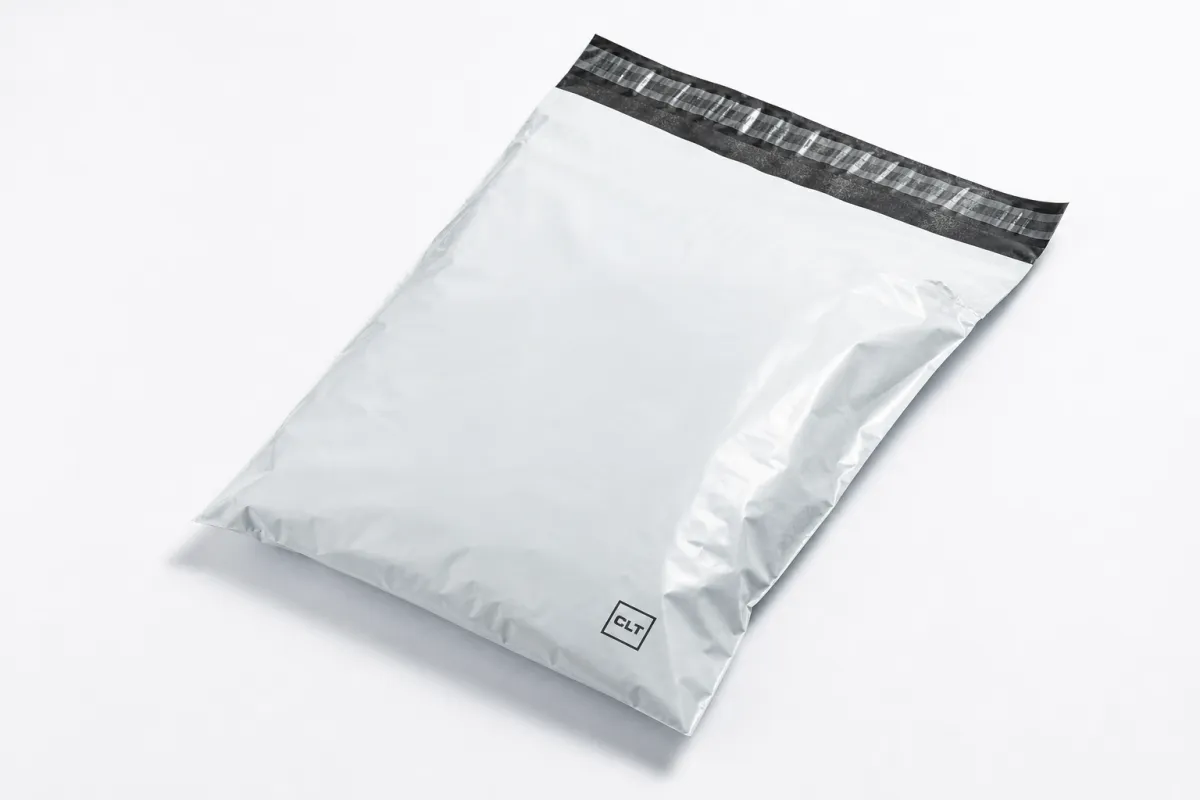
Custom Poly Mailers with tear strip are lightweight polyethylene shipping bags printed with a brand’s artwork, sealed with a pressure-sensitive flap, and built with an integrated tear line that guides the recipient through a controlled opening. The simplest way to think about them is this: they are flexible mailers for soft goods that open without a knife, scissors, or a desperate tug at the corner. That sounds modest. It is not. The tear strip changes the package’s behavior at the exact moment the customer touches it, which is usually the moment judgment is fastest.
That small design choice matters in the packing room too. A worker inserts the product, closes the flap, and moves on with a repeatable motion. Later, the customer follows the tear line instead of improvising a safer or more destructive opening. Less chance of puncturing a garment. Fewer complaints about split seams. Fewer packages that look as if they were opened in a hurry and then repaired with bad tape. For brands focused on package branding, that clean opening helps the outer package feel intentional, even if the product inside is simple.
Price and weight explain why many brands choose custom poly mailers with tear strip instead of jumping directly to boxes. The comparison is a little like choosing a field jacket over a suit of armor. Both cover the body, but one is built for movement. Boxes still make sense for fragile goods, premium unboxing rituals, or items that need structural support. Mailers make sense when the product is soft, the fulfillment pace matters, and shipping cost has to stay sane. That difference becomes glaring once you start counting every extra inch of void fill and every extra ounce of freight.
Planning gets easier once the conversation shifts from “mailer or box?” to “what job does this package need to do?” In practice, that usually means looking at three things: product fragility, packing speed, and the opening experience. If the product is folded apparel, a scarf, a set of socks, or a subscription item with compact contents, the mailer often wins. If the item is rigid, delicate, or likely to be crushed, the box wins. That’s not glamorous, but packaging decisions rarely are.
For brands shipping soft goods, the tear strip adds one more layer of value. It lets the bag open cleanly without turning into shredded film. That matters because the customer’s first interaction with the package is physical, not visual. They feel the seal, pull the strip, and decide within seconds whether the packaging seems thoughtful. A clean tear makes the package feel controlled. A jagged rip makes it feel cheap. The difference is tiny on paper and loud in the hand.
How Custom Poly Mailers with Tear Strip Work in Packing
Most custom poly mailers with tear strip use a straightforward structure: one or more polyethylene film layers, heat-sealed side seams, an adhesive closure flap, and a tear feature placed so the end user can open the package along a predictable route. Some designs place the opening cue on the flap itself; others position it just below the seal. The goal is always the same. The tear line should be easy to find, but not so weak that the package opens on its own during transit. That tension between accessibility and durability is the central engineering problem.
On the line, the motion is simple enough to disappear into muscle memory. Insert the item. Press out excess air. Close the flap. Stack the finished mailer. Good adhesive grabs quickly and survives conveyor movement, warehouse handling, and parcel sorting pressure. Weak adhesive, a narrow flap, or slick film changes the story fast. The package pops open before it reaches the carrier, and a simple mailer turns into an expensive mistake. Fulfillment teams learn quickly that flap geometry, adhesive strength, and film finish matter as much as artwork. With custom poly mailers with tear strip, the functional seal and the printed surface have to cooperate.
The customer’s side of the experience is just as revealing. A tear strip prevents the classic over-rip, where someone pulls at a corner, tears the film unevenly, and cuts too deep into the contents. The package opens with less effort, the contents stay safer, and the brand avoids the feeling of disposable frustration. That matters for branded packaging because the opening moment often decides whether the shipment feels considered or merely functional. Subscription orders especially depend on that moment; one clean opening can carry more emotional weight than a loud print design. That may sound a little dramatic, but customers really do remember friction more than they remember claims.
These mailers are well suited to lightweight, non-fragile goods such as:
- Apparel and folded textiles
- Accessories like scarves, hats, and belts
- Soft home goods, pillow covers, and bedding components
- Subscription shipments with compact contents
- Retail packaging for items already cushioned inside an inner pouch
They also reduce shipping drag in a practical way. Lighter packages are easier to move through carrier networks and less likely to incur avoidable dimensional penalties when the contents are low-profile. A soft item in a well-sized mailer can move faster and cost less than the same item in an oversized rigid box. For teams that care about throughput and perception, custom poly mailers with tear strip sit in a useful middle ground: compact, branded, and easy to open. It is kinda the point of the format.
Key Factors That Affect Performance and Print Quality
Film thickness is usually the first number buyers compare. It may be listed as gauge or micron, but the question is the same: how much body does the mailer have, and how much abuse can it absorb? Thicker film usually improves puncture resistance and makes the bag feel more substantial in hand. Thinner film can lower material use and trim cost. Bigger is not automatically better. If the mailer becomes too stiff for the product size, operators spend extra time folding, aligning, and forcing the seal into place. The best custom poly mailers with tear strip feel durable without slowing the person packing them.
Closure performance deserves equal scrutiny. The adhesive flap needs enough bite to survive handling, temperature swings, and stacked storage, but not so much that it wrinkles badly or creates a messy finish. Humidity, cold dock conditions, and dust can all change how a pressure-sensitive adhesive behaves. That is why sample testing matters. A bag that looks correct on a screen may feel entirely different once it is filled, pressed, and handled dozens of times. In a real fulfillment environment, small seal problems become large ones quickly.
Print quality behaves differently on flexible film than it does on paperboard. Heavy coverage, large solid fields, and tight registration all require planning. Deep brand colors can print beautifully, but the artwork still needs contrast where customers need it most: logo marks, return instructions, and tear-strip cues. If the visual field is too busy, the opening point can disappear into the design. That undercuts one of the main reasons buyers choose custom poly mailers with tear strip in the first place. The package should be easy to read before it is easy to open.
Sizing causes more trouble than many teams expect. Oversized mailers waste film and let the packed order slide around. Undersized mailers force the seam to work harder and can stretch the film beyond comfort. The safe way to size a mailer is to measure the packed form, not just the product. Account for the fold, the insertion motion, and the adhesive overlap. For folded apparel, a few millimeters can separate a clean seal from an awkward one. I have seen that in sample runs more than once: a spec that looked fine on the page turned into a wrestling match on the bench.
Material choice shapes both performance and perception. Some brands want downgauged film to reduce resin use. Others ask for recycled content or a matte finish that feels closer to retail packaging than ordinary shipping plastic. Sustainability claims need proof, not vague language. The EPA’s recycling guidance at EPA recycling resources provides a useful baseline, and shipping test methods from ISTA can help define what a package should survive in transit. With custom poly mailers with tear strip, the functional spec and the brand spec live in the same object, so both deserve attention.
Comparing mailers to other packaging formats is less about declaring a winner and more about matching the tool to the job. A box makes sense for rigidity, protection, or premium structure. A mailer makes sense for speed, low-profile products, and fewer shipping penalties. If the item is soft and the process needs to move quickly, custom poly mailers with tear strip often make more business sense than heavier custom printed boxes. The savings are not always dramatic on a single order, but over a quarter they can become real money.
Custom Poly Mailers with Tear Strip: Cost, Pricing, and MOQ
Pricing for custom poly mailers with tear strip usually turns on a handful of variables: size, film thickness, number of printed colors, print coverage, adhesive specification, tear-strip style, and total quantity. A small one-color mailer with limited coverage costs less than a full-bleed design with reinforced film and a more complex conversion process. Buyers often fixate on unit price, then miss the larger picture. The real budget includes proofing, freight, setup, packaging configuration, and any rush fees that come with a compressed schedule.
MOQ, or minimum order quantity, matters because custom printing and converting carry setup costs. Plates, cylinders, prepress review, and machine adjustment all have to be paid for somewhere, and that cost gets spread across the run. Short runs usually carry a higher unit cost than larger ones. As a rough planning range, stock poly mailers can land around $0.09-$0.18 each depending on size and market conditions, while custom one-color mailers with a tear strip may fall around $0.18-$0.32 each at common production volumes. More complex custom poly mailers with tear strip, especially with heavier film or dense print coverage, can move into the $0.28-$0.48 range or higher. Those numbers are planning ranges, not guarantees, because resin, freight, and capacity all move.
Here is a simple comparison that buyers often find useful:
| Option | Typical MOQ | Common Unit Range | Best Fit | Notes |
|---|---|---|---|---|
| Stock poly mailer, no print | 500-1,000 | $0.09-$0.18 | Fast replacement needs | Lowest setup burden, no branding |
| Custom one-color mailer with tear strip | 3,000-5,000 | $0.18-$0.32 | Starter branded shipping | Good balance of cost and presentation |
| Custom full-color mailer with tear strip | 5,000-10,000+ | $0.28-$0.48+ | Brand-forward campaigns | Higher print complexity and setup cost |
| Heavy-gauge premium mailer | 5,000+ | $0.32-$0.60+ | Higher abuse handling | Better stiffness, higher material use |
The cheapest-looking option is not always the cheapest landed option. A mailer that tears badly, fails in transit, or slows the pack line can cost more than a slightly pricier spec that works every time. If your brand is comparing custom poly mailers with tear strip against broader custom packaging products, ask how the packaging affects labor, damage risk, and shipping weight over a full month of orders. Those indirect costs are easy to ignore and hard to recover once they show up.
Freight can swing the final number more than buyers expect if cartons are bulky or the shipment crosses zones. Print complexity matters too. A design with many colors may require more setup than a bold single-color mark. Request landed cost, not just factory price, so the quotes can be compared on the same terms. Clarity in the request usually comes back as cleaner pricing and fewer revisions, especially for custom poly mailers with tear strip. I would also ask for a plain-language spec sheet, not just a price line. That makes comparisons less fuzzy.
Custom Poly Mailers with Tear Strip: Production Steps and Lead Time
The production path begins with the specification sheet. Size, film gauge, print colors, closure style, tear-strip placement, and packing configuration all need to be clear before the job moves forward. Artwork review follows, with the supplier checking bleed, safe zones, resolution, and file format. Vector files usually hold text and logos more cleanly on flexible film because the edges stay sharp. A complete file saves time. An incomplete one burns it. For custom poly mailers with tear strip, a good brief can remove days of back-and-forth.
After the proof is approved, materials are scheduled and the printing run begins. Depending on the print method and the plant’s workflow, the process may include color matching, curing, slitting, converting, and final packing. Each stage carries its own checks. If the film needs a particular finish or the adhesive has to meet a target grab level, those details are verified before the run is boxed. Lead time is never just “printing time.” It is prepress, materials, machine scheduling, and quality control stacked together. A job that looks simple on paper can still take longer than the buyer expected.
- Confirm the finished size and packed product dimensions.
- Approve the artwork and dieline layout.
- Review and sign off on the proof.
- Schedule materials, print, and converting.
- Inspect the finished run and pack for shipment.
Lead time shifts with season, order size, and complexity. A straightforward one-color order with ready-to-print files may move quickly. A dense full-color design, a recycled-content request, or a larger run can extend the schedule. Build in time for sample review and full production. If a launch date is fixed, say so early. Honest timing makes planning easier on both sides, particularly with custom poly mailers with tear strip, where artwork approval and material allocation often set the pace.
Samples help, but they do not predict everything. A sample can confirm size, feel, closure behavior, and general print look, yet the final production run may still vary a little because of machine settings and material batch variation. That is normal. The useful questions are practical ones. Does the tear strip open in the expected direction? Does the flap seal with normal pressure? Does the bag fit the product without forcing the seam? If those answers are yes, the job usually has a solid base.
One more thing: if the supplier only shows a digital mockup and refuses to discuss real material behavior, that is a warning sign. It does not automatically mean the job will fail, but it does mean the buyer is carrying more risk than they probably realize.
Common Mistakes When Ordering Tear-Strip Mailers
The first mistake is sizing the bag from the product dimensions alone. That ignores the packed shape, the closure overlap, and the way the item changes once air is pressed out. A folded sweatshirt, for example, can look compact on a spec sheet and still occupy more width and depth in real life. If the mailer is too tight, the flap becomes harder to close and the tear strip may end up awkwardly placed after folding. Good custom poly mailers with tear strip are based on the finished packed form, not the raw item alone.
Another mistake is overdesigning the print. Busy artwork can look energetic on a screen and become hard to read once transferred to flexible film. If the tear-strip cue, shipping information, or brand mark gets swallowed by too many graphics, the package loses the clarity it was supposed to gain. Packaging design should serve the function first and the style second. Strong retail packaging usually respects how the package will be held, stacked, and opened. The same rule applies to custom poly mailers with tear strip.
Seal behavior gets underestimated often. A pressure-sensitive flap may look fine in a small test and struggle in cold storage, dusty rooms, or fast fulfillment environments where operators do not hold the flap long enough. Ask how much overlap the seal includes and whether the adhesive is chosen for the actual line conditions. Gloves, cooler temperatures, and high-speed packing change the equation. A spec sheet that ignores those details usually misses the real risk. Nobody enjoys finding that out on the first outbound pallet.
“A tear strip only earns its place if the customer can find it, trust it, and open the bag without fighting the film.”
Skipping sample testing is another expensive shortcut. A mailer can look polished in a PDF and still feel slippery, weak, or awkward in the hand. It can also open too aggressively or not aggressively enough. The best buyers run the package through a real packing flow at normal speed. That test shows whether custom poly mailers with tear strip fit the warehouse as well as the design file.
The human side of fulfillment matters too. If the tear strip is hard to find, if the opening cue is vague, or if the seal closes too aggressively for fast work, staff will build their own workaround. Extra tape. Extra pressure. A different fold. Once that happens, the intended efficiency gain disappears. The strongest custom poly mailers with tear strip reduce friction for the shipper and the recipient at the same time, and that only happens when the bag is designed around real handling conditions.
There is also a trust issue here. Brands sometimes promise recyclability, premium feel, or premium protection in the same breath, even when the chosen material can only honestly support one of those claims. That kind of overreach creates a mismatch between marketing and reality. Better to be precise: the package is lightweight, printable, and easy to open, or it is made with recycled content, or it is designed for low-profile apparel. Specific claims are more useful than glossy ones.
Expert Tips and Next Steps for Ordering
Three pieces of information improve a quote request more than anything else: the finished product dimensions, the expected monthly volume, and the level of branding you want. If you can add a photo of the packed item and a note about fulfillment speed, the recommendation gets sharper. That helps the supplier judge whether a lighter gauge, a stronger adhesive, or a more visible tear-strip cue makes sense. For custom poly mailers with tear strip, specifics lead to better answers.
Real-world testing matters more than desk testing. Put a few samples through the same motions your staff uses every day: insert the item, close the flap, stack the order, and open the bag after a simulated transit. Watch for snagging, unclear tear behavior, or print that becomes hard to read once the film bends. If you are comparing options, place the mailer beside a box, a plain shipping bag, and your current package. Side-by-side comparison reveals tradeoffs faster than a spec sheet ever will. A heavier package is not automatically the better package. The right one is the one that fits the work.
Compare closing feel, tear-strip clarity, and print durability together. A mailer that looks good but tears badly is not a win. A mailer that seals well but prints poorly misses the branding goal. A mailer that prints beautifully but slows the line costs more than it saves. Custom poly mailers with tear strip earn their keep only when they support speed, presentation, and reliable opening in the same spec.
A sensible launch plan looks like this: confirm the size, approve the artwork, request samples, review pricing, and schedule production with enough cushion for review and freight. That order keeps the project moving without skipping the checks that prevent expensive rework. If your packaging system is broader than the mailer itself, review how these bags fit with your other product packaging choices, from inserts to labels to mailer boxes. A coordinated system usually feels stronger than a pile of unrelated parts.
If you are making the call now, here is the practical filter: choose custom poly mailers with tear strip only after the packed size is confirmed, the adhesive is tested in real line conditions, and the tear feature is visible in the artwork. That combination is what turns a mailer from “custom” into useful.
Custom poly mailers with tear strip work best when they are treated as a tool first and a branding surface second. The print matters. The customer sees it. The real value sits deeper: how the bag behaves under load, how quickly it seals, and how cleanly it opens after the parcel has traveled through the shipping network. Get those details right, and custom poly mailers with tear strip can make shipping faster, opening easier, and the brand experience more polished without adding unnecessary complexity. If there is one takeaway to carry into the next order, it is this: spec the package from the packed item outward, then test the tear strip before you commit to a full run.
FAQ
What are custom poly mailers with tear strip used for?
They are used for lightweight, non-fragile shipments such as apparel, accessories, and soft goods. The tear strip makes opening easier for the customer and helps reduce the chance of damaging contents with a knife or scissors. They also give brands a large printable surface for logos, messages, and other package branding details.
How do custom poly mailers with tear strip stay sealed during shipping?
They typically use a pressure-sensitive adhesive flap that bonds after the mailer is closed. The tear strip is separate from the primary shipping seal, so the package can remain secure until the recipient opens it. Good performance depends on proper flap closure, the right adhesive strength, and the correct film thickness in the finished custom poly mailers with tear strip.
What affects the price of custom poly mailers with tear strip?
Size, film gauge, print coverage, and the number of ink colors are the biggest cost drivers. MOQ, setup requirements, freight, and rush timing can also move unit cost up or down. More complex artwork and special finishes usually add cost compared with simple branding on custom poly mailers with tear strip.
How long does production usually take for custom poly mailers with tear strip?
Lead time depends on artwork approval, material availability, and the size of the run. Simple jobs with ready-to-print files usually move faster than projects that need proofing or revisions. A realistic schedule should include time for samples, approval, printing, converting, and packing, especially if you want the final custom poly mailers with tear strip to match the approved proof closely.
How do I choose the right size for custom poly mailers with tear strip?
Measure the finished product in its packed form, not just the product itself. Leave enough room for easy insertion and a secure seal without forcing the seams. If you are unsure, sample two nearby sizes and test them on your actual packing line before ordering, because the best custom poly mailers with tear strip are the ones that fit the line as well as the item.

