Buyer Fit Snapshot
| Best fit | Custom Shipping Bags for Apparel projects where brand print, material claims, artwork control, MOQ, and repeat-order consistency need to be specified before quoting. |
|---|---|
| Quote inputs | Share finished size, material target, print colors, finish, packing count, annual reorder estimate, ship-to region, and any compliance wording. |
| Proofing check | Approve dieline scale, logo placement, barcode or warning zones, color tolerance, closure strength, and carton packing before bulk production. |
| Main risk | Vague material claims, crowded artwork, missing packing details, or unclear freight terms can make a low unit price expensive after revisions. |
Fast answer: Custom Shipping Bags for Apparel: Costs, Fit, and Use should be specified like a repeatable production item. The safest quote records material, print method, finish, artwork proof, packing count, and reorder notes in one written spec.
Production checks before approval
Compare the actual filled-product size with the drawing, then confirm tolerance on folds, seals, hang holes, label areas, and retail display edges. Reserve space for logos, QR codes, warning copy, and material claims before decorative graphics fill the panel.
Quote comparison points
Review material grade, print process, finish, sampling route, tooling charges, carton quantity, and freight assumptions side by side. A quote is only useful when the supplier can repeat the same color, closure quality, and packing count on the next order.
A bag can change three numbers at once: freight, damage rate, and first impression. That is why custom shipping bags for apparel deserve more attention than they usually get. A well-chosen mailer can trim ounces, speed up packing, and make a tee or hoodie feel like part of a brand story instead of just another parcel on a conveyor. The savings can be small on a single order and obvious across thousands of shipments. In apparel logistics, that kind of compound effect is hard to ignore.
From a packaging buyer's point of view, the interesting part is not whether a bag looks good on a desk mockup. It is whether Custom Shipping Bags for apparel still hold up after folding, sealing, carrier handling, and the rough edges of ecommerce shipping. Get the spec right and you protect margin as well as product. Get it wrong and the result is usually wasted space, higher return risk, or a brand presentation that feels cheaper than it should. A packaging choice that looks polished on screen can still fail in a warehouse if the fit, film, or seal is off by a few millimeters.
Custom Logo Things works in the middle of those realities every day: brand, protection, and practical packing behavior. That balance matters because apparel packaging is rarely one-size-fits-all. Tees, hoodies, leggings, socks, and subscription bundles all create different demands, even when they are all soft goods. A lightweight cotton shirt and a fleece crewneck may travel through the same carrier network, yet they do not need the same bag. The same is true for branded mailers, garment mailers, and higher-end retail packaging.
Good apparel packaging does not just move product. It manages cost, keeps order fulfillment moving, and gives the customer a clear signal that the brand understands details.
Custom Shipping Bags for Apparel: What They Are and Why They Matter
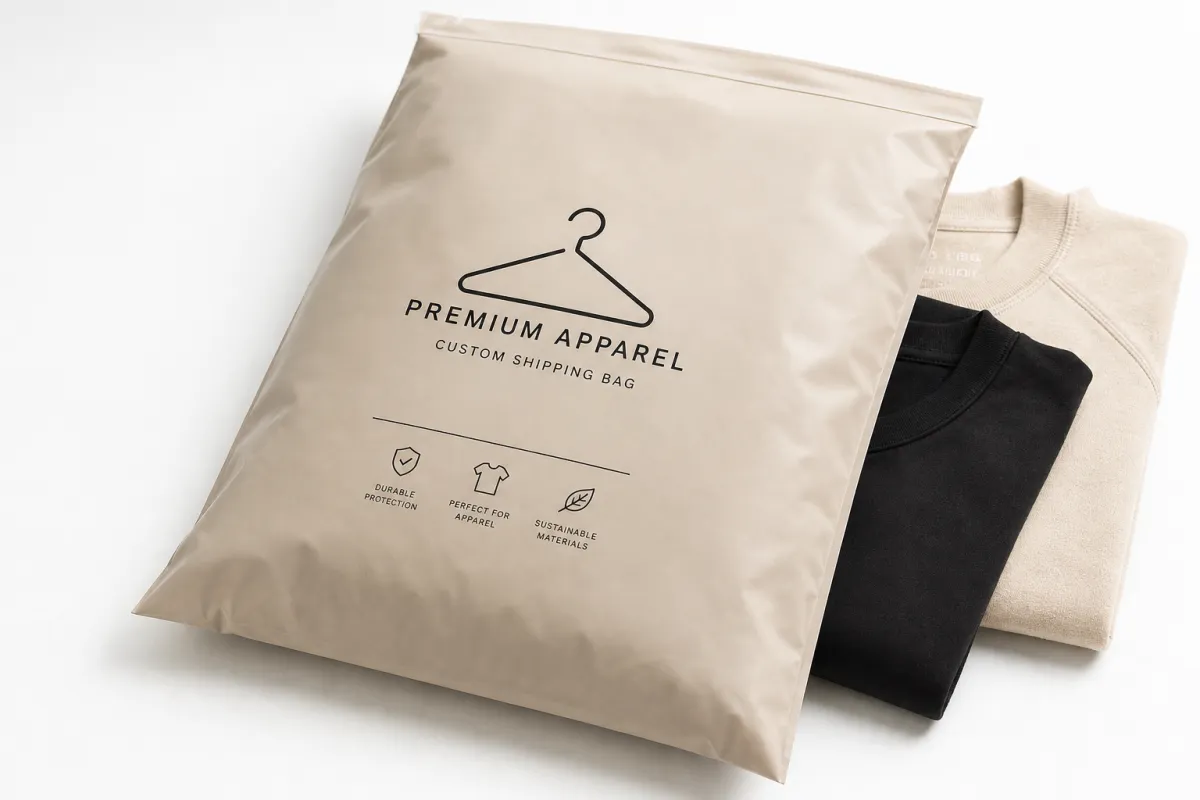
Custom Shipping Bags for apparel are flexible mailers designed to move folded garments safely and efficiently through the shipping process while also carrying brand identity on the outside. In plain language, they are the outer layer that helps a shirt, hoodie, or activewear set arrive clean, protected, and recognizable. Depending on the build, that outer layer might be a plain poly mailer, a fully printed mailer, a recycled-content option, or a specialty apparel bag with extra features like tear strips or dual adhesive seals.
The surprise for many buyers is how much a bag influences the economics of the order. A small shift in material thickness, overall dimensions, or closure style can change labor time in order fulfillment, the carrier's dimensional weight math, and the customer's perception of value. That is why custom shipping bags for apparel are not just a packaging purchase. They are a packaging design decision, a logistics decision, and a retail packaging decision all at once. The bag is doing brand work even while it is trying to disappear into the shipping process.
Where do they fit in the lifecycle? Right at the practical center. Garments are folded, sometimes wrapped in tissue, then placed into the mailer or bag, sealed, labeled, and sent into transit. Once the parcel leaves the warehouse, the bag must do three jobs at once: protect from moisture and abrasion, hold up to handling, and represent the brand at delivery. For many DTC apparel brands, that means custom shipping bags for apparel become the most visible form of package branding the customer ever sees. The label may be the same as any other box on the porch; the color, print, and closure are what make it feel specific.
The most common use cases are easy to guess, but the details matter. Tees often fit in slim mailers that keep the package profile low. Hoodies and sweatshirts need more depth and a stronger seal area. Activewear frequently benefits from a cleaner, tighter fit because customers are sensitive to wrinkling and presentation. Accessories, socks, and small add-on items may ride along in the same bag if the spec allows it. Subscription boxes are a slightly different animal; some brands still use mailers for the outer shipper, while others move to custom printed boxes when the contents deserve more structure.
That comparison matters. A box is not automatically better just because it feels more substantial. For soft goods, the right custom shipping bags for apparel often provide enough protection at lower weight and lower cost. Boxes make more sense when crush protection, rigid presentation, or multi-item sets are driving the experience. Most apparel brands are not choosing between “good” and “bad.” They are choosing the packaging format that best matches product, margin, and fulfillment speed. A bag that saves 3 ounces and 20 seconds can beat a box that looks premium but slows the line.
If you are building a broader packaging program, it can help to think in tiers. Some brands use Custom Poly Mailers for everyday apparel orders, add a second packaging layer from Custom Packaging Products for inserts or retail presentation, and move select premium orders into Custom Shipping Boxes. The point is not to force every order into the same format. The point is to Choose the Right container for the job. That choice often changes with season, product mix, and price point.
How do custom shipping bags for apparel work in real shipping?
In a live warehouse, custom shipping bags for apparel are judged by speed as much as appearance. The flow is usually simple: fold the garment to a target size, insert tissue or an information card if needed, place the item into the mailer, remove the adhesive liner, seal, and send it to labeling or manifesting. That sounds basic. It is not. A bag that is 20 millimeters too narrow can slow the packer down on every order, and a bag that is too deep can make the final parcel sloppy, bulky, and harder to stack. One bad dimension can ripple through the whole bench.
Material thickness shapes performance in very concrete ways. A 2.0 mil poly film may work for very light shirts, but a 2.5 mil to 3.0 mil range is more forgiving for general apparel use because it better resists puncture from zippers, hang tags, and sharp folded corners. If the bag is intended for heavier garments or mixed-item shipments, 3.0 mil to 4.0 mil can be worth the extra cents. That extra thickness is not only about toughness. It also affects how the bag feels in the hand, how confidently the adhesive closes, and how much the package telegraphs care when it lands on a porch. Customers notice that last part, even if they cannot name it.
Seal strength matters more than many first-time buyers expect. A strong adhesive strip gives tamper evidence and protects against accidental opening during transit. For return-friendly programs, dual-seal designs can make sense because the customer can reuse the same mailer for a return without hunting for tape. That said, not every line needs a return feature. If your return policy or margin model does not support it, a simpler seal may be the smarter choice. The right custom shipping bags for apparel should reflect the business model, not just the wish list. A feature that looks convenient in a pitch deck can become dead weight in production.
Printed mailers do double duty. They are packaging and media. Every surface can reinforce the brand through color, logo placement, a short message, a social handle, or a return policy note. In practice, the best printed mailers are not crowded. They are clear. A sharp logo on one side, a repeat pattern on the other, and a legible message near the seal can look more premium than a surface filled edge to edge with graphics. That is a useful lesson in package branding: restraint often reads as confidence. Too much ink can make even a good garment feel over-sold.
There is also a comparison that buyers should make early, before artwork starts. Poly mailers are usually lighter and faster to pack than padded mailers, and they often cost less per unit. Padded mailers help if the product needs a bit of extra cushion, but they add material and bulk. Boxes offer the most structure, yet they increase weight, storage footprint, and packing time. For many folded garments, custom shipping bags for apparel are the most efficient option because the product is soft, stackable, and not especially crush-sensitive. A soft product in a rigid box can feel like using a suitcase for a T-shirt.
For brands that want a benchmarking frame, testing protocols from the International Safe Transit Association are worth reviewing. You do not need a lab coat to learn from them. Even a basic attitude of drop testing, vibration awareness, and seal verification can reveal whether your mailer spec is realistic before a full run is approved. A few simple tests can uncover problems that a hundred design revisions would miss.
Practical detail: a tighter fit can reduce movement inside the mailer, and less movement often means fewer scuffs, cleaner arrival presentation, and less time spent correcting issues at the packing table. That is the kind of operational gain people miss when they think only about artwork. In a warehouse shipping 1,500 orders a day, even a 6-second improvement per pack adds up to more than two and a half labor hours. For apparel brands, that is real money.
Key Factors That Shape Custom Shipping Bags for Apparel
Sizing is the first filter. A mailer that fits a slim tee may be useless for a heavyweight hoodie, and a mailer that swallows a small order can make the shipment look underpacked. The best custom shipping bags for apparel start with actual folded dimensions, not rough guesses. Measure the tallest stack you ship regularly, then add enough room for a smooth seal and any tissue, hangtag, or insert that needs to travel with the garment. If you sell mixed packs, size for the real packout, not the lightest single item. Brands often misjudge this part because a showroom fold and a warehouse fold are not the same thing.
Material choice comes next. Low-density poly can feel softer and more flexible, which is helpful when a brand wants a smooth hand feel. High-density poly can allow for thinner film while preserving a firmer feel and better tear resistance. Recycled-content films are increasingly common, but they should be chosen with a clear understanding of performance trade-offs, print results, and shelf-life requirements. Compostable options exist, yet they are not the default answer for every apparel brand. Their barrier performance, certification claims, and disposal pathways need review before anyone puts them into production. Green claims sound good; the material still has to survive the route.
Branding decisions should match the product tier. Some apparel lines look best with a simple logo, a return address, and one secondary brand line. Others want louder color, large graphics, or a full wrap print. Neither approach is inherently better. If the customer experience is premium and the garment price is high, bolder package branding can support the positioning. If the line is minimalist or sustainability-focused, quieter packaging may be more honest. The key is fit between the product packaging and the message. A luxury tee in an overworked mailer can feel less expensive, not more.
Closure options also matter. A standard adhesive strip is fine for many use cases, but tear strips, double seals, and return-use features can improve usability. The return feature, in particular, is underused because brands sometimes assume it is only for premium commerce. That is not always true. If the line has a measurable return rate and the bag design can make returns easier without adding too much cost, the feature may pay for itself in fewer support issues and less friction for the customer. A small design change can remove a surprisingly large amount of post-purchase friction.
Compliance and operations are the hidden layer. A mailer for apparel still needs to fit into the shipping system, survive carrier handling, and work within warehouse speed targets. If the bag is too glossy, labels may not adhere well. If the film is too slippery, packers may slow down. If the print is too busy, barcodes or routing labels may be harder to place. The best custom shipping bags for apparel are the ones that make the entire packing line faster, not slower. Packaging that creates problems at label application has already failed, even if it looks elegant on a shelf.
For sustainability claims, use current standards rather than vague promises. The EPA sustainable materials management guidance is a useful reference point for thinking about source reduction, recycling, and material efficiency. It is a good reminder that “eco-friendly” should be backed by specifics: recycled content percentage, end-of-life guidance, or actual material reduction. The difference between a claim and a fact is often one line on the spec sheet.
Useful rule of thumb: if you can shave 5 to 10 seconds off pack time per order and keep the mailer size honest, the savings can compound quickly across thousands of shipments. That is often more valuable than a slightly more dramatic print pattern. In many apparel operations, labor is the hidden cost that dwarfs a few cents of material savings.
Custom Shipping Bags for Apparel Cost: Pricing Factors That Actually Matter
Pricing is where many conversations get distorted. Buyers ask, “What does a mailer cost?” and suppliers have to answer with, “It depends.” That is not dodging the question. It is the reality of custom shipping bags for apparel. Size, thickness, print coverage, artwork complexity, material type, quantity, and freight all push the number around. A plain stock mailer and a fully printed branded bag can live in very different cost bands even if they share the same dimensions. The difference can be a few cents per unit or enough to change the economics of a whole launch.
At a practical volume like 5,000 pieces, a basic custom-Printed Poly Mailer for apparel might land around $0.18-$0.28 per unit depending on size and print coverage. A thicker or more specialized option can move into the $0.25-$0.40 range, especially if there is heavier ink coverage, recycled content, or a more complex closure. Smaller orders usually cost more per unit because setup work is spread across fewer bags. Larger orders typically push the unit price down, sometimes meaningfully, but only if the brand can actually use that inventory without tying up too much cash.
The main driver is scale, but it is not the only one. Minimum order quantities matter because they force a decision: buy fewer bags at a higher unit cost, or commit to a larger run and hold inventory. New apparel brands often underestimate how quickly MOQ structure shapes cash flow. A supplier might quote a beautiful unit number for custom shipping bags for apparel, but once the order lands, the total spend can be much larger than expected because the brand did not account for freight, plates, or packaging storage. A quote that looks clean on email can arrive dirty on the balance sheet.
| Option | Typical unit price at 5,000 units | Best fit | Trade-offs |
|---|---|---|---|
| Stock poly mailer with logo | $0.12-$0.18 | Basic apparel shipping, tight budgets | Less design control, limited branding impact |
| Fully printed poly mailer | $0.18-$0.28 | DTC apparel, stronger package branding | Higher setup cost, needs artwork precision |
| Heavier-gauge or recycled-content mailer | $0.25-$0.40 | Premium lines, durability-focused shipments | Higher material cost, may require more lead time |
| Specialty returnable apparel mailer | $0.28-$0.45 | Return-heavy categories, premium service programs | Added features raise price and complexity |
Hidden costs are where true comparison becomes useful. Art setup fees can be small or sizable depending on how much work the design requires. Plate charges may apply for certain print methods. Freight is easy to overlook, yet bulky packaging can turn a cheap per-unit quote into a more expensive landed cost. Storage matters too. A warehouse that can stack 20,000 mailers efficiently is in a different place than one that has to work around oversized cartons all month long. A low quote that arrives in oversized boxes can quietly eat up the savings.
Labor savings also belong in the cost conversation. If a well-sized bag reduces fold adjustments or speeds the seal step, the packaging may effectively pay part of its own cost back. That is especially true in order fulfillment environments where every second counts and the labor line is already under pressure. For apparel businesses shipping hundreds or thousands of orders a day, the cheapest bag on paper is not always the cheapest bag in practice. A 2-cent difference can disappear the moment one option slows the bench by 4 seconds.
One useful comparison: a box can cost more upfront, but if the product is delicate, premium, or part of a bundled set, the extra structure may lower damage and complaint rates. On the other hand, for soft garments, custom shipping bags for apparel usually deliver better cost-to-performance balance than boxes. The decision is less about prestige and more about fit, shipping method, and volume. That makes packaging a financial choice, not a decorative one.
That is also where product mix matters. If your line includes lightweight tees and bulkier hoodies, the cheapest packaging strategy may be a two-spec system instead of one universal spec. In some cases, a brand will use custom shipping bags for apparel for core orders and move edge cases into custom printed boxes. That split can be more economical than forcing every item into the same bag and absorbing avoidable waste. A second mailer spec can save more than it costs if the catalog is broad enough.
Cost lens: when buyers focus only on unit price, they miss the larger equation. A good packaging purchase reduces rework, stabilizes pack speed, and supports the brand at delivery. That is a better measure than a quote line by itself. Price per unit tells part of the story; landed performance tells the rest.
Step-by-Step Process for Ordering Custom Shipping Bags for Apparel
The cleanest ordering process starts with product mapping. Before asking for quotes, list the garment types you ship, the folded stack size, whether you include tissue or inserts, and whether seasonal assortment changes the packout. A lightweight summer tee can occupy a very different footprint from a fleece hoodie. If your catalog changes often, custom shipping bags for apparel should be specified against the largest realistic pack rather than the smallest one. That avoids a painful correction later, when the run is already in motion.
Next comes the bag specification. Decide on dimensions, film thickness, closure style, and print method. If you need a soft, low-gloss appearance, that should be stated early. If the bag must show a logo on both sides, say so before artwork is finalized. If there is a return strip or tear feature, note where it must sit relative to the seal edge. A good spec sheet reduces confusion and keeps suppliers comparing the same thing. That is especially important when sourcing from multiple vendors or looking at related formats like custom shipping bags for apparel versus mailers for promotional product packaging. The closer the spec, the cleaner the quote.
Artwork preparation is its own discipline. Flexible film is less forgiving than a flat paper board, so important elements need safe margins. Logos should stay away from seal areas, barcodes should be readable against the film color, and small text should be tested on an actual proof, not just assumed readable because it looks fine on screen. Strong packaging design is not just about style. It is about keeping the brand recognizable after printing, folding, and transit handling. Ink behaves differently on a glossy film than on a matte bag, and the proof should reflect that.
At this stage, ask for samples or mockups. Better yet, request a sample that matches the intended material and print style, then test it with actual garments. A mockup can hide fit issues. Real product does not. Put in a folded tee, then a hoodie, then one of your most common mixed orders. Check how the bag seals, whether the contents shift, and whether the outer surface still looks polished after handling. This is where many brands discover that custom shipping bags for apparel need a slight size change or a different print layout. A one-size estimate rarely survives contact with the actual packout.
Approval should include a realistic timeline. A typical path might look like this: 2-5 business days for artwork and proofing, 10-15 business days for production after proof approval, and then shipping time based on distance and mode. If freight is international or the order needs a special material, add buffer. For launch programs or seasonal drops, a cushion of at least one to two extra weeks is wise because art changes, sample revisions, or port delays can ripple into the schedule. Rushed packaging tends to be more expensive, and rushed approvals are usually where errors hide.
Here is a simple checklist that helps buyers avoid a painful second round:
- Measure the actual folded product instead of estimating by garment type alone.
- Confirm the seal area so the adhesive does not land too close to the edge.
- Test print readability under warehouse lighting, not just on a design proof.
- Check fit with inserts if thank-you cards, QR codes, or tissue are part of the standard packout.
- Review shipping box crossover if some apparel orders will still ship in rigid cartons.
The suppliers that handle this well usually ask sharp questions. They want dimensions, order volume, material preference, and the exact use case. That is a good sign. It means they are trying to match the bag to the process, not just sell a decorative film roll. And if you want a wider view of format options before you commit, reviewing a broader mix of Custom Packaging Products can help clarify whether the best solution is a mailer, a box, or a combination of both.
Field lesson: the cheapest bag can become expensive if it slows the line. A spec that saves 8 seconds per order can matter more than a tiny unit-price gap, especially once volume climbs. At scale, time is not an abstraction; it is payroll. For custom shipping bags for apparel, timing is part of the product.
Common Mistakes With Custom Shipping Bags for Apparel
The first mistake is choosing by appearance alone. A sleek mockup can fool a buyer into thinking the bag is ready for production, but fit is what actually decides whether the package works. Oversized mailers can make a tiny tee feel careless. Undersized mailers can distort the garment or force a weak seal. Many of the problems that show up later in support tickets start here, before the first carton even leaves the printer. That is why custom shipping bags for apparel should be specified from product dimensions outward, not from artwork inward. The garment should drive the bag, not the other way around.
The second mistake is underestimating the importance of seal quality. A weak adhesive, especially on a bag with heavy ink coverage or a slick finish, can create transit failures that look random but are actually systematic. One open mailer is bad enough. Repeated seal failures are a sign that the material, adhesive, and bag design are not working together. If customers receive wrinkled, partially opened, or dirty shipments, the brand loses more than the cost of the bag. It loses trust. Replacing a shirt is cheaper than repairing a first impression.
Lead times are another trap. Apparel launches are often tied to drops, influencer campaigns, or seasonal changes, and packaging gets ordered too late because it feels secondary. It is not secondary. A late packaging run can delay a launch just as effectively as a late product run. When buyers order custom shipping bags for apparel on a compressed schedule, they often pay more for rush production, tighter freight, or imperfect artwork approvals. Planning early is cheaper than improvising later. A delayed bag order can stall an entire launch calendar.
Overbranding is a subtler problem. Some brands try to fill every surface with graphics, taglines, QR codes, and warnings. The result is busy, not premium. A clean design often photographs better, prints more reliably, and costs less because there is less coverage or fewer production complications. In some cases, the smartest move is a restrained logo, a subtle pattern, and one clear message. That can feel more elegant than a louder package branding approach. The package should speak in the same tone as the apparel line.
The last mistake is skipping test runs. If the first live shipment is also your first fit test, you are using customers as your quality control team. That is an expensive habit. Even a short pilot run can reveal whether the bag tears during packing, whether inserts bunch up, whether labels stick properly, and whether the mailer suits the real pace of the warehouse. A pilot is cheap compared with a bad month of returns and replacements. It also tells you whether the bag is helping the line or quietly slowing it down.
According to common transportation test logic, packaging should be evaluated against the stresses it will face, not just against how it looks on a screen. If you need a practical standard to reference during internal testing, ISTA transport-test thinking is a useful benchmark. It forces a conversation about drop behavior, sealing, and handling instead of assumptions. A good spec is still a theory until it survives a real ship cycle.
Simple warning: if a supplier seems uninterested in sample testing, that is a sign to pause. A good packaging partner will want to see the product inside the bag, not just the bag by itself. If they skip the test step, they are skipping the part that protects your brand.
Expert Tips and Next Steps for Custom Shipping Bags for Apparel
Build a packaging spec sheet before you ask for quotes. It sounds administrative, but it saves real money. A clean spec lets suppliers compare apples to apples on size, thickness, print coverage, closure type, and material. Without that, one quote may appear cheaper simply because it assumes a thinner film or smaller dimensions. For custom shipping bags for apparel, precision at the quote stage prevents disappointment at the production stage. The best quotes are boring in the right way: they are specific.
If your apparel line includes several garment types, order a small test run first. Ten thousand bags that only fit the average order are not useful if a meaningful slice of your SKUs are hoodies or bundled sets. A pilot run of 500 to 1,000 units can be enough to confirm the bag feels right, prints correctly, and runs cleanly through the packing bench. That small investment often exposes issues that would be far more expensive at scale. A small test can save a warehouse from weeks of rework.
Track the same three measurements after launch: packing speed, seal reliability, and customer reaction. Packing speed tells you whether the bag helps or hurts labor. Seal reliability tells you whether the material and adhesive are correct. Customer reaction tells you whether the presentation supports brand value. The interesting thing about custom shipping bags for apparel is that they can be measured like an operational tool, not just admired like a design asset. If the metrics move in the wrong direction, the design is telling you something.
Use packaging to support the broader brand, not distract from it. If your identity is clean and minimal, the bag should feel intentional and quiet. If the line is expressive and bold, the mailer can carry that energy. Either way, the best designs respect the product. They do not compete with it. They make the apparel feel more coherent from cart page to doorstep. That is why branded packaging matters even when the item itself is simple. The packaging becomes part of the customer's memory of the purchase.
One practical way to move forward is to shortlist two or three supplier options, request sample kits, and ask each one to quote the same exact spec. Include size, thickness, print colors, material preference, and quantity. Then compare not only the unit price but also freight, lead time, and proof process. If one option includes easier reordering or better material guidance, that can be more valuable than a tiny quote difference. For many buyers, that is the moment custom shipping bags for apparel stop being a commodity and start becoming a managed part of product packaging.
Recommended next step: lock a final spec before launch, then keep it stable long enough to measure results. If the first run performs well, you can refine later. If it performs badly, the data will show you exactly where to adjust. Packaging only gets smarter when the same variables stay still long enough to compare.
Honestly, I think the most successful apparel brands treat packaging as part of the product, not a wrapper around it. Done well, custom shipping bags for apparel improve ecommerce shipping, reduce avoidable damage, and make the entire order feel more complete. That is the real payoff: not just a printed bag, but a packaging system that fits the garment, the warehouse, and the customer's expectations at the same time.
What size custom shipping bags for apparel should I order?
Measure the folded garment stack first, then add enough room for a clean seal without leaving too much empty space. Tees, hoodies, and bundled orders often need different dimensions, so test the bag against your most common packouts before placing a large order. If tissue or inserts are part of the normal process, include them in the size check as well. A bag that fits on paper can still feel wrong once it reaches the packing bench.
Are custom shipping bags for apparel better than boxes?
For most soft goods, mailers are lighter, cheaper, and faster to pack than boxes. Boxes make more sense when you need crush protection, rigid presentation, or extra room for multi-item bundles. For standard folded apparel, a well-sized mailer is usually the more efficient option and often the better fit for order fulfillment. The better format is the one that protects the garment without adding unnecessary weight or handling time.
How much do custom shipping bags for apparel usually cost?
Pricing depends on size, thickness, print coverage, material type, and quantity. At common order volumes, unit costs can range from roughly $0.18 to $0.40, with higher volumes usually lowering the price. Always compare landed cost, not just the quoted unit cost, because freight and setup fees can change the total. A quote that looks low can become expensive once storage and shipping are included.
How long does it take to produce custom shipping bags for apparel?
Production time depends on proof approval, print method, material availability, and shipping distance. A typical timeline is often 12-15 business days after proof approval, but artwork revisions and sample reviews can extend that. Build extra buffer into your schedule if the order supports a launch or seasonal drop. Packaging delays have a way of showing up right when the calendar is least forgiving.
What should I test before placing a large order?
Test the fit with real garments, not only with mockups. Check seal strength, print readability, label adhesion, and how the bag handles in normal warehouse lighting. A small pilot shipment can reveal issues with size, presentation, or packing speed before you commit to a full production run of custom shipping bags for apparel. If the sample fails, the fix is still cheap; if the full run fails, the fix is no longer cheap.

