Die Cut Handle Bags for Coffee Brands: MOQ Planning
Coffee packaging gets judged fast. A bag has to look premium, carry well, survive handling, and still make sense on a spreadsheet. That is the real job of Die Cut Handle Bags for coffee brands moq planning: balance shelf appeal with a production run that does not bury cash in inventory.
Handle bags sit in a useful middle ground. They feel more finished than a plain pouch, but they do not carry the cost or bulk of a rigid carton. For launches, seasonal SKUs, tasting sets, wholesale handoffs, and gift packs, that matters. The planning mistake is usually starting with artwork before the format is locked. Size, fill weight, film structure, and MOQ should come first.
Why Die Cut Handle Bags Work for Coffee Launches
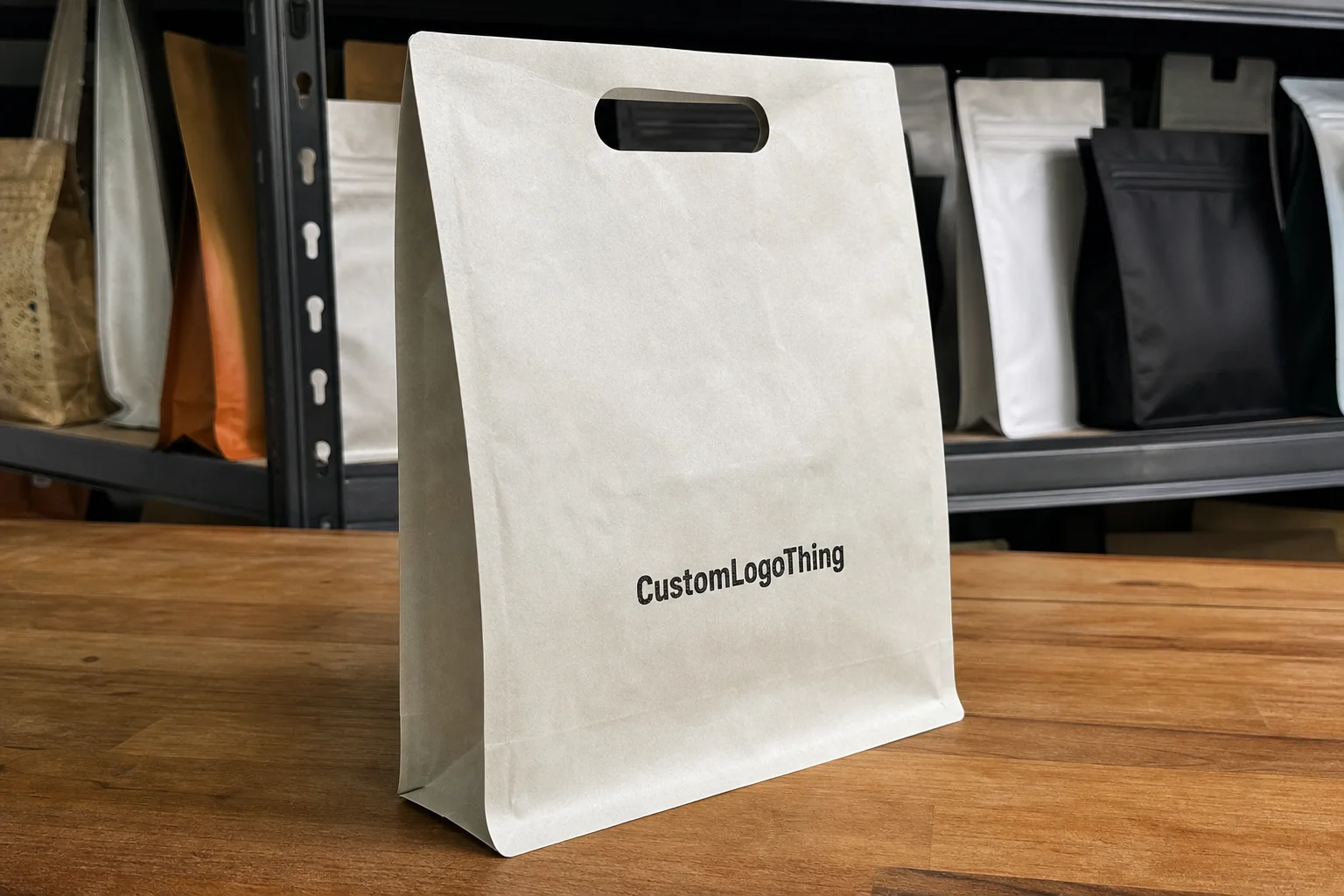
Coffee sells in motion. A customer picks it up, carries it to a register, leaves with it in a tote, then decides whether the brand felt worth the price. Die Cut Handle Bags support that sequence better than a pouch that needs a second carrier bag.
The handle changes the perceived category. The bag stops reading like bulk goods and starts reading like a considered retail item. That can matter for roast-level differentiation, small-batch origins, and gift-ready seasonal releases.
Three use cases show up often: sample packs for café visits and wholesale meetings, event sales where buyers leave with more than one bag, and premium gift packaging where the package itself needs to hold up before the coffee is opened.
There is a practical side too. Handle bags reduce the need for extra carrier bags and improve display handling. Staff can move them without crushing the top seal or scuffing a soft finish as easily as they might with a loose pouch.
That said, not every coffee line should use them. A high-volume commodity SKU that ships mostly through warehouse distribution may do better with a simpler structure. The format has to match the channel.
If you want to compare packaging formats against buying scenarios, the Case Studies page is useful. If the main question is ordering mechanics, keep the FAQ close while you build the spec.
Product Specs That Matter Before You Quote
The quote depends on the spec sheet, not the mockup. At minimum, a buyer should lock down material, width, gusset depth, handle shape, seal style, print coverage, finish, and target fill weight. If those variables are loose, pricing will be loose too.
Coffee weight is the starting point. A 250 g bag, a 500 g bag, and a 1 lb bag do not behave the same once filled. The gusset has to hold the product upright, and the top area has to leave room for the handle without crowding the seal.
Barrier requirements matter more than many buyers expect. If the coffee is moving quickly through retail, a standard retail-ready laminate may be enough. If the product needs longer shelf life, stronger aroma retention, or more protection from humidity, the film structure needs to reflect that.
- Material: kraft laminate, PET/PE laminate, mono-material film, or another retail-grade construction
- Size: width, gusset, and height matched to the real fill weight
- Handle: die cut style, reinforcement, and carry comfort
- Print: one color, spot colors, full color, or white underprint
- Finish: matte, gloss, soft-touch, or uncoated look
Print coverage changes price faster than most buyers expect. A simple one-color kraft layout is not in the same cost band as a fully covered dark bag with white text and multiple spot colors. Matte finishes usually feel softer and more premium. Gloss can make color pop, but it also shows scuffs faster. White underprint helps on darker materials, but it adds setup complexity and can affect registration tolerances.
Compliance and handling checks should be part of the first conversation. If the bag is in direct contact with coffee, ask for food-contact documentation. If the cartons will move through distribution centers, ask how the master case stacks and whether the pallet pattern is standard. For forest-certified paper inputs, the FSC site is a useful reference. For shipping and transit testing methods, ISTA is the right place to check the standard.
A fast quote is not the same thing as a useful quote. If the bag size, fill weight, finish, print count, destination, and launch date are missing, the number on the page is mostly decoration.
die cut handle bags for coffee brands moq planning
MOQ is not just a factory floor number. It is the point where setup charges, tooling, waste, and press time finally spread across enough units to make sense. Below that point, the unit price climbs. Above it, inventory risk starts to grow.
The useful MOQ is tied to the launch plan, not the supplier’s headline minimum. A brand testing one new roast may only need enough bags for the first 60 to 90 days. A roaster selling through cafés, events, and online channels may need a larger initial run so the packaging does not run out halfway through the campaign.
Artwork complexity pushes the break point around. More colors, spot varnish, white ink, custom die work, and reinforced handles each add time or material cost. A plain one-color print on a standard format can support a lower MOQ than a fully customized retail bag with premium finish and tighter registration.
There is a second trap. Buyers often over-order because they focus on unit cost and forget timing. If a roast changes, a label shifts, or a seasonal blend ends early, extra bags turn into dead stock. Saving two cents per bag is not a win if thousands of units become obsolete.
| Order tier | Typical MOQ | Indicative cost per piece | Setup charges / tooling fees | Lead time | Best fit |
|---|---|---|---|---|---|
| Pilot run | 3,000 to 5,000 bags | $0.24 to $0.38 | Higher relative setup charges | 12 to 18 business days | New blend tests, small retail drops, market validation |
| Launch run | 8,000 to 15,000 bags | $0.17 to $0.29 | Spread across more units | 15 to 22 business days | Main SKU launches, mixed channel sales |
| Scale run | 20,000+ bags | $0.12 to $0.22 | Lower cost impact per unit | 18 to 28 business days | Repeat orders, seasonal volume, private label programs |
Those numbers are indicative, not universal. Material thickness, print count, handle reinforcement, packaging configuration, and freight destination can move them quickly. Still, the pattern holds: as quantity rises, the unit price usually falls because setup is diluted. Ask for tiered pricing at 5,000, 10,000, and 20,000 units so the break points are visible before the order is placed.
It also helps to think in terms of usage, not just quantity. If a branded sample pack will be handed out at events, the bags may move faster than the wholesale format. If a flagship roast sells steadily all year, a larger run may be safe. If the packaging supports three limited editions, the math gets more complicated. The order size should support launch plus one clean replenishment cycle without creating storage problems.
Cost, Pricing, and Quote Variables to Compare
When quotes arrive, compare the full landed cost, not just the unit price. A low per-piece number can hide freight, tooling, plate charges, packing surcharges, or a minimum for a smaller carton count. The real number is the cost at the warehouse door.
These variables usually move pricing the most:
- Bag size: larger formats consume more material and more print area
- Handle complexity: custom shapes and reinforcement add tooling or conversion cost
- Print colors: each added color raises setup time and press cost
- Finish: matte, gloss, and soft-touch lamination all carry different material costs
- Packaging format: retail cartons, master cases, and pallet patterns affect freight
Make every supplier quote the same spec. Same dimensions. Same film structure. Same finish. Same print count. Same delivery location. If one quote is for a 250 g bag and another is for a 500 g bag, the comparison is useless.
Some buyers underestimate the value of a slightly higher quote. A stronger handle can reduce product damage during events. A better laminate can keep the bag looking sharp after warehouse handling. A more stable structure can reduce returns from crushed top seals or scuffed graphics.
Ask for pricing at several thresholds. If the cost drops sharply at 10,000 units, it may justify a larger first order. If the drop from 10,000 to 15,000 is tiny, the extra inventory is not buying much. The best purchase is usually the smallest order that protects margin and keeps the reorder cycle under control.
Production Steps and Lead Time From Proof to Delivery
Custom packaging moves faster when the buyer knows the sequence: specification confirmation, artwork review, proofing, material sourcing, printing, conversion, inspection, and shipment. Every one of those steps can be clean. Every one of them can also turn into a delay if the brief is vague.
The biggest delay is usually pre-production. Missing dielines, unfinalized logo files, incorrect Pantone targets, and last-minute layout changes all eat time before the press starts. If the supplier has to guess at bleed, handle placement, or seal clearances, the schedule slips.
For custom coffee handle bags, a realistic lead time often falls between 12 and 22 business days after proof approval. Simple orders move faster. Heavier films, custom dies, special finishes, and more complex print builds move slower. Rush work is possible in some cases, but it usually costs more because the schedule has to be compressed.
Sample approval matters because it catches handle placement, print registration, top seal behavior, and fill fit before a full run starts. A good sample also reveals whether the bag actually stands the way the mockup promised. If the filled bag leans, bulges, or feels awkward in hand, the problem is easier to fix before production than after thousands of units are already on the line.
If the launch date is fixed, the packaging spec has to be fixed first. Artwork can flex. The production calendar usually cannot.
Plan packaging against the roast calendar. If product is supposed to land in stores in six weeks, the order needs enough room for proof corrections, freight, and a small inspection buffer. That matters even more when multiple SKUs are in play.
Quality Checks That Protect Repeat Orders
Repeat orders are built on consistency. Coffee brands come back when the color matches the approved proof, the dimensions stay stable, the handle feels the same, and the bag arrives in a condition that can go straight into the channel.
Four checks matter most:
- Print registration: edges, logos, and type should stay aligned across the run
- Handle strength: the cut and reinforcement need to hold under real carry weight
- Seal integrity: top seals should close cleanly without wrinkling or weak spots
- Carton fit: master cases should stack and ship without crushing the bag structure
Color control matters too. A second run that drifts from the approved shade can make a product line look inconsistent even if the coffee is unchanged. Buyers should ask what standard is being used for approval and whether the production sample is the same reference point that will be used on reorder.
Good suppliers keep the working file history organized: prior dimensions, approved artwork, version notes, previous quantities, and reorder timing. That saves the brand from rebuilding the spec every time a seasonal roast comes back or a best-selling SKU is replenished.
If a vendor cannot explain their setup charges in plain language, that is a warning. Coffee packaging should not require a decoding session. Clear notes on tooling, freight, packing, and approval steps are part of the job.
Next Steps for a Faster, Cleaner Order
Before requesting a formal quote, lock the essentials: bag size, fill weight, material, print count, finish, target MOQ, delivery destination, and launch date. Add the expected reorder volume if there is one. Missing details force the supplier to guess.
Send the best artwork files available, but do not wait for the design to feel perfect before opening the packaging conversation. A supplier can usually spot dieline issues, bleed problems, and color risks early. That is more valuable than discovering them after the design has already been approved internally.
A good first brief should also include the use case. Retail shelf, event sales, wholesale carryout, or subscription. The use case changes the bag structure, which changes the price and lead time.
The practical rule is simple: sort out Die Cut Handle Bags for coffee brands moq planning before artwork is finalized. If the order size, spec, and timeline are aligned early, the project moves faster and costs less to correct. If they are not, the budget usually pays for the confusion in setup charges, freight surprises, or excess stock.
For a second pass on common questions, the FAQ helps with the usual ordering mechanics. For format comparison and production context, the Case Studies page is useful when a brand is deciding between packaging styles.
What MOQ should coffee brands expect for die cut handle bags?
MOQ usually depends on size, print complexity, and whether the bag is built from an existing format or requires custom tooling. Simpler jobs can start lower. Custom sizes, premium finishes, and more colors usually push the minimum up. A practical first target is launch volume plus one reorder cycle, not the lowest possible number on paper.
How do I compare pricing for die cut handle bags for coffee brands?
Compare unit price, setup charges, freight, and tooling fees together. Make sure every quote uses the same dimensions, film structure, print count, and finish. If one supplier is quoting a different size or a lighter material, the lower price is not really a better price.
What lead time is typical for custom coffee handle bags?
Lead time depends on proof approval speed, material availability, and print complexity. Simple runs often land around 12 to 18 business days after approval. More complex jobs usually need longer. Build the schedule backward from the launch date and leave room for sample review and freight.
Can die cut handle bags support heavier coffee packs?
Yes, if the structure matches the filled weight. Heavier packs may need stronger film, wider gussets, or handle reinforcement so the bag carries safely. Ask for a recommendation based on the actual fill weight, not a similar-looking size.
What should I send before requesting a quote?
Send the target dimensions, fill weight, quantity, artwork files, finish preference, and delivery destination. Also note whether the order is for retail shelves, events, subscriptions, or wholesale carryout, because the use case affects the spec. If there is a launch date, include that too.


