For corporate buyers, Die Cut Handle Bags for corporate buyers moq planning is not about picking the prettiest carrier on a sample page. It is about matching the bag to the contents, the campaign, and the inventory reality. Trade show kits, onboarding packs, store promotions, and boxed gifts can all use the same basic format, but the wrong gauge or size turns a simple order into a mess.
The smarter way to buy starts with the use case. A bag that carries a few brochures does not need the same construction as one holding apparel, catalogs, or a boxed sample set. Get the load, print area, and quantity aligned early and the rest of the process gets much less dramatic. Procurement also gets a cleaner comparison, which is nice for everyone involved.
Die Cut Handle Bags are popular in corporate programs for a reason. They stack flat, pack efficiently, and present branding cleanly on a broad panel. That makes them useful for high-volume distribution and for situations where the packaging itself needs to look intentional, not like an afterthought somebody grabbed from a shelf.
Why die cut handle bags work for corporate orders
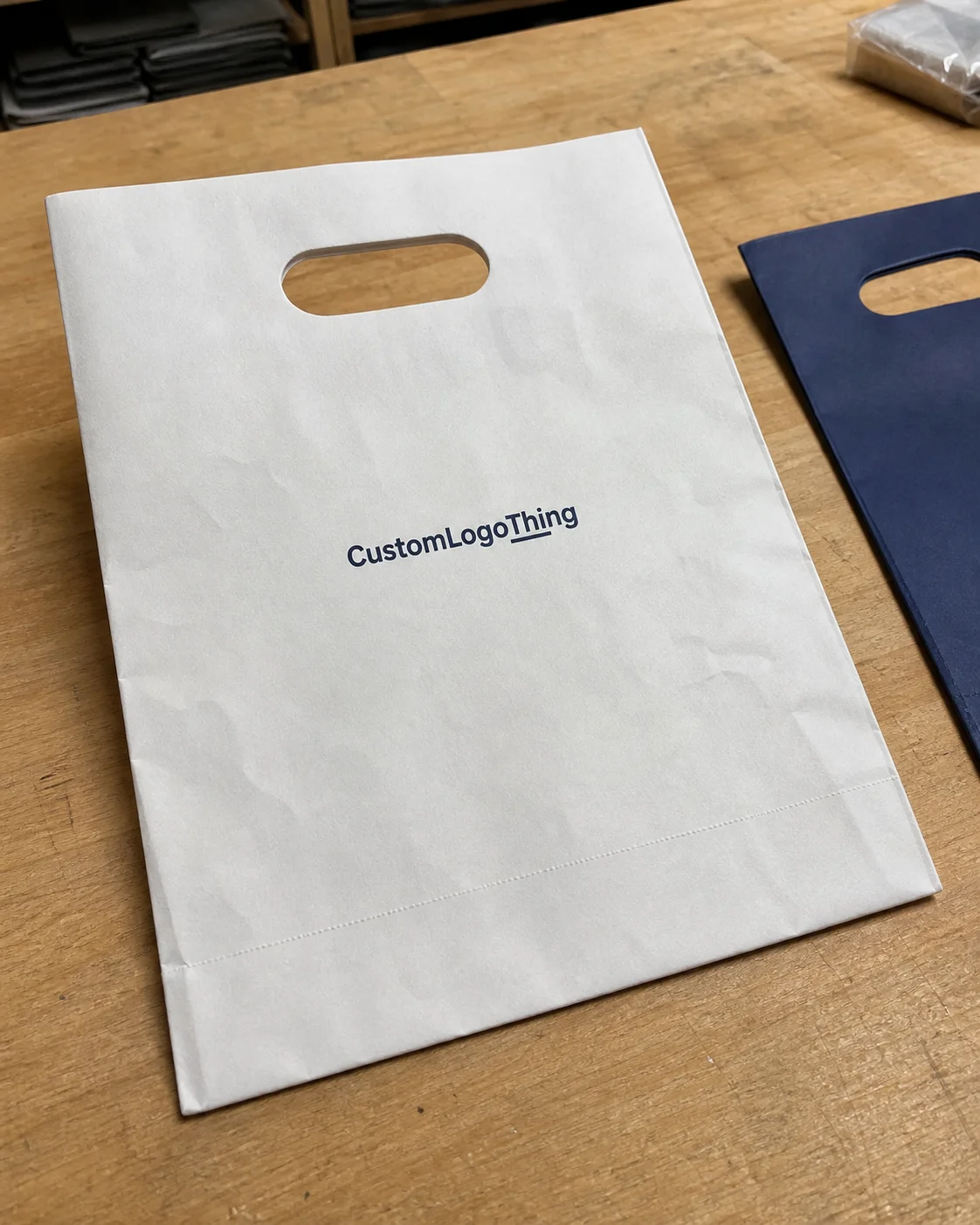
A die cut handle bag is one of the easiest formats to standardize across different departments. Marketing likes the print area. Operations likes the flat pack. Receiving likes the simple carton counts. The structure is basic, which is a strength, not a weakness. Fewer moving parts usually means fewer surprises.
That matters in corporate buying because the same bag may move through different programs over a year. One quarter it is for an event handout. Next quarter it is an internal welcome kit. Later it may hold a retail promo bundle or a product sample. If the base construction is sound, teams can reuse the spec instead of starting from scratch every time.
Presentation also improves with this format. A clean die cut opening looks more polished than a flimsy carrier with uneven proportions, especially when the bag is part of a branded kit. That visual effect is not subtle. People notice when the packaging feels considered. They also notice when it looks cheap. Corporate buyers spend a lot of time trying to avoid the second one.
The practical advantage is flexibility. The same style can be adjusted for different contents by changing dimensions, film thickness, and handle reinforcement. That is where Die Cut Handle Bags for corporate buyers moq planning becomes useful in real buying terms. A familiar format can still be tuned to the job without creating a custom bag from scratch for every campaign.
The first thing to settle is what the bag will actually carry. Lightweight paper inserts, apparel, boxed products, and mixed kits all stress the bag differently. If that part is unclear, the quote will be vague too. And vague quotes are how budgets get “surprised.” Which is a polite way to say broken.
Specs to confirm before requesting quotations
Before asking for pricing, buyers should confirm the material and construction basics. Most Die Cut Handle Bags are made from LDPE or HDPE. LDPE is generally softer and has more stretch. HDPE is crisper, often lighter for the same feel, and common in cost-sensitive programs. Specialty blends do exist, but buyers should only go there if the program actually needs a specific property.
Handle style comes next. A standard punched handle is fine for very light loads. For corporate programs, though, a reinforced die cut handle is often the safer choice because it spreads stress better around the opening. Some bags also use patch reinforcement when the load is heavier or the presentation matters more. If the supplier starts talking about soft loop handles, that is a different product category entirely. Worth catching early.
Dimensions are more important than many first-time buyers expect. Width, height, and gusset depth all affect usable capacity and packing efficiency. A bag that seems generous on a spec sheet can feel tight once brochures, samples, and inserts go in. Oversizing has its own problems too. Too much empty space can make the kit look sloppy and can cause items to slide around in transit.
Artwork details should be locked before quoting, not after. Number of print colors, front-and-back coverage, matte or gloss appearance, and any placement restrictions near the handle cutout all affect press setup and price. If the logo sits too close to the cutout or seal area, that needs a hard review before production. Moving the artwork later is how a “small correction” becomes a new setup charge.
Buyers should also confirm how the bags will be packed. Loose-packed, poly-bundled, or case-packed configurations affect receiving labor and storage. Bundle counts and carton quantities matter more than they sound like they should. A warehouse team receiving 20 pallets of bags needs consistent packaging or the whole thing becomes a counting exercise nobody asked for.
Materials, thickness, and print decisions that affect performance
Film thickness should be chosen by load, handling, and reuse expectation. Buyers often ask for a thickness because “that’s what we used before.” Fine, but the better question is whether the bag needs to survive one handoff or several. For a simple handout, a lighter gauge may work well. For boxed products, apparel, or kits handled multiple times, a thicker film usually makes more sense.
The stress points are predictable. The handle area and bottom seal take the most abuse. A bag can hold weight in the center and still fail at the die cut opening if the film is too light or the handle area is too narrow. Wider bags distribute weight better for documents and folded materials. Narrower bags may be fine for one item, but they are less forgiving when the contents vary.
Print quality depends on substrate and coverage. Thin film can make large solid areas look less uniform. Dark inks can also behave differently on lighter or softer films. If the artwork includes precise brand colors, request a proof on the actual substrate whenever possible. A digital image on a screen is not a color standard. That should not need saying, but here we are.
Color count is one of the easiest ways to shape cost without wrecking the design. A clean one-color logo often gives the best value. Two or three colors can still be efficient if the artwork is simple. Full-coverage art, gradients, and large solid blocks are where pricing and waste tend to rise. They also increase the chance of registration issues, so buyers should make peace with that before they approve a complex layout.
Quality control should not stop at “looks okay.” Buyers should ask how the supplier checks handle cut placement, seal integrity, print registration, and count accuracy. For repeat programs, even small variation in handle placement can affect the way the bag hangs and carries. Tolerances should be stated clearly. If a supplier cannot give a straight answer on size variation or print consistency, that is not a sign of flexibility. It is a sign of vague production control.
Some programs also carry material requirements tied to internal sustainability or compliance policies. That may mean recycled content targets, resin declarations, or region-specific packaging rules. Buyers should state those requirements before quoting. Otherwise the price may be attractive and the material wrong. A classic corporate-buying trap.
For reference points on packaging and waste-reduction criteria, buyers can review resources from the packaging industry association and EPA guidance on materials and waste reduction. Those resources will not pick your bag spec for you, but they can help frame internal requirements without guesswork.
Cost, MOQ, and budget planning for corporate buyers
For die cut handle bags for corporate buyers moq planning, pricing usually comes down to five variables: bag size, film thickness, print colors, reinforcement, and order quantity. Bigger bags use more material. Thicker film uses more resin. More print colors increase press setup and can create extra waste during make-ready. Custom sizing adds tooling or setup complexity. None of this is mysterious. It is just manufacturing math pretending to be negotiation.
MOQ exists because setup costs need to be spread across the run. A small one-color order in a standard size may support a lower minimum than a custom program with multi-color print and a reinforced handle. Buyers should expect that relationship. If the quote looks unusually low at a tiny quantity, something is missing. Usually it is either setup, freight, or reality.
The right move is not always to buy the biggest quantity available. It is to ask for quantity breakpoints. A jump from 5,000 to 10,000 pieces may reduce unit cost enough to matter. A jump from 10,000 to 25,000 may do even more. But if the bags sit in storage for a year, the savings evaporate in carrying cost and handling.
| Option | MOQ profile | Unit cost tendency | Best fit |
|---|---|---|---|
| Small standard bag, one-color print | Lower minimum, easier to place | Lower setup burden | Event handouts, simple promo kits |
| Mid-size bag, two to three colors | Moderate MOQ | Mid-range | Apparel, retail promotions, onboarding sets |
| Large custom bag, reinforced handle, full print | Higher MOQ | Higher initial cost, better at volume | Premium giveaways, boxed products, multi-site programs |
There are a few straightforward ways to control cost without weakening the bag. Keep dimensions standard if the contents allow it. Reduce print colors when the design can tolerate it. Avoid unnecessary premium finishes. Use a common film gauge when the load is light enough. None of those choices sounds dramatic, but they often decide whether a quote lands inside budget or not.
Freight needs to be included in the comparison. So do cartons, pallets, sample costs, and proof charges. A low bag price can become an expensive landed cost once shipping and packaging are added. Buyers should always compare quotes on the same basis. Otherwise the cheapest number is just a decorative number.
Repeat programs benefit from tiered pricing. Ask for 5,000, 10,000, and 25,000 piece breakpoints, or whatever quantities fit the business. That gives procurement a real view of where the price moves and whether a slightly larger order is worth the inventory. It also helps with internal approvals, because finance can see the tradeoff instead of being asked to bless a mystery spreadsheet.
Budget planning should include an overrun allowance where appropriate. Some production processes allow for slight variance. Buyers should confirm whether the supplier quotes exact quantity, permitted overrun, or under-run terms. That detail matters when the bags are tied to a launch date or a fixed event headcount.
“The lowest quote is not the best quote if the bag fails at the handle, ships late, or arrives packed in a way the warehouse hates.”
Artwork, proofing, and timeline realities
The basic order sequence is simple: quote, artwork submission, prepress review, proof approval, production, inspection, packing, and shipment. The part that slows everything down is usually not the factory schedule. It is missing information. A file that is not print-ready can stall production. A logo supplied in low resolution can trigger back-and-forth. Unclear sizing can delay proofing because nobody wants to guess at the final fit.
Timeline depends on complexity. A straightforward one-color bag with approved artwork can move faster than a multi-color, custom-sized, reinforced order. That said, speed only matters if the proof is right. A rushed approval that misses a handle placement issue is a false economy. Fixing the mistake later costs more than spending an extra day on the front end.
Corporate approvals also create delays. Procurement, marketing, operations, finance, and sometimes legal may each need a look. If those stakeholders are not aligned early, the order can sit while everyone waits for someone else to say yes. The cleanest programs are usually the ones where budget, artwork, and delivery timing are already settled before the RFQ goes out.
Sample and proof options reduce risk, especially for higher-value orders. A digital mockup helps validate layout. A pre-production proof checks size and print placement. A physical sample is better when the bag will carry a heavier load or needs to meet a specific presentation standard. If the program is important enough to review twice, it is probably important enough to review properly.
Buyers should also be realistic about shipping windows. Even a well-run production schedule can be upset by freight availability, peak season congestion, or documentation issues. If the bags need to arrive by a fixed event date, build in buffer time. Not a heroic buffer. Just enough to absorb normal friction.
How to compare suppliers without getting lost in the fluff
The best supplier is not always the one with the slickest presentation or the lowest first number. Clear specs matter more. Buyers should look for direct answers on material, thickness, handle reinforcement, print limitations, and tolerance ranges. If a supplier cannot explain those things clearly, the quote probably has gaps too.
Ask for a written spec summary before approving the job. That should include dimensions, material type, thickness, print colors, packing format, carton count, and any special requirements. It sounds basic because it is. Basic documentation is what prevents receiving disputes later.
It also helps to compare landed cost, not just unit price. One supplier may look cheaper until freight, proofing, cartons, or minimum order terms are added. Another may have a slightly higher unit cost but better packing or fewer extra fees. Procurement teams that compare the whole number, not the shiny number, usually make better decisions.
Operational consistency matters too. A bag program that goes to multiple locations needs accurate labeling, clean carton counts, and predictable packing. These are not glamorous features. They are the things the warehouse notices first. And if the warehouse notices a problem, everyone else will hear about it eventually.
- Ask for a written spec summary before approval.
- Compare landed cost, not just bag price.
- Confirm packing format for warehouse receiving.
- Check repeat-order support if the program may continue.
Testing references can also help buyers judge fit for purpose. For load and transit-sensitive programs, standards from ISTA can frame packaging performance expectations. If the broader packaging set includes paper components, FSC may be relevant for sourcing discussions. Not every bag needs a long certification conversation, but Buyers Should Know what their internal policy requires before they start shopping.
Order planning checklist before you send the RFQ
Start with the basics: finished dimensions, estimated load, print colors, artwork file, target quantity, shipping destination, and required delivery date. If you already have a sample or a reference bag, include it. That cuts down on guesswork fast. A physical reference is often more useful than a paragraph of enthusiasm.
Then decide whether the order should cover one SKU or several related uses. Sometimes consolidating programs improves pricing and simplifies reorders. Other times, separate specs are cleaner because each department has a different load or presentation requirement. There is no universal rule here. Inventory control and actual use should decide, not habit.
Before artwork is finalized, get internal agreement on budget range and MOQ tolerance. That prevents awkward revisions later when a quote comes back with a quantity the finance team does not want to touch. It also avoids wasting time on a design that only works at a volume the business will never approve.
Ask every supplier to separate the quote into unit price, setup or tooling, freight assumptions, proof charges, and any packing or overrun terms. That makes comparisons much easier and keeps the conversation grounded. For die cut handle bags for corporate buyers moq planning, this is the difference between a manageable sourcing process and a week of chasing clarifications nobody wanted in the first place.
Buyers who plan well usually get three things: fewer surprises, better consistency, and a cleaner reorder path. That is the real value here. Match the bag to the load. Match the MOQ to the program. Match the timeline to the approval process. Do that, and the order tends to behave like an order instead of a rescue operation.
FAQ
What is a typical MOQ for die cut handle bags for a first corporate order?
MOQ depends on size, film thickness, print complexity, and whether the bag is standard or custom. Simpler one-color runs usually allow lower minimums than large custom bags with reinforced handles or full coverage print. The useful question is not just the minimum, but how the unit price changes at higher quantities.
How do buyers choose the right film thickness?
Start with the actual contents, handling frequency, and the amount of stress on the handle and seal. Light handouts can use a thinner film, while apparel, boxed products, or repeat use usually need a thicker gauge. A supplier should be able to recommend a starting point once the load and dimensions are known.
Can unit cost be lowered without changing the bag format?
Yes. Standard sizes, fewer print colors, and common film specs often reduce cost without affecting performance. Higher quantities also help because setup costs are spread across more pieces. Just do not trim the spec so far that the bag stops doing its job.
What information should I send for a fast quotation?
Send finished dimensions, artwork, print colors, quantity, delivery location, target date, and the contents or product weight. If you have a sample bag or a reference image, include that too. It helps the supplier judge construction, thickness, and packing requirements faster.
How long does production usually take after artwork approval?
Lead time varies by quantity, print complexity, and current production load. Simple jobs can move faster than multi-color or custom orders. Proof approval, freight scheduling, and documentation can add time, so build a buffer into the plan if the bags must arrive for a fixed event or launch.
Good corporate packaging does not happen by accident. It comes from clear specs, realistic quantity planning, and supplier communication that is direct instead of decorative. That is how die cut handle bags for corporate buyers moq planning stays organized, keeps cost per piece under control, and delivers a bag that works the way the program needs it to.


