Ecommerce brand Custom Poly Mailer Bags factory quote checklist sounds like a procurement form, but it is really a risk filter. Two mailers can look nearly identical in a mockup and still land in very different cost brackets once the factory fixes the film gauge, seal width, print coverage, adhesive, and packing format.
That is where many buying decisions go sideways. A cheap quote may be built on a thinner resin blend, fewer print passes, tighter tolerances than the artwork can actually hold, or freight assumptions that disappear later. The cleaner approach is to compare every supplier on one spec sheet, then ask what each line item means in production.
Quote the structure, not the artwork alone. Artwork changes how the bag looks; structure changes how it performs, how it ships, and what the landed cost really is.
Ecommerce brand custom poly mailer bags factory quote checklist: what to inspect first
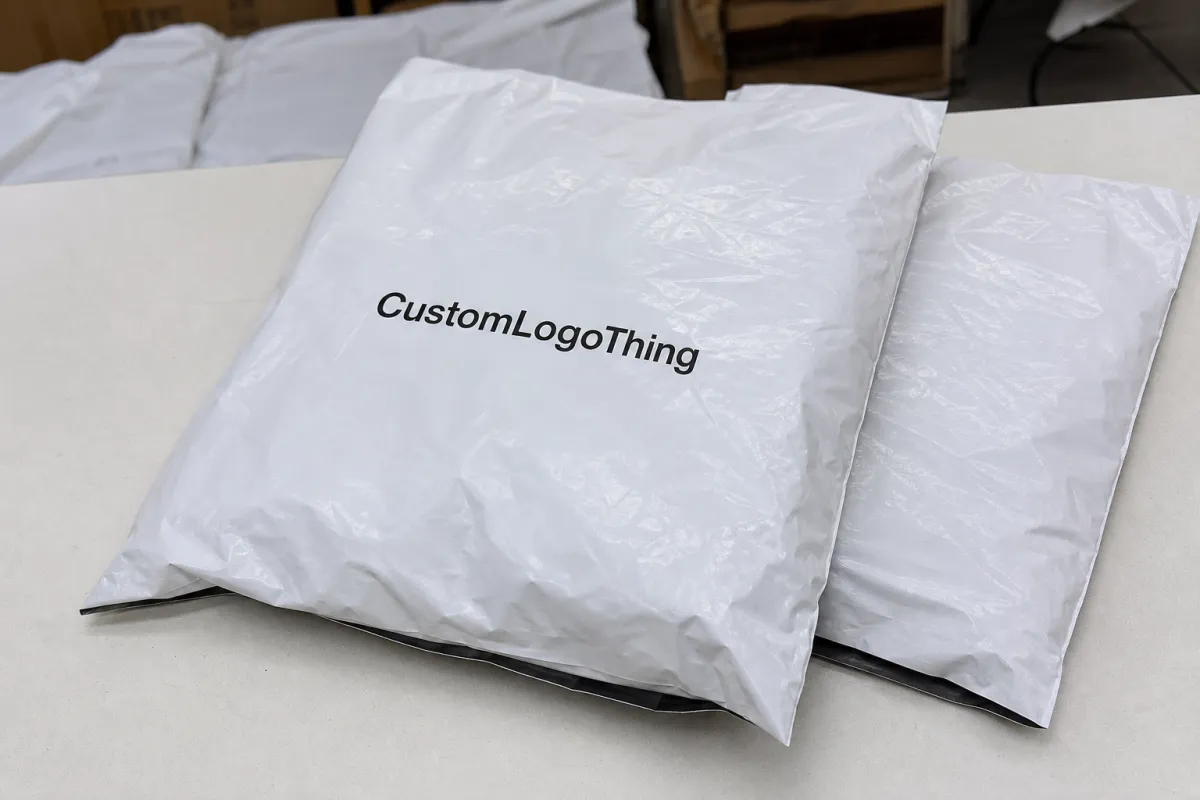
Start by reading the quote like a technical document. A polished rendering tells you almost nothing about the build. A factory can show a sleek bag and still leave out the detail that determines whether it survives a conveyor belt, a sorting arm, or a damp doorstep.
The first pass should verify the basics: finished size, thickness, print sides, closure style, and packing format. If those are unclear, the quote is still a sketch. That is especially true for ecommerce programs that ship a mixed catalog, because a mailer that works for soft apparel may fail on boxed accessories, hardware, or any item with corners.
One common mistake is treating all flat poly mailers as interchangeable. They are not. A bag with the same outer dimensions can still vary in tear strength, gloss or matte finish, seal reliability, and how well ink adheres during transport. That is why the ecommerce brand Custom Poly Mailer Bags factory quote checklist should begin with structure, not branding.
If a factory cannot explain why its number is lower than another supplier’s, the quote is incomplete. Sometimes the reason is benign. Often it is missing something buyers will pay for later.
Choose the right mailer structure for your product and shipping lane
The right mailer depends on the product and the route it will travel. Light apparel can often move in a standard poly mailer, while products with sharper edges, higher value, or repeat returns usually need more structure. That may mean a coextruded film, a bubble-lined format, or a tamper-evident closure that makes handling more predictable.
Shipping lane matters as much as the product. Domestic direct-to-consumer parcels face one kind of abuse; cross-border freight, warehouse automation, and mixed-carton fulfillment create another. The longer the route and the more touchpoints involved, the more important tear resistance, seal strength, and scuff resistance become.
| Mailer structure | Best fit | Typical watch-outs |
|---|---|---|
| Single-layer poly mailer | Light apparel, soft goods, low-cost shipping lanes | Less puncture resistance and less margin for sharp edges |
| Coextruded mailer | General ecommerce, better tear resistance, cleaner print hold | Slightly higher material cost, usually better overall value |
| Black-out liner mailer | Privacy-sensitive shipments, resale programs, returns | More opacity and more material use, so unit price rises |
| Bubble-lined mailer | Fragile accessories, small electronics, protective shipping | More freight cube and a tougher sustainability conversation |
| Tamper-evident closure mailer | Higher-value goods and products likely to be returned | Seal design needs real peel testing, not just a visual check |
A useful way to narrow the choice is to ask what failure costs more: damage, returns, freight, or print compromise. A premium-looking bag that tears in transit is not premium. A simpler build with consistent seals, stable print, and the right thickness usually creates more value than a showier option with weak production control.
If the pack also includes inserts or custom printed boxes, the mailer should support the same brand tone instead of competing with it. In practice, a clean, well-made bag beats a loud one that scuffs easily or opens too early.
Confirm the specs that factories need before they quote
Factories can quote quickly only when the brief is tight. Every missing detail forces an assumption, and assumptions are where pricing becomes unreliable.
- Finished size: width by length, plus gusset or expansion panel if needed.
- Film thickness: microns or mil, and whether the film is mono-layer or coextruded.
- Print build: one side or two, number of colors, white underprint, and coverage level.
- Closure: permanent adhesive, peel-and-seal, tamper-evident strip, or reseal strip for returns.
- Artwork setup: Pantone references, bleed, safe area, and whether the design uses solids, gradients, or full-coverage backgrounds.
- Compliance needs: recycled content target, opacity, labeling, and any marketplace or retail packaging requirement.
Even if final art is not ready, send a clean mockup. A factory can estimate print coverage, color count, and panel placement from a clear draft. A blurry PDF or a screenshot tends to create more email chains than useful pricing.
For buyers who need technical language that a production team will recognize, packaging standards groups and transit test references are more helpful than marketing gloss. Institute of Packaging Professionals resources help frame design decisions, and ISTA is useful for discussing distribution testing. If tensile strength or impact resistance is part of the discussion, ask whether the film is evaluated against common methods such as ASTM D882 or ASTM D1709. The test name is less important than the fact that everyone is talking about the same metric.
That level of specificity does not make the project harder. It makes the quote more honest.
Pricing, MOQ, and what moves your unit cost
Price is shaped by a handful of hard inputs: resin cost, gauge, print complexity, tooling, packing format, and shipping terms. A plain one-color mailer in a standard size is not in the same cost class as a matte, full-coverage, white-ink design, even if the outer dimensions match.
For common ecommerce orders, simple Custom Poly Mailers often land around $0.08-$0.18 per unit at 10,000-20,000 pieces. Heavier gauge construction, more colors, special finishes, and wider print coverage can push the number above that. Short runs usually absorb setup cost less efficiently, so the spread gets wider fast.
MOQ changes the math too. Straightforward jobs may start around 3,000 to 5,000 pieces, while more complex builds can climb higher. A supplier that gives only one quantity should be treated cautiously. Tiered pricing at 5,000, 10,000, and 20,000 pieces shows where the real breakpoints sit.
| Quote item | What it should spell out | Why it changes cost |
|---|---|---|
| Unit price | Price per bag at a stated quantity tier | Quantity, gauge, and print build all move the number |
| Plate or cylinder charge | Setup cost for each printed color or print method | Can make a low-volume order much more expensive than expected |
| Sampling fee | Proof, preproduction sample, or color strike cost | Useful for approval, but it should be visible up front |
| Packing format | Flat pack, carton count, master carton dimensions | Changes labor, freight cube, and damage risk |
| Freight terms | EXW, FOB, or delivered pricing with named destination | Prevents hidden shipping assumptions from distorting the quote |
The quote should separate those items instead of hiding them inside a single line. A bag price without freight, tooling, sample work, or carton data is not a full quote. It is a starting point, and sometimes not even a clean one.
One practical habit is to ask for the same line items from every factory: unit price, setup cost, sample cost, packing cost, and freight basis. That simple structure makes landed-cost comparisons much easier, and it exposes inflated assumptions quickly.
Production steps, lead time, and approval milestones
A standard order moves through a familiar sequence: artwork review, spec confirmation, sample or proof, prepress, printing, converting, inspection, and final packing. The sequence is simple. The timing rarely is.
- Artwork review: the factory checks size, color count, and panel placement.
- Spec confirmation: size, film gauge, closure, and packing format are locked.
- Proof or sample: the buyer approves the look, color, and copy placement.
- Prepress and setup: plates, cylinders, and press settings are prepared.
- Printing and converting: film is printed, sealed, cut, and finished.
- Inspection and packing: bags are counted, packed, and prepared for shipment.
The slowest step is usually proofing. If artwork arrives without Pantone references, if copy needs another round of revision, or if the bag size changes after the first approval, the calendar stretches fast. For clean jobs, production often runs about 12-15 business days after proof approval. Complex print builds, peak-season workloads, or special packing instructions can add time.
Shipping time deserves the same treatment. Air freight cuts transit but can inflate landed cost. Ocean freight lowers unit freight, but it reduces flexibility. Carton size matters too, because oversized master cartons can turn an efficient production run into a costly shipment.
A good quote distinguishes production time from shipping time. Blending them into one promise hides the part buyers need to manage internally.
Print quality, packing, and ecommerce handling details
Print quality is not only about branding. It affects how the bag behaves in a warehouse and how it looks after rubbing against other parcels. Poor ink adhesion, weak registration, or inconsistent seal lines show up after the shipment has already left the factory.
For package branding, the mailer is often the first physical touchpoint. That means the print has to support the identity of the brand and still work like shipping packaging. A bright graphic on a weak film is a bad trade. Customers notice the damage before they notice the design.
Warehouse handling creates specific demands. Machine feeding needs consistent width and clean edges. Return reuse needs a closure that can survive a second seal or a peel-and-reseal operation. Moisture exposure during last-mile delivery favors films and adhesives that do not soften too quickly.
Pack-out details are easy to overlook, but they matter at scale:
- Flat pack versus rolled pack: the wrong format can slow fulfillment or create extra handling.
- Carton count: keep counts consistent so warehouse teams can reconcile stock quickly.
- Master carton strength: weak outer cartons lead to crushed bags and more claims.
- Palletization: stable stacks reduce damage on export loads and mixed freight.
Retail teams sometimes focus too much on graphics and too little on operational handling. In practice, a mailer that loads efficiently, stacks cleanly, and survives transit tends to protect the brand better than a louder bag that creates waste at the warehouse dock.
If the seal line is inconsistent, the brand looks cheap before the parcel leaves the dock.
Why direct factory quoting helps buyers compare apples to apples
Direct communication with the factory reduces quote drift because the team pricing the job can also confirm the material, print, and packing assumptions. That matters in ecommerce, where a small spec change can shift a mailer from a simple packaging item into a core part of the brand experience.
The main benefit is consistency. A direct factory quote shows what can be repeated on the next order, which matters for subscription programs, seasonal drops, and brands that expect volume to grow. Used well, the ecommerce brand Custom Poly Mailer Bags factory quote checklist becomes a repeatable buying standard rather than a one-time form.
There is also room for practical advice. A factory may suggest reducing print coverage, tightening the size spec, or changing film structure to cut cost without hurting performance. That kind of adjustment is more useful than chasing the lowest headline number from a middle layer that cannot explain the build.
A better quote comparison asks one question: which supplier can repeat this bag at the same quality, the same cost range, and the same lead time next quarter? That is the real test for an ecommerce packaging program.
What to send for a fast, accurate quote next
Fast quotes come from clean inputs. The more exact the brief, the fewer assumptions the factory has to make, and the smaller the risk of rework later.
- Finished bag size and whether the product needs a gusset or expansion panel.
- Target thickness in microns or mil, plus any strength expectations.
- Artwork files in editable vector form when possible, with Pantone references and logo placement notes.
- Estimated annual volume and the first order quantity.
- Destination port or ZIP code so freight can be quoted accurately.
- Required delivery date and whether the order is tied to a launch or replenishment window.
- Approval needs such as sample review, color match, or printed proof signoff.
Ask for a sample and a formal quote table before production starts. That extra step gives the factory a chance to confirm structure, print, and MOQ in the same frame, which usually avoids surprise charges later.
For a new supplier request, keep the ecommerce brand custom poly mailer Bags Factory Quote checklist as the intake standard every time. It gives procurement, production, and the factory the same language to work from. In practice, that is what protects the schedule and keeps landed cost readable.
What should be included in an ecommerce custom poly mailer bags factory quote?
The quote should list bag size, film thickness, print method, color count, closure type, MOQ, and lead time. It should also show tooling, sample fees, packing format, and whether freight or duties are included.
How do I compare poly mailer bag quotes without missing hidden costs?
Compare quotes on the same spec sheet, not on bag photos or unit price alone. Check setup charges, artwork changes, freight assumptions, and packing differences that can move the real landed cost.
What MOQ is normal for custom poly mailer bags from a factory?
MOQ varies by size, print count, and construction, but simple mailers usually have a lower threshold than complex printed builds. Ask for multiple quantity tiers so you can see how the unit cost changes as volume increases.
How long does production usually take after a quote is approved?
Lead time depends on sample approval, artwork readiness, and current factory load, so a clean approval process is the fastest route. Ask for separate timing for proofing, production, and shipping so the delivery date is realistic.
What artwork files help a custom poly mailer quote come back faster?
Provide editable vector artwork when possible, along with Pantone references, logo placement, and any bleed or safe-area notes. If final art is not ready, send a clear reference mockup so the factory can confirm print coverage and color count early.

