Ecommerce Custom Poly Mailer Bags Wholesale Ordering Plan
ecommerce brand Custom Poly Mailer bags wholesale order planning starts with shipping math, not artwork. That is the part many buyers skip, because a mailer looks simple until dimensional weight, pack time, and carrier pricing begin treating empty air like a billable item.
For apparel, socks, accessories, and light kits, a poly mailer often beats a carton on total cost because it stays close to the product, trims cubic inches, and speeds pack-out. A box still makes sense for fragile or rigid goods, but for soft items it can add material, labor, and freight without adding much protection. The useful lens is practical: monthly volume, parcel mix, average fill weight, and the brand experience all need to line up before the first quote goes out.
Ecommerce Brand Custom Poly Mailer Bags Wholesale Order Planning Starts With Ship Method
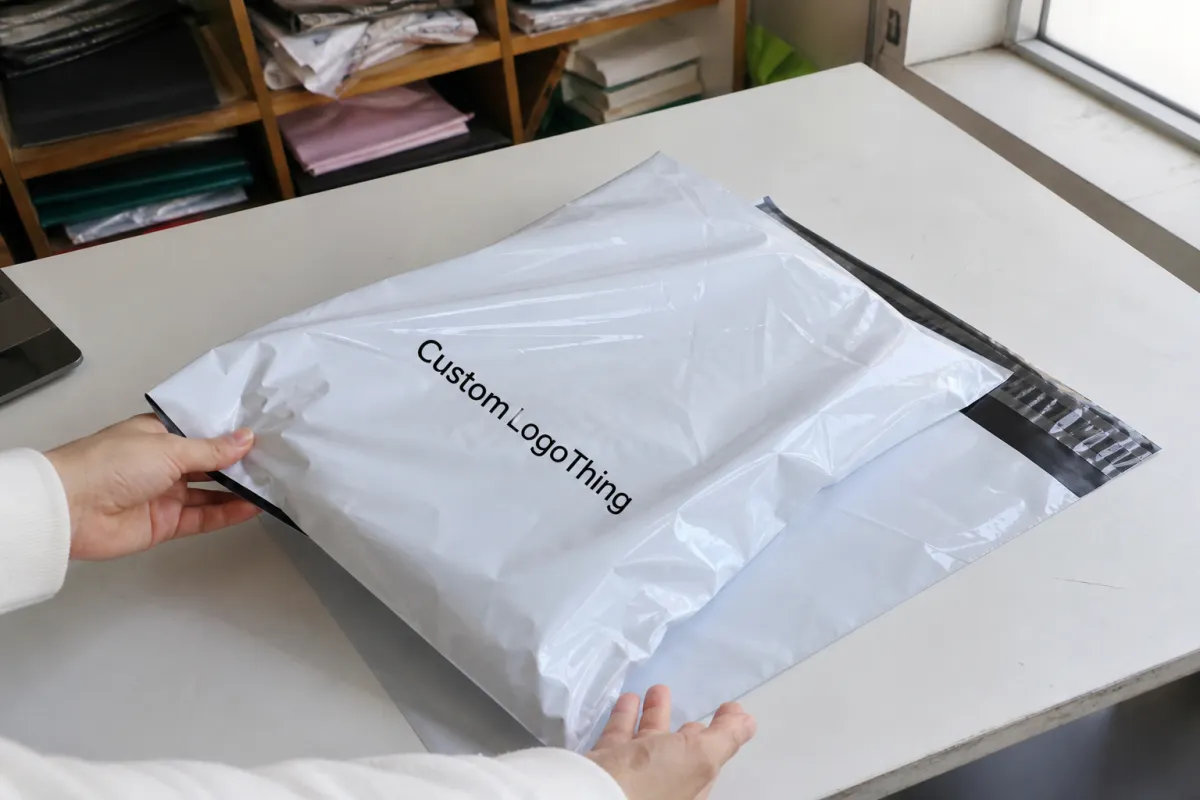
The first question is not “What should the bag look like?” It is “How does this parcel move through the network?” If most orders ship with one carrier and one service level, the mailer spec should fit that route rather than fight it. In ecommerce brand Custom Poly Mailer Bags wholesale order planning, the lowest unit price can still become the most expensive option if it slows packing or invites damage claims.
Soft goods make the case cleanly. A folded hoodie, a pair of socks, a small accessory kit, or a beauty bundle usually travels better in a right-sized poly mailer than in a carton filled with void material. The savings are not limited to the bag itself. There is also less warehouse storage, less tape use, less labor at the pack station, and less dimensional waste on the freight invoice.
A mailer can still carry strong brand presence with a much smaller parcel footprint, which matters when carriers price by weight and dimensions together. The strongest choice is rarely the most ornate one. It is the one that keeps the product protected, the line moving, and the margin intact.
Before requesting quotes, define the operating picture:
- Monthly volume by product family, not just total orders.
- Carrier mix so dimensional weight pressure is visible.
- Average parcel weight and the heaviest likely pack-out.
- Branding needs such as print coverage, finish, and perceived value.
Those four inputs prevent the common trap of asking for “a custom mailer” without telling the supplier how the package will actually be used. The more exact the shipping profile, the more useful the quote.
Mailer Film, Seal, and Print Options That Protect Margin
Material choice affects feel, stiffness, opacity, puncture resistance, and price. Co-ex film is common because it balances strength with print quality. Recycled-content film can support sustainability goals without forcing a jump to heavier packaging. Single-layer film can work for low-risk soft goods, but co-ex blends usually hold up better during sortation, stacking, and last-mile handling.
Seal style is not a minor detail. A permanent adhesive strip is standard for most ecommerce use, while peel-and-seal options help when packers need speed or when a bag must be easy to close in high volume. Tamper-evident features are worth considering for higher-value items, subscription kits, or any workflow where the package is handled several times before it reaches the customer.
Print choices change both presentation and cost pressure. One-color logos generally keep pricing under control. Full-bleed artwork, matte finishes, white ink on dark film, and specialty textures move the unit price up, but they can also improve shelf impact and perceived value. That trade-off only works if the product margin can absorb it.
Buyers should ask how claims map to testing, not just how the bag looks in a proof. ASTM references help with thickness and tensile conversations, while transit validation should reflect the kind of parcel abuse the order will see. If sustainability documentation matters, review chain-of-custody requirements at FSC. For transport testing, the resources at ISTA are a practical benchmark.
"If the quote does not spell out film type, thickness, print count, and landed freight, it is not a real comparison."
That is the line experienced packaging buyers tend to come back to. Two bags can look nearly identical on a screen and behave very differently once they are filled, sealed, stacked, and pushed through an actual order stream. Spec sheets decide whether the difference shows up as a minor variance or a recurring cost.
Size Specs, Thickness, and Closure Choices for Real Shipping Loads
Size should begin with the packed product, not the bare item. Measure the largest configuration you expect to ship, including inner wrap, tags, tissue, inserts, and any folding variation. Then confirm the usable width, usable length, and whether a gusset is needed for bulkier kits. If the bag only fits when the product is flattened to an unrealistic degree, it is the wrong size.
Thickness needs to be selected against the toughest package configuration, not the easiest one. Lightweight apparel can often work in thinner film, while heavier or sharper items need more puncture resistance. A small increase in microns or mils often costs less than a single damaged order, which is why many buyers move up a grade after testing the first production run.
A simple fit-check catches problems before they become reprints:
- Pack the bulkiest product exactly as the warehouse will ship it.
- Place the label or invoice where it will be used in production.
- Seal the bag and check whether the closure area stays flat and readable.
- Shake the parcel, then inspect corners, adhesive hold, and bag stretch.
That test reveals more than a drawing or dieline ever can. It also shows whether the brand is designing around the way a package performs or around the way it photographs.
Barcode visibility and warehouse handling belong in the sizing decision too. If the label interferes with the print area, scanning slows down. If the seal fails in a warm dock or a cold receiving bay, the customer experience suffers before the parcel reaches the carrier.
As a rule, ask the supplier to size against your heaviest fill state and your most common multi-item order. Those are the conditions that expose the weak spots.
Pricing, MOQ, and Quote Variables That Change Unit Cost
MOQ is not a penalty. It is how setup cost gets spread across a production run. Smaller orders usually carry a higher unit price because artwork prep, plate or cylinder setup, press time, and inspection are divided across fewer bags. Larger runs usually improve unit economics, but only if the design is stable enough to justify the inventory.
The main quote drivers are straightforward: quantity tier, number of print colors, film type, size, seal style, packaging format, and whether the artwork needs correction. One-color runs on standard co-ex film are generally easier to price than full-bleed mailers with dark film, white ink, and specialty finishing. A supplier that cannot explain those differences line by line is usually leaving room for confusion later.
| Option | Typical MOQ | Indicative Unit Cost | Best Fit |
|---|---|---|---|
| Plain co-ex mailer with one-color logo | 3,000-5,000 | $0.10-$0.16 | Pilot launches and simple branded packaging |
| Recycled-content mailer with two-color print | 5,000-10,000 | $0.16-$0.28 | Brands balancing sustainability and package branding |
| Full-bleed print with white ink on dark film | 10,000+ | $0.20-$0.38 | Premium unboxing experience and stronger shelf impact |
| Heavy-duty or specialty finish mailer | 10,000+ | $0.24-$0.42 | Higher-risk products or more demanding retail packaging |
Those ranges are directional. Resin pricing, freight, region, and artwork complexity all move the final number. Still, they help anchor ecommerce brand Custom Poly Mailer bags wholesale order planning because they show how the spec itself pushes cost before a shipping quote is even added.
Process, Proofing, and Lead Time From Artwork to Dock
The production path is usually orderly, but only if the artwork is ready. A clean run typically moves through artwork intake, dieline review, proof creation, proof approval, setup, production, inspection, packing, and shipment. Every handoff can slow the order, so the best planning happens before the proof is signed.
Delays usually come from avoidable issues. Low-resolution logos make print quality hard to judge. Color references arrive late. The buyer changes bag size or seal type after the proof has already entered production. That kind of revision does more than tweak the mockup; it can shift the schedule by days, sometimes longer, depending on the factory queue.
Practical lead times usually fall into a few bands. Straightforward one-color runs often land around 15-25 days after proof approval. Full-bleed prints, recycled-content materials, or specialty finishes may need 25-40 days before freight is added. If the order is tied to a launch, add buffer for customs, receiving, and warehouse intake.
Ask for timeline checkpoints, not a vague promise:
- Proof turn so the mockup arrives on a known date.
- Production start so the job is officially in queue.
- Estimated completion for the factory finish date.
- Transit window with a realistic freight assumption.
- Buffer time for customs, receiving, and warehouse intake.
That level of visibility matters most before a launch, seasonal promotion, or subscription drop. Reorders move faster only when the first run is documented well. Saved files, approved colors, and recorded tolerances reduce back-and-forth the second time around.
Quality Control and Reorder Controls That Keep Branding Consistent
Quality control should behave like a checklist, not a slogan. Before shipment, a proper run should be checked for seal integrity, print alignment, color consistency, bag dimensions, and random-sample inspection. If any of those drift, the customer sees it quickly, often before the product itself gets noticed.
Consistency matters because ecommerce brands rarely ship one campaign and stop. They reorder across warehouses, seasonal drops, and new product lines. If the shade shifts or the finish changes, the packaging can look disconnected from the rest of the brand. That weakens the package even when the product remains unchanged.
Documented specs are the best defense. Keep the approved artwork file, exact size, thickness, adhesive type, and color notes together. That file set becomes the control point for repeat runs. It also prevents a common problem: one acceptable version drifting into another because the original approval is buried in someone's inbox.
For brands building out broader retail packaging or product packaging systems, this discipline matters even more. A team comparing Custom Poly Mailers with Custom Packaging Products should think about how the mailer interacts with inserts, hang tags, and any outer shipper. That is how package branding stays coherent across channels. If the team wants to compare order structures, the Wholesale Programs page is a useful starting point, and Case Studies can show how other brands handled the same decision set.
A controlled model keeps problems from showing up in the first place. That is the difference between a vendor and a packaging partner.
What a Strong Supplier Should Deliver Before You Approve the Order
A reliable manufacturer should make the decision easier, not harder. Look for clear communication, repeatable QC, realistic lead times, and the ability to explain pricing differences without hand-waving. If the answers stay vague, the risks usually stay vague too.
Evidence matters more than claims. Ask for samples, documented specs, production photos, and a direct explanation of why one film or seal costs more than another. A serious supplier can describe the trade-offs plainly: more ink coverage usually means more press time, thicker film usually means higher material cost, and tighter tolerances usually mean more inspection.
Support after the sale matters as much as the quote itself. Reorder reminders, file storage, size guidance, and help matching mailer specs to fulfillment needs all reduce friction. A supplier that remembers the prior approved build can save hours on the next order and keep the mailing format aligned with the product line.
Here is the filter I would use:
- Can they quote landed cost clearly?
- Can they explain film and seal choices?
- Can they show proof of QC?
- Can they support reorder consistency?
That checklist works because it is practical. It does not assume the supplier is perfect. It simply asks whether the supplier has the systems needed to reduce remake risk and keep the order aligned with the brand's actual volume.
Action Steps for a Clean First Wholesale Order
Start with a short internal brief. Confirm product size, monthly volume, target thickness, seal type, print coverage, and delivery deadline before asking for final pricing. If those details are still moving, the quote will move too. That is normal, but it should be recognized early rather than after proof approval.
Then request a sample and test it on a real product, not an empty table. Check the heaviest order mix, the largest folded item, and the label placement your warehouse will actually use. Compare landed cost, not just bag cost, and set a reorder threshold based on sell-through instead of wishful demand.
Promotions and seasonal spikes deserve safety stock. Ordering only to the monthly average is how brands end up paying rush freight or approving a compromise spec because the launch date is already close.
For ecommerce brand Custom Poly Mailer Bags wholesale order planning, the smartest sequence stays the same: specs first, quote second, proof third, timeline fourth, reorder control after launch. That sequence keeps the purchase tied to shipping reality, which is where the margin lives.
If your team is building a larger packaging system, the same discipline applies across branded packaging, insert cards, and custom printed boxes. The format changes. The buying logic does not.
FAQ
How should an ecommerce brand size custom poly mailer bags for wholesale orders?
Measure the largest packed product, not the product alone, so the bag fits the item plus any inner packaging or fold. Leave room for the seal area and warehouse handling, then test one sample with the heaviest order mix before approving production sizes.
What MOQ is normal for custom poly mailer bags wholesale purchases?
MOQ changes by size, print complexity, and film type, but lower quantities usually raise the per-bag price because setup cost is spread across fewer units. Ask for tiered pricing so you can compare a pilot run against a larger first order.
Which thickness is best for ecommerce brand custom poly mailer bags wholesale use?
Light apparel and soft accessories often work with thinner films, while heavier or sharper products need more puncture resistance. Choose thickness based on the bulkiest shipping configuration, not the easiest single-item pack, and move up a grade if damage or returns are a concern.
What files do I need before ordering custom poly mailer bags?
A vector logo or high-resolution artwork file is the best starting point for clean print reproduction. Provide brand colors, print placement notes, and any required text so the proof stage does not stall, and ask the supplier for a dieline or template before finalizing dimensions.
How long does a wholesale custom poly mailer bag order usually take?
Timing depends on proof approval, print setup, production load, and shipping method, so the schedule starts before manufacturing does. Simple jobs can move faster than multi-color, full-bleed runs, and it is smart to build in a buffer for artwork changes and freight delays if the bags are tied to a launch date.

