The phrase event merch Frosted Zipper Plastic Bags factory quote checklist sounds clunky, but the buying problem behind it is simple: a merch kit can look either polished or improvised depending on the bag it ships in. Frosted Zipper Bags sit in a useful middle zone. They cost less than rigid boxes, feel more controlled than loose poly mailers, and do a better job hiding the visual noise that comes with event packing.
That matters because event merch is judged fast. Attendees glance, pick up, and decide whether the kit feels worth keeping. A frosted finish softens glare, gives printing a more deliberate look, and makes the contents readable without turning the package into a display window. For conference kits, sponsor packs, launch-day handouts, and VIP bundles, that balance can matter more than an extra spot color or a fancier insert.
From the buyer side, the real job of the bag is not decoration. It is to protect the contents, hold the set together, and present the kit in a way that survives venue lighting, courier handling, and the first five seconds on the table. That is why the quote has to cover more than size and price.
Why frosted zipper bags make merch feel retail-ready
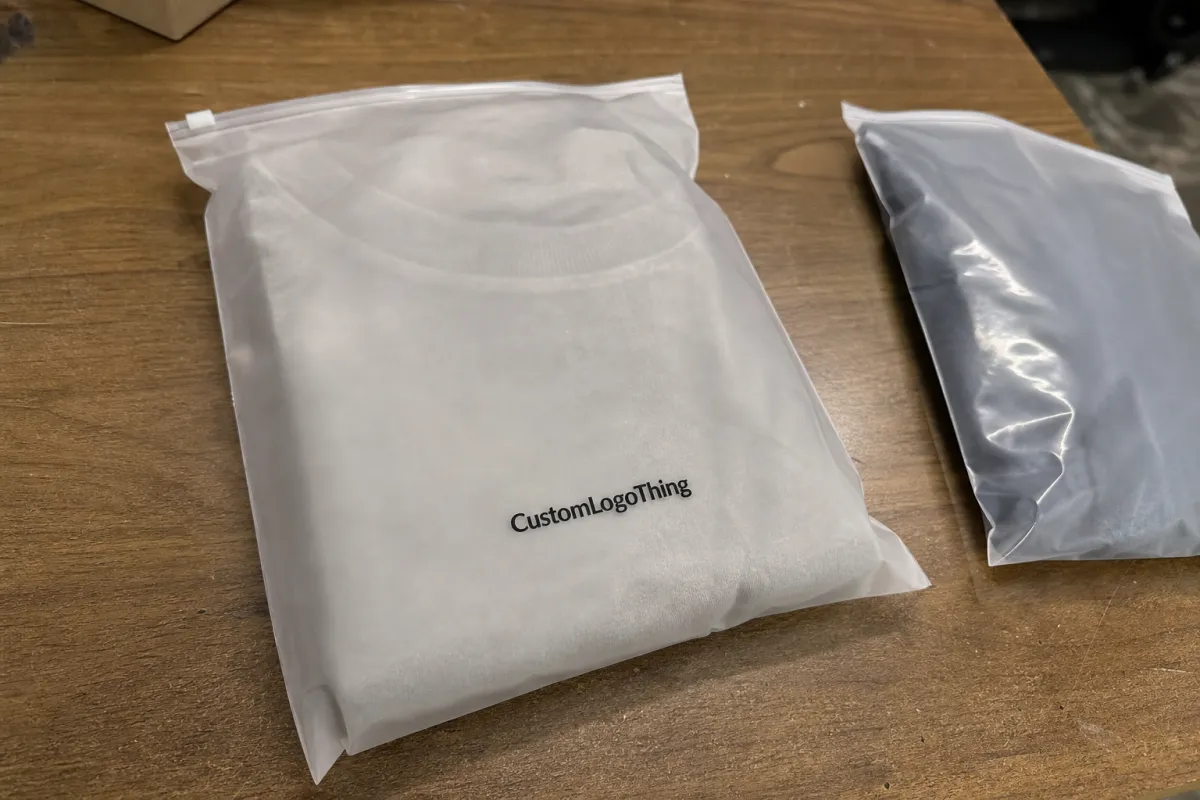
Frosted film has a practical advantage: it reads cleaner under mixed light. Clear glossy bags reflect overhead fixtures and camera flashes, which can make printed logos harder to read. Frosted material reduces that glare and gives the package a quieter surface. The effect is small in isolation, but noticeable once the bags are stacked, photographed, and handed out in a busy room.
The zipper is part of the value proposition too. A closure that opens and reseals cleanly keeps inserts, cables, cards, and folded apparel from spilling out in transit. That sounds basic until a kit arrives with a bent badge or a missing insert. Event merch rarely has a second chance. The package either holds its shape, or it does not.
There is also a perception issue. A frosted pouch suggests order and restraint. A loose bundle suggests the opposite. Neither costs much to signal, which is why small changes in film finish and closure style often outperform bigger spending elsewhere. Buyers tend to chase print complexity first. In practice, the bag structure usually has a larger effect on how premium the kit feels.
Where do these bags work best? Conference welcome packs, trade show giveaways, speaker kits, media drops, product launch sets, sponsor bundles, and small retail-style gift packs. The common thread is not the event itself. It is the need for a package that looks intentional without creating box-level freight and packing overhead.
Practical rule: if the merch will be handled in public, photographed, or stored in a stack for several hours, a frosted zipper bag is usually easier to defend than a glossy clear pouch.
Product details: film, zipper style, print, and finish
Most Frosted Zipper Bags for event merch are made from PE film. Some suppliers use blends that tweak stiffness, clarity, or seal behavior, but the buying questions stay similar: how thick is the film, how consistent is the frosted effect, and how well does the zipper hold? Thickness for event use often lands in the 2.5 to 5 mil range, though the right number depends on the size of the bag and the weight of the contents.
Thicker film usually feels more substantial and resists tearing better. It can also stand up more neatly on a table, which matters if the pack is meant to look like a curated kit instead of a storage pouch. Thinner film lowers cost and can feel softer, but it is easier to wrinkle and may show stress more quickly around the seal and corners. That tradeoff is worth discussing before anyone prices the order.
Translucency is not fixed. It shifts with resin mix, thickness, and frosted treatment. A buyer who wants the contents partly visible for quick identification has a different goal from one who wants a more concealed reveal. The factory should be able to explain that difference without drifting into marketing language. If they cannot describe how the film behaves under light, they are not giving you much to work with.
Zipper style deserves more attention than it usually gets. Standard press-to-close zippers are common, but the seal profile, opening force, and repeatability all affect user experience. A bag that is too stiff frustrates the attendee. A bag that closes too loosely can open during transit. If the kit includes heavier items or will be reused after the event, ask for a closure that tolerates multiple openings without snagging.
Print adds another layer of choice. One-color logos are typically the lowest-cost option. Two-color prints are still manageable if the artwork is clean and the registration is not too tight. Multi-color coverage, edge-to-edge decoration, and large solid blocks of ink raise the stakes because the frosted look can disappear under heavy coverage. That is not a flaw, but it changes the finish. Some buyers want that stronger imprint. Others do not.
Common extras include hang holes, gussets, tear notches, custom dimensions, and side seals designed for heavier kits. Each one changes material usage or labor. None is complicated in itself. The issue is that these details often show up late, after a quote has already been built on a simpler assumption.
For shipping, the bag is only part of the system. If the merch is moving through parcel networks or mixed freight, ask how the cartons will be packed and whether the outer configuration has been tested for rough handling. A clean-looking bag does little good if the kit arrives bent, crushed, or scuffed before the event starts.
Event merch frosted zipper plastic bags quote checklist
The best quote requests read like production briefs. The weak ones read like quick messages. If the factory has to guess the bag size, print area, or packing format, the number you get back will either be padded for safety or wrong in a way that costs time later. A good checklist reduces both risks.
Start with finished dimensions. Width, height, and gusset depth should be included if the kit holds folded apparel, a thick card stack, or accessories with irregular shapes. Next comes film thickness, then zipper style, then print plan. State whether the logo is one-sided or double-sided, and make the artwork position clear if there are seal lines or margins to avoid. A print that sits too close to a seam can turn a usable proof into a remake.
Quantity needs to be specific. One number is not enough if the buyer is comparing price breaks. Ask for tiers such as 3,000, 5,000, and 10,000 pieces so the spread is visible. Add the target ship date, destination country, and artwork file type. Packing format matters too. Bulk packed, carton-packed by count, and kitted with inserts all carry different labor loads.
"The quote that looks cheapest is often the one that omitted freight, packing, or the real size of the merch set. The savings only become real after the full brief is complete."
A useful checklist for a factory quote includes:
- Finished bag dimensions and gusset depth
- Film thickness and frosted finish preference
- Zipper style and seal strength expectation
- Print colors, print side, and artwork file type
- Quantity tiers, deadline, and destination
- Packing format and any insert or kitting notes
There is a reason this level of detail saves money. It prevents the common back-and-forth where the supplier quotes a size assumption and the buyer later discovers the merch does not fit. The gap between "close enough" and "actually usable" is where most avoidable costs sit.
One more thing: keep the language functional. Avoid broad statements like "premium feel" unless you can translate them into a measurable spec, such as thicker film, sharper print, or a stronger zipper. Factories price specifications, not adjectives.
Pricing, MOQ, and unit cost drivers to compare
Frosted zipper bag pricing usually drops as quantity increases, but only after the order clears the factory's minimum and setup threshold. That is why a small run can appear reasonable at first and then turn expensive once printing, labor, and packing are spread across too few units. The issue is not the unit price alone. It is the total structure of the order.
The main cost drivers are straightforward: size, thickness, zipper type, print coverage, number of colors, and whether custom tooling or special packing is needed. A large gusseted bag uses more material and takes more handling. Multi-color decoration adds setup and press time. Special inserts or individual kitting add labor. None of these are mysterious, but they should be visible in the quote instead of hidden inside a single line item.
| Example spec | Typical MOQ | Estimated unit price at 5,000 pcs | Main cost notes |
|---|---|---|---|
| 4 x 6 in, 3 mil, one-color print | 3,000-5,000 | $0.16-$0.24 | Good for cards, lanyards, and light inserts |
| 8 x 10 in, 4 mil, one- or two-color print | 5,000 | $0.24-$0.38 | Common for conference kits and small apparel items |
| 12 x 15 in with gusset, 4-5 mil, printed front and back | 5,000-10,000 | $0.36-$0.62 | Higher material usage and more handling |
| Custom size, special packing, multi-color artwork | Varies | $0.45-$0.85+ | Best for premium kits; quote needs tighter artwork control |
Those ranges are planning tools, not promises. Freight, customs, samples, and local delivery can move the landed cost enough to change a decision. A buyer comparing only factory prices can miss the larger picture. Sample cost, production cost, and landed cost are not interchangeable, even if they appear close on a spreadsheet.
Ask for multiple breakpoints. A 3,000-piece quote, a 5,000-piece quote, and a 10,000-piece quote often reveal where the best value begins. Sometimes the jump is small. Sometimes it is enough to justify a larger order. The point is to see the curve before approving the run.
If sustainability questions come up, keep them specific. The EPA's general recycling guidance is a useful reference for avoiding vague claims about end-of-life handling: EPA recycling basics. It will not price a zipper bag, but it does help teams avoid overpromising about recyclability.
Process and timeline from artwork review to shipment
A predictable process usually follows the same sequence: RFQ, quote, proof, sample if needed, production, inspection, packing, and outbound freight. If a supplier cannot describe that flow without skipping steps, order control may be weaker than the sales conversation suggests.
Lead time and turnaround are different things. A clean proof may be approved quickly, but production can still take 10 to 15 business days after approval, depending on quantity, print complexity, and the factory schedule. Shipping time comes after that. Air freight and ocean freight should be treated as separate decisions, not blended into the same estimate.
The biggest delays are predictable. Missing artwork files, late size changes, unconfirmed colors, and slow deposit approval show up again and again. A factory can only move as fast as the buyer's decisions. That becomes obvious on event work, because the calendar is fixed while the product is still being defined.
For an event with a hard deadline, build backward from the in-hand date. Leave room for proof review, sample approval, production, inspection, and transit. A buyer who starts too late is no longer planning packaging. They are buying speed, which usually costs more and leaves less room for correction.
Transport planning deserves the same discipline. If the carton stack is going by mixed freight or parcel carriers, ask for packing details and, where relevant, a test framework that resembles real shipping stress. Not every order needs a formal lab program, but the mindset behind ISTA procedures is useful: cartons should survive the route, not just the warehouse shelf. For reference, ISTA publishes shipping test standards here: ISTA test standards.
How to judge factory capability before you place an order
Capability shows up in details that are easy to overlook. A serious factory can document film thickness, zipper behavior, print tolerance, and inspection steps without sending you to three different people for the answer. Vague confidence is cheap. Clear documentation is the useful part.
Ask for samples or recent photos of similar work. Focus on seal straightness, frosted consistency, logo sharpness, and how the bag looks under ordinary lighting. A product shot taken under perfect lighting can hide a lot. Uneven edges, crooked zipper lines, or blotchy print usually do not improve after the first order. They tend to repeat.
Repeat order control matters too. If a supplier has to reinterpret the same dimensions every time, the risk of variation rises. A good production partner should be able to hold a specification across reorders without forcing a full restart. That is especially valuable for event programs that happen every quarter or every year.
Response speed is another indicator. Fast answers are not valuable because they are fast. They are valuable because they catch problems early: artwork too close to the seal, a merch set that is too thick for the quoted bag, or a packing method that would inflate freight. That is cost control, not customer service fluff.
There is room for a sustainability discussion here, but only if it stays precise. If the project includes paper inserts, sleeves, or certificates, ask whether those components can be sourced in certified paper stock. The bag itself is still plastic. Clear limits are more credible than sweeping claims.
Ordering mistakes that add cost or delay event merch jobs
Guessing the size is the most common mistake. A bag that is slightly too small can force a reorder or a rush remake, and event work rarely has slack built into the calendar. A kit should fit without looking stuffed. If it is overfilled, the zipper becomes harder to close and the presentation starts to look forced.
Artwork problems come next. Low-resolution files, missing bleed, and unconfirmed colors slow proofing and can distort the final result. A factory should not have to rebuild a logo from a presentation slide. Vector artwork is the cleanest option. If that is unavailable, a high-resolution raster file is the minimum starting point.
Deadlines create another trap. If the buyer says "ASAP," the factory may quote a standard schedule while the buyer is expecting rush handling. The quote should say whether the event date is fixed, whether partial shipment is acceptable, and what happens if freight slips. Those details belong in the request, not in a follow-up email after the number arrives.
Skipping the sample is costly in a different way. A sample is not just a formality. It checks whether the bag actually holds the merch, whether the zipper feels right, and whether the print area avoids the structural edges. For premium kits, the sample should be treated as part of the presentation system. If it fails, the whole program feels weaker.
Packing instructions also deserve more attention than they usually get. Bulk packed, grouped by count, or individually boxed are not small differences once labor and freight are added. Two quotes can look similar on paper and diverge sharply after packing is counted. That is often where the supposedly cheaper option stops being cheaper.
Next steps: submit specs, approve proof, and lock delivery
The cleanest workflow is simple. Put the size, thickness, print plan, quantity, packing method, and event date into one file. Attach the artwork. Ask for price breaks at multiple quantities so the cost curve is visible before anyone approves the run. That saves time and makes the quote easier to compare.
Then review the proof against the merch contents, not just the artwork. Check zipper placement, usable interior space, print area, and whether the bag closes comfortably once the inserts are inside. That single review step catches more errors than buyers usually expect. The bag can look right and still fail the pack-out test.
Compare like with like. Same size. Same film thickness. Same print coverage. Same packing method. Same freight basis. Without that discipline, pricing comparisons become noise. With it, the gaps usually make sense fast. The best option is often the one that looks plain on the surface but answers the production questions cleanly.
For event merch teams, the goal is not the lowest-looking number. It is the order that arrives on time, fits the contents, and still looks intentional when the table opens. That is the real value of a solid factory quote checklist for frosted zipper bags.
FAQ
What do I need to request an accurate frosted zipper bag quote?
Provide finished size, thickness, quantity, print colors, zipper style, and the event deadline. Add artwork files and packing instructions so the factory can price setup and labor correctly. Ask for separate sample, production, and freight costs so the quote is easier to compare.
How do I choose the right size for event merch zipper bags?
Measure the full merch kit, not just the main item, because inserts and accessories add bulk. Leave enough room for easy loading and a clean presentation without forcing the zipper shut. If the set includes apparel or multiple pieces, request a gusset or a larger flat size before approving the spec.
What MOQ should I expect from a factory for frosted plastic bags?
MOQ depends on size, print complexity, and whether the job needs custom tooling or special packing. Smaller runs are possible, but the unit price usually rises because setup costs are spread across fewer pieces. Ask for several quantity tiers so you can see where the price curve starts to improve.
How long does production take after artwork approval?
Lead time usually includes proof finalization, production, inspection, packing, and shipping. Simple orders move faster than custom jobs with multiple print colors, special sizing, or samples. Build in extra time if the event date is fixed, because freight delays can affect even finished orders.
Will printing on frosted zipper bags make the finish look dull?
Heavier ink coverage can reduce the frosted effect, while lighter prints usually preserve more of the translucent look. Ask for a proof or sample on the exact film grade you plan to use. If presentation matters more than ink coverage, keep the design simple and test it before mass production.
For event teams that want a tighter estimate, the Event Merch Frosted Zipper plastic bags factory quote checklist works best as a production brief. That is how price, timing, and presentation stay aligned from the first request to the final handoff.


