Event Merch Slider Lock Bags Unit Cost Review for Buyers
Event packaging gets judged in seconds. A bag can look polished in a mockup and still fail the moment staff start loading it, sliding it shut, or stacking it into cartons. That gap between appearance and performance is where a serious event merch slider lock bags Unit Cost Review earns its keep. The right comparison is not only about sticker price. It is about how the bag behaves under real handling, how much rework it creates, and whether the final landed cost still makes sense after freight, proofs, and setup are added.
For merch programs, registration kits, sponsor giveaways, and sample packs, the closure matters as much as the print. A slider that seals cleanly, opens without tearing the film, and holds up after multiple uses can reduce waste at the table and friction on the floor. A cheaper bag that needs hand resealing or fails at the seal line usually costs more by the end of the event. That is the part buyers remember after the cartons are opened.
The key is to treat the bag as part of the delivery system, not just a container. If the contents arrive wrinkled, shifted, or exposed to dust, the giveaway loses some of its value before it reaches the attendee. Small details on a spec sheet can change that outcome by a surprising amount.
Event merch slider lock bags: why small seal details matter
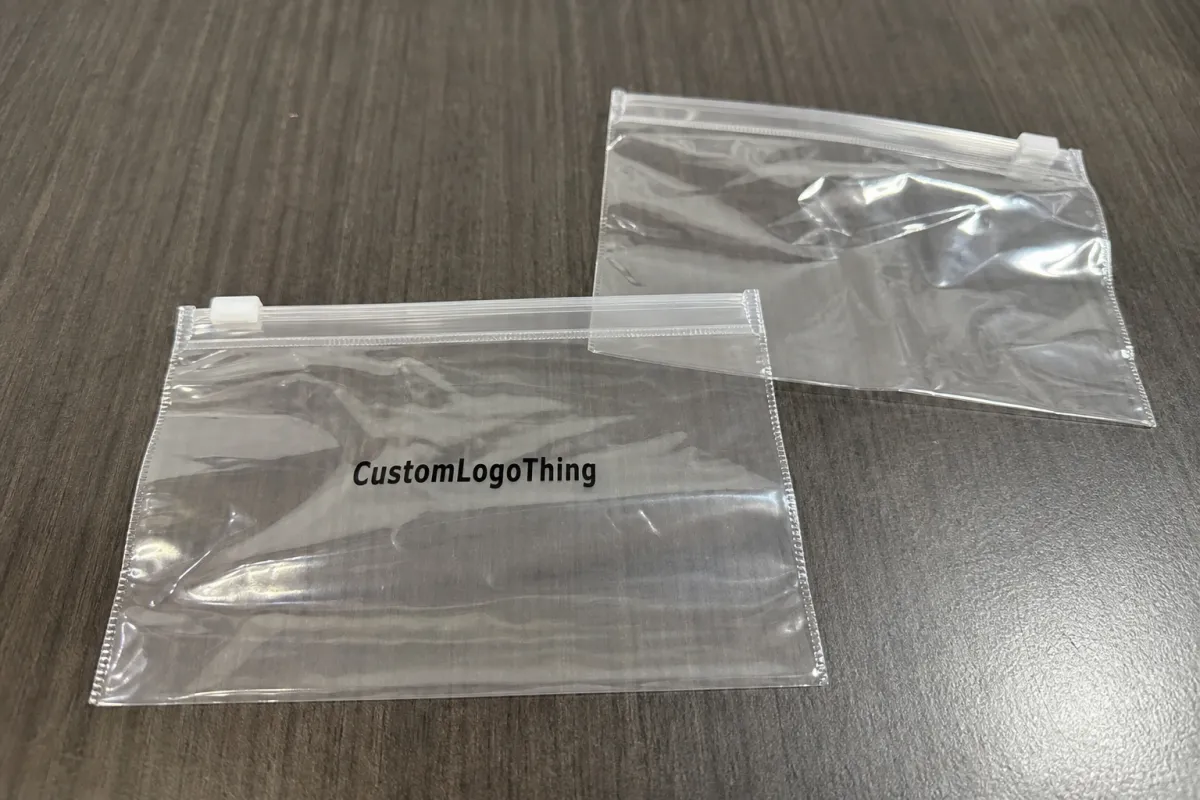
Live events are hard on packaging. Bags get stacked, passed across tables, opened for inspection, and repacked more than once. They travel from storage to staging to the show floor, often in a rush and often by people who are not thinking about packaging as a technical object. That is why a slider lock bag has an advantage over a plain open-top pouch: it gives staff a closure that is fast, repeatable, and easier to use without damaging the film.
The practical value shows up in the small stuff. Inserts stay clean. Loose items stay together. Apparel does not slide out when a cart bumps a table edge. A sponsor kit that includes a shirt, a card, a pen, and a sample packet looks more deliberate when the bag closes evenly and does not buckle at the top. That presentation has a measurable effect on how premium the kit feels, even when the contents are simple.
There is also the labor angle, which buyers sometimes undercount. If the seal is weak or inconsistent, staff slow down. They stop to press the track twice, inspect for gaps, or toss a bag and start over. Multiply that by several hundred kits, and a slightly better bag can save more than its price difference. The lower unit cost may look attractive on paper, but labor is usually the larger hidden expense.
The cheapest bag is expensive the moment a team has to rebag 300 kits before doors open.
That is why an event merch slider lock bags Unit Cost Review should start with performance. Cost matters, but it only matters after the bag has been tested against the contents, the packing speed, and the event timeline. A quote that ignores those factors is incomplete.
One more detail worth watching: how the bag behaves after repeated opening. A lot of event packaging is not truly single-use. Staff may inspect contents, close the bag, reopen it, and close it again. If the slider drifts, catches, or stops engaging cleanly, the bag loses value fast. That makes closure design a real buying variable rather than a minor finishing touch.
Film, zipper, and closure choices that change performance
Clear polyethylene remains the most common base material for slider lock bags because it balances visibility, flexibility, and cost. Depending on the build, you may see LDPE, LLDPE blends, or multi-layer film structures. Each behaves a little differently. Softer films can feel easier to pack and compress well for shipping. Firmer films often hold shape better on display and can feel more premium in the hand.
Film clarity matters more than many first-time buyers expect. If the merch is meant to be seen, scuffed or cloudy film undercuts the presentation. Clear film also makes quality checks easier because staff can spot missing inserts or mispacked items before the bag goes out. That is not a cosmetic benefit; it is a production control advantage.
The slider itself deserves close attention. Ask how smoothly it travels, how much force it takes to close, and whether the track stays engaged after several uses. Some sliders feel fine during a quick sample test and then become frustrating once the order is packed at speed. On an event floor, a closure that needs two hands or repeated pressure slows everyone down. The bag should work with the way people actually pack, not with an idealized version of the process.
Optional features can make a real difference, especially when the bag is doing more than holding a single item. Hang holes help if the pack will be displayed or stored on hooks. Writable panels help with size notes, packing codes, or room labels. Tamper-evident features can be useful for controlled kits or premium giveaway programs where you need to signal that the contents were not opened after packing. Each option adds complexity and often cost, so it helps to decide which features are functional and which are just nice to have.
Print placement also changes how the bag performs. If branding sits too close to the seal zone, the top edge can look cramped and the closure can become harder to use. In a clean layout, the print respects the working area of the slider and leaves enough clear space near the mouth of the bag. That detail is easy to miss until the proof arrives.
For buyers comparing bulk pricing, the material and closure usually explain more of the spread than the artwork itself. A standard clear slider bag with minimal print is one thing. A thicker, higher-clarity bag with a smoother slider, a hang hole, and a custom printed panel is a different product, even if the outside dimensions look similar. Treat them as different builds, because the factory will.
Dimensions, gauges, and print specs buyers should lock in
Size is the first decision that should be settled. A bag that is too small slows packing and can stress the seal. A bag that is too large wastes material and makes the merch look loose or unfinished. Buyers should define finished width, length, usable interior space, and whether any gusset or depth is needed. Flat collateral and thin inserts usually fit well in a simple profile. Folded garments, padded items, and mixed kits often need extra room at the mouth or a more forgiving structure.
Film gauge affects both feel and price. Thinner film lowers material cost, but only if it still handles the weight and shape of the contents without stretching or distorting. Thicker film costs more, yet it tends to improve stiffness, puncture resistance, and perceived quality. The difference is easy to dismiss until packing starts. A bag that is just a little too flimsy can slow the line because people handle it more carefully.
Print specs deserve the same discipline. One-color branding is usually the cleanest path to controlling cost. Multi-color designs can work well too, but they need enough contrast to read through clear film and enough room to avoid the working seal area. If the bag needs barcodes, legal text, or size labels, those elements should be placed early in the layout, not squeezed into the last available corner. If the design is too crowded, the bag starts to look like a proof instead of a finished product.
There is also the issue of tolerances. On a custom order, a few millimeters can change the pack-out experience. A shirt may fold neatly one way and wrinkle badly another. A sample card may slide in cleanly or catch at the mouth. That is why experienced buyers treat dimensions as an operating spec rather than a decorative note on the quote. The bag has to work with the exact contents it will carry.
Before approving production, it helps to test the real merch inside the actual bag. A spec sheet can say the size is acceptable, but the fit test tells you whether the pack feels tight, loose, unstable, or awkward to seal. That check is inexpensive compared with correcting a full production run.
- Width and length: confirm finished size and usable interior space, not just catalog dimensions.
- Gauge: match thickness to contents, handling, and the level of presentation required.
- Closure style: verify slider fit, track consistency, and closing force on a sample.
- Print area: protect the seal zone and leave room for labels, codes, or safety text.
- Load test: pack the actual merch instead of estimating from photos or descriptions.
Pricing, MOQ, and unit cost drivers to compare
For any event merch slider lock bags Unit Cost Review, the pricing conversation should begin with the variables that actually move the number: size, film thickness, slider style, print coverage, and whether the bag uses a standard setup or needs custom tooling. A small change in one of those areas can shift cost more than a bigger change in artwork. That is why two quotes that look close at a glance can diverge once they are broken down.
MOQ, or minimum order quantity, matters because setup time and material waste have to be spread across the run. A 1,000-piece order usually costs more per unit than a 10,000-piece order, even if the bag is visually identical. The same is true for custom printed work that needs plates, proofing, or special handling. In other words, the supplier is not necessarily charging more for the sake of it; the math changes when the run is small.
The smartest comparison is landed cost, not headline cost. Check whether freight is included, whether sampling is billed separately, whether proof revisions are covered, and whether there are overrun or underrun allowances. A quote can look low until shipping and correction charges are added. A slightly higher quote that already includes freight and sampling may be easier to trust because the number is less likely to change later.
Budget buyers sometimes ask for the absolute lowest unit price without adjusting the spec. That usually leads to disappointment. A standard clear bag with a simple logo is a different economic category than a fully custom size with a multi-color print and a premium slider. If the use case does not require the premium version, simplify the build. If the merch has to look polished enough for sponsors or VIP attendees, accept that the cost will move upward.
| Option | Typical MOQ | Typical cost per piece | Best use | Watch-outs |
|---|---|---|---|---|
| Stock clear slider bag, no print | 1,000 to 5,000 | $0.12-$0.22 | Simple handouts, fast turns, low-risk kits | Limited branding and fewer size options |
| Custom printed single-color slider bag | 3,000 to 10,000 | $0.18-$0.32 | Branded event kits, sponsor packs, apparel inserts | Artwork setup and plates can add startup cost |
| Fully custom size and multi-color print | 5,000 to 20,000 | $0.28-$0.55 | Premium merch programs, retail crossover, complex kitting | Higher tooling fees, longer lead time, tighter spec control needed |
Those ranges are not guarantees. A larger bag, heavier film, or more demanding print layout can move the number quickly. Freight can also change the final landed cost more than buyers expect, especially when the order is bulky and the event deadline is fixed. Still, the table is useful because it separates real cost drivers from the false comfort of a low headline figure.
If the bag affects presentation, packing speed, and contents protection, do not shop it like a commodity liner.
Process, timeline, and production steps from proof to ship
Good packaging orders move through a predictable sequence: inquiry, spec review, quote, artwork check, proof approval, material scheduling, production, inspection, packing, and shipment. Each step matters because small errors early in the process become expensive once the line is running. If the dimensions are wrong or the art file is unclear, the entire schedule can slip before the bags even reach production.
Lead time is more than factory run time. It includes proofing, possible revisions, material availability, transit time, and a cushion for receiving on the buyer side. A straightforward custom bag might move through production in roughly 12-15 business days after proof approval, but that should be treated as a planning baseline, not a promise. Seasonal demand, material shortages, and queue length can all extend it.
Event calendars rarely leave room for surprise. If the bags are needed for a fixed handout date, the order should be placed with enough time to inspect the shipment and, if necessary, correct the count or replace a portion of the run. Freight delays happen. Proofs need revision. A packing spec that looks simple may still slow down if the contents are irregular or the print has to be aligned carefully. Good planning assumes those problems might happen instead of pretending they will not.
One practical method is to set an internal cutoff date before the event date. Anything that arrives after that date is too risky to rely on. That creates room for receiving, count verification, and a backup decision if the shipment misses the mark. It also helps buyers avoid emergency freight, which usually destroys any savings from a low unit price.
There is a quiet rule in packaging procurement: the later the correction, the more it costs. A small issue caught at proof stage can be fixed quickly. The same issue found after production can mean reshipment, reprint, or a compromised event experience. That is why timeline management belongs in the cost review, not beside it.
What separates a dependable packaging supplier
A dependable packaging supplier should be able to explain the bag build in plain technical terms. Not marketing language. You want documented specs, sample approval, tolerance ranges, and a production team that can describe how the film, slider, and print interact. If the supplier cannot explain how the closure is made or how it is checked, that is a warning sign on any custom program.
Quality control should cover seal integrity, slider function, print registration, clarity, and carton count accuracy. Those checks sound basic because they are. They are also the checks that prevent a live event order from becoming a floor problem. A bag with attractive print and a weak slider is not good packaging. A bag with strong closure performance but inaccurate counts is not good fulfillment.
Good suppliers also talk honestly about tradeoffs. If a standard size and simplified print can lower the unit cost without hurting the program, they should say so. If the film needs to be thicker to carry the contents safely, they should say that too. The most useful vendor is not the one that promises everything. It is the one that explains where cost can move and where it should not.
Documentation matters when the order is likely to repeat. Keep the approved spec sheet, the art files, and the sample reference together. If the same bag has to be reordered later, the supplier should be able to reproduce it without drifting from the original. That protects continuity and prevents the quiet quality slide that can happen when a run gets recreated from memory.
For teams that care about testing and material standards, supplier familiarity with transport testing can help. If the merch will be shipped in cartons and stacked for delivery, resources such as ISTA can provide useful context. If the program includes paper inserts, cartons, or display components, sourcing with recognized forestry certification through FSC can support a broader sustainability claim without overreaching.
What to send for a fast, accurate quote
A clean quote starts with a clean brief. Send the bag dimensions, quantity, artwork files, closure preference, and the actual merch items that will go inside. A bag for a folded tee is not the same as a bag for a sample kit with cards and accessories. The supplier needs the real use case to price the job accurately and to avoid underestimating packing difficulty.
Include the must-haves up front: clear film, printed branding, hang holes, writable space, tamper-evident features, or a specific color target. Add the ship date and the event date, because those are not always the same. If there is a budget ceiling, say so early. That helps the supplier simplify the build or suggest a standard spec that fits the number without wasting time on options that will never be approved.
It also helps to ask the right operational questions. Is freight separate? Is sampling included? Are tooling fees or additional setup charges likely? What are the tolerances on size and count? If those items are left vague, the quote may look attractive but still fail as a planning tool. A more complete brief usually produces a tighter price and a better production schedule.
That is the best moment for an event merch slider lock bags Unit Cost Review. Once the size, closure, print plan, and quantity are set, the pricing conversation has a real foundation. Before that, the numbers are only placeholders. After that, the comparison becomes useful enough to guide a decision.
For most buyers, the best move is straightforward: lock the spec, test the fit, compare landed cost, and resist the temptation to chase the lowest number alone. That approach usually produces a more reliable bag, fewer surprises at receiving, and a better result at the event itself.
What affects event merch slider lock bags unit cost the most?
Bag size, film thickness, print coverage, slider style, and quantity usually drive the biggest price changes. Lower quantities raise unit cost because setup and waste are spread across fewer bags. Freight, proofs, and special packing requirements can also change the final landed cost.
What MOQ should I expect for custom slider lock bags?
MOQ depends on the size of the bag, the print method, and the production setup needed for the order. Standard clear bags often allow lower minimums than fully custom printed versions. If the run is small, ask whether a stock size with a simpler print plan will work better.
How long does production usually take after proof approval?
Lead time depends on material availability, print complexity, and the current production queue. Simple orders move faster when artwork is ready and proof approval comes quickly. Add time for freight transit if the bags must arrive before a fixed event date.
Can I order printed event merch slider lock bags in a small quantity?
Yes, but small runs usually cost more per unit because setup costs are spread across fewer bags. Simpler artwork and standard dimensions make the order easier to run. In some cases, a stock-size bag with print is more practical than a fully custom structure.
What details do I need for an accurate quote?
Provide bag dimensions, quantity, print artwork, film preference, closure type, and target ship date. Include the product that will be packed so the supplier can confirm fit and handling. If you have a budget ceiling, share it early so the quote can be shaped around it.