A fitness pvc garment bags Unit Cost Review should focus on what the bag changes after packing: return risk, shelf presentation, moisture protection, and labor. The lowest quote is not always the lowest cost if the bag leads to repacking, damage claims, or a messy display.
For fitness apparel, packaging often influences the customer's first impression. A bag that keeps the garment visible, clean, and easy to handle can justify a slightly higher unit price if it reduces work later. That is the right lens for comparing options.
Why Fitness PVC Garment Bags Cut Return Risk
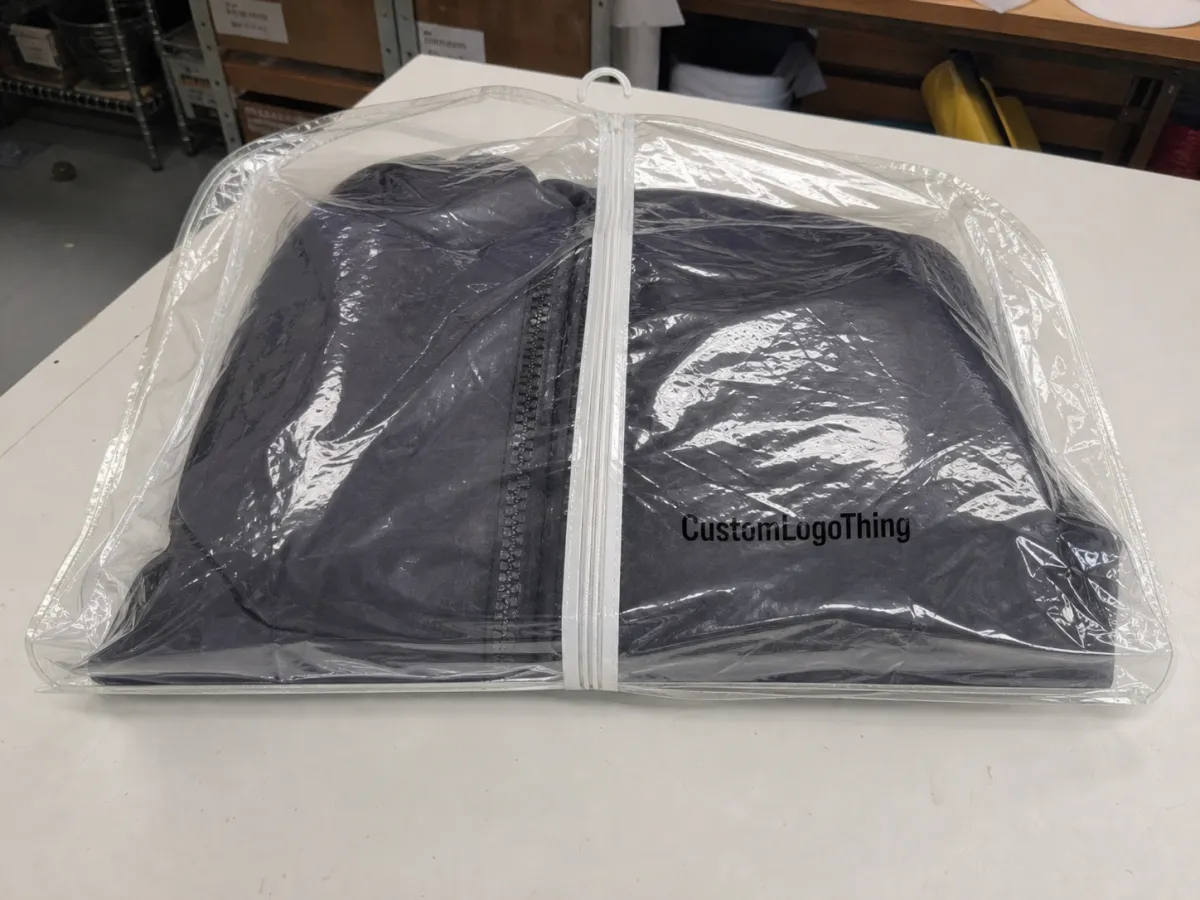
Fitness apparel moves through many hands before it reaches a customer. It gets folded, stacked, hung, re-hung, inspected, and shipped. Every step adds a chance for dust, moisture, wrinkles, or scuffs. A clear PVC garment bag gives the product a protective layer without hiding what is inside.
Return risk is not only about damage in transit. It also comes from presentation. If a yoga set arrives crushed, or a hoodie looks dull and dusty, the customer may treat it as a packaging failure. A bag that keeps the garment in a clean, stable condition lowers that risk.
For a buyer doing a fitness PVC Garment Bags unit cost review, the useful comparison is landed value. One avoided repack can offset the price difference on a run. One avoided damage claim can do even more. That is why the bag should be judged as a control point, not a cosmetic extra.
The channel matters. Retail shelves need visibility. Studio counters need quick size checks. DTC orders need packaging that arrives neat and survives handling. The same PVC bag can work across those channels, but only if the spec matches the route.
A small price difference matters less than the labor and damage it prevents.
If the bag protects the garment, supports the brand presentation, and reduces handling work, it is earning its place. If not, the lower price is just a distraction.
Product Details That Shape Shelf Appeal
Clear PVC usually leads because it shows color, shape, print placement, and fabric texture without opening the package. That is important for fitness apparel, where buyers often decide from visual appearance. Frosted PVC softens the look and hides minor handling marks. Tinted film creates identity but reduces visibility. Each option solves a different problem.
Construction details matter just as much as film type. A zipper that drags slows packing and frustrates staff. Reinforced seams help the bag keep its shape after repeated handling. A hanger hole must sit in the right place or the package tilts on the rack. A gusset gives folded sets room to sit naturally instead of bulging.
Transparency also helps operations. If staff can confirm size, color, and style without opening the bag, they save time and damage fewer units during inspection. That is one of the main hidden benefits that can justify PVC in the first place.
Branding should be deliberate. A printed logo can help on premium retail programs, but print coverage should earn its cost. If the same item will move through web orders and store replenishment, a plain or lightly printed bag usually offers more flexibility and a faster turnaround.
One practical point: PVC can pick up pressure marks if cartons are packed too tightly. Flat packing, consistent stacking, and a simple internal pack pattern help the film arrive looking cleaner. It is a small detail, but it affects how the product reads on shelf.
For buyers comparing structure options, packaging.org is useful for general material references, while ISTA provides transport test methods that help buyers think beyond a quote and into real handling.
Specs Buyers Should Lock Before Sampling
Sampling goes faster when the brief is precise. Before requesting a prototype, lock the dimensions, thickness target, zipper style, hanger opening, and artwork area. If those items are vague, the sample usually comes back close but not right.
Thickness needs careful attention. A nominal 0.20 mm film can feel very different depending on resin quality and finishing. Some runs feel crisp and structured; others feel softer and less stable. Many buyers end up in the middle range because it balances body and cost. Heavier garments or transit-heavy routes may justify a thicker film.
Size the bag against the actual garment, not a guessed chart. A bag can be technically large enough and still look wrong if the fit is loose or the hanger line is off. The simplest test is to put the real product inside, hang it, close it, and check whether it keeps a clean profile.
- PVC thickness: confirm the target in mm or mils, not "standard" or "heavy."
- Dimensions: verify width, height, and gusset depth against the actual garment.
- Zipper style: decide on full-length, top, or side entry before sampling starts.
- Hanger hole: confirm size and position so the bag sits correctly on rack hardware.
- Artwork area: define logo placement early if print is part of the design.
- Pack count: confirm units per carton before freight is quoted.
Tolerances matter more than many buyers expect. If the supplier is vague about cut variation or carton count, freight math gets fuzzy fast. A few millimeters can change how many units fit per carton, which changes cube, pallet count, and shipping cost.
A pre-production sample or a clear digital proof is worth the delay. It is much cheaper to fix zipper placement or logo position before the run starts than after the first shipment is packed. For multi-SKU programs, one sample often reveals whether the bag should be simplified or resized.
Pricing, Unit Cost, and MOQ Breakpoints
PVC garment bag pricing usually includes raw material cost, thickness, size, zipper type, print coverage, labor, carton efficiency, and freight. A buyer who looks only at unit price is missing part of the picture.
MOQ changes the math. As volume rises, bulk pricing lowers the cost per piece, sometimes sharply at first and then more slowly. But the lowest tier is not always the smartest tier. If inventory will sit too long or cash flow is tight, the best unit price may create a worse result overall.
Setup fees matter, especially on smaller runs. Print preparation, plate work, and sample handling can distort the comparison between plain and branded bags. Ask for those charges separately so the quote shows the full cost path. If setup is hidden in the unit price, the economics are harder to read.
The table below uses indicative ranges for a standard retail-size PVC garment bag with straightforward construction. These are planning numbers, not promises. Size, print coverage, zipper type, and carton layout all move the final price.
| Volume tier | Plain clear bag unit cost | Printed logo bag unit cost | What usually changes |
|---|---|---|---|
| 1,000 pieces | $0.45-$0.82 | $0.63-$1.08 | Higher labor share, more setup pressure, less packing efficiency |
| 5,000 pieces | $0.29-$0.50 | $0.40-$0.70 | Better material buying power, steadier production rhythm, lower unit packing cost |
| 10,000 pieces | $0.23-$0.39 | $0.31-$0.57 | Best unit-cost efficiency, but higher storage and inventory exposure |
Those ranges make the tradeoff clear. Small runs protect cash flow but cost more per unit. Bigger runs reduce unit cost but require confidence in demand, storage, and replenishment timing. If the program is experimental, smaller can be smarter. If reorder volume is steady, the larger tier usually wins.
Sampling also has a cost. A sample may be free, charged back, or billed separately, and freight can exceed the sample itself. That is normal. The mistake is treating samples as irrelevant simply because the bag is cheap.
For many fitness programs, plain clear bags are the best starting point. They are cheaper, simpler, and easier to deploy across channels. Add print only if the bag itself needs to support merchandising or brand recognition. Otherwise, spend the money where it affects product quality.
Production Steps and Lead Time Expectations
A clean schedule starts with a complete inquiry. The supplier needs dimensions, thickness target, zipper details, artwork files, MOQ goal, and destination port or delivery point. If that information arrives in pieces, the quote will too.
The process usually moves through artwork check, proof or sample approval, material sourcing, production, inspection, and shipping. Each step is straightforward, but each can stall if the brief keeps changing. Sample approval should be treated as a gate, not a suggestion.
Lead time depends on complexity. A plain unprinted order can move faster than a printed program with custom packaging. Odd sizes, custom zipper pulls, and late artwork edits all stretch the schedule. In many cases, the delay comes from indecision upstream rather than factory capacity.
Typical planning ranges are simple: sample development often takes 5-10 days, production after approval often takes 20-35 days, and printed or highly customized programs can run longer. Freight adds its own clock. Buyers Who Need product on shelves by a fixed date should work backward from that date.
- Inquiry and quote: confirm exact product spec and target volume.
- Proof and sample: approve size, clarity, zipper behavior, and logo placement.
- Material sourcing: lock the PVC film and zipper components.
- Production: cut, weld or stitch, print, and assemble.
- Inspection: check seams, alignment, carton count, and outer packaging.
- Shipping: confirm carton dimensions, pallet count, and transit method.
For transit-sensitive orders, ask whether cartons are packed to relevant ISTA-style handling expectations. The goal is not to over-engineer the bag. It is to make sure the finished goods can survive the route they will actually take. If the program also includes paper inserts or hang tags, FSC-certified paper options are easy to source through FSC.
Seasonal launches punish slow approvals. If product must hit shelves before a drop or store reset, the supplier needs enough room for proofing and freight. Rush orders usually cost more, and the premium shows up in mistakes as well as price.
Quality Checks That Protect the Order
A quote only tells part of the story. The rest shows up in quality control. For PVC garment bags, buyers should care about material clarity, seam strength, zipper travel, hanger-hole reinforcement, carton count, and visual consistency from unit to unit. If the bag looks uneven before shipping, it will not improve in transit.
Film clarity is easy to overlook. A bag can look fine in a sample and cloudy in production if the resin lot changes or if the process is sloppy. Zipper movement is another small detail that becomes a large complaint when it jams on the packing line. One bad closure can create repeat labor across an entire lot.
Seam integrity matters because fitness apparel is handled repeatedly. A weak seam may hold during packing and fail after a few store moves. Hanger-hole strength matters for the same reason. If the top opening starts to deform, shelf presentation falls apart fast.
Good suppliers should be able to explain their inspection method clearly. Basic checks usually include visual inspection, zipper cycling, sample measurements, and carton count verification. If that process is vague, the unit cost is probably being protected by vague quality control.
Ask for a finished sample from production, not only a lab sample. Lab samples can look better because they are hand-made and less representative of assembly speed. A production sample tells you more about what the order will actually feel like in a warehouse.
How to Request a Quote That Holds Up
To get a quote that is worth comparing, send the spec in one clean package. Include dimensions, thickness target, zipper style, print requirements, quantity range, carton pack count, and destination. If available, attach a photo of the garment inside a current bag or on a hanger.
It helps to request more than one option. A plain bag, a printed bag, and a slightly thicker version can show where the cost jumps are. That makes internal approval easier because the trade-off is visible.
Do not wait to decide everything before asking for pricing. Approve the sample, confirm the order quantity, and lock the production window once the brief is right. That is what turns a fitness pvc garment Bags Unit Cost Review into an actual buying decision instead of a spreadsheet exercise.
For most fitness programs, the winning formula is simple: clear spec, sensible thickness, enough structure to protect the garment, and a cost that still leaves room for margin. Fancy is optional. Consistency is not.
What drives fitness PVC garment bag pricing the most?
PVC thickness, bag size, zipper style, and print coverage usually move the price the most. MOQ and carton configuration matter too because they change labor and shipping efficiency. Freight, setup, and sampling should be included in the comparison so the real landed cost is visible.
What PVC thickness works best for garment bags used in fitness retail?
A mid-range thickness often balances clarity, structure, and cost for retail display use. Thicker film makes sense when the bag will be reused often or needs extra body on a hanger. The right choice depends on garment weight, handling frequency, and whether the bag is mainly for display or transit.
What MOQ should I expect for custom fitness garment bags?
MOQ depends on bag size, print method, and whether the design is built from an existing pattern or fully custom. Lower MOQs usually carry a higher unit cost, but they can be smarter if demand is uncertain. Ask for tiered pricing so you can see where the savings start to flatten.
How long does sampling and production usually take?
Sampling often takes 5-10 days, while production after approval commonly runs 20-35 days for a simple order. Printed programs, special hardware, or unusual sizes can take longer. Prompt proof approval is one of the easiest ways to keep the schedule under control.
Can fitness PVC garment bags be customized with branding and hardware?
Yes. They can be customized with printed logos, hang tabs, zipper pulls, and size-specific dimensions. Branding should be chosen based on how much shelf impact you need versus how much cost you want to hold down. A mockup before production is the safest way to confirm placement and readability.
The best fitness pvc garment bags Unit Cost Review pulls spec, sample, freight, and reorder logic into the same decision. Split those pieces apart and the quote looks cheap. Put them together and the real answer usually appears quickly.

